


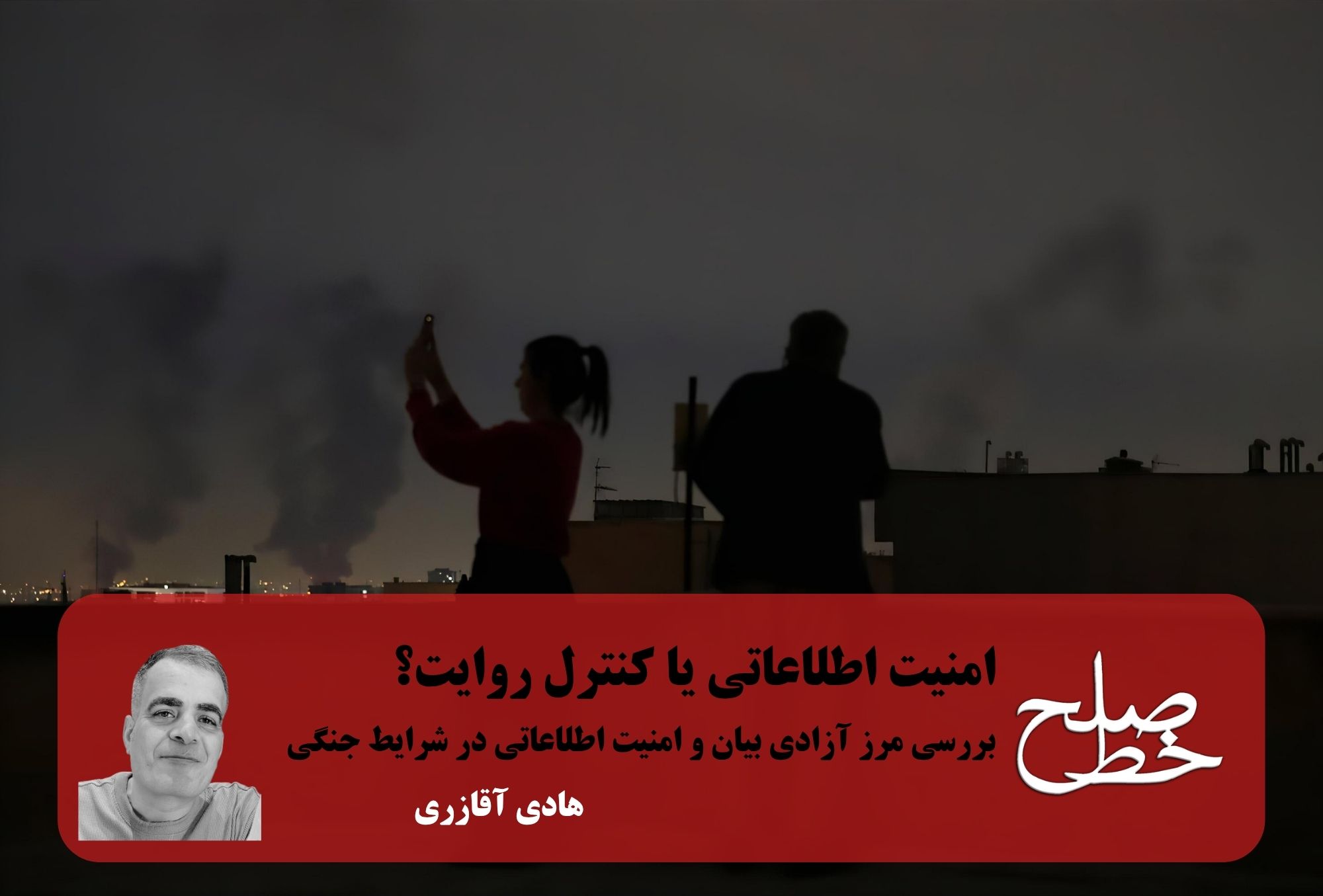
Information Security or Narrative Control?/ Hadi Aghazari
This article is being written at a time when more than one thousand hours have passed since the widespread internet shutdown in Iran, justified on the grounds of maintaining security. During this period, communication between Iranians inside and outside the country has been seriously disrupted, and access for those inside the country to the outside world—especially independent media and sources—has been severely restricted. The consequences of this situation are not limited to the sphere of information; its human dimensions must also be considered. On occasions such as Nowruz and Eid al-Fitr, many families have been deprived of even the simplest form of communication—exchanging greetings and checking on one another.
The stated reason for these restrictions has been a new round of military tensions and the possibility that the opposing side could exploit the internet to obtain information. However, such measures raise a fundamental question: where exactly is the boundary between protecting information security and violating the right to access information and freedom of expression?
In security literature, information security is defined as the protection of sensitive data and information against unauthorized access, disclosure, or misuse. In wartime conditions, this concept becomes even more significant, as the publication of certain information—such as military positions or operational details—can directly affect the course of conflict. For this reason, governments attempt to prevent the opposing side from gaining informational advantage by restricting the flow of information. However, the issue becomes more complex when these restrictions extend beyond sensitive information and are applied broadly to control communications and the free flow of information in society.
Experience shows that, in practice, such restrictions do not remain limited to the protection of sensitive information but expand in scope. Internet shutdowns and restrictions, especially during periods of crisis, effectively disrupt citizens’ access to the free flow of information and create serious obstacles to their communication with the outside world. At the same time, extensive filtering of websites and social media platforms reduces access to diverse and independent news sources and severely limits the media environment. This process is compounded by judicial and security actions against journalists, writers, and media activists—individuals who face arrest, prosecution, or various forms of pressure for publishing reports or critical viewpoints.
Alongside these developments, one of the key consequences of such policies is their role in shaping the official narrative of war and crisis. Restricting the free flow of information in this framework operates not only with the aim of managing security, but also to stabilize and reinforce the official narrative of the situation. As a result, reduced access to independent sources limits the possibility of reflecting critical or contradictory accounts and steers the media environment toward reinforcing the official perspective—a narrative in which achievements are highlighted and negative consequences are downplayed.
Moreover, in some cases, the scope of these restrictions has extended into the legal and civic domains, including the proposal or implementation of policies such as revoking the citizenship of some citizens living abroad, confiscating their property, or criminalizing the sending of images and videos to foreign media outlets. Such measures—especially when aimed at controlling the flow of information—not only affect freedom of expression, but also the right to access information and personal security. In such an environment, many activists and even ordinary citizens are pushed toward self-censorship, as the costs of expressing opinions freely increase significantly. In addition, the disruption or restriction of communication platforms weakens the ability to exchange information and maintain personal connections.
Overall, these measures not only limit the free flow of information, but also significantly reduce society’s capacity for oversight, advocacy, and documentation of human rights violations.
On the other hand, the experience of democratic countries shows that even in times of crisis, war, or security threats, the principle is to preserve freedom of expression, and restrictions are imposed only within the framework of necessity, proportionality, and independent oversight. In these systems, distinguishing between sensitive military information and public information is a key principle. This means that the publication of details such as troop locations or operational data may be restricted, but reporting on humanitarian consequences, criticism of government performance, and independent media coverage remain free.
In democratic systems, the security of citizens and the security of the state are not entirely separate and, in times of crisis—such as wartime conditions—can influence one another, although this relationship is usually constrained within legal frameworks and institutional oversight. The key difference, however, lies in how this tension is managed: restrictions must be targeted, temporary, and subject to oversight in order to prevent their expansion into the realm of fundamental rights. In contrast, in cases such as the experience of the Islamic Republic, the extension of security policies into the domain of public communications and the widespread disruption or restriction of citizens’ internet access is not merely a technical or informational issue; it directly affects the sense of social security. In such circumstances, the disruption of communication among citizens and the difficulty of obtaining information about the condition of family members and relatives itself leads to feelings of insecurity and anxiety within society—even if these measures are carried out under the stated aim of protecting information security. This situation shows that in the absence of clear boundaries between information security and public communication, security policies can unintentionally have the opposite effect on citizens’ psychological and social security.
By contrast, in some authoritarian governments, a different pattern of information management during crises can be observed. In these systems, the boundary between security and political control is often blurred, and media restrictions typically extend beyond military information into broader areas of public life. For example, during the war between Russia and Ukraine, the Russian government, by restricting independent media, blocking certain international platforms, and criminalizing specific narratives and forms of coverage, has attempted to solidify the official framework of the war narrative. In such an environment, access to independent news sources is reduced, and the media space moves toward homogenization of narratives. In this model, control of information is not only a tool for managing security, but also a means of managing public opinion and preventing the emergence of alternative narratives.
Ultimately, these experiences show that in democratic systems, restrictions on freedom of expression are defined as a temporary and controllable exception, not a permanent tool for managing the information space. In contrast, in some authoritarian systems, such restrictions can become a structural component of media and public opinion management. This institutional difference plays a significant role in the level of media diversity, freedom of expression, and citizens’ access to independent narratives.
In fact, the central issue in the relationship between information security and freedom of expression is not the denial of the necessity of security restrictions, but the precise determination of their boundaries and mechanisms of implementation. Experience shows that whenever the concept of security extends beyond the defined scope of military and operational information into the broader sphere of public communications and citizens’ access to information, the risk of violating fundamental rights increases. Therefore, the main challenge lies in finding a balance between two simultaneous necessities: protecting sensitive information in times of crisis and ensuring the free flow of information as a fundamental pillar of human rights.
Within this framework, principles such as necessity, proportionality, and temporariness of restrictions are of fundamental importance. Restrictions are acceptable only when they are clear, targeted, and minimal, and when they do not continue beyond the end of the crisis. Otherwise, security exceptions can gradually become a permanent practice in managing the information space—a process that ultimately leads to reduced transparency, diminished accountability, and restricted public oversight.
As a result, maintaining a balance between security and freedom of expression is not a simple choice between two opposing options, but a complex and continuous process that requires institutional transparency, independent oversight, and respect for citizens’ fundamental rights. Ultimately, a society in which the flow of information is unnecessarily restricted—even if short-term security is achieved—will, in the long term, face serious challenges in the areas of public trust and legitimacy.
 Created By: Hadi Aghazari
 April 21, 2026
Tags
Censorship Freedom of information Freedom of speech Hadi Aghazari Information control Internet freedom Internet outage Iran-US war peace line Peace Line 180 The war between Iran and Israel. War ماهنامه خط صلح