


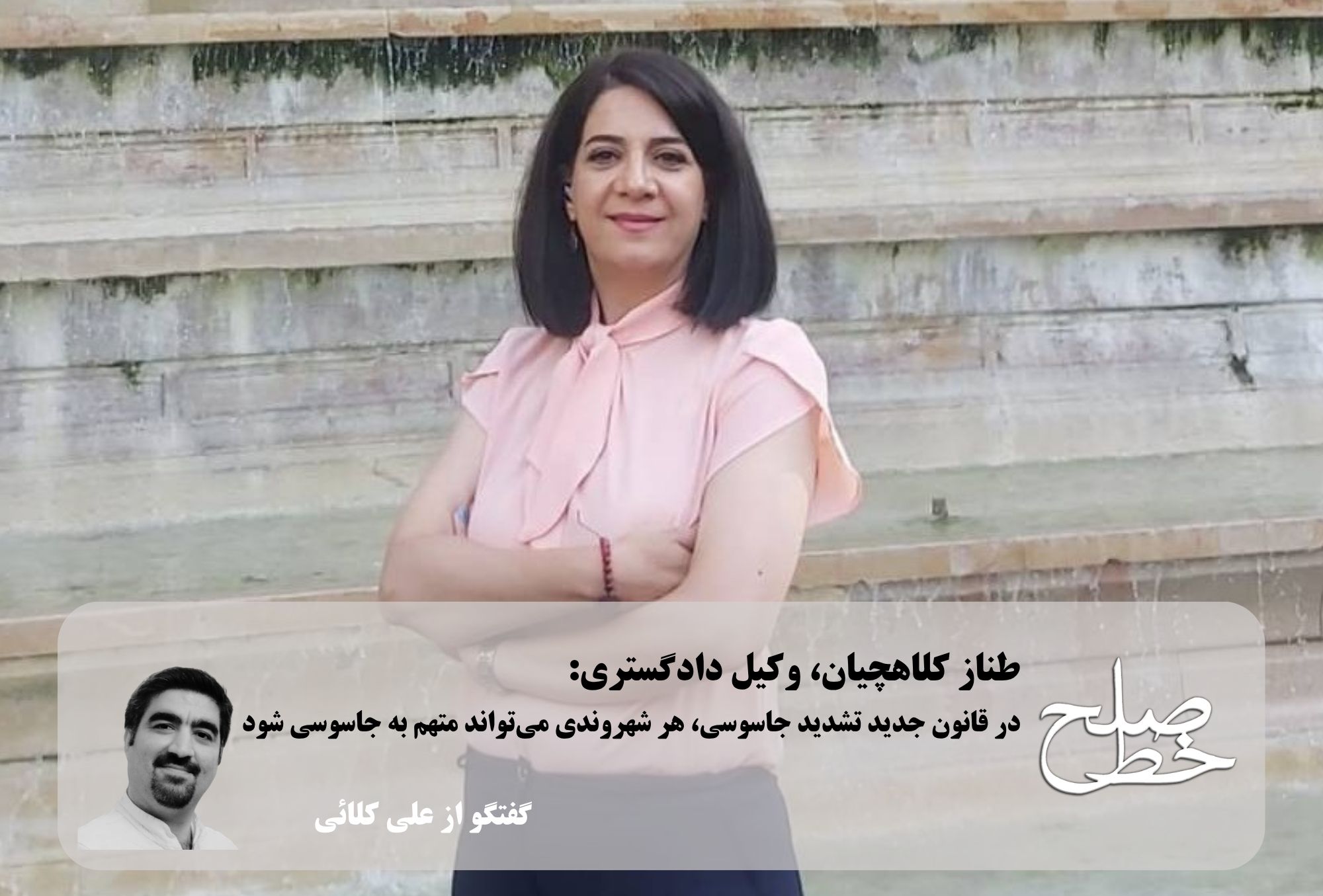
Tannaz Kolahchian: Under the New Law on Intensifying Espionage, Any Citizen Can Be Accused of Espionage/ Ali Kalaei
After the adoption and communication of the “Law on Intensifying Punishment for Espionage and Cooperation with the Zionist Regime and Hostile States Against National Security and Interests” in October 2025 (Mehr 1404), concerns have intensified in Iran over the expansion of the security atmosphere, the broadening of criminalization, and the escalation of severe punishments, including execution. By extending examples of security crimes into areas such as cyber activities, collecting and sending information, publishing content online, using satellite internet, and also employing broad concepts such as “operational action” and “intelligence activity,” this law has been criticized by many jurists and civil activists because of the ambiguity of its concepts, the absence of a clear boundary between civil activity and security accusations, and the way it creates grounds for broad and arbitrary interpretations.
In this regard, Peace Mark Monthly Magazine spoke with “Tannaz Kolahchian,” attorney at law, about the legal and political dimensions of this law; a conversation covering issues such as the Islamic Republic’s changing approach to defining and prosecuting security and espionage crimes, the role of the Supreme National Security Council in determining examples of “hostile states,” the impact of this law on civil and media freedoms, and concerns about its use to intensify security crackdowns and issue harsh sentences, including execution.
The full text of Peace Mark Monthly Magazine’s interview with Tannaz Kolahchian, attorney at law, follows:
Given that under previous laws, the crime of espionage was mainly concerned with the transfer of classified information and direct intelligence cooperation, what exact new behaviors and areas has the new law brought into the definition of “espionage”?
In the Penal Code adopted in 2013 (1392), which was communicated and implemented at the same time, there were several articles concerning the crime of espionage. The maximum punishment was ten years, unless the offense committed fell under the categories of moharebeh or baghy, which led to the issuance of a death sentence. But the crime of espionage was never defined, and only according to the developments in the country during that period did they try to make the articles related to espionage in that law more detailed and expansive, so that they would cover all crimes in the security field. If they saw that the matter was espionage, they would intensify it by placing the matter under baghy or moharebeh.
But after the 12-day war, lawmakers and the country’s security officials, including the Supreme National Security Council, saw that there was a gap in the existing law and that the law had not taken social media issues into account in the field of espionage. So they wanted to pass a new law that would include all these issues; that is, to give the previous law a broader form, give themselves a freer hand, and be able to issue death sentences and punishments harsher than previous sentences for defendants in this field. That is why this law was submitted to parliament as an urgent double-priority bill, and in October 2025 (Mehr 1404) it was adopted by parliament, approved by the Guardian Council, and communicated. In other words, it was among the few laws that was proposed quickly, received a response in parliament, and after the Guardian Council raised only one or two objections and those were resolved, was approved by the Council and immediately implemented. The process related to this law moved so quickly that some of our lawyer colleagues in Iran were saying that some detainees whose indictments had not yet been issued were placed under this law on intensifying the crime of espionage, and a new indictment was issued for them on the basis of this law and sent to court.
Under this law, judges have a completely free hand. In my view, this law is extremely ambiguous. In this law, the crime of espionage is not defined in the precise sense of the word, and only examples are mentioned that they imagined might occur given the wartime conditions, economic conditions, and crises in Iran, and which they could then use this law against. In fact, this was the very basis for the lawmaker and the Supreme National Security Council. The 12-day war occurred and acted as a driving force for the rapid adoption of this law.
Has the addition of concepts such as media, cyber, economic, or technological cooperation with a “hostile state” not in practice blurred the boundary between civil activity and security action in this law?
Yes, it is very, very ambiguous. I say again that this law on intensifying punishment for the crime of espionage was adopted completely suddenly and all at once. No legal basis or legal and penal principles were taken into account in this law. In this law, the lawmaker has used a series of concepts so broad and expansive that they include any activity. That is, if I post a story on my Instagram page that is available to viewers for only 24 hours and that story is viewed by others, they can consider it propaganda activity, activity against national security, or media activity; because they have no definition for this issue. In the previous law, too, there was no definition for online activities and activity through social media, and because there was none, broad interpretation to the detriment of the accused occurred. We always say that in penal principles and the principles used for criminal matters, interpretation must be strict; that is, it must be limited and narrowed in favor of the accused. But in this law, as well as the law adopted in past years on computer crimes, concepts have no definition, example, or clear boundary. This causes the lawmaker, by proposing a general concept, to give the judge a free hand to issue harsh sentences.
Under the previous law, the issuance of death sentences in espionage cases was more limited; how has the new law expanded the scope of applying the death penalty?
In the previous law, a series of examples of espionage had been provided. A lawmaker whose perspective and approach is to restrict society and create fear, terror, and intimidation among the people, considering the events that occur in the country and the information about those events that is covered and published by media outside Iran, begins to think that the existing law is not sufficient for the examples that are taking place. So a new law is needed so that it can be used more extensively. The perspective I am referring to is that of an authoritarian ruling establishment and a government that thinks in security terms and sees everyone as an enemy. That is why this government passes a law so that it can use its concepts.
Why do I say it uses broad concepts? Because, for example, it says “any action against national security,” but it does not explain what concept of national security is meant. This means that if, for instance, I attend a protest, they can consider me an enemy. That is, my participation in this protest is regarded as an action against a national security that the lawmaker has not defined at all. This law gives the lawmaker and judge a free hand to place me under this concept and issue a ruling against me.
Now what happens? In protests that become widespread, such as the protests of January 2026 (Dey 1404) or November 2019 (Aban 1398), very large numbers of people are present in gatherings and protests. Any kind of incident may also occur. Sometimes, out of anger and other issues, destruction also takes place. But by adopting such a law, the lawmaker shows that its approach is to use this crime as action against security and to place the matter under cooperation with enemies. News of these protests is also covered by networks outside Iran. So from their viewpoint, because this happens, these individuals are cooperating with one another.
Here, there is no definition of any of the elements. No definition of cooperation has been provided, whereas cooperation has a specific definition; that is, you provide information that is specific only to Iran to another country or organization and receive money in return. The definition of espionage is of course broader than this, but in any case it has a specific framework.
But when a person participates in protests and was merely observing that destruction, recorded a video on their phone, and their phone was checked and it was seen that the video existed on the mobile phone, then on this basis—this “therefore” and chain of conclusions is the problem—that person participated in the protests, therefore it was against national security, and as a result they were in contact with a hostile state. The result is that under the title of espionage that has been adopted, the punishment is execution. In other words, it is these broad and expansive conclusions that have expanded the scope of the death penalty.
The judges of the Revolutionary Court are also completely security-oriented; they have no legal knowledge, no judicial experience in the sense of executive experience in cases requiring legal evidence and documentation, and they operate entirely under the supervision of the security team. The security team gives the order, and that judge effectively has only one ruling before him, and that is execution. That is, based on the issued indictment and the interrogator’s case summary, whose output is the death sentence, the judge issues the death sentence. That is why death sentences are expanding and being issued to such an extent.
Regarding the ambiguity you mentioned, this law uses phrases such as “any operational action,” “any cooperation and assistance,” and similar concepts and expressions. Can this ambiguity in concepts open the way for arbitrary and political interpretations?
Yes, it is entirely a political matter and not a legal matter at all. You can take a legal view of an issue only when the judge has legal reasoning. In penal and criminal principles, the basis is that interpretation must be strict; that is, limited and narrowed in favor of the accused. But this approach is broad interpretation to the detriment of the accused. That is, the lawmaker has given the judge a free hand; a judge who does not accept any legal reasoning, does not allow anything to be said, and there is no evidence or documentation in the case, only an order.
Let us take one step back. All security and political cases that lead to verdicts are based on the case summary from the interrogation period and whatever the interrogator has written on one page or a hundred pages. That same thing becomes the basis of the indictment and the issued verdict. There is no documentation. Sometimes the case file is prepared based on a film, sometimes based on statements and confessions by another person against this person, and sometimes based on the defendant’s own forced confessions. There is no documentation indicating the transfer or receipt of cash, emailed documents and evidence, or matters of this kind, and because there is none, the judge sees no reasoning to accept. The judge has only one sentence, and that is execution; and that is because of the security and political approach present in these cases.
Under Note 2 of Article 1 of this law, the U.S. government and the Zionist regime are examples of hostile entities. But the continuation of this note states that in other cases, the authority for identifying hostile states, regimes, and groups is the Supreme National Security Council. How can this ambiguity in the concept of hostile state, and entrusting it to the Supreme National Security Council, contribute to a lack of transparency and certainty in this law? For example, suppose at some point the SNSC decides that a country is hostile, and suddenly all exchanges and communications with that country could become examples of contact with a hostile state.
What is happening is based on the defect in these very concepts. The issue is that when a law is being adopted, it is necessary for jurists and lawyers to be present in parliament, or to present their proposals to the judiciary, or even to present the outcomes of judges’ meetings in the judiciary to the lawmaker and say that these legal gaps exist. When a law is adopted all at once and suddenly, these gaps become more visible. In the previous law, there was a hostile state, and because it had no definition or interpretation, all Revolutionary Court judges assumed that Israel, as the Zionist regime, was an example of this hostile state. Of course, we also made other interpretations in court and said that you yourselves call it the Zionist regime, not a state. So it is a regime and is not considered a state, and should not be a hostile state. The United States was also not considered a hostile state. But in the current law, they have written the names of the United States and Israel completely specifically and left the rest open, placing it in the hands of the Supreme National Security Council.
This Supreme National Security Council may one day interpret that this country is at odds with us, so it is an example of a hostile state. As a result, all individuals who have dealings with this country, even commercial dealings, and who are now arrested on security grounds or accused in a case, can be recognized as having dealings with a hostile state. This is the very example of broad interpretation to the detriment of the accused; that is, to leave a matter, especially in penal concepts, so open and broad without its examples being specified.
Penal and criminal concepts rest on three principles. That is, when you raise a case and a criminal title, three principles must exist: the principle of legality, the principle of materiality, and the principle of mental element. Regarding the principle of legality, it means that there must necessarily be a law concerning it. One cannot accuse someone and issue a ruling against them out of stubbornness or personal whim. But this matter has become entirely arbitrary and based on the will of the Supreme National Security Council, depending on what policies it has, what measures it devises, and who is at its head. This is broad interpretation to the detriment of the accused. In principle, it also calls into question materiality and mental element respectively. That is, all three principles are called into question. Because the legal element is not clear, the other two elements are also called into question.
Critics say this law can become a tool for broader repression, increased security sentences, and even the execution of opponents—which, of course, has already led to cases of execution. To what extent is this concern based on the Islamic Republic’s previous experiences?
The Islamic Republic learns from every protest, gathering, and dissenting voice what it must do to confront the next dissenting voice. That is, it learned from how it dealt with January 2018 (Dey 1396) in order to deal with November 2019 (Aban 1398). In that security think tank and advisory circle, the question is raised that if the people take the next action, how should fear, intimidation, the restriction of society, and suffocation be increased. In 2022 (1401), we witnessed a huge volume of judicial cases, and if my estimate is not wrong, nearly 15,000 to 20,000 judicial cases were opened. The charges were, without exception, propaganda against the system and assembly and collusion, and carried a maximum sentence of five years in prison. When they saw that this volume of cases existed, they issued an amnesty on February 11, 2023 (22 Bahman 1401), and these cases were closed. But this mindset and presumption existed for the Islamic Republic: if something happens in Iran, given the economic issues that existed and still exist, what should they do?
We are unfortunately witnessing this now. After the 12-day war, given the very severe economic crisis, they considered the possibility that protests of this kind might take place again; not like 2022 (1401), but broader and different. And because there is an economic crisis and foreign media also cover it, they decided to devise a measure for it and broaden the crime and criminal title somewhat, so that they would have a freer hand to issue sentences that instill fear, terror, suffocation, and anxiety in society.
The Islamic Republic government did not stop executions even during this recent U.S. and Israeli war against Iran, and we had waves of executions every day. That is, even in that severe and critical psychological state, the Islamic Republic government, meaning the dictatorial government, still continued the executions. This government looks at this issue from only one perspective, and that is the perspective of fear and suffocation. That is, it says that eventually the war will end, and what will happen afterward? If I, the government, do not want to inject fear and terror and do not maintain suffocation, the people may protest again, and I, the government and judiciary, do not now have the conditions to contain these protests. So the government comes and intensifies the wave of executions and places a charge such as espionage in the file of anyone it arrested in these protests.
In these very protests, I had people who contacted me for consultation and said: believe me, there was nothing on my brother’s, sister’s, or spouse’s mobile phone. That is, merely because they recorded a video, the charge of espionage is attached to it. The callers were very anxious and worried about what they should do if this charge became a sentence. This anxiety and stress affects the entire family and causes psychological collapse. But this does not matter to the Islamic Republic. It injects terror and fear into society so that if another protest forms, people know what is going to happen. Today, the Islamic Republic has an intensifying law under which it attributes all kinds of protests to it and issues death sentences. It also tells the people: you know for yourselves whether you want to come to the street or not. If you come, I, the government, will attribute espionage to everyone. This is what is happening.
When some media, research, or international communication activities can be defined under cooperation with a hostile state, what guarantee is there that journalists, civil activists, and academics will remain immune?
Unfortunately, there is no immunity in the Islamic Republic. That is, it cannot be clearly and explicitly said that a case will definitely remain immune in the Islamic Republic. I have always said that even if you are summoned by phone in a case, or someone calls you from an unknown number, a private number, as long as the Islamic Republic exists, the Islamic Republic’s Sword of Damocles will hang over your head. This is unavoidable for the Islamic Republic’s security system, and it says that I must keep an eye on all the people. When I summon someone, I am in fact saying that I am watching them. I invite another person and tell them that I am watching them. When I fabricate a case against someone and begin the process of examining their espionage charge, I am also telling them that I am watching them. That is, the Islamic Republic’s security apparatus carries out these examples one by one.
Unfortunately, there is no immunity. Teaching at many universities has now been disrupted. As a result, students and academics are forced to contact people outside Iran to obtain articles. This can itself become the basis for saying that they gave and delivered information to others. That is why they still keep the internet disrupted and provide access to some people in very specific ways. In reality, they do not want normalcy to return to society, because they fear that communications may exist. All citizens active in the civil sphere are under this state and this view of the Islamic Republic, and no one has immunity.
Some believe this law is focused more on controlling the media sphere, the internet, and cross-border communications than on confronting classic espionage. Does the text of the law confirm such an interpretation?
In my view and in the view of many jurists and lawyers, this law was adopted to prevent any protest and any matter that disrupts the Islamic Republic’s governance process, and it has nothing to do with the crime of espionage. According to scholarly articles and as an international matter, the crime of espionage has a specific definition, and the Islamic Republic government also knows that definition. But why should it pass such a law? Only so that it can attribute any act or omission to this law and punish citizens on that basis. In one part of this law, it says up to degree three. A third-degree punishment can carry up to 15 years in prison. This is not a joke. Every single day in prison, given the current conditions and restrictions, has its own crises. It is not an ordinary matter. Now suppose someone is to be interrogated for 20 days or one month, and then enters prison while no sentence has yet been issued for them. If they are not executed, a third-degree punishment applies to them, and they may, for example, be sentenced to 15 years in prison. These sentences are not a joke.
The issue is that the Islamic Republic says: I know what the definition of the crime of espionage is. I know none of you are spies. I know this crime has not occurred. But for my own survival and to create fear and terror and prevent disruption in the order I have arranged for myself, I use this law. That was the reason this law was adopted so quickly. We now have laws that have been going from one room to another in parliament for years and have not moved, or have been waiting for the Guardian Council’s opinion for a long time. They do not look at those laws either, because there is no benefit in it for them. But this law is adopted quickly after the 12-day war. The only reason is that if something happens in society, they will have a law, because the previous laws were not sufficient. How much could they use moharebeh?! Now they can use this law. If I am not mistaken, there is even an article in this law related to possessing electronic tools such as Starlink.
Yes. At the beginning of Article 5 of this law, it says: “The use or carrying, keeping, purchasing or selling, or importing of unlicensed satellite internet communication electronic tools, such as Starlink, for personal use is prohibited and punishable by a sixth-degree ta’zir imprisonment and confiscation of the equipment.”
Yes. Why does it include Article 5 in this law? Because the government disrupts communications and the internet during events such as the 12-day war. Then it feels that, given the advancement of science and technology, people might have a freer hand to use such tools and send issues outside Iran and provide news coverage. So it includes this article and arrests activists in this field as well, and by issuing prison sentences, disrupts the person’s life. That is, the lawmaker’s thinking is that any example that did not exist in previous laws, such as issues related to social media and cyberspace, which at the time the previous law was adopted had not advanced to this extent, should be placed in an intensified law so that there is a free hand to issue sentences such as execution.
Given the rising number of executions in Iran, can this law be considered part of a new legal framework for legitimizing harsher repression and the further securitization of society?
Yes, definitely that is exactly what it is. The issue of intensification appears in the title of the law itself. The articles of this law also include any kind of activity. That is, the lawmaker did not merely want to address the crime of espionage. In this position and institution, it wanted to include in a law any activity that causes disruption to the government’s internal security and anything that causes the system to leave its normal state, and everything it has in mind, so that if one day any disruption occurs in these matters, it can use that law. In reality, the perspective of the lawmaker and the security government is to use this law for its own survival; that is, to come and preserve itself and issue death sentences.
Outside Iran too, campaigns against execution take place very often. My first word to my other colleagues is that if you write a letter to human rights institutions, these letters must explain why execution is taking place. When you send a statement to human rights organizations, they effectively say that this is the country’s domestic law. But if it is explained what articles have been included in this law, how dangerous these articles are, and in what way they can include all members of society, that human rights institution’s view of the issue of executions changes. That is, the issue is not simply the law. But what happens is that a matter is written down and the Islamic Republic’s conduct is also described. That human rights institution then says that the Islamic Republic has acted according to its own law. But no explanation is given about this dangerous law that the Islamic Republic has adopted. This requires a comparison, saying that previously there was a law, and now a new law has been adopted under which any activity, even having a video on a person’s mobile phone, can be considered an example of espionage and carry the death penalty. That is, in practice, it includes every person in a society. Here, the Islamic Republic tries in every way, for its own survival, to create fear and terror so that the smallest disruption does not occur in the order and stability desired by the government.
Of course, this law is apparently for peacetime. Article 6 of this law says: “If the ta’zir crimes that are the subject of this law are committed during wartime or security or military situations, as determined and announced by the Supreme National Security Council, the perpetrator’s punishment shall be intensified by up to three degrees.”
Exactly. That is, if something happens during wartime and an ordinary person is arrested, for example, for possessing Starlink, that punishment increases by three degrees. So if it is degree six, five, or four, it reaches degree three, two, or one, and can lead to life imprisonment and harsher sentences such as execution. Here, the lawmaker is practically trying to preserve itself, and it does not matter to it what vacuum is created in society or what crises arise. Its entire effort is to give itself legitimacy from its own point of view, although of course it is not legitimate.
Thank you for the time you gave to Peace Mark Monthly Magazine.
 Created By: Ali Kalaei
 May 22, 2026
Tags
CIA Espionage Execution Forty Days War Iran-US war Mossad National security peace line Peace Line 181 Spy Tanaz Kolahchian The war between Iran and Israel. Twelve-day war