


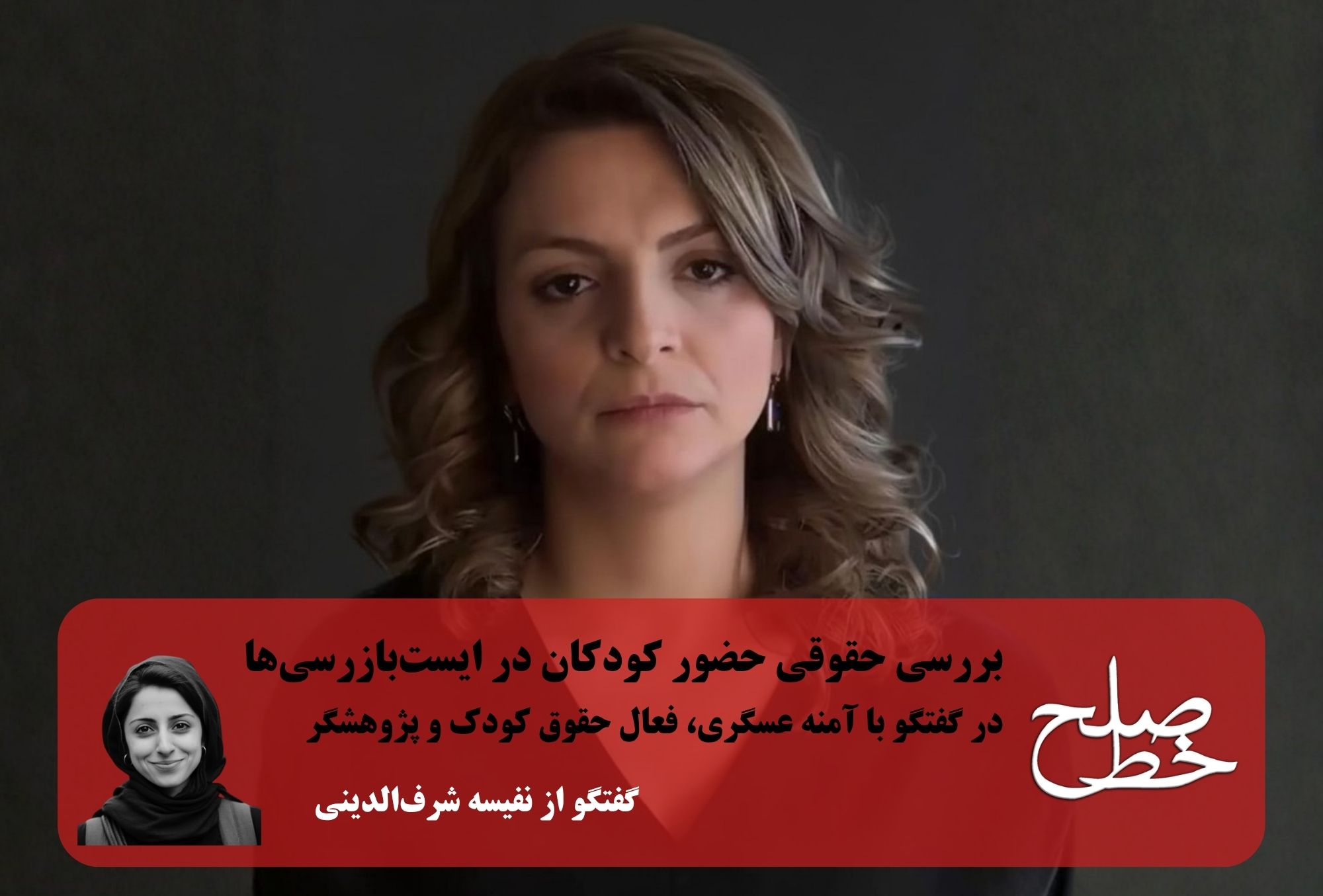
Legal Examination of the Presence of Children at Checkpoints in Conversation with Ameneh Asgari/ Nafiseh Sharafaldini
In a situation where reports of the use of individuals under 18 at checkpoints are being published, this question becomes increasingly important as to how such actions are evaluated within the framework of international law and the obligations of states. Examining this issue is important not only from a legal perspective, but also from a human and ethical angle; especially since one of the most vulnerable social groups, namely children, is involved. “Ameneh Asgari,” a child rights activist and representative of “Defenders of Children’s Rights in Iran,” in a conversation with “Khat-e-Solh,” has attempted to present a clearer picture of this situation by referring to international documents; a picture that, more than anything, emphasizes the conflict between formal commitments and on-the-ground realities.
International Frameworks; From 15 to 18 Years
At the beginning of this conversation, Ameneh Asgari, referring to the “Convention on the Rights of the Child” as one of the most important international documents in the field of child protection, reminds that Iran joined this convention in 1994 and is therefore obligated to comply with its provisions. According to this child rights activist, Article 38 of this convention specifically addresses the issue of armed conflicts and obliges states to take all possible measures to prevent the direct participation of children under 15 in hostilities. At the same time, she emphasizes that international standards in this area have undergone changes in subsequent years and with the adoption of the “Optional Protocol on the Involvement of Children in Armed Conflict” in 2000, the protective age has effectively increased to 18.
This child rights activist emphasized in an interview with Khat-e-Solh: “Within the framework of the United Nations, it is no longer merely the presence on the battlefield that is discussed, but any form of participation in military activities can be considered a violation of children’s rights.” Referring to reports of the Special Representative of the UN Secretary-General for Children and Armed Conflict, she explains that six types of grave violence against children have been identified, the first and most important of which is the recruitment and use of children in military structures. According to Ms. Asgari, placing children at checkpoints—even if these individuals are not armed—due to being in an operational position and exposed to danger, falls within this category.
The Broad Definition of “Child Soldier”
She continues, in order to further clarify the dimensions of the issue, by referring to the “Paris Principles (2007),” principles that provide a broader definition of the concept of a child soldier. This child rights activist explained in an interview with Khat-e-Solh: “According to the Paris Principles, a child soldier is not only someone who takes up arms. Any individual under 18 who is used by state armed forces or non-state groups for any purpose, including support, services, espionage, or even presence at checkpoints, falls within this definition.” She emphasizes that this broad definition effectively places many actions that may at first glance appear non-military within the scope of prohibition.
According to Ameneh Asgari, based on these frameworks, the use of children under 15 in any activity related to hostilities is “absolutely prohibited” and there is no legal justification for it. She adds that “regarding the presence of children between 15 and 18 in military activities, countries that have not joined the relevant Optional Protocol—including Iran—cannot use this gap to justify placing children aged 15 to 18 in high-risk military positions. Article 51 of the Convention on the Rights of the Child considers any reservation or interpretation that conflicts with the fundamental objective of protecting children as invalid. Since Iran has ratified the Convention on the Rights of the Child, it is obligated to adhere to its overall spirit; a spirit that emphasizes maximum protection of all children under 18, without exception.”
Direct Participation or Inherent Violation?
One of the key questions in this area is whether the presence of children at checkpoints can be considered “direct participation in hostilities” or not. However, Asgari believes that raising this question essentially places the issue within a narrower framework than reality. She emphasized in an interview with Khat-e-Solh: “Is it necessary to show that participation was direct in order to prove that a violation of children’s rights has occurred? No.”
Ameneh Asgari explains that based on the Optional Protocol and the Paris Principles, any use of children by armed forces, regardless of the nature of the role, is prohibited. According to her, within this framework, the distinction between direct and indirect participation is of secondary importance, because “the violation of children’s rights occurs at the very moment the child is placed under the authority of an armed force.” This child rights activist also added in this regard: “The issue of direct participation relates more to targeting rules in international humanitarian law, not to the obligation of the state to protect the child.”
Thus, from the perspective of children’s rights, the main question is not whether the child constitutes a legitimate military target, but rather that the government has no right and has not had the right to expose the child to such violence and violation of children’s rights.
Multi-layered Violation of Children’s Rights
In the continuation of this conversation, Asgari explicitly considers these actions a direct violation of international obligations. She emphasized: “Placing children at checkpoints or any similar position is a clear and multi-layered violation of the Convention on the Rights of the Child.” To explain this, she refers to several key articles of this convention.
According to her, Article 6 of this convention recognizes the inherent right to life for all children, and placing them at risk constitutes a direct violation of this right. Article 19 also emphasizes the necessity of protecting children from all forms of violence and exploitation; something that, according to her, is clearly ignored in these cases. Asgari stated in an interview with Khat-e-Solh: “A military environment is inherently accompanied by danger and stress, and the presence of a child in such an environment is a clear violation of the obligation to protect them.”
From War Crime to International Responsibility
In response to the question of whether such actions can constitute a war crime, this child rights activist refers to the “Rome Statute of the International Criminal Court.” She explained in an interview with Khat-e-Solh: “This statute explicitly considers the conscription or use of children under 15 in hostilities as a war crime.”
At the same time, she points out that the age threshold in this document is 15, not 18, but judicial practice, including in the case of Thomas Lubanga, has shown that the widespread and systematic use of children can even be examined under the category of “crimes against humanity.” According to her, although Iran is not a member of this court, the possibility of referral of the case by the Security Council or the use of the principle of universal jurisdiction in some countries still keeps avenues of accountability open.
“Consent” of the Child; An Invalid Argument
Another important محور of this conversation is the issue of “voluntary participation” or “consent” of the child; an argument that is sometimes raised to justify such actions. However, Asgari completely rejects this claim. She emphasized in an interview with Khat-e-Solh: “Children are essentially incapable of giving valid consent to participate in hostilities.”
Referring to the practice of the International Criminal Court, she explains that even in cases where a child has apparently voluntarily joined an armed group, this does not reduce the responsibility of the state or armed group. According to her, the vulnerability of children to psychological, social, and ideological pressures means that the concept of “free choice” has no meaning in their case. Asgari added in this interview: “What appears voluntary is often the result of long-term conditioning, not an independent decision.”
Obligations of States; From Prevention to Reintegration
In the final part of this conversation, Asgari addresses the obligations of states in preventing the participation of children in hostilities. She explains that these obligations are not limited merely to legal prohibition, but include a set of preventive, protective, and supervisory measures.
This child rights activist said in an interview with Khat-e-Solh: “States are obliged to adopt domestic laws criminalizing the recruitment of children, strengthen birth registration systems, train military forces, and monitor the performance of armed forces.” She also refers to the necessity of cooperation with international institutions, reporting to the Committee on the Rights of the Child, and providing the possibility of independent monitoring.
According to Ameneh Asgari, another important part of these obligations relates to supporting children who have previously been involved in hostilities, including providing psychological services, ensuring access to education, and facilitating their reintegration into society. These obligations, based on various articles of the Convention on the Rights of the Child, including Articles 7, 19, 36, 38, and 39, are binding on states.
The Gap Between Law and Reality
Overall, what emerges from this conversation is a picture of a relatively clear legal framework in which the use of children in military or شبهنظامی positions is broadly prohibited or restricted. However, the gap between these legal frameworks and what occurs in practice remains a matter of discussion and concern; a gap that not only calls into question the effectiveness of international instruments, but also challenges the accountability of states with regard to their obligations.
Despite these repeated emphases on the absolute prohibition of the use of children—whether under the justification of military necessity or claims of voluntariness—and considering the existence of international mechanisms for prosecuting these violations, this question still remains as to why, in practice, these principles are ignored and ultimately what mechanism can compel states not to leave such a deep gap between their legal obligations and their conduct on the ground?
 Created By: Nafiseh Sharafaldini
 April 21, 2026
Tags
Amine Askari Child soldier Children's rights 2 Inspection station Iran-US war peace line Peace Line 180 Suppression The war between Iran and Israel. War ماهنامه خط صلح