


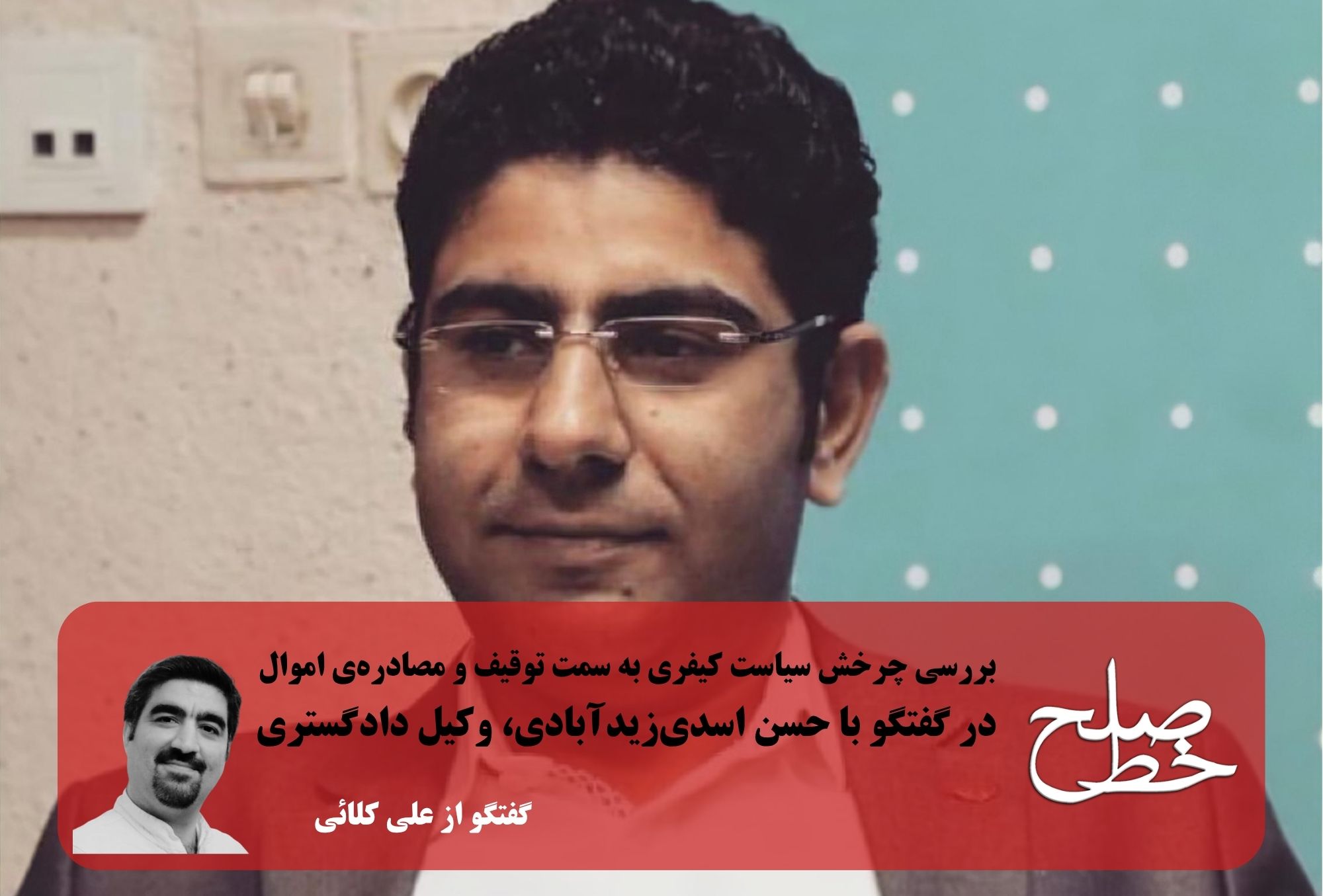
Legal Examination of the Shift in Criminal Policy Toward Seizure and Confiscation of Property; Conversation with Hassan Asadi Zeydabadi/ Ali Kalaei
The tense developments and the war of the United States and Israel with Iran have brought about noticeable changes in the country’s domestic environment. These changes have not been limited merely to the security and political spheres, but their effects are also clearly observable in the legal and judicial arena. Reports have emerged of the seizure and confiscation of property, restrictions on financial access, and the imposition of legal and economic pressures against citizens who, in some way, have been categorized as critics or protesters; especially some Iranians abroad, including actors and media figures, who have faced new limitations in managing their assets or whose property has been entirely seized by the judiciary of the Islamic Republic.
It is precisely this situation that has led the monthly “Khat-e-Solh” to approach Mr. Hassan Asadi Zeydabad, a lawyer and political activist, and to conduct a conversation regarding the legal foundations of these seizures and their distinction from confiscation, reference to recent laws including the law on intensifying the punishment for espionage, and the relationship of these measures with the principles of fair trial and the right of access to a lawyer. Additionally, the consequences of these processes on legal security and public trust in the judicial system have been examined in conversation with this lawyer and former political prisoner.
You can read the full text of the conversation of the monthly “Khat-e-Solh” with Mr. Hassan Asadi Zeydabad below:
In recent weeks and months, many reports have been published regarding the widespread confiscation of the property of some opponents of the government or protesters. From a legal perspective, is this phenomenon justified, and is it not in conflict with the principle of respect for property?
We do not have precise information regarding the legal basis of these actions. The only thing we know is that the judicial authority pursuing this matter is the prosecutor’s offices of various cities. Therefore, the legal understanding of the issue is that the cases that have been publicly announced stem from an expansive interpretation of, among other things, the preventive powers of the prosecutor. Thus, it can be said that these seizures, in each case, are the beginning of a judicial پرونده for subsequent examination of the matter. Of course, in each case it must be seen which criminal charge is being invoked. As you know, after the 12-day war, a strict and unprecedented law entitled the law on intensifying the punishment for espionage and cooperation with the Zionist regime and hostile countries against national security and interests was passed in Parliament, which, in addition to operational and intelligence actions in favor of Israel and the United States, has considered the highest punishments for media and propaganda activities in favor of these sides.
In any case, one type of recognized punishment in criminal systems is precisely monetary penalties and the confiscation of part of property, which naturally is in conflict with the right to property. Similar to imprisonment, which restricts the right of movement and so on. The point here is that whenever these punishments are carried out against a protester who has acted in good faith and within the framework of human rights and fundamental freedoms, we are naturally faced with violations of human rights and standards of justice.
In practice, has the legal distinction between “temporary seizure” and “final confiscation” been observed, or have the seizures become a kind of prior confiscation?
Yes, temporary seizure is a preventive measure that may be applied by prosecutorial authorities at the stage of investigating a crime. But confiscation is a term used for a type of punishment. Obviously, seizure is a temporary matter that ends with the issuance of a final judgment or before that, and if it has been without justified reason, it creates the right to compensation for the citizen. But confiscation, as a punishment, is a subsequent matter relative to the process of a fair trial; that is, confiscation without a fair trial is legally meaningless. As I said, on the surface it appears that these cases that have been publicized are, for now, at the level of seizure.
Is the confiscation of all of a person’s assets on charges such as “cooperation with the enemy” compatible with the principle of proportionality between crime and punishment in Iranian law?
I am speaking on the assumption that this charge of cooperation with the enemy—which is recognized as a crime everywhere in the world—has actually occurred and has been proven. In this case, a distinction must be made between types of property. Naturally, all property derived from the crime is confiscated in favor of the state. But regarding other property, the matter is different. In ordinary crimes, they do not go after the rest of the property, but in the law I mentioned, it is explicitly stated that all the property of the محکومعلیه will be confiscated, and no distinction has been made between the type of the offender’s property and the method of its acquisition. In this regard, refer to Articles 2 and 3 of this law. Of course, it should be recalled that according to Note 5 of Article 19 of the Islamic Penal Code, in every case where an order for confiscation of property is issued, the ordinary living expenses of the convict and those under their care must be excluded, which also applies in cases of cooperation with the enemy.
Are restrictions on access to a lawyer and the acceleration of proceedings in wartime conditions—especially for individuals outside the country—compatible with the standards of fair trial in the International Covenant on Civil and Political Rights?
Before answering this question, let me say that according to Article 4 of this covenant, states are allowed, under conditions such as war, to suspend some rights, which itself has specific conditions. But in response to this question, I would say no. It does not appear that such restrictions serve a fair trial. Access to a lawyer for every accused person in the first hours and days of detention is valuable, which unfortunately has been violated by the note to Article 48 of the Criminal Procedure Code; and that too under normal conditions, not wartime. Of course, a proposal to remove or amend this note is under consideration in Parliament, and the judiciary itself has also retreated from this regulation. In the law on intensifying the punishment for espionage, no new restriction on access to a lawyer has been imposed. However, the principle of urgency has been emphasized, and for example, the period for appeal, which is 20 days in all cases, has been reduced to 10 days. The main punishment in this law is also execution. When we are faced with such a punishment, justice requires that, on the contrary, more deliberation and more time be allocated for proceedings. Perhaps from a security perspective as well, such delay would be more appropriate. Nevertheless, it seems that the legislator’s aim in accelerating these cases is to reach the outcome of implementing the death penalty, which the criminal policymaker in our country still believes has the greatest deterrent and intimidating effect and can be used to control the public space. Whereas in practice it has also been proven that this is not the case, and these accelerations only increase the risk of innocent individuals becoming victims.
In recent days, the Prosecutor General has announced the issuance of a judicial order to the Ministry of Foreign Affairs to stop the registration of powers of attorney related to the transfer of the assets of Iranians abroad in the “Mikhak” system; a measure that can limit the possibility of transferring assets for these individuals. To what extent is stopping the registration of powers of attorney for asset transfer, even for individuals labeled as “opponents,” compatible with civil rights in Iran and human rights standards?
Shutting down an existing procedure in civil law—namely granting power of attorney—and doing so generally for all Iranians abroad is something whose examples are probably very rare in history; it is like saying that marriage registration is prohibited for all Iranians abroad. Well, this has no legal justification and constitutes a violation of the law and the legal and شرعی rights of individuals.
In your opinion, to what extent can reference to “national security” limit the right to property without leading to systematic violations of human rights?
“National security” in general is one of the grounds that can limit some rights—such as “freedom of expression.” However, in global human rights standards and documents, emphasis is placed on national security as understood in a democratic society. Nevertheless, we have no basis that would justify violation of the right to property on the grounds of national security. Restriction of the right to property is conceivable only by the order of a competent court and as a result of a complete judicial process, without leading to the impoverishment of the individual, and nothing else. Any other deprivation of individuals’ property that is not based on law is understood legally as theft, fraud, breach of trust, and the like.
Is there an effective mechanism for objection and appeal in cases of confiscation?
If it is in the form of an order at the stage of investigation, its authority is the investigating authority itself or the criminal court, and in other cases as well—like other judgments—it is subject to objection and appeal.
What effect do these types of seizures have on legal security, public trust, and the sense of economic stability in society?
The best description of the effect of these actions is precisely the widespread مراجعه to the “Mikhak” system for granting power of attorney, which led the prosecutor to order its shutdown. That is, while according to official statistics a few hundred people have had their property seized, tens or even hundreds of thousands of Iranians abroad probably feel concerned that their property will be seized and confiscated. This means that such a population, instead of considering the country’s judiciary as their trustee and protector of their assets, thinks the opposite.
As a final question, as a legal expert and human rights activist, are you not concerned that these confiscations may become a practice? What can be done?
It seems that for quite some time criminal and security policymakers in such areas have reached the conclusion that imprisonment does not have the necessary effect and imposes material and immaterial costs on the government and is not very deterrent. In their view, targeting property and monetary penalties has greater deterrence and creates less noise. You previously saw in the well-known hijab bill that most punishments had a financial nature. Considering the tools available to the modern state and various systems, these financial punishments can also be implemented much more easily and on a wide scale, and they do not have financial burden and cost. Therefore, it is completely clear that the judicial and decision-making system is moving in this direction.
With thanks for the time you gave to the monthly Khat-e-Solh.
 Created By: Ali Kalaei
 April 21, 2026
Tags
Ali Kala'i Censorship Confiscation of property Freedom of speech Hassan Asadi Zeidabadi Increasing penalties for espionage and collaboration with the Zionist regime Increasing the punishment for espionage Iran-US war National security peace line Peace Line 180 Seizure of property The war between Iran and Israel. War ماهنامه خط صلح