


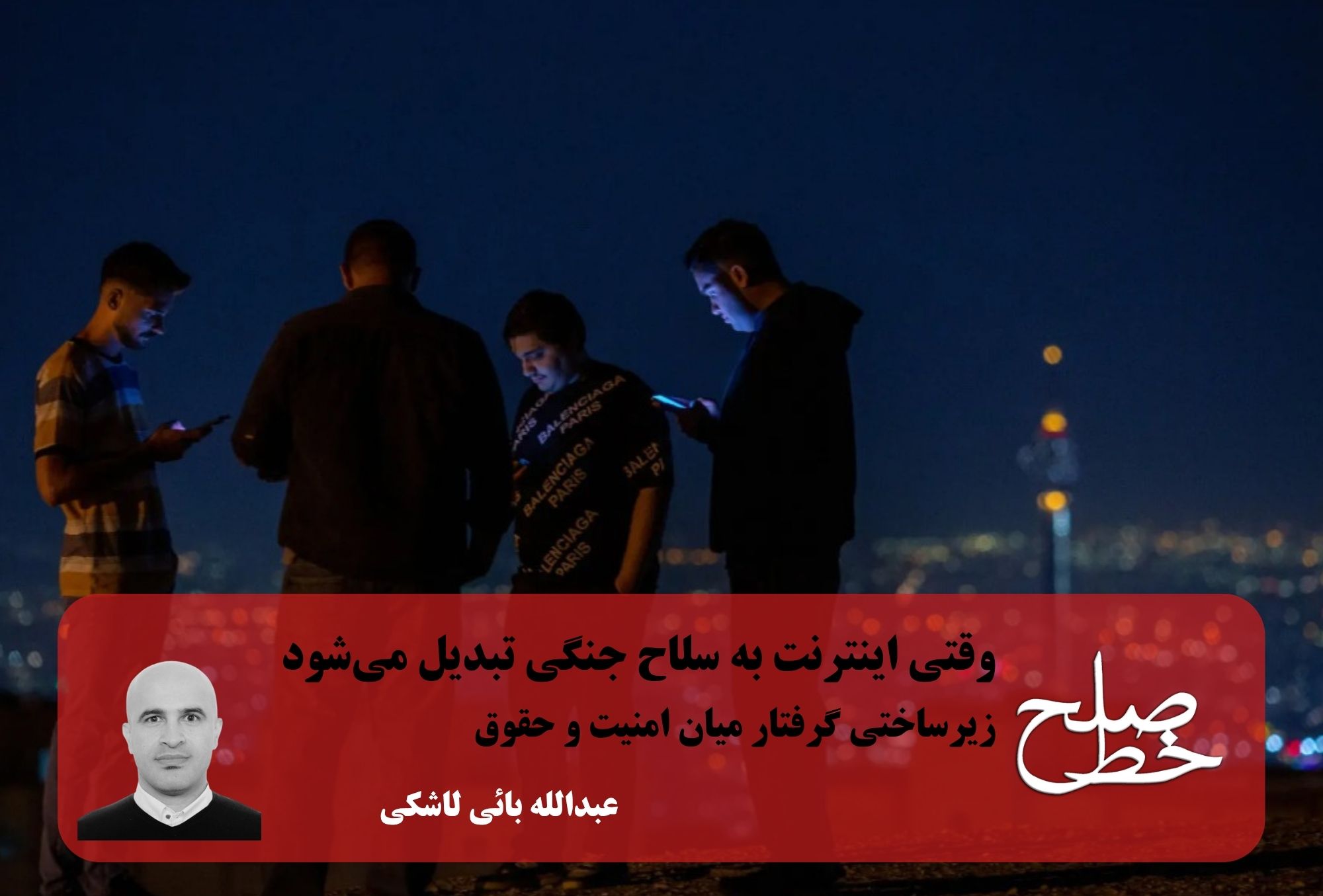
When the Internet Becomes a Weapon of War/ Abdollah Bai Lashaki
In the contemporary world, the internet is no longer merely a communication tool; it has become one of the fundamental pillars of social, economic, and political organization. Critical infrastructures—from banking and healthcare systems to media, education, and even emergency response mechanisms—depend, to varying degrees, on stable access to the internet. However, in situations of armed conflict, this very vital infrastructure is increasingly transformed into an object or instrument of state security intervention. One of the most prominent manifestations of this transformation is the resort to widespread internet shutdowns or restrictions during wartime—an action that, although often justified on the grounds of national security, raises serious challenges from the perspective of international law.
At the analytical level, the issue of internet shutdowns during war must be examined at the intersection of two key areas of international law: international human rights law and international humanitarian law. Each of these legal regimes provides a set of principles and rules that directly or indirectly influence the legitimacy of such measures. A proper understanding of this issue requires recognizing that war, contrary to some simplistic interpretations, does not mean the complete suspension of rights, but rather a change in the manner of their application and interpretation.
From a human rights perspective, although the internet is not explicitly mentioned in classical instruments such as the International Covenant on Civil and Political Rights, interpretations by international bodies—particularly over the past two decades—clearly indicate that rights such as freedom of expression and access to information, guaranteed under Article 19 of the Covenant, apply equally in the online space. This interpretive development is fundamental, as it means that the internet is not merely a technical tool, but a platform for the exercise of fundamental rights. Consequently, restricting or shutting it down can have multilayered effects on various rights, including freedom of expression, the right to access information, political participation, and even, in certain circumstances, rights such as health and personal security.
Within this framework, any restriction on these rights must pass a three-part test established in international human rights law: legality, necessity, and proportionality. The requirement of legality demands that restrictions be based on clear, predictable, and accessible laws. However, in many cases, governments can formally satisfy this condition by relying on emergency regulations or domestic security laws. The real challenge emerges in relation to the other two criteria—necessity and proportionality.
Necessity requires that the restrictive measure be indispensable for achieving a legitimate aim, such as the protection of national security. This criterion implicitly obliges governments to consider whether less restrictive alternatives are available. In the case of the internet, this question becomes particularly important. Could targeted restrictions, specific filtering, or limited monitoring measures be used instead of a complete shutdown? In many instances, the answer is yes, which calls into question the necessity of resorting to a nationwide shutdown.
Proportionality means that even where necessity is established, the scope and intensity of the restriction must not exceed what is required. A complete internet shutdown, due to its broad and indiscriminate nature, is difficult to reconcile with this principle. Such a measure affects all users without distinction and therefore imposes widespread consequences on civilians. From this perspective, many international bodies, including United Nations Special Rapporteurs, have emphasized that such actions can only be justified under very exceptional circumstances.
The complexity of the issue increases when it is examined within the context of armed conflict. Contrary to common assumptions, human rights law does not cease to apply during war. The International Court of Justice, in its jurisprudence—including its advisory opinion on nuclear weapons—has affirmed that human rights law and international humanitarian law apply concurrently. However, the interpretation and implementation of these rights may be adjusted in light of the specific conditions of war.
In this context, if internet shutdowns are considered a domestic security measure, they must still comply with human rights obligations. But if they are viewed as part of military or cyber operations, then the principles of humanitarian law also become relevant. Two core principles in this field—the principle of distinction and the principle of proportionality—play a decisive role. The principle of distinction requires states to differentiate between military and civilian targets, while the principle of proportionality prohibits actions that would cause excessive harm to civilians.
Internet shutdowns, as broad and non-targeted measures, are difficult to align with these principles. Communication infrastructures often serve dual purposes, being used by both military forces and civilians. As a result, any disruption to these infrastructures inevitably affects the civilian population. This issue has been clearly observed in recent conflicts.
For example, in the war in Ukraine, cyberattacks and attempts to disrupt communication infrastructures have been part of broader strategic efforts by the parties involved. At the same time, significant efforts have been made to maintain internet access, highlighting its vital role in sustaining both governmental and societal functions. In Gaza, communication restrictions and disruptions have repeatedly raised serious concerns about their impact on humanitarian operations and access to information. Humanitarian organizations have emphasized that such limitations can directly undermine their ability to deliver essential aid.
Outside the framework of classical armed conflicts, experiences such as those in Iran shed light on other dimensions of this issue. Internet shutdowns during periods of protest, although occurring in a different context, follow a similar logic: controlling the flow of information in times of crisis. These cases demonstrate how narrow and fluid the boundary can be between legitimate security measures and unjustified interference with fundamental rights.
An important aspect of analyzing this phenomenon is the gradual shift in the perception of the internet as a “critical infrastructure.” In international law, critical infrastructures typically receive a higher level of protection because their disruption can have widespread and unpredictable consequences for civilians. In modern conflicts, the internet increasingly exhibits the characteristics of such infrastructure. Its disruption can trigger cascading failures in essential services, including healthcare, banking, and emergency response.
Moreover, the internet plays a crucial role in documenting and disseminating information about human rights violations. In many cases, information shared by citizens or local organizations constitutes the only available source for assessing on-the-ground realities. Shutting down the internet can disrupt this flow of information, thereby reducing accountability and transparency. These consequences have significant legal and political implications that extend beyond purely security considerations.
Despite all these concerns, it cannot be categorically asserted that any form of internet restriction is illegitimate. International law, acknowledging the complexity of security realities, allows for limited and targeted restrictions under specific circumstances. However, the distinction between targeted restrictions and a complete internet shutdown is legally decisive. While the former may be justifiable within the framework of necessity and proportionality, the latter, due to its broad and indiscriminate nature, is rarely compatible with these principles.
Ultimately, the assessment of the legitimacy of internet shutdowns in wartime depends on the extent to which states adhere to the fundamental principles of international law. These principles, although challenged by new realities, continue to provide an essential framework for limiting state power and protecting individual rights. In a world where digital communication has become the backbone of societies, the decision to turn off the internet is not merely a technical act, but a deeply legal and political choice—one whose consequences extend far beyond the battlefield.
 Created By: Abdullah Bai Lashaki
 April 21, 2026
Tags
Abdullah Bai Lashki Cyber attacks Freedom of speech Information control Infrastructure Internet outage Iran-US war National security peace line Peace Line 180 The right to freedom of expression The war between Iran and Israel. Ukraine War War ماهنامه خط صلح