


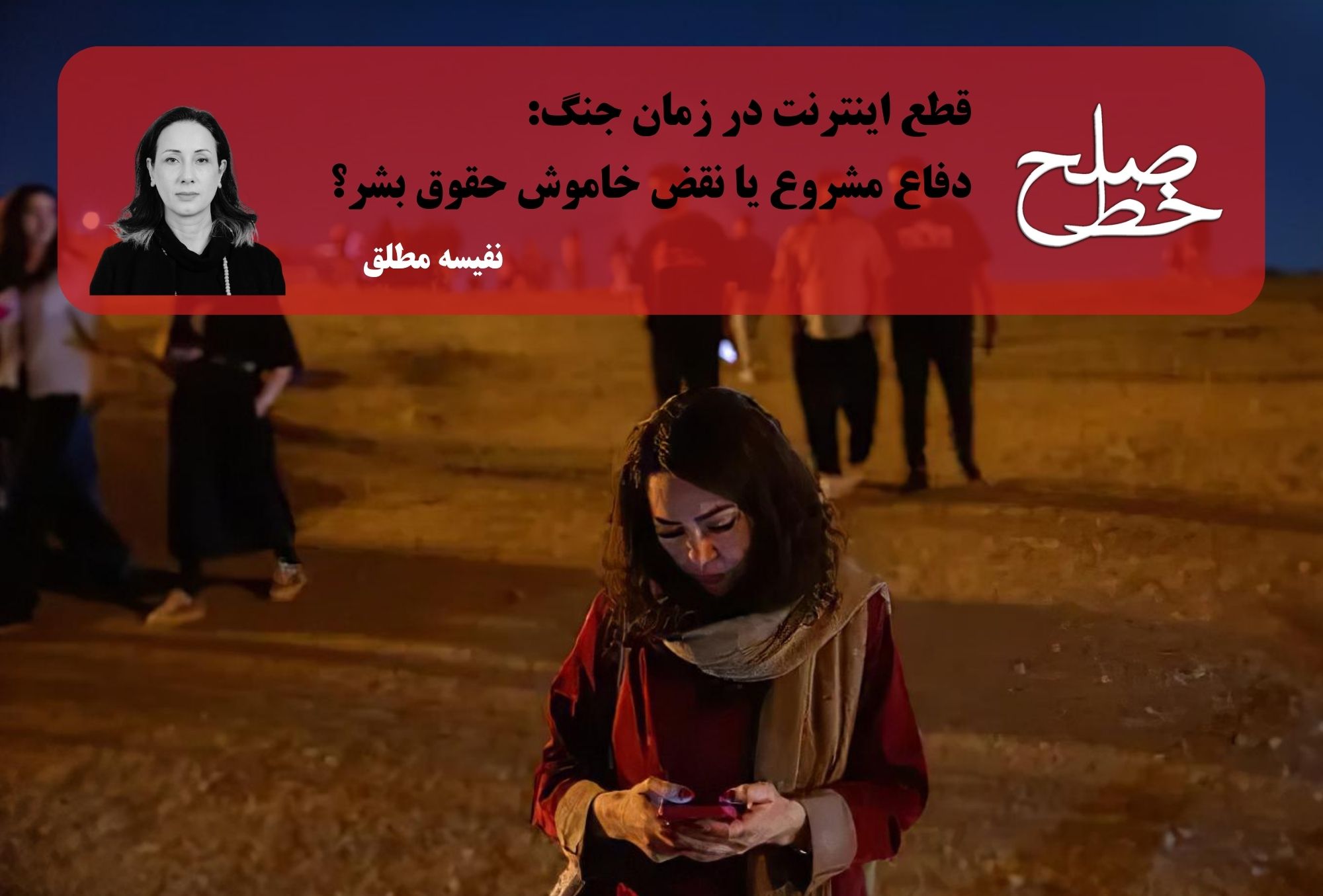
Internet Shutdowns During Wartime: Legitimate Defense or a Silent Violation of Human Rights?/ Nafiseh Motlagh
In the contemporary world, access to the internet is considered one of the vital pillars of social and economic life, and even a condition for the survival of citizens. However, this reality has not yet been explicitly recognized in international law—neither as an “independent human right” nor as a “critical infrastructure.”
This legal gap has allowed authoritarian governments, particularly in times of crisis and especially during war, greater freedom to restrict or shut down the internet. Nevertheless, existing interpretations within the framework of human rights regard access to the internet as a prerequisite for the realization of rights such as freedom of expression and access to information—rights guaranteed in documents such as the International Covenant on Civil and Political Rights. From this perspective, shutting down the internet is not merely a technical decision, but a profound intervention in the civic life of citizens.
Recent experiences show that authoritarian governments adopt different approaches when facing security crises. Some, like Russia, instead of imposing a complete shutdown, move toward gradual control of information flow by restricting foreign platforms, strengthening domestic networks, and centralizing communications. In contrast, countries such as Syria, Sudan, and Myanmar have, at times of war or unrest, resorted to total internet blackouts. Although these two approaches appear different, they converge at one point: restricting citizens’ access to the free flow of information. The key difference may lie in the fact that the first model gradually and quietly institutionalizes control, while the second, through a sudden shock, plunges society into communicative darkness.
From the perspective of international law, any restriction on fundamental rights must be based on three principles: legality, necessity, and proportionality. Even if we accept that, under exceptional circumstances, governments may impose restrictions in the name of national security, the central question remains: can a complete internet shutdown meet these criteria?
For a citizen in the midst of conflict trying to contact family, for a patient needing urgent coordination with a medical center, or for a relief worker requiring real-time information, the internet is not merely a communication tool—it is part of the chain of survival. Disrupting this chain—even temporarily—can have irreversible consequences: disruption of emergency response, reduced access to healthcare services, and the paralysis of economic activities.
Alongside these immediate consequences, more hidden forms of harm are also emerging. Selective access to the internet—through tools such as special SIM cards or the ability to purchase expensive virtual private networks—gradually turns free internet access into an economic and class-based privilege. Under such conditions, digital inequality deepens: a segment of society gains access to information, communication, and opportunities, while the majority remains confined within a limited and controlled network. This gap extends beyond differences in the quality of access and gradually becomes a disparity in the ability to participate in social and economic life. For example, an individual with access to an open internet can pursue job opportunities, educational resources, or international connections, while another is effectively excluded from this cycle. In this way, the internet—once envisioned as a tool for reducing inequality—becomes a factor in deepening it.
At the same time, internet shutdowns create a kind of “monitoring blackout.” In the absence of free communication, the ability to document, disseminate, and verify information is diminished. This situation not only makes it more difficult to monitor potential human rights violations, but also contributes to the formation of one-sided narratives at the international level. Under such conditions, what is communicated to the world about a crisis often passes through limited and selective filters, reducing the possibility of forming a comprehensive and pluralistic picture of reality. The silencing of tens of millions of Iranian citizens in the global media sphere effectively erases their lived experiences and firsthand accounts—narratives that, in their absence, are replaced by others, shaping global collective memory in line with external media agendas.
Ultimately, even if a government can justify a temporary internet shutdown under emergency conditions, critical questions remain: who bears the real cost of this decision? In a world where many fundamental human rights are realized through digital infrastructures, can internet shutdowns still be considered a legitimate tool of governance—even in wartime—or should they be seen as one of the most costly and rarely justifiable forms of restricting human rights in the digital age? And finally, why have international legal institutions and bodies not, as they should, pursued the issue of widespread, prolonged, and selective internet access restrictions in Iran?
 Created By: Nafiseh Motlagh
 April 21, 2026
Tags
Freedom of information Freedom of speech Information control Internet freedom Internet outage Iran-US war Nafiseh Motlagh peace line Peace Line 180 Sudanese War The right to freedom of expression The war between Iran and Israel. War ماهنامه خط صلح