


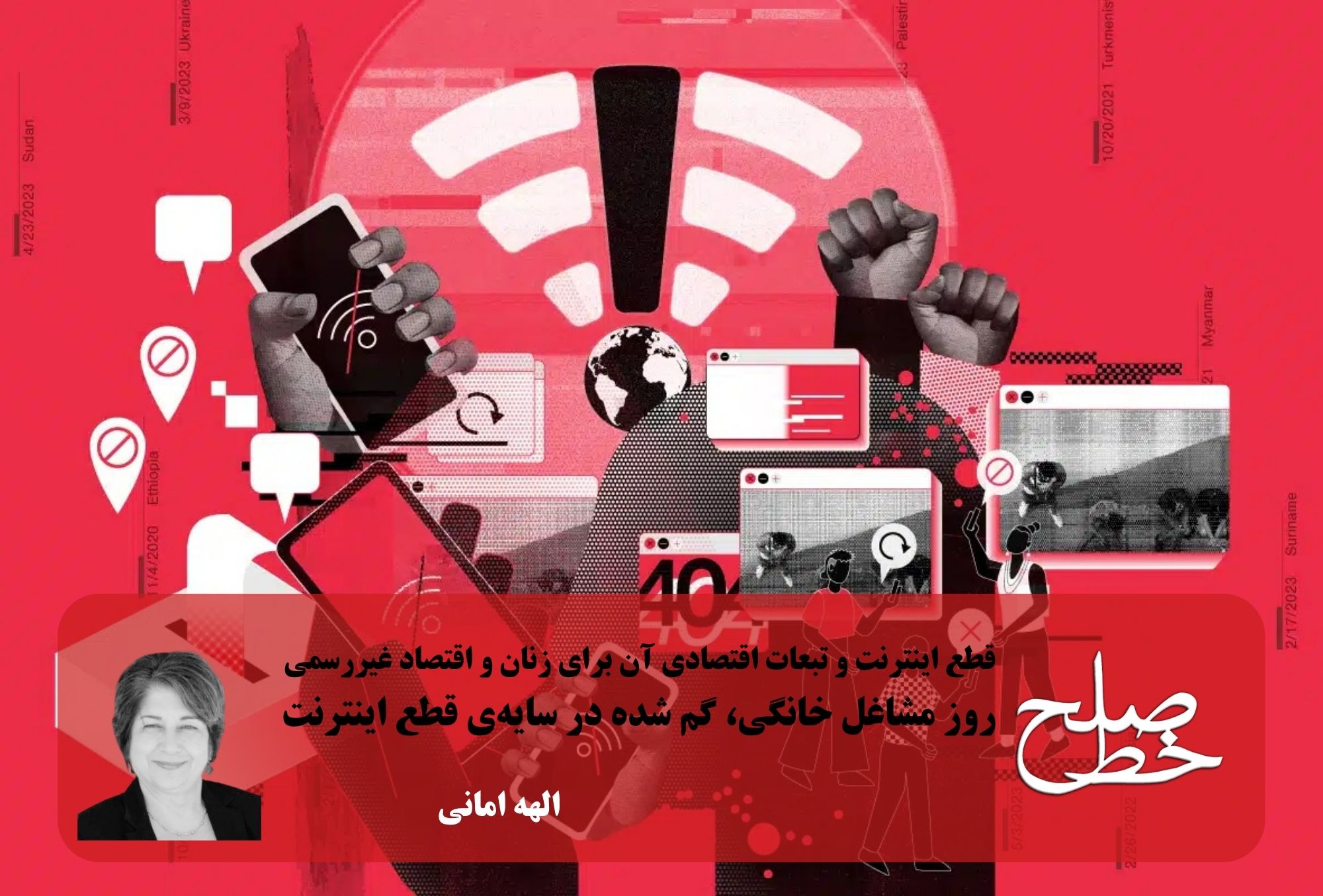
Internet Shutdowns and Their Economic Consequences for Women and the Informal Economy/ Elaheh Amani
This article is not about the catastrophic depth of war as an absolute evil; it is not about the innocent children who lost their lives and never returned home; it is not about the civilians in Iran and other countries of the region who were killed; it is not about the historical heritage destroyed and the civilian infrastructure reduced to ruins; nor is it about the millions of people displaced from their homes. These tragedies are undeniable, and each requires separate examination and accountability. This article addresses a less visible yet deeply consequential dimension of war: internet shutdowns and their wide-ranging economic impacts, particularly on home-based businesses, the vast majority of which are run by women. May 12 (22 Ordibehesht), designated in Iran as “Home-Based Businesses Day,” arrives at a time when many of these livelihoods have effectively been removed from the cycle of income generation due to internet disruption.
More specifically, this article examines how prolonged disruption and shutdown of the internet function as a form of economic and social paralysis, intensifying inequalities and increasing livelihood insecurity. The consequences of this situation are far more severe for groups already on the margins of society, including informal economy workers, small businesses, and especially women whose livelihoods often depend on digital access for income generation, networking, and survival. When connectivity is cut, jobs disappear, markets collapse, and fragile sources of economic independence are lost—pushing many into deeper economic insecurity and social isolation.
This is not the first time authorities in Iran have shut down internet access for citizens. However, now, at one of the most critical moments in Iran’s history, restrictions imposed by the government on access to global networks have exceeded 1,000 hours. The shutdown, which began on February 28, 2026, has not only set a record for the longest and most severe nationwide internet disruption in terms of scale and duration, but also ranks among the longest such restrictions globally. During this period, even with brief ceasefire intervals in this devastating war, internet access for the majority of Iranians has remained cut off—a situation often described as a “garrisoned internet.”
It is estimated that during this time, access has been available only to approximately 700,000 selectively approved users placed on a “whitelist,” who are connected to power structures and government institutions. For years, a specific circle has benefited from “white SIM cards,” allowing unrestricted and unfiltered access to the global internet.
At the beginning of 2026, approximately 73.8 million people in Iran had access to the internet, representing a penetration rate of 79.6 percent of the total population. Despite having one of the largest numbers of internet users in the Middle East due to its population size, Iran ranks at a متوسط level compared to other countries in the region. Countries such as Saudi Arabia, the United Arab Emirates, Kuwait, Qatar, and Bahrain have reached internet penetration rates of 99 to 100 percent. Similarly, countries such as Oman (95 percent), Jordan (93 percent), and Israel (88 percent) enjoy high levels of connectivity. By contrast, Iran (79.6 percent), Egypt (73 to 75 percent), and Iraq (81.5 percent) fall within the mid-range.
Nevertheless, despite the high number of users, the quality of internet access in Iran has consistently faced specific challenges, including what is defined as “network resilience.” The Internet Society has assigned Iran a resilience score of 45 percent, pointing to weaknesses in provider diversity and only moderate capacity to withstand disruptions.
Even before the recent restrictions, internet users in Iran faced additional challenges. Due to heavy filtering, 71.3 percent of users rely on virtual private networks to bypass government restrictions, as access for most citizens is limited to a “domestic internet”—referred to as the National Information Network, a state-controlled system separate from the global internet—while international connections are frequently slowed or blocked.
It should be noted that Iran’s population in 2026 is estimated at over 93 million (93,168,497), of whom approximately 73.8 million access the internet via mobile devices, reflecting the same 79.6 percent penetration rate.
By the end of 2025, internet access in Iran was relatively balanced in terms of gender, with approximately 78 percent of women and 80 percent of men using the internet. The gender gap in internet access in Iran is about 2 percent, whereas in the Middle East and North Africa region, the average gender gap in mobile internet access is estimated at 17 percent. However, despite this relatively high level of access, significant challenges remain, including gender-based digital skill gaps, restrictions and filtering of social media, and widespread reliance on circumvention tools.
Internet shutdowns not only violate citizens’ human rights but also have severe economic consequences for digital businesses and their essential communications—effects that, given the level of internet penetration in Iran, disproportionately burden citizens, especially women.
Intentional disruption or restriction of internet access can be considered a violation of human rights, as the internet today is one of the most important tools for exercising other fundamental rights, including freedom of expression, access to information, the right to protest, education, health, employment, and participation in public life. The United Nations Human Rights Council has also emphasized that intentional disruption of access to online information may constitute a violation of international law. In practice, internet shutdowns can silence journalists, block access to vital information, and prevent individuals from documenting human rights violations, repression, and killings of protesters or from seeking assistance from the international community.
In fact, restricting or cutting internet access affects a wide range of fundamental rights. Freedom of expression is severely limited, as individuals are unable to voice opinions or organize activities online. Access to information is disrupted, depriving people of news, public services, and educational resources. Moreover, internet shutdowns can facilitate the concealment of violence, arrests, or other repressive actions and reduce accountability of those in power. Ultimately, economic and social rights are also harmed, as activities such as banking, commerce, healthcare, and education are seriously disrupted.
In Iran, possession of tools used to bypass such restrictions, such as satellite internet terminals, can even carry the death penalty. Instances of internet shutdowns or restrictions in Iran have been identified by monitoring organizations such as NetBlocks as among the most restrictive and longest nationwide disruptions in modern history.
Officials of the Islamic Republic often describe internet shutdowns during wartime or widespread uprisings as “security and emergency measures,” or, as stated by Iran’s foreign minister Abbas Araghchi in interviews with international media, as actions taken solely “to protect people during war.”
However, it is clear that the motivations behind internet shutdowns extend beyond “protecting people during war.” The imposition of digital silence and darkness, particularly in suppressing widespread public movements in Iran—especially during the mass killings of January 2026 (Dey 1404)—and in managing war, information confrontation, and narrative control, has made cutting internet access a strategic prerequisite for achieving these goals. The bloody and historic events of January 2026, carried out in digital darkness alongside internet shutdowns, are a clear example of this pattern. This pattern is not unique to Iran and can also be observed in other countries during the management of crises and social uprisings.
Statistical data from Access Now for 2025 confirms this alarming reality: the use of internet shutdowns by authoritarian governments worldwide is increasing, with wide-ranging impacts on people’s lives. The organization estimates that there were 313 internet shutdowns across 52 countries in 2025, continuing an upward trend that began in 2020. However, aside from North Korea, where internet access is fundamentally absent at the national level, Iran, according to the latest data as of April 2026, has experienced the longest nationwide internet shutdown to date.
These figures demonstrate that in the twenty-first century, despite widespread internet access, wars and military conflicts are fought not only on battlefields but also across digital networks and in the realm of public opinion.
Economic Processes of Internet Restriction in Wartime Conditions
The economic impacts of this devastating war on Iran include deep recession, rising inflation, and disruptions to production activities—a trend that has led to mass layoffs, increased unemployment, reduced purchasing power, and intensified poverty. The shutdown of industries and digital businesses, alongside currency fluctuations and economic uncertainty, has further worsened living conditions, pushing them to catastrophic levels.
According to statistics published up to May 2025 (Ordibehesht 1404), home-based businesses in Iran have become a significant pillar of employment. More than 2.112 million licenses have been issued for such activities, and this sector accounts for approximately 20 percent of total employment in the country. The diversity of activities has also increased significantly, with the number of categories expanding from 335 to 515—indicating the growth of small-scale and home-based business opportunities. A substantial portion of these businesses operate online, and their continuity depends on internet access.
Women play a central role in this sector, constituting about 80 percent of those engaged in home-based businesses—a figure even higher than the global average of women’s participation in the informal economy, which is around 60 percent. Some reports estimate this share in Iran to be as high as 90 percent. The distribution of these businesses shows that 47 percent operate in industry, 43 percent in services, and 10 percent in agriculture. This breadth has made home-based businesses an important platform for women’s economic participation, especially in a context where access to formal labor markets is more restricted due to gender-based policies.
In recent years, government support policies—although limited—have focused on developing this sector. Two types of licenses are defined: independent licenses for individual activity and licenses tied to specific fields. Based on this, financial facilities of up to 1.5 billion rials are provided for independent businesses and up to 3 billion rials for certain specialized fields. The importance of this sector is amplified in conditions where large-scale investment is constrained, and home-based businesses, as a flexible and low-cost solution, enable greater participation of the population—especially women—in the economic cycle.
Within this context, internet disruption or shutdown in Iran—particularly during crises and wartime—extends beyond a communication limitation and becomes a tool for paralyzing economic arteries. Estimates indicate that these disruptions cost the national economy between 37 and 80 million dollars per day (approximately 5 trillion rials). Additionally, direct damage to digital infrastructure and operators is estimated at around 500 billion rials per day, with total economic losses exceeding 215 trillion rials over longer periods.
The consequences of this situation have directly affected the labor market and people’s livelihoods. In Iran, around 10 million people work in internet-dependent jobs, and their livelihoods are under serious threat. Among them, nearly 2.5 million are owners of online businesses who, due to restricted access to international platforms, have faced severe income reductions—sometimes up to 80 percent—or complete shutdown of their activities.
Furthermore, disruptions in essential tools such as maps, navigation systems, and international communication platforms have hindered the work of service providers, knowledge-based companies, and freelancers. Under such conditions, given the limited resilience of internet-based businesses (approximately 20 days), the risk of widespread closures, rising unemployment, and deepening economic crisis has significantly increased.
Ultimately, internet shutdowns during wartime are not merely technical or security measures for citizens; they are tools with profound economic, social, and human consequences. By disrupting the flow of information and economic activity, they disproportionately harm the most vulnerable groups in society and intensify existing gender inequalities.
Women active in the informal economy are among the first victims of this situation, as losing access to markets and support networks deprives them of their livelihoods. Therefore, any analysis of the consequences of war that fails to consider the vital role of the internet and the processes of its disruption in shaping women’s livelihoods in the informal economy will remain incomplete. Restoring free and stable access to the internet is not only a technological necessity, but an essential part of protecting human rights, human dignity, and the possibility of rebuilding disrupted lives.
 Created By: Elahe Amani
 April 21, 2026
Tags
Elahe Amani Home jobs Homework Day Influencer Internet freedom Internet outage Iran-US war Nationwide internet shutdown Online economy peace line Peace Line 180 Poverty of women Swelling The war between Iran and Israel. Unemployment War ماهنامه خط صلح