


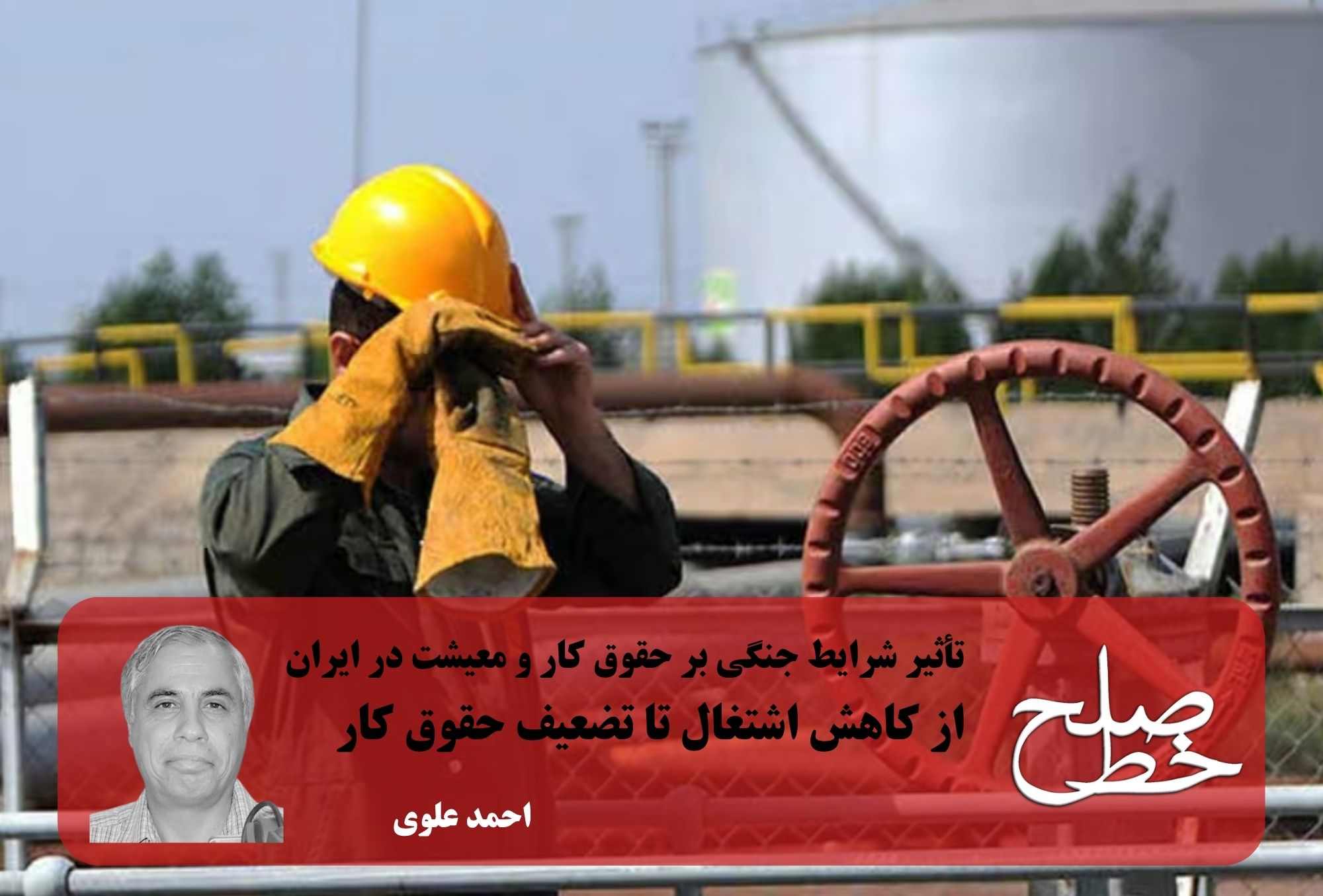
The Impact of Wartime Conditions on Labor Rights and Livelihoods in Iran/ Ahmad Alavi
Wars in the modern economy are no longer merely military events; rather, they are multidimensional phenomena that simultaneously affect economic, social, and institutional structures. In the case of present-day Iran, in the year 2026 (1405), this characteristic is clearly observable, where the economy had already been facing chronic imbalances and war has acted as an “intensifying shock.”
Under such conditions, the labor market, as one of the most sensitive economic institutions, reacts rapidly. Declining employment, rising hidden unemployment, the withdrawal of labor from the market, and changes in the quality of employment are all signs of a deep disruption. What makes this situation more complex, however, is its intersection with the specific legal and institutional structure of Iran’s labor market—where laws allow for the suspension of contracts, but corresponding support mechanisms have not been adequately developed.
Thus, the issue is not merely “job loss,” but the emergence of a new condition that can be described as “institutional instability in the labor market”; a situation in which neither stable employment exists nor unemployment is fully recognized and compensated. This report attempts to examine this condition from both theoretical and empirical perspectives.
Conflict Economy and the Approach of Cumulative Destruction
Within the framework of conflict economics, war functions as a process of “cumulative destruction,” meaning that its effects spread in a chain-like and reinforcing manner across different sectors of the economy. The destruction of infrastructure is only the beginning of this process. This destruction leads to reduced production, reduced production lowers incomes, and declining incomes constrain demand. This cycle ultimately results in reduced employment.
More significant than physical destruction, however, is the “destruction of expectations.” The uncertainty caused by war shortens the planning horizon of firms and pushes them toward defensive behavior. Under such conditions, even firms that have not been directly damaged refrain from hiring new workers and instead move toward reducing their existing workforce.
Labor Rights and the State of Suspension
Under normal conditions, labor rights are based on the stability of employment contracts, job security, and continuity of income. However, in wartime conditions, all three of these components are simultaneously weakened.
The suspension of contracts, although seemingly a temporary legal instrument, can in practice become a permanent condition. This creates a form of “legal-livelihood suspension,” in which workers are not fully protected by law, yet have very limited opportunities to find alternative employment. This condition generates a type of structural instability in labor relations whose effects extend beyond the wartime period.
Capability Approach and Multidimensional Poverty
The capability approach allows for a deeper analysis of the consequences of war. Within this framework, unemployment is not merely the loss of income, but the restriction of a set of capabilities: the ability to choose employment, the ability to plan for the future, and the ability to participate socially. As a result, war produces a form of “multidimensional poverty” that is not easily remedied even with the return of employment.
Empirical Evidence
Available data indicate a consistent pattern of labor market weakening. Declining employment and economic participation are only surface indicators of this crisis. At deeper levels, structural changes in the labor market are evident: an increase in the share of informal employment, a decline in job quality (including reduced job security and benefits), and a rise in hidden and underemployment.
From a demographic perspective, women and young people, due to their more marginal position in the labor market, have been more exposed to exclusion. This indicates that war not only reproduces existing inequalities, but intensifies them.
Business Closures: From Shock to Collapse
The closure of firms under wartime conditions is a gradual but accelerating process. In the first stage, firms face declining demand and disruptions in supply. In the next stage, liquidity problems emerge. Ultimately, if conditions persist, full closure occurs.
This process happens more rapidly among small and medium-sized enterprises, which have limited access to financial resources. As a result, the economic structure moves toward greater concentration and the elimination of smaller firms.
Forced Unemployment: The Emergence of a Grey Labor Market
Unemployment resulting from contract suspension is not a classical form of unemployment. This type of unemployment is not fully captured in statistics, does not benefit from full support, and creates greater psychological uncertainty.
This condition can be described as a “grey labor market,” where the boundary between employment and unemployment becomes blurred. This phenomenon also reduces the effectiveness of labor market policies, as accurately identifying target groups becomes difficult under such conditions.
The Void of Social Protection: Institutional Failure
In such conditions, the social protection system should play a stabilizing role, but in Iran this system faces structural limitations.
The most significant sign of this failure is the inability to cover informal workers. These groups, which constitute a substantial portion of the labor force, are effectively left without any safety net.
In addition, high inflation reduces the effectiveness of existing support measures. As a result, the social protection system is not only unable to compensate for the shock, but in some cases becomes part of the problem itself.
Conclusion
Iran’s labor market in 2026 (1405) has entered a state of “chronic instability.” This condition has several key characteristics:
- self-reinforcing crisis dynamics, where unemployment and declining demand intensify one another;
- de-institutionalization of labor, as labor relations move خارج formal frameworks;
- polarization of the labor market, with a widening gap between advantaged and disadvantaged groups.
Among the most significant consequences is the emergence of a “poverty trap.” Households that lose their income gradually consume their assets and become caught in a downward cycle. Exiting this cycle is extremely difficult without policy intervention.
This report shows that war has pushed the labor market into crisis not only quantitatively (through declining employment), but also qualitatively (through the erosion of labor rights).
What is unfolding in Iran in 2026 (1405) is not merely an economic crisis, but a sign of the deepening crisis of market, state, and social institutions simultaneously. War has exposed and intensified this process.
 Created By: Ahmad Alavi
 April 21, 2026
Tags
Iran-US war Job market Online economy peace line Peace Line 180 Retrenchment Swelling The war between Iran and Israel. Unemployment War ماهنامه خط صلح