


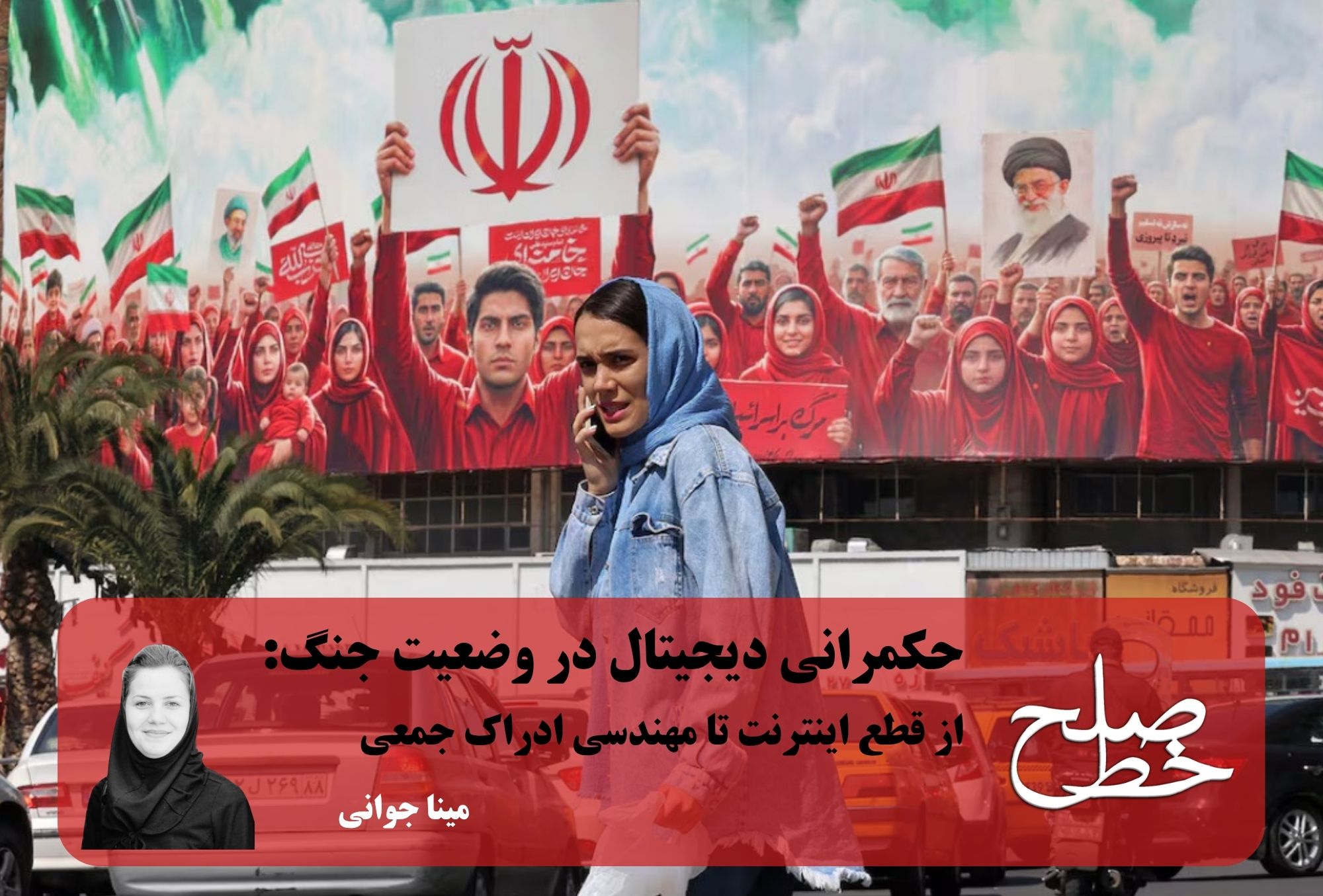
Digital Governance in a State of War: From Internet Shutdowns to the Engineering of Collective Perception/ Mina Javani
Sometimes, in the midst of war, what disappears is not only sounds and images, but access to reality itself. The internet, this seemingly obvious and always-available platform, suddenly goes dark in such moments and plunges society into a state of informational rupture; a condition in which the boundary between what is happening and what is being narrated becomes more ambiguous and more controllable than ever. During the Israeli and American attack on Iran, the widespread internet shutdown in Iran made this rupture clearly visible. Millions of users were deprived of access to the global network, and the free flow of information was severely disrupted. This event cannot be understood merely as a technical malfunction or a temporary decision; rather, it must be analyzed within the framework of a broader strategy in which the internet becomes a tool for the simultaneous management of security, public opinion, and the narrative of war. Accordingly, this report seeks to examine the phenomenon of internet shutdown not as an isolated event, but as part of the logic of digital governance; a logic in which control over the flow of information acquires a role equal to control over the battlefield.
The Internet as a Tool of Control and Management
In recent decades, the internet has evolved from a communication tool into one of the principal pillars of social, economic, and political life. Many everyday activities—from personal communication and economic exchange to the circulation of information and the formation of public opinion—depend directly on this infrastructure. Under such conditions, any disruption or shutdown of internet access has consequences that go far beyond a simple technical problem and can be understood as a profound intervention in the social order and the flow of information. As the political significance of the internet increased, the idea of controlling and restricting it emerged in the form of filtering and the project of a national internet. In this context, the internet was not only a means of communication, but also a key instrument in crisis management, information dissemination, and social coordination. Conversely, controlling or shutting it down became one of the strategic tools of power actors; a tool capable of affecting internal security, the flow of news, and the formation of narratives all at once.
To understand internet shutdown during war, one must move away from an event-centered perspective and view it instead as part of a pattern of governance. In Iran, the internet is not merely a technological infrastructure; it has gradually become part of the architecture of power, where access, speed, and connectivity are not only technical issues but adjustable political variables. Earlier experiences, especially during domestic crises and protests, show that the state has gradually developed a kind of internet policymaking. During the protests of November 2019 and January 2026, a complete internet shutdown was employed as a maximal measure: a form of total blackout aimed at creating a sudden interruption in the circulation of information and collapsing horizontal communication. But at times, instead of a total blackout, a more complex form of intervention has been observed: deliberate slowing, filtering of specific platforms, disruption of tools used to bypass restrictions, and the invisible management of traffic. This shift signals the targeted management of internet flow, turning it from a right into a privilege.
Within this framework, the internet is no longer a unified whole; rather, it becomes a set of separable layers, each of which can be controlled independently. This is precisely where the concept of layered control becomes important: a user may still have access to some domestic services, while their connection to the global network, independent media, or key communication platforms is disrupted. In this context, the development of the National Information Network, or the national internet, should be understood not merely as a technical project, but as part of this doctrine. This network makes it possible, when necessary, to reduce or sever connection to the global internet without disabling the entire communications infrastructure of the country. In other words, a kind of dualization of space takes shape: the global internet as an uncontrollable and high-risk space, and the domestic network as a manageable and secure one.
What is noteworthy in this process is the shift in the position of the internet within the logic of power. If in the past control of information was exercised mainly through official media, today this control has been transferred to the level of infrastructure. That is, instead of competing in the production of narrative, access to other narratives is restricted. This shift transforms the internet from a medium into a tool for regulating the field of narrative. Accordingly, internet shutdown during war must be understood as the continuation and intensification of this same logic. War merely creates the conditions in which this pattern can be implemented more broadly, more rapidly, and with stronger security justification. As a result, what appears on the surface to be an emergency reaction is in fact part of an established trend in digital governance; a trend in which crisis control is inconceivable without control over the flow of information.
The Consequences of the Policy of Silencing the Global Internet: Reconfiguring Society, Economy, and Perception
The shutdown and restriction of internet and communications during war, beyond being a technological disruption, became a structural instrument for the exercise of power and social engineering, with deep and multilayered consequences in the social, economic, media, and cognitive spheres. From a social perspective, restricting the flow of information and reducing access to global networks severely disrupted the possibility of horizontal interaction among citizens and the formation of independent civic networks. Faced with reduced speed, filtering, and disruption of tools for bypassing restrictions, users were left with access only to official information flows and domestic services, which meant that alternative narratives and independent news were almost entirely eliminated, and the public sphere was transformed into a field of single narrative. This continuous control over the flow of information engineers social behavior by creating a form of digital self-censorship and behavioral limitation; in such a way that citizens, even when they have limited internet access, refrain from publishing sensitive or critical content, and thus the processes through which collective identity and collective action are formed become disrupted.
At the economic level, digital governance and infrastructural restrictions had significant effects on activities dependent on the global network. Online businesses, companies active in e-commerce and digital services, and many network-dependent sectors faced a sharp decline in efficiency and income because of reduced access to the global internet and financial exchange tools. Freelance work and international software projects, which depend on stable connection to global platforms, were either halted or faced increased cost and risk. From a macroeconomic perspective, these restrictions reduced the operational capacity of the digital sector, concentrated activity within domestic and controllable networks, and decreased market flexibility. In other words, the internet came under management and engineering by power not only as a communication tool, but as an economic platform as well.
The media consequences are equally significant. Restricted access to the global internet and the filtering of foreign news platforms and social media severely weakened independent media and alternative news flows, transforming the media environment into a closed and controlled system. The official narrative, without competition or independent criticism, found the opportunity to dominate, and the possibility of forming a pluralistic public opinion was sharply reduced. This situation, combined with the creation of domestic channels and the National Information Network, produced a dual media pattern; one in which domestic media continue their activity under restriction and intense supervision, while access to the free global flow is blocked.
A complete internet shutdown transforms the processes of collective cognition. Users, in order to reconstruct a picture of reality, turn to limited and controlled sources, which reinforces acceptance of the official narrative and reduces the capacity for critical thinking. In the literature of social psychology, this phenomenon aligns with the concept of collective self-censorship: citizens, even when they have relative access to information, refrain from expressing critical opinions because of fear of political or social consequences. Its psychological effects include anxiety, distrust, and a sense of isolation, which, combined with the reduction of horizontal interactions among citizens, weakens society’s ability to make collective decisions and form social identity. Civic networks and virtual communities, which are arenas for the production of knowledge and social critique, face disruption and limitation, and as a result, the collective intelligence of society is pushed toward single narrative and passivity.
In other words, digital governance in authoritarian systems targets not only technical control of the internet and access to information, but also leads to the psychological and cognitive reengineering of society. Within this framework, the internet becomes a field for the exercise of authoritarianism and a direct instrument for influencing the perception, behavior, and collective capacity of citizens; a tool that transfers political power from the level of media and traditional institutions to the level of individual and collective perception. As a result, shutting down and restricting the internet during war offers a strategic experience of cognitive and social control, demonstrating that the internet, as a field of digital policymaking, can simultaneously serve as an instrument of crisis management, social engineering, and the consolidation of authority.
Afterword
In reality, this policy is a condensed reflection of the same long-standing pattern of unequal distribution of resources over past decades; a pattern in which the right of access has been transformed into a privilege, and its allocation is based on proximity to power or possession of wealth. The emergence of white SIM cards and multimillion-toman VPNs once again reveals the class character of access. Within this framework, access to the global internet is no longer a public infrastructure, but has been reduced to an unequal and unstable possibility: a minority with stable and low-cost access, and a majority that either faces complete disconnection or has only temporary and extremely expensive access.
The consequences of this policy extend beyond disruption of communications and spill over into politics and society as well. The selective distribution of access to information creates a gap in the perception of reality and weakens the possibility of democratic dialogue and the formation of independent public opinion. In this process, the government is transformed from a representative of the public interest into an instrument of privilege allocation and information control. The continuation of internet shutdowns—even under ceasefire conditions—no longer has a security justification and in practice becomes a tool for the political control of society: restricting the flow of information, reducing the capacity for social mobilization, and weakening public oversight of power. In such a situation, restricting the internet neither produces security nor manages crisis; rather, by eroding social trust, it becomes itself a factor of instability. Therefore, the demand for the full and stable restoration of the global internet is not merely a technical or welfare-related demand; it is a political and legal demand: the restoration of the right of access to information to its universal and non-discriminatory status. Every day of delay in this connection not only prolongs everyday disruption, but also sends a clear political message: access to information will continue to remain in the hands of those who hold power and wealth.
 Created By: Mina Javani
 April 21, 2026
Tags
Censorship Filtering Freedom of speech Information control Internet outage Iran-US war Online economy peace line Peace Line 180 The war between Iran and Israel. Unemployment War ماهنامه خط صلح