


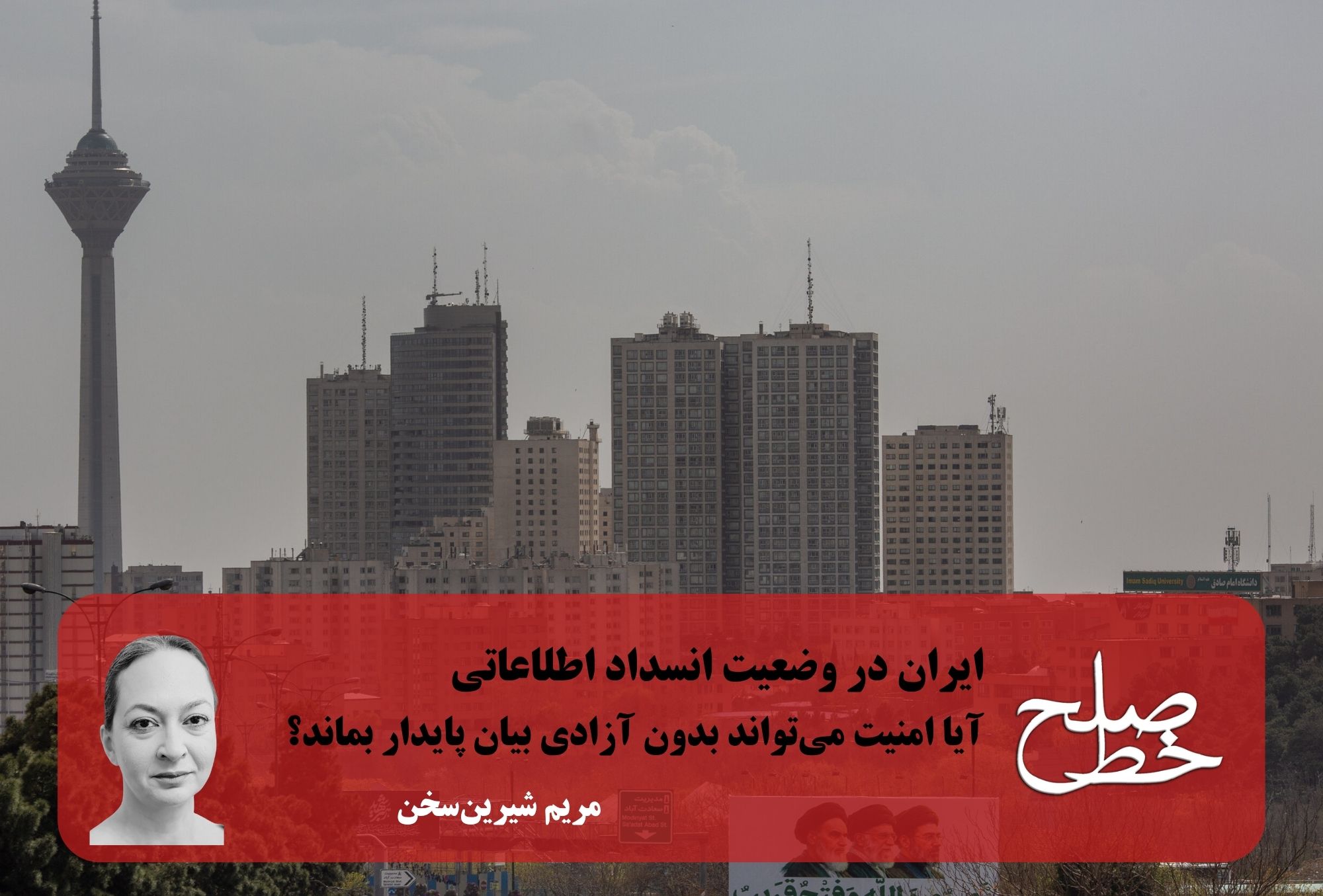
Iran in a State of Information Blockade / Maryam Shirin Sokhan
These days, Iran is undergoing an unprecedented experience: weeks of widespread internet shutdowns, severe restrictions on media, and the concentration of narratives within a single official channel. For more than two months, access to the internet in Iran has been completely cut off. Although limited access has recently been granted to certain individuals and professional groups, the general public remains deprived of this possibility. Newspapers, which even before the war were subject to censorship and constantly at risk of losing their licenses, are now operating under even greater pressure. Political activists and civil actors face threats, confiscation, and seizure of their electronic devices. Reports have emerged of inspections and searches of mobile phones at checkpoints, all under the justification of maintaining security during wartime. Not that these conditions did not exist before the war. Even prior to the conflict, filtering, blocked informational websites, and threats against independent or dissenting newspapers were present. Now, however, these measures are justified by something that appears, at least superficially, legitimate on a global scale: “information security in wartime conditions.”
In this situation, a fundamental issue becomes more visible than ever: where is the boundary between “information security” and the “right to freedom of expression”? And can one be preserved at the cost of completely eliminating the other?
At a time when independent media have either been shut down or are operating under severe pressure, and the national broadcaster reflects only a single narrative, the public sphere gradually becomes monophonic. This uniformity may, at first glance, appear to contribute to cohesion, but a closer look raises serious questions. If only one narrative exists and there is no possibility for comparison or scrutiny, how can trust be formed, and how can judgment be made?
For a generation that has grown up with the internet, disconnection is not merely a technical limitation but a form of cognitive confinement. The internet is not only a tool for entertainment or everyday communication; it is also a platform for the formation of collective awareness. When this platform is removed, society is inevitably forced to rely on more limited sources. Under such conditions, different narratives do not reach individuals, and a complete picture of truth—one that emerges only through the interaction of diverse perspectives—remains trapped behind the high walls of filtering, disconnection, and media censorship.
Today’s audience seeks diversity of narratives. When such diversity is absent in official media, people turn to alternative sources—sources that do not necessarily adhere to professional standards or offer verifiable information.
The Duality of Information Security and Freedom of Expression: A Comparison with Other Countries
No fair analysis can ignore the importance of information security during wartime. Preventing the disclosure of sensitive information, countering psychological operations by adversaries, and maintaining internal stability are all legitimate and necessary, and are practiced in all countries. In many European nations, even in Germany—where freedom of expression is enshrined in the second article of its constitution—restrictions are imposed on the publication of certain information during times of crisis. However, these restrictions are usually specific and targeted, subject to oversight by legal institutions, and most importantly, do not lead to the complete silencing of the media.
Europe, particularly after the bitter experiences of the twentieth century, has undergone a long process in redefining the relationship between the state, media, and society. During World War II, extensive censorship was part of the reality of war. Governments attempted to fully control the flow of information. However, the consequences of that era—including the spread of one-sided propaganda and public distrust—led to the development of new frameworks after the war. Defining these frameworks was a crucial turning point. Within them, restrictions are implemented for the purpose of protecting information, not eliminating it in order to achieve total control.
In fact, the challenge begins when the concept of information security shifts from targeted protection to comprehensive control.
For example, during Russia’s invasion of Ukraine, the Ukrainian government faced serious security challenges. Some media outlets were merged, and frameworks for news dissemination were established. At the same time, however, the internet remained widely accessible, domestic and foreign journalists continued their work, and citizens retained access to multiple narratives. This relative diversity contributed to the formation of a degree of public trust.
Even in Israel, despite its particular security conditions, there are laws of military and informational censorship that regulate the publication of certain content. However, this control exists alongside the activity of independent media and the possibility of public criticism.
In contrast, the experience of countries that have moved toward complete information blockades shows that the outcome is often the opposite of what is intended. An increase in rumors, the spread of distrust, and the emergence of a deep gap between official narratives and public perception are among the results of such restrictions. According to a report by The Moscow Times dated April 11, 2026, public trust in state media has decreased by seven percent compared to the same time the previous year.
Historical experience has led to the understanding that when information is fully controlled, it ultimately results in declining trust. For this reason, even during wartime, efforts are made to maintain a balance between security, freedom, and public trust. One of the less visible but deeply significant consequences of one-sided media is the gradual erosion of public trust. When audiences feel that they are hearing only part of the truth, they naturally seek out other parts—even if this search leads them to less reliable sources. This phenomenon contaminates the informational environment of society. In such a space, “rumor” replaces “news,” and “analysis” gives way to “speculation.” It is here that perhaps the most important harm of one-sided media becomes apparent—not in the short term, but in the long term: the loss of public trust, a form of capital that is difficult to build and quickly lost. This process also creates a paradox: efforts to control information lead to the spread of uncontrollable information.
If security is defined solely as the prevention of immediate threats, then severe restrictions on information and a monophonic media environment may seem justifiable. However, if security is understood in its broader sense—encompassing social stability, public trust, and long-term cohesion—the picture changes. Security built on distrust is inherently fragile.
Reconsidering Information Security in Iran Is Necessary
The issue is not the rejection of security, but the quality and manner of its realization. Global experiences show that it is possible to protect sensitive information without halting the overall flow of information, and to present an official narrative without eliminating other narratives. Such an approach not only does not weaken security, but strengthens it.
In an era where wars are determined not only on the battlefield but also in the realm of narratives, perhaps the most important right is the right to hear different voices, to see diverse perspectives, and to have the ability to evaluate and choose.
In reality, the main issue is not a choice between security and freedom. Rather, the question is how these two can be preserved together.
Precise and targeted restriction of sensitive information, maintaining public access to the internet alongside robust cybersecurity measures, allowing independent media to operate within defined frameworks, and above all, transparency in the application of restrictions can form the basis of this solution. Such an approach helps reduce tension, facilitates the healthy circulation of information, and at the same time enables the formation of a degree of public trust. In a world where information flows rapidly, the complete elimination of information is neither possible nor sustainable; what is possible is how this flow is managed. Freedom of expression, even under the most security-sensitive conditions, serves as a tool for reducing error, increasing awareness, and strengthening social resilience. Freedom of expression complements social security. A society that can hear and evaluate multiple narratives is ultimately a more secure one.
 Created By: Maryam Shirin Sokhan
 April 21, 2026
Tags
Filtering Freedom of speech Information blockage Information control Internet freedom Internet outage Maryam peace line Peace Line 180 The right to freedom of expression the sweet-talker The war between Iran and Israel. War ماهنامه خط صلح