


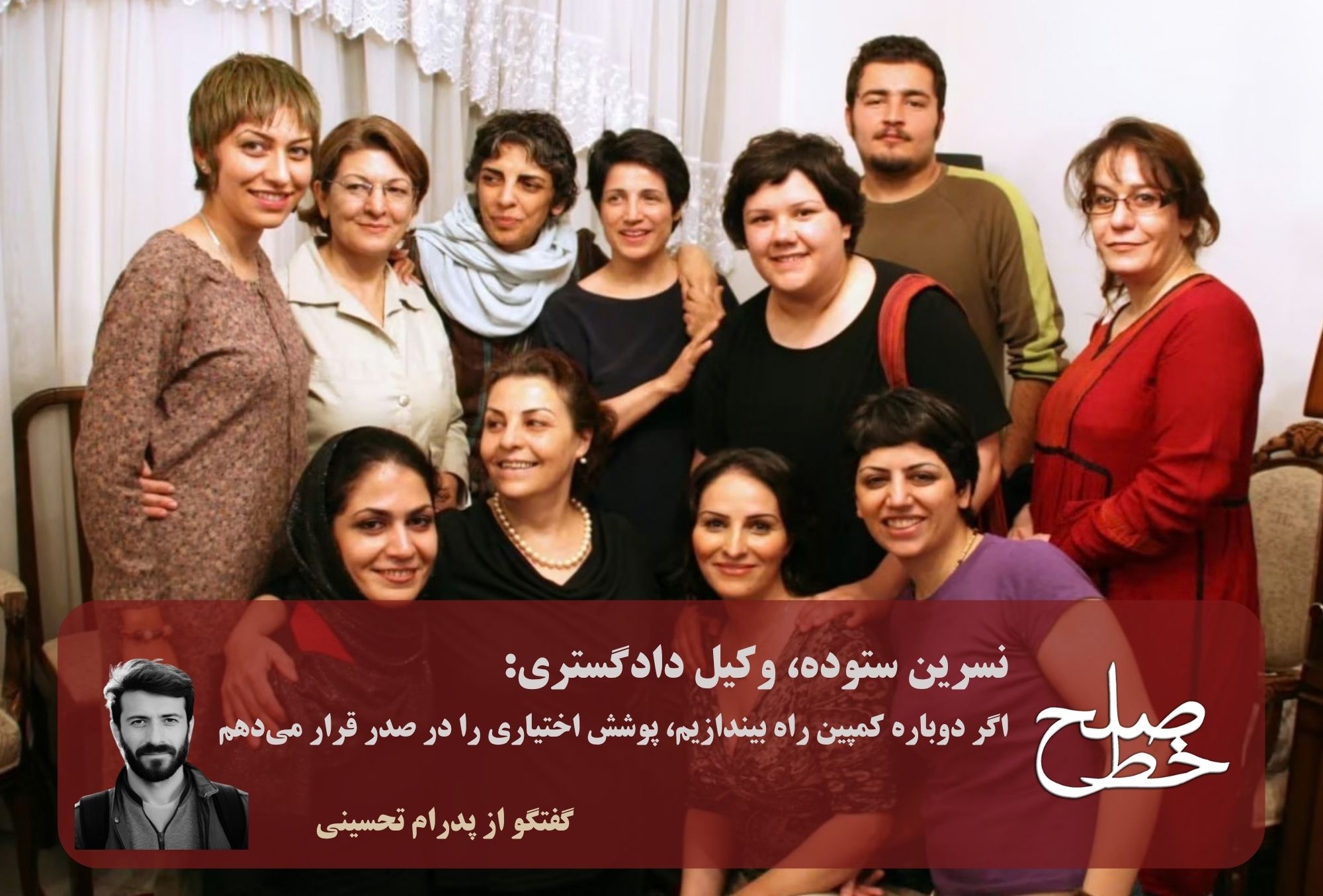
Nasrin Sotoudeh: If We Were to Launch the Campaign Again, I Would Put Optional Hijab at the Top of the Agenda/ Pedram Tahsini
The One Million Signatures Campaign can be regarded as one of the most important and influential experiences of women’s civil activism in contemporary Iran—an experience that emerged from legal demands, entered the public sphere, faced repression, and, despite the cessation of its activities, played a significant role in changing attitudes and expanding women’s demands. What follows is Peace Mark Monthly Magazine’s interview with Nasrin Sotoudeh, a lawyer and human rights activist, about this experience. This interview is not merely a historical review; in a firsthand account, Sotoudeh explains how protests against legal discrimination against women—from polygamy and unequal diya to inequality in the right to divorce and the legal value of testimony—were expressed in simpler language and moved from articles into the streets and families. She speaks about the solidarity of women with different beliefs, the role of lawyers, sociologists, and psychologists, and the importance of men’s support—support that, she says, helped reduce the pressure of moral stigmatization against women and allowed the movement room to breathe. The final part of the interview turns to the present: compulsory hijab, the Mahsa Movement, protests against recent executions, and questions about the future. Sotoudeh emphasizes that society’s tolerance is not unlimited and that the fate of these demands depends on collective action and people’s resistance.
The full interview with Nasrin Sotoudeh follows:
Ms. Sotoudeh, thank you for giving Peace Mark Monthly Magazine your valuable time to speak with us about one of the most important campaigns of recent years—a campaign that, despite having ceased its activities, left its mark. We wanted to ask your view on this. If we go back to the early days of the formation of the One Million Signatures Campaign, how did you become involved with this movement? What was it about the campaign’s idea and method that made you think it could help advance women’s demands?
If we consider 2022 (1401)—that is, the Mahsa Movement—the high point of the women’s movement, then we must look for the roots of its formation and expansion in the 1990s (1370s). This does not mean that there had been no movement by women before then. As you know, immediately after the Revolution in 1979 (1357), women staged many protests that were severely repressed, and under the influence of the prevailing social culture, the movement went into eclipse for a time. But from the 1990s (1370s) onward, I can say that women sparked the women’s movement in Iran by paying greater attention to International Women’s Day, recounting events that had taken place around the world on March 8, and commemorating the day. During those same years, they also paid considerable attention to examining women’s efforts during the Constitutional Movement and before it, women’s role in enlightenment movements, their role in local and national associations, as well as women’s schools and publications.
After that, among the pioneers of Iran’s women’s movement in the post-revolutionary period, we should mention Mehrangiz Kar and Shirin Ebadi, who did a great deal to raise awareness through their illuminating articles on women’s rights. These activities then entered the social sphere, and women began holding scattered gatherings here and there to protest discrimination against women in the law, such as unequal diya, the unequal right to testify, polygamy—which men were permitted—and the right to divorce, which had been taken away from women. In general, all of these were issues women protested. These issues were first widely reflected in articles, and then entered the public sphere and took the form of gatherings. At one point in 2006 (1385), women said that we should form a campaign called “One Million Signatures.” You certainly know what its philosophy was and where it came from, but in fact, we should say that it was a turning point. The One Million Signatures Campaign had reached the point where it was telling official authorities: “You can no longer govern us with those old laws.” The campaign was formed in Iran in 2006 (1385).
I am a lawyer, and my daughter Mehraveh and I signed the campaign. She was only six years old at the time; Mehraveh actually insisted on signing it herself, although, as you know, her signature was more symbolic because she was so young. After the campaign was formed, as soon as girls or women went into the streets to collect signatures, they would be arrested in different cities. There were a number of us lawyers who would take on their cases and defend them in court. In any case, the approach of these women and the lawyers’ defenses were such that although women were periodically arrested, none of them endured lengthy detention for this reason, and they were released. But the repression continued, and the women, of course, were prepared to pay every kind of price. They suffered greatly from these forms of discrimination.
I remember one case in which Maryam Hosseinkhah Foumani, along with eight other women, had been arrested in front of the Revolutionary Court. They had gone there to support one of the women who had been arrested and was on trial that day, and they themselves were arrested. Maryam Hosseinkhah called me from prison and said, “I want you, as my lawyer, to announce that what we stated as our demands in the campaign represents the minimum of our demands. We stand by them, and whatever the cost may be, we are prepared to pay it.” So these were not women and girls who were going to retreat because of this repression.
Ultimately, the campaign continued its work until 2009 (1388). In 2009, amid widespread repression, many labor, professional, and feminist movements went into eclipse, and many activists in these movements were forced to leave Iran. The activities of the One Million Signatures Campaign also gradually diminished. Although it is true that the campaign stopped, as you said, it left its effects behind.
From your perspective, which of the campaign’s legal demands was most closely connected to women’s everyday problems? In your professional experience, where did you see the greatest need for change?
I think polygamy was one of the worst issues, one that truly tormented women psychologically and emotionally. Men were unconditionally permitted to live however they wanted, to live completely without restraint, while that same society and that same judicial system subjected women to the harshest moral pressures—from the hair on their heads to cases in which, for example, a woman was found to have had a relationship with a man. Well, you know that in traditional societies, attitudes toward the taboo of relations between women and men are worlds apart depending on whether the person is a woman or a man. So what I mean is that polygamy, just as it fundamentally encouraged men to pursue a way of life contrary to the interests of the family, also subjected women to repression.
The “One Million Signatures” Campaign sought to present women’s legal demands in simple and comprehensible language. In your view, which forms of discrimination were more difficult to explain, and why? Was there an issue that, because of its legal complexity or cultural and familial sensitivities, was harder to translate into everyday language? Also, do you remember a woman whose perspective on her own life changed after becoming familiar with the campaign’s demands—someone who came to understand her rights better or made a change in her everyday decisions or behavior?
Yes, I saw this repeatedly. My family roots are in northern Iran; we are from Langarud. So I travel frequently in the north. I remember that from the time the feminist movement in Iran gained momentum, every time I traveled north, among women who were relatives, acquaintances, and friends—in large and small cities as well as villages—I could see that they had moved one step forward in their demands.
They would complain to me that their husbands had now transferred land into their sons’ names—something that might have seemed perfectly normal to them ten years earlier, but I could see that it was no longer normal to them. They were making demands about these things and asking for their rights. They would say, “We have rights in these matters, but all of this is going only to our sons.” That is one example I can give you, but there were different kinds of approaches. I witnessed firsthand how women were advancing step by step alongside this movement.
There is a serious gap between being aware of a right and being able to pursue it. What did the experience of the “One Million Signatures” Campaign show you about this gap? In your view, what other forms of support did women need in order to take this awareness from the level of thought and conversation to the level of action and decision-making in their everyday lives?
I would have liked to answer your question by saying that women did not need any support at all and were sufficient on their own, but that really is not the case. Our society is patriarchal, but we had one very important cultural factor: a number of our men were truth-seeking, genuinely democratic, and committed to equality. I simply cannot overlook that.
Let me say this plainly: if it had not been for their support… Consider the determination involved. I had seen women whom nothing could stop. But when men stood behind this women’s movement, the movement suddenly took a breath. It was as though a current of air began flowing through the movement. It was as though women became freer and could finally breathe. They were being freed from moral stigmatization.
For example, I remember that among my own clients, Jelveh Javaheri and her husband, Kaveh Mozaffari, both worked side by side in the campaign. There was also Payam Roshanfekr, Arash Eghbali Nasir, Ali Abdi, and Amir Yaghoubali. Some of them were single. Mr. Keyvan Samimi also stood very sincerely behind the feminist movement. I remember that during the interrogation of one of my clients, the interrogator said to him, “Fine, the women go and become activists, but why did you join this movement?” He replied, “What do you mean, why did I join the movement? This movement has legitimate demands.” He defended the movement and said, “Whatever sentence you give me, I will serve it.”
I would also like to mention my own husband, Reza Khandan, here again, and then Dr. Farhad Meysami, and how he stood firm in protesting compulsory hijab. My husband is also currently in prison for protesting compulsory hijab, and so far he has served two years in prison for his protest, as has Vahid Ghadiri, and other men. Many men and women… We had women who, after Ms. Ebadi and Mehrangiz Kar, were pioneers: Noushin Ahmadi Khorasani, Parvin Ardalan, Mansoureh Shojaee, Khadijeh Moghadam. All of them were pioneers in bringing the women’s movement into the public sphere.
So these forms of solidarity—with men, with lawyers, with sociologists and psychologists who were all present in the movement, as well as the unity and solidarity among women themselves—helped us try to reduce the limitations. For example, we never commented on whether a woman wore hijab or did not wear hijab. We were free in our own choices, and this did not create distance between us. All of these things contributed to our unity and empowered us. The most important source of our strength was that unity.
Even with this unity, we still needed support. In fact, we both gave support and received it. We genuinely worked to gain men’s support, so that they would become aware of our rights and support us. They came to believe in our sincerity.
We created factors that united us. We would say, “It does not matter whether my perspective is communist leftist or this woman’s perspective is religious and Islamic; here, we only want to talk about women’s rights.” They approached it in the same way. In fact, many women who came wearing chadors participated in the feminist movement and believed that our beliefs should not separate us from one another; I saw this firsthand in their behavior.
Among the characteristics you mentioned was the collaboration of people with legal expertise and volunteers with various other forms of experience who supported the campaign. What impact did this collaboration have on the way women’s demands were articulated? Did encountering women’s accounts make any issue clearer to you as a lawyer?
Yes. On the one hand, women were caught in a state of confusion. To understand what kind of situation we were really trapped in, let me take you back to 1991 and 1992 (1370 and 1371)—years when people said men could marry as many women as they wanted: four permanent wives and an unlimited number of temporary wives! Women had to be this way and that way, their hijab had to be such and such. Everything was full of restrictions. Even for a woman to work, she needed her husband’s permission; the same applied to going out—for everything.
Well, all of us come from cultures in which we want to abide by the law and, as far as possible, avoid breaking it. A woman who has grown up in this society thinks to herself: “What does this law say? It has taken everything away from me, and yet I am still required to obey it.” You see, this creates a mental challenge for the person hearing it. Her human rights are violated, and then she is told it is “in the name of the law”—a law that is supposed to protect her rights, while that very law violates them. Women were mentally trapped in such a bind.
People like us who stood beside them first reassured them that what they were feeling was valid, and that what was written in the law—such as polygamy, the unequal value of testimony, unequal diya, and all these things—was contrary to the principles of equality, the equality that underlies law and rights. In other words, we said that we were challenging the law. And once again I must say that it was Kar and Ebadi who had the courage to do this. They challenged the law, not individuals.
In other words, Mr. X or Y might go and act under that law and take four wives, even though he could not support any of them. Without attacking that man, our criticism was directed at the law that gave him such permission. That was why the One Million Signatures Campaign to change the law was created. The process that took shape… You can see how structured it was. In my view, this process advanced in a structured way for almost twenty-five years until we reached the point where we said: “Yes, you must change the law itself. We will gather one million people so that the law will change.”
So first of all, women emerged from that confusion in the face of the law, which had been treated as something sacred, and arrived at the concepts of justice and equality. These are higher concepts; in other words, the purpose of law itself should be to realize them. Law must provide equality and justice, whereas those laws did not provide justice and equality. Then we entered the campaign stage, and that stage has continued to this day.
You also saw the issue of compulsory hijab. For years, women resisted compulsory hijab in public spaces and in the streets and expressed their anger. Every day we encountered reports of women screaming—of how they screamed while being arrested—and our collective social psyche was shattered. We constantly waited for the government itself to stop enforcing this law. Now, all the better that women themselves obtained this right: the right to optional hijab. Since they themselves obtained it, they themselves must also protect it. No one can easily say whether we will return to the previous situation. That depends on women’s confrontation with a government. If we stand firm and protect this right, we will not allow the previous situation to return.
Given the current circumstances, public awareness, and generational change, it seems unlikely that those previous conditions will return—at least not so easily…
In my view, of course, that is more of a slogan. We can certainly repeat that slogan, but within it there is a kind of prediction about the future. Whereas, as an activist, I prefer to attribute the future outcome to our collective action. I prefer to say that we will not allow them to do such a thing, and in order not to allow them to do it, we must stand firm.
During the campaign, were there people within the government or the system—even within the judiciary—who were supportive, or at least expressed sympathy? Or did they agree but say, for example, that their hands were tied? Were they actually able to take any practical steps in support? Did you see any supportive action from within the government?
Since I have no connection whatsoever with people inside the government, I really cannot comment on that. But one example that occurred two years ago concerned the Hijab and Chastity Bill. After all, the current president, Mr. Pezeshkian, said that we cannot implement this law.
Or when I was in prison about fifteen years ago, I had become involved in a dispute with prison officials over the requirement to wear a chador during visits. Visits had been suspended for months, and my children were very young at the time. Some members of parliament at the time said, “No, we should not force women to wear floral chadors.” So these things did happen.
Or Ms. Parvaneh Salahshouri, when she herself was a member of parliament—and that itself was important—expressed the view that we should put the hijab law to a referendum. Well, they could have done these things, but the will was not there. They did not want to, and that [law] had in a sense become a means of creating fear and intimidation in society. People within the government were not entirely without influence either. After twenty years… yes, I think we cannot say that it had no effect on the government whatsoever. It certainly did.
The inequalities you yourself have mentioned have become so intertwined with people’s everyday lives and so normalized that they appear unchangeable. In your view, to what extent was the campaign able to open up conversations about these issues within families—even between women and men—particularly in more traditional sectors of society? Of course, we do not necessarily mean that change had to occur; if you have a memory of this kind, please share it.
I do not agree with that assessment. Why? Because I have seen it many times among them. One example was at Bu-Ali Sina University in Hamedan. One day I gave a talk there about these very rights of women. Our analysis was always legal. That day, too, I spoke about women’s rights under the law.
After the session, a female student came up to me wearing full hijab—exactly as the government expected. She had apparently liked my talk. She expressed her appreciation and said, “It was very good; we learned a lot.” But at the end, with some fear and trembling, she asked me a question: “Ms. Sotoudeh, are you a feminist?” She could not believe that I was a feminist.
I told her, “My dear, I do not know what you mean by ‘feminist.’ But if you yourself object to unequal diya, then in that respect you are a feminist. I am a feminist too; I object to unequal diya.” When I said that, she felt at ease. I knew what had happened. In those days, among our religious communities, there was propaganda saying that feminists were this and that, and they would immediately connect it to sexual matters, claiming that feminists wanted to have four husbands just like men! Naturally, we did not accept any of this talk at all, nor were we afraid of it.
I knew that when she asked me that question with such fear, she had a particular image of a feminist in her mind. So I explained the concept of feminism to her and said, “If you object to any form of legal inequality, you are a feminist.” After that, she seemed to feel more at ease and left. What I mean is that this woman, who was also a university student in a relatively large city such as Hamedan, belonged, in my view, to traditional society, but she was examining her own ideas, which is why she asked me that question. So I have seen many similar encounters among people with traditional views. Yes, it was therefore effective.
If you were to reread the campaign’s demands today, which parts would still remain priorities, and which issues require greater attention? What have women’s experiences over these twenty years added to our understanding of legal equality?
I think that if we were to launch the campaign again today, I would put optional hijab at the top of the agenda. Of course, I would also raise all of those demands again; all of them were valid. I would put optional hijab at the top because, in fact, they began violating our rights by imposing compulsory hijab. We are now running this path, this film, backward, and we want to reach the point where we remove their final achievement from our lives.
In fact, hijab was something that was extremely difficult to confront for many years because of the moral taboo it carried with it. If a woman expressed a desire not to wear hijab, she was regarded as an immoral person. But that is no longer the case. So if I were to return to that campaign, I would add optional hijab. It was not possible at the time. Twenty years have passed since then, and today it is absolutely necessary.
Thank you very much for giving us your time. If there is anything else you would like to add, please do so in closing.
We went through years in our society when every day we heard the screams of girls and women as they were being arrested. We knew they were being taken to Vozara Detention Center and subjected to severe violence. We had heard many accounts from them, and this had devastated the psyche of society, both women and men. Time and again, even some clerics said that the government should stop doing this. Many times. Women had shown that they were willing to pay any price to reclaim the right to optional hijab, but the government paid no attention until it led to the Mahsa Movement.
What is happening now with the executions—the fact that every day and every week, at regular intervals, we hear news of death sentences being issued against our young people—reminds us of the same psychological devastation we endured in those days from witnessing violence against women. This tolerance is not infinite; this tolerance is not unlimited. At some point, something, some spark, will truly move society in a direction where it will stop these executions as well.
If the government does this, it will work to its benefit; and if the people stop these executions, then that is the people’s right. I do not know. I hope they obtain this right and that these executions simply stop.
 Created By: Padram Tahsini
 September 23, 2026
Tags
Compulsory hijab Mahsa Amini Peace Line 185 Revolutionary Court Woman Women's rights Women's rights activists