


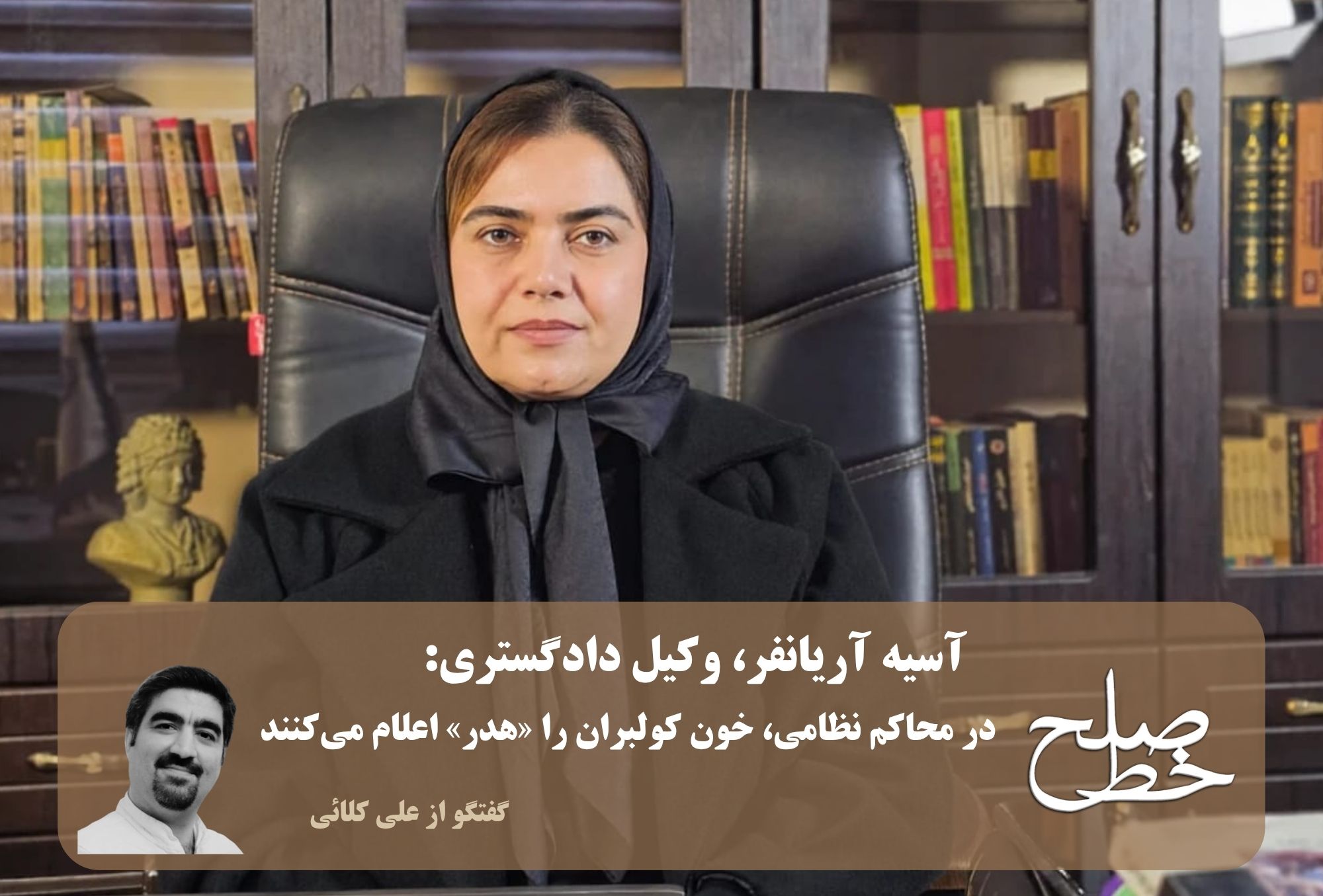
Asia Arianfar: In military courts, the blood of kolbars is declared “wasted” / Ali Kalai
The shooting of Kolbars in the western border regions of Iran has raised serious questions about the right to life, the limits of the powers of armed officers, and the right of victims to seek justice for years. Although the Law on the Organization of Border Trade has set a framework for some of the activities of Kolbars, the shooting of Kolbars and the difficulty of prosecuting them remains a matter of controversy. United Nations experts have also recently expressed concern about the continuation of these killings and reported new cases of shooting without warning, emphasizing that suspicion of smuggling is not a license to use firearms.
To investigate this issue, Peace Line Monthly spoke with Asiyeh Arianfar, a lawyer at a court in Piranshahr and a member of the West Azerbaijan Province Bar Association. Drawing on her experience in representing dozens of cases in this area, Arianfar discusses the rules of shooting, the responsibility of officers and commanders, the performance of the Border Regiment Accident Commission, the issuance of a restraining order, and the difficulty of demanding blood money. She also discusses the practice of some courts in considering the blood of kolbars as “waste,” the lack of impartial proceedings, and the need to reform the law on the use of weapons.
The following is a detailed interview between the monthly magazine Khat Sohl and Asiyeh Arianfar, a lawyer at a court in Piranshahr and a member of the West Azerbaijan Province Bar Association:
Can we say that kolbari has been legalized according to the “Law on Organizing and Monitoring Border Trade (Kolbari and Sailors) and Creating Sustainable Employment for Border Residents”?
No, kolbari is not legal. It is not a job that has been legalized.
One of the issues that kolbars face is the issue of being shot at. This is a reality that is happening.
I want to make a distinction regarding the shooting of kolbars. Sometimes, people are allowed to move a series of goods from a neighboring country to the Iranian border from border points as kolbars. This traffic is carried out through authorized and legal routes and borders and has a legal permit. There is no case or problem with this. Those who are shot at are those who are crossing unauthorized borders. That is, people who are trying to smuggle goods. The border regiment is also there. Border regiment officers are given permission to shoot there. That is, shooting is when goods enter the border illegally and illegally.
What is being discussed about the Kolbari and the shooting of them is actually referring to these illegal movements. Is that correct?
We also have legal kolbari. As I said, sometimes cargo is unloaded from across the border and people bring it to the loading point. This is legal and it crosses the border legally. These goods also go through their own customs procedures and formalities at the border. There is no problem here. People also receive money for this movement. The problem of these people is completely different from those who cross illegally and over long and sometimes difficult routes. This is the type of kolbari that is most often shot at.
Are the relevant regulations, such as the “stop, warn, and necessity” regulations, observed in these shootings? The regulations that exist in the Law on the Use of Weapons. What laws do we have in this area?
We have laws governing crimes committed by the armed forces. In those laws, there are provisions regarding shooting by officers, both inside the country and at the borders. That is, shooting at those who enter the country illegally and shootings that occur inside the country by the armed forces. This law is general and is not specific to legal borders and unauthorized and illegal movements.
In response to your question, whether the regulations are being followed? Do you think the law is being followed in a place that is difficult to cross, has hills and valleys, and the officers are inexperienced and inexperienced? Sometimes there are also adverse weather conditions. In any case, it is mainly mountainous areas. Do you think it is possible to comply with the legal provisions? We can definitely say no. That is, in most cases, these issues are not being followed.
Of course, a transparency system has recently been put in place. Part of my own work is also in military courts. The military courts are where complaints are filed against officers who have shot at people. Whether this shooting was against people who were illegally traveling and entering or leaving Iran’s borders or against other people. If, according to their own laws and hierarchy, they should warn the other party and shoot when the other party does not listen or pay attention. Whether this is traveling inside Iran or outside Iran. These cases of officers shooting at people are investigated and handled by military courts. I have had cases in this area.
A series called “Nun.Kh” was aired in Iran. In its fifth season, the topic of kolbars was raised and a positive image of kolbars was shown, who help and deliver medicine to children with cancer. This is exactly the kolbar that travels through difficult routes. You spoke of two types of kolbars, one legal and the other illegal. Can you explain more?
I live in Piranshahr, which is a border city. That’s why I know about this issue. As you said, there may be special procedures and regulations, but I haven’t seen them. At this point, I can say that people, both men and women, are allowed in this area. People who may not be in a bad financial situation and can barely make ends meet. But they say that we go and do something and it’s better than sitting at home idle. They go and pick up goods when unloading and deliver them to the other side of the border for loading. If this is the definition of a kolbar by the Islamic Republic, then this is not a special job. So far, no one has complained, been injured, or been shot. But we definitely don’t talk about this issue and it’s not our topic.
We have another issue that is controversial. The issue of the fact that several people who were Kolbars were killed. Their spinal cords were severed and their limbs were mutilated. We have heard this many times. This is the Kolbar that the humanitarian and international community has in mind. Not the Kolbar that the Islamic Republic has defined for us. That is, these are the people who are shot. These are people who enter or leave the country illegally. That is, they mainly leave the country to receive goods and go to a neighboring country and enter to import goods. The officers also shoot these people. The issue of unauthorized movement across the illegal border has its own definition and its own punishment.
The point is that according to the opinion of the UN experts in a statement published in September 2026 by the UN High Commissioner for Human Rights, suspicion of smuggling is not a license to use firearms. You say that these are smuggled in and out. We also have a law on the use of weapons in Iran and these people are shot. How contradictory do you think these are?
We have a law in this regard. Suppose a person wants to leave the country empty-handed and enter with full hands and with sex. This person must have a passport and leave and enter through legal authorities. Otherwise, the officer has a duty according to the law and the discussion of how to shoot. That he must first be stopped. If he does not pay attention, you can shoot in the air. These are in the law on how to use weapons. If he does not pay attention to the air shooting, you can shoot him from the waist down. If he does not pay attention again, you can shoot directly.
Well, in these difficult conditions and despite the natural ups and downs, when you stop someone, they may run away. We also have adverse weather conditions. Also, most of the people who are sent to the border to guard the border are usually not skilled shooters who want to take aim and follow the rules. They are also mentally and physically isolated in those remote areas and far from their families. Most of my defenses are based on these issues, and I emphasize that they are mainly not accepted in military courts and courts. Now the question is, can someone who is mentally and physically under pressure from being away from their family comply with the provisions of the law? Are these people in a normal situation to consider such issues? It is unlikely that this will happen. Mostly, these cases happen in the dark, and this also adds to the cause. In these circumstances, those officers cannot abide by the laws, and we do not have law enforcement there.
The question is, is this shooting legal or not?
No.
How can this be investigated? Which competent judicial authority can address these issues and establish the officer’s responsibility?
We have the Border Regiment at the border posts. There, we also have a commission called the Border Regiment Accident Commission. These are their own experts. They are a five-member board, mainly consisting of military ranks such as colonel, and they investigate the situation. What the situation was like, was it dark or not, what time it was, how many people wanted to enter or exit, how many officers were in charge and on guard, which officer was with them, and who was the commander at the time. Here they say that according to a certain officer who was at the scene, he saw these people (pullers) and stopped them, and they did not pay attention and were forced to take the next steps. That is, what is in the law on the use of weapons. Article 3 of this law says all these things. They also say that our officer came and complied with all these things. But what happened in the end? The person who wanted to cross the border did not pay attention and the officer was forced to shoot. Or another issue that I have seen repeatedly in the cases is that they say that these people not only did not pay attention to our officers, but they also attacked them. That is, these people (the kolbars) had weapons and shot at the officers, and the officers (the soldiers at the border) were forced to defend themselves. That is, if we compare ten cases in the Border Regiment Accident Commission, their points are similar.
This is one side of the story. What about the other side, the injured and shot Kolbar? Will these accounts be taken into account?
Unfortunately, no. The one in charge of investigating this issue and determining whether or not the officer was at fault is the Border Regiment Accident Commission, which is itself a subsidiary of the Border Regiment. Can this commission be impartial?
So you see the lack of an impartial institution and commission as a problem here?
Yes. Now, when we object that your commission cannot be impartial and should be an impartial authority, they come and appoint an expert. Of course, in most cases they do not pay attention at all and do not appoint an expert. But in some cases they do appoint an expert. This expert will express an opinion, which is mostly not considered a criterion for opinion. Perhaps the expert will come and object that the bullet that hit the person was fired from close range or that it does not seem at all that the defenses that the officers wrote are acceptable and correct. I have seen the opinions of weapons experts. There was even a case where this expert found the officer guilty. But then we have the issue of the prosecution and military courts. These prosecutions and courts are specialized and only deal with specific crimes committed by the military. They are not impartial either. This means that even if an impartial expert is appointed, the judicial review authority is not impartial.
I have had cases in the prosecution and military courts in both Kurdistan and West Azerbaijan provinces. In these two provinces, we have two different approaches. I have been a lawyer for thirteen years and have had cases in the prosecution and military courts since 2014. In West Azerbaijan province, I have not seen the military prosecution issue a guilty verdict for the officer who fired the shot in the cases I have been involved in, even for one case. In all the cases and cases in which I have been a lawyer, a restraining order has been issued for the officers. However, there have also been cases (from Kurdistan province) that have been sent to me for study. In them, I have seen a guilty verdict and an indictment issued. In these two provinces, I have seen two different approaches to the investigation, which I do not know where they come from. However, in West Azerbaijan province, I have not seen a guilty verdict and an indictment issued for the officers. What I said is, of course, personal experience.
What rights do the victims’ families have to complain to the officers and demand blood money or compensation?
The victims in these cases have legal heirs. Those legal heirs have the right to come and file a complaint and prove the officer’s guilt. Look! Someone was killed. An officer committed a murder, and the murder is a clear example of this. Who should come and prove the officer’s guilt here? The heirs who were not there and cannot come and prove anything. What is certain is that a murder occurred and it has been proven. Now the officer must come and defend that his action was legal. But what do they do? They say that the principle is that the officer is not guilty and it is you who must come and prove the officer’s guilt. Maybe they will come and point to the principle of innocence. But the principle of innocence is for when the fact of the murder is in dispute. Or, for example, you have arrested someone on suspicion of murder and no one saw the murder and he himself did not confess and there is no other evidence against him. Here, the principle of innocence prevails. But where it is certain that an officer killed someone, that officer must come and say that I committed the murder, but I observed the legal hierarchy according to these legal clauses. But here, the prosecutor’s office and the Border Regiment Accident Commission support the officer and the officer does not need to do anything in principle. That is, the officer is guaranteed here. When someone is supported and guaranteed in every way, why should he be cautious? He shoots very easily.
Because nothing happens to him?
Nothing will happen to him and he has his back to the judicial system and the commission investigating the crimes. This officer does not feel any danger here.
Of course, I have to add something. There is also the issue of the weather conditions of the place and the prevailing atmosphere and the fear that is imposed on the officers. Because they have weapons. Or the courage they find, because there is no one there and it is just them. Sometimes there is a volley of shooting. That is, you see three or four people (colbars) who have been shot three or four times each. At the very least, these people (colbars) have been shot two or three times. That is, the result of the shooting is a volley that injures those people (colbars) in this way.
In this shooting, apart from that officer, can his command hierarchy also be held legally responsible?
One hundred percent. Here we have two different issues. There is a place where the officer claims that he acted based on the necessity he himself recognized. Usually, these people have a commander in groups of three or four people. That is, one of the members of the group is responsible for commanding the military group at the border, who is also higher in terms of military rank. He usually gives the order to shoot.
Does that mean the officer doesn’t shoot the resident first and gets the order to shoot?
There are limited cases. Agents go in small groups of three, four, or five and ambush. One of those agents is the leader of that group, and the others take orders from him.
Based on this, can that leader and head of the group be held responsible?
Here we have the issue that when an officer pays attention to and acts on an order from his superior, he must determine whether that order is legal or illegal. If the officer knows that the order is illegal, he should not obey. But if he determines that it is legal, he must obey. If the order from his superior is clearly illegal, the officer who acted on this illegal order is also responsible. It is not the case that he is not responsible because he acted on the order. That is, the officer can obey the illegal order of a lawful superior. These matters are explained to them before they are sent on a mission, and they have certainly had a training course.
What about the criminal liability of others, such as higher officials?
We have two parts. One is criminal liability, which is directed at the attacker and the person in charge. That is, the people who were involved in the operation are criminally liable, and a lawsuit is filed in the prosecutor’s office against these people, the officers who were present at the scene, to prove criminal liability. However, if the officers’ guilt is not proven, the organization itself is civilly liable for paying the blood money. If a restraining order is issued for the officers, that restraining order can be appealed. The appeal is under the jurisdiction of the Military Court II. They hold a hearing and most of the time they do not invite a lawyer to hear the appeal. They handle the case themselves, which is also approved there and ultimately a restraining order is issued. Here, the legal heirs have another opportunity to come and demand blood money. Based on Article 631 of the Criminal Procedure Code and in the form of a blood money demand, they request that the case be sent to the court to hear the blood money request and pay it.
Based on your experience, how often have these requests been answered?
After the officers issue a restraining order, another story comes up. They come and make strange arguments. Their argument is that this gentleman and this person, knowing the danger, entered the forbidden border area and at any moment there was a possibility that he would be shot. So his blood was wasted.
Does that mean that the blood of the murdered Kolbar will be declared wasted?
Yes, this is how it is announced in military courts.
Is there any basis for this? To declare a human being’s blood wasted?
Yes, in military courts, at least in our province (West Azerbaijan) and in the cases I have had – 55 cases that I have worked on so far – this has been the case. A restraining order is issued for officers. It is the prosecutor’s office, military courts, and the judicial organization of the armed forces that issue the restraining order. Their argument is that, firstly, a restraining order was issued for officers, despite the objections of the legal heirs, and it was confirmed in court. Secondly, that it is a prohibited border area there. It has already been notified to all residents of the border areas. It has been issued many times. So the principle is that people are aware and enter the prohibited area knowing the danger. They themselves have already foreseen that they may be killed there. We have the principle and rule of action here. When a sane and mature person enters a prohibited area with knowledge of the danger, they themselves have created the conditions for shooting themselves and are at fault. The organization is not responsible for paying their blood money.
Unfortunately, the argument is this. If I put ten verdicts together, they are all copied from each other. That is, it is not like they come and handle these cases in an expert manner. Most of the arguments are similar. The text of the verdicts is also similar most of the time. The judges are also similar. That is, if you look at ten cases, the same judge came and ruled in each of the ten cases.
Interestingly, recently I have seen several of these judges who, after retiring from the Armed Forces Judicial Organization, have come and applied for a lawyer’s license, and they have been granted this lawyer’s license. That is, someone who declared the blood of people as wasted in his rulings comes and wants to defend these same people as a lawyer. So you can see the contradiction, where it leads.
So what is their job?
We have an article in the Islamic Penal Code that says that in cases where the officer is not guilty and the person killed is innocent, the blood money must be paid by the treasury. The conditions of the military courts that I explained are that they do not pay. We come and file a lawsuit against the treasury in the general courts in the form of a petition. That is, after the military courts have gone through the stages and we have not succeeded in collecting the blood money, we come and file a lawsuit in the general courts. There is also the possibility of receiving blood money, but again, the decisions are based on taste and the judge makes decisions based on taste. Some judges say that the least we can do for the person killed is to pay the blood money to his heirs. The Ministry of Justice is responsible for paying the blood money. Some judges come with the same mentality as the military court and repeat the same reasoning as the military court and rule that the case is unjust. That means we have two different approaches there too. Some are able to collect blood money from the Ministry of Justice, while others are unable to receive blood money due to the courts’ arbitrary decisions.
Do you see in this judicial system a will to handle these cases fairly and impartially and the minimum requirements to maintain the independence of the judicial institution?
Not at all. Not at all. Let me tell you from my own personal experience. Maybe other colleagues and lawyers have different experiences. I was in a hearing on a case. We had demanded blood money on behalf of the Martyrs’ Corps of the province (West Azerbaijan). This was the only case where I had received a ruling from the first instance branch to pay blood money. In the hearing in the appeals court, the representative of the Corps did not need to speak at all. That is, I, the plaintiff’s lawyer or, so to speak, the defendant’s lawyer, was accused there, and the judge was questioning me on behalf of the Corps. What does this mean? When the representative of the organization itself is present there, why should the judge come and try me, the party demanding blood money? I felt that I was the defendant in the case there. I will not think about your answer. At least in military courts, we do not have impartial proceedings.
Given the situation you are directly facing, do you think we need to change or amend the Law on the Use of Weapons or other laws to change this situation? To make institutions more accountable and at least the processes lead to compensation and the situation improves somewhat?
The country is in their hands. The law, the judicial system, and the legislative assembly are all in their hands. They can easily pass or amend new laws. Their hands are very wide in this area.
We have illegal crossings, and yes, this is illegal. But if someone is crossing illegally, if it is possible to arrest them, you can eventually arrest them. But if you can’t arrest them, you should let them go. This is better than trying to kill them. Because your opponent is a human being. Isn’t a human life much more valuable than killing them at the cost of not crossing the border? Well, let them cross the border and go. That this law, which in the last stage allows direct shooting at officers, should be removed. Because you don’t need to kill a human being to prevent them from crossing the border. Do we have anything worse than killing a human being?
This is due to the specific situation in the region.
You see, in some borders, like Sardasht, the borders are intertwined. That is, there are two villages on both sides of the border that travel together. They are related to each other. Many of their shepherds come to this side of the border to graze their sheep. The same thing happens from this side to the other side of the border. This border traffic is very normal in these areas. Well, in this situation, let this person cross the border. This is better than killing a human being. And then the punishment for unauthorized movement is not murder; ultimately, the punishment in case of arrest is a month in prison or a cash fine. We need to prioritize. A human life is much more valuable than these words. The last resort is not killing a human being, and this can be corrected.
Thank you for your time in providing the Peace Line monthly magazine.
 By: Ali Kalaei
 October 23, 2026
Tags
Ali Kala'i Asia Arianfar Border Border guard Fuel smuggling Fuel tester Kulbar Kulbars Kurdistan peace line Peace Line 186 Sistan and Baluchestan Sukhtabar Uncontrolled shooting ماهنامه خط صلح