


Latest Posts

Superstition in the guise of benevolence; Conversation with a prayer writer/ Reza Dehlavi
Fortune-telling and divination, with claims of using supernatural powers or offering pseudo-scientific advice, are phenomena that have become very common in Iran, to the extent that people with different beliefs and educational backgrounds turn to them for solving their problems. These individuals often claim to have the ability to reveal information about the future or […]...
Read More Created By: Reza Dehlavi
 March 21, 2025
Nowruz and the ailing economy of Iran; conversation with Sohrab Delangizan, university professor/ Azar Taherabadi
The Iranian economy has faced serious challenges in the final months of 1403, challenges rooted in structural factors and recent developments. High inflation, devaluation of the national currency, and economic recession are among the issues that have directly affected people’s purchasing power. In this regard, we sat down with Sohrab Delangizan, a full professor of […]...
Read More
Created By: Azar TaherabadMarch 21, 2025
“Organizing Greater Tehran or Relocating the Capital?; A Conversation with Dr. Mohammadtaghi Rahnamayi / Pedram Tahsini”
The transfer of the capital was one of the topics that has been discussed since the beginning of the fourteenth government and by the President, in order to create a platform for a specialized discourse about this important concern of the government and the people. Supporters and opponents of this idea have expressed their opinions […]...
Read More
Created By: Padram TahsiniFebruary 19, 2025
Taqi Azadarmaki: Relocating the capital is a wrong and self-serving project/ Ali Kalaei
For decades, the issue of transferring the capital in Iran has been raised and each time this discussion ends without any clear results, it is pushed to the sidelines. Tehran, as the center of political, economic, cultural, and other activities in the country, faces numerous problems such as overpopulation, air pollution, and concentration of major […]...
Read More Created By: Ali KalaeiFebruary 19, 2025
Ardeshir Pisheng: The diversity of mother tongues in Iran is an opportunity, not a threat/ Azar Taherabadi.
Iran is a land with a wide range of linguistic and cultural diversity. Mother languages such as Kurdish, Persian, Turkish, Arabic, Balochi, Turkmen, Gilaki, Mazandarani, and others are not only a part of the country’s historical identity, but also serve as a bridge for cultural interaction, scientific development, and regional diplomacy. While some may see […]...
Read More
Created By: Azar TaherabadFebruary 19, 2025
The Supreme Council of Cyberspace Acting Against National Security An Interview with Alireza Bozorgmehri/ Pedram Tahsini
Alireza Bozorgmehri, a former member of the Digital Economy Working Group at the Ministry of Economy, spoke with Peace Mark Monthly Magazine about the filtering environment in Iran and the obstacles to its removal. According to Bozorgmehri, until the composition of the Supreme Council of Cyberspace changes, there is little hope for the acceleration of […]...
Read More
Created By: Padram TahsiniJanuary 20, 2025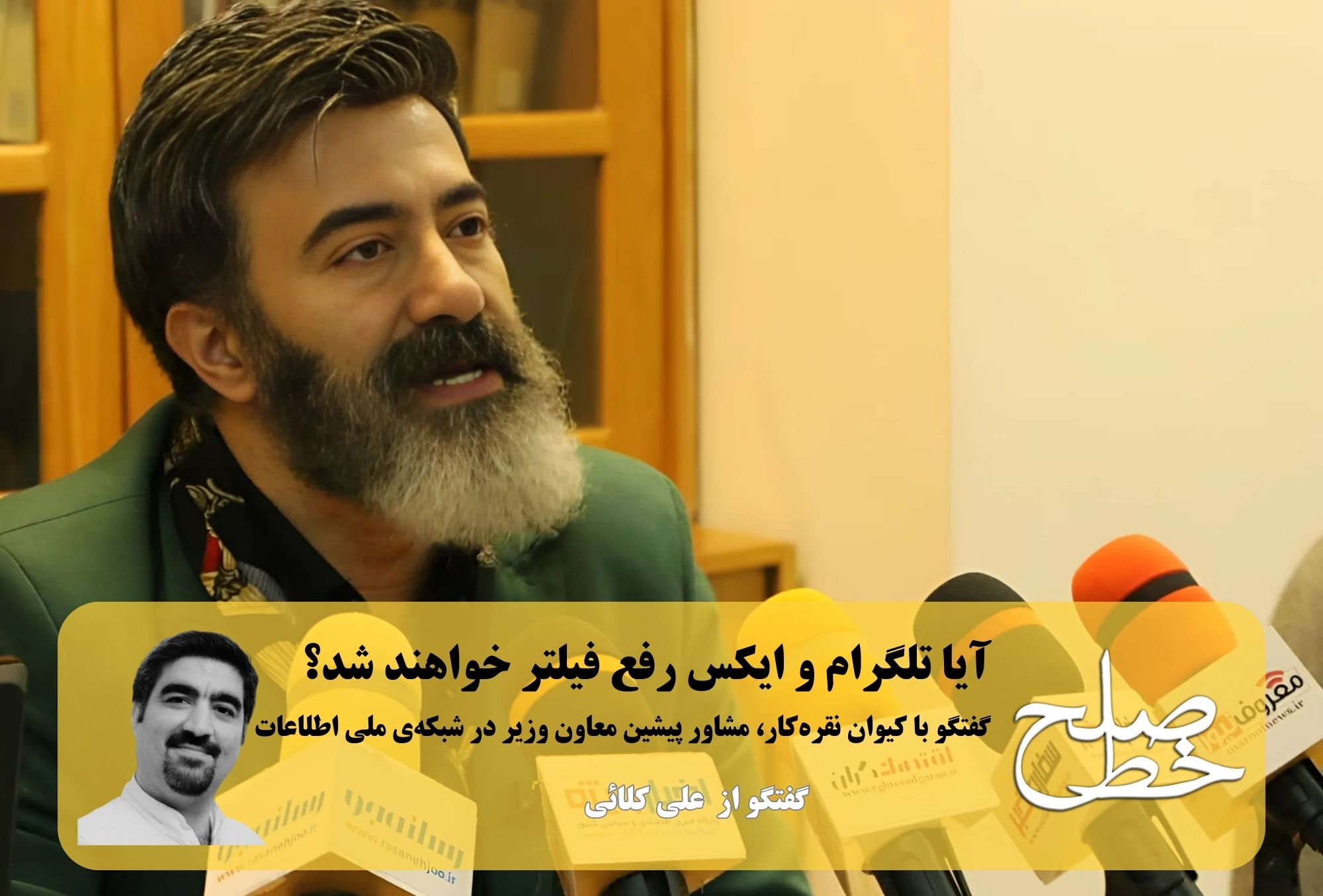
Will Telegram and X Be Unblocked? An Interview with Keyvan Noghrehkar/ Ali Kalaei
The issue of filtering and removing restrictions on various internet platforms has been a highly debated topic in Iran over the past few years. While the Minister of Communications has stated that lifting the ban on all platforms is on the government’s agenda—and recently, WhatsApp and Google Play were unblocked—public opinion and observers are left […]...
Read More
Created By: Ali KalaeiJanuary 20, 2025
An Interview with Citizens on the Daily Impacts of Internet Filtering/ Dina Ghalibaf
Internet filtering in Iran has become one of the most complex and serious social and economic issues. This policy has not only affected citizens’ daily lives but also challenged public perceptions of trust and transparency in governance. In this report, we visited Enghelab Street, one of the busiest areas in Tehran, to speak with various […]...
Read More
Created By: Dina GhalibafJanuary 20, 2025
Energy: A Commodity or a Political Tool? With Dr. Hashem Oraee, Professor at Sharif University/ Pedram Tahassini
Dr. Hashem Oraee was born in 1957 (1336) in Mashhad. In 1974 (1353), he left for England to continue his education and earned his Ph.D. in Engineering from Cambridge University in 1985 (1364). He is a recipient of the “Pochu Brodsky Prize” from Churchill College at Cambridge University and the “Institution of Engineering and Technology […]...
Read More
Created By: Aban RayDecember 21, 2024
Mohammad Sadegh Mehrjou: Up to 70% of Power Plant Gas is Emitted and Wasted/ Ali Kalaei
Power outages, energy imbalances, and their resulting hardships have become one of the country’s most significant national challenges. The nation is grappling with air pollution, power outages, and cold weather, with the issue of energy imbalance frequently arising. In the midst of this, national energy policies and planning, along with their economic, social, and environmental […]...
Read More
Created By: Ali KalaeiDecember 21, 2024
