


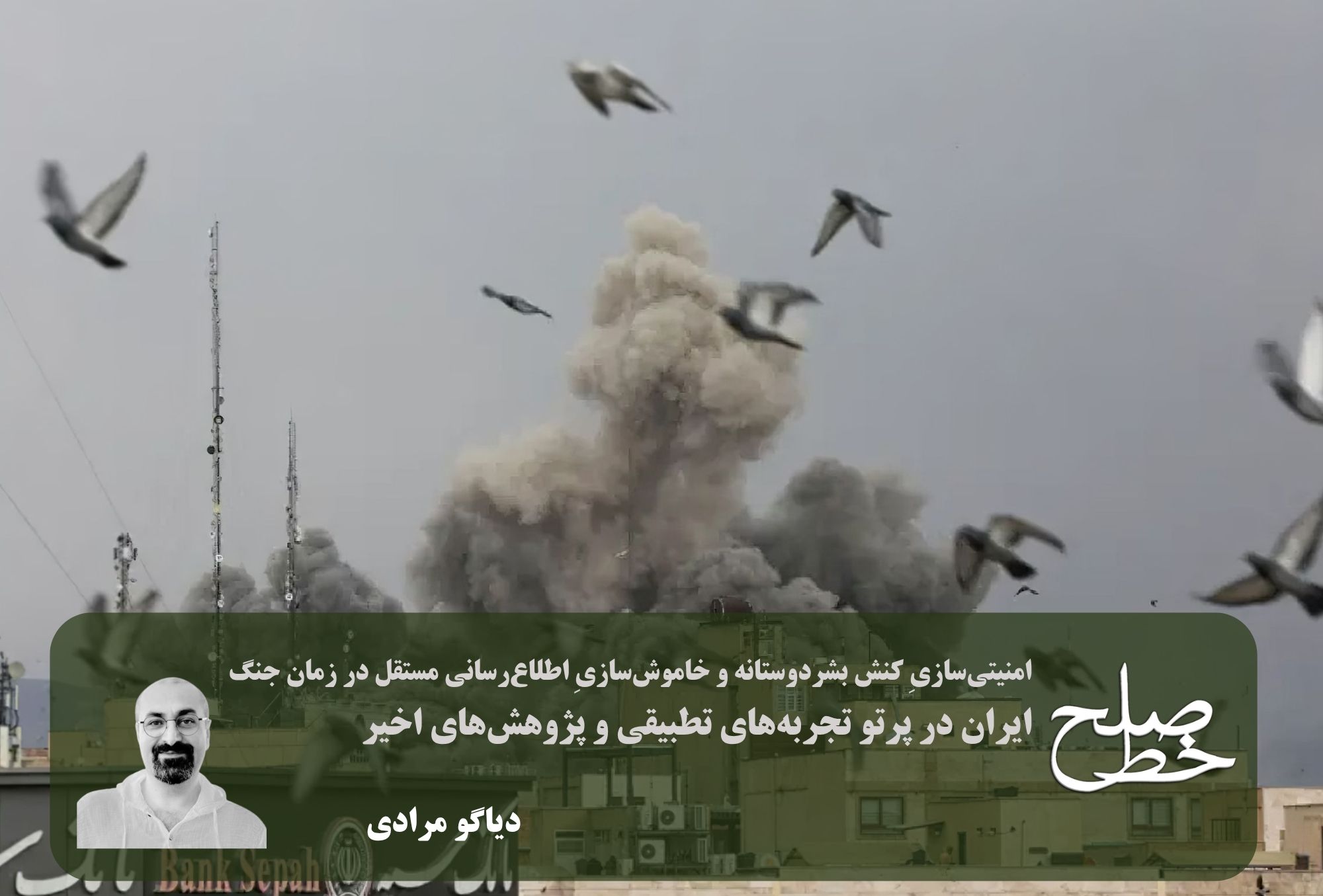
Securitizing Humanitarian Action and Silencing Independent Reporting in Times of War/Diako Moradi
This article attempts to show that in contemporary wars, the battlefield is no longer limited to the military arena, but that the humanitarian, media, communication, and legal spheres are increasingly integrated into the logic of war. In such a situation, war is waged not only through weapons, bombing, and the destruction of physical infrastructure, but also through narrative control, limiting the flow of information, weakening civil institutions, and redefining independent civilian actors as “suspicious” or “threatening” elements. Focusing on this transformation, this article analyzes the “securitization of humanitarian action” and the “silencing of independent information” not as two separate processes, but as two intertwined manifestations of a common logic; a logic in which inherently civilian and humanitarian activities are absorbed into the security discourse and removed from their civil status.
The theoretical and analytical basis of the article is based on two sets of sources. First, research by Liam Switzer and Heather Dix, which uses comparative data from 136 countries between 1997 and 2019 to show a significant relationship between the increase in “securitized aid” and the increase in violence against aid workers. The research argues that the more foreign aid is framed in terms of security logic, crisis management, security sector reform and quasi-peacekeeping interventions, the more complex, hostile and risky the humanitarian operating environment becomes. Second, the Article 19 report on digital warfare, censorship and threats against journalists in Sudan, Palestine and Ukraine, which shows how in today’s conflicts, internet shutdowns, security labeling, attacks on communication infrastructure and restrictions on access to independent media have become part of the war strategy itself.
In this framework, Iran is analyzed not only as the scene of an ongoing war, but also as a case where, even before the war, there were clear signs of the securitization of the humanitarian and civil sphere. From this perspective, the case of the dissolution of the “Imam Ali Society” as well as examples such as the case of Hamid Gharahasanloo are not considered merely legal or administrative events, but rather as important case studies in the process of securitization of social and humanitarian action in Iran. These examples show how even activities focused on poverty, child labor, vulnerable women, social work, medicine, and charity can be shifted from a position of humanitarian support to a position of security suspicion.
The main argument of the article is that today’s Iran must be understood at the intersection of three trends: militarization, securitization, and information blackout. Militarization subjects public space and political decision-making to the logic of wartime urgency; securitization deprives the civic, media, and humanitarian spheres of their independence; and information blackout undermines the possibility of verification, public oversight, legal documentation, and even effective relief. The result of this overlap is not simply an increase in pressure on civil activists or journalists, but a direct weakening of civilian security and a limitation of society’s capacity for humanitarian response in times of crisis.
Accordingly, the article concludes that defending independent humanitarian action and defending accurate, free, and reliable information is not simply a defense of civil liberties, but also a defense of the most fundamental rights of society in a state of war: the right to survival, the right to know, the right to access assistance, and the right to record the truth. Whenever these two areas are absorbed into the logic of security, not only does the possibility of protecting civilians diminish, but it also creates the ground for violations to go unaccounted for, ambiguity to spread, and the gradual erasure of the truth. Therefore, understanding the situation in Iran in light of comparative experiences and recent research shows that protecting human and media space is an integral part of any responsible vision for reducing the harms of war and protecting human dignity.
Introduction
War in the contemporary world is no longer limited to physical battlefields. If in the past the dominant idea of war was limited to the confrontation of military forces, the occupation of territory and the destruction of vital infrastructure, in today’s conflicts other dimensions have become increasingly important: the battle over narrative, control of the flow of information, political legitimacy and the management of public perception. In such circumstances, war proceeds simultaneously on several levels: on the military level through armed operations, on the communication level through information control and the war of narratives, and on the social level through the redefinition of civil and humanitarian actors within the framework of the logic of security. From this perspective, the battlefield has expanded not only to the military front lines, but also to the media space, communication networks and the field of human action.
In many contemporary conflicts, what is ostensibly called “security action” actually leads to a process in which civilian spheres are gradually integrated into the logic of security. In this process, humanitarian activities, independent journalism, human rights documentation, and even the free flow of information are removed from their civil and human status and redefined as “suspicious,” “dangerous,” or “with the enemy.” This process, referred to in the political science and security studies literature as “securitization,” occurs when states or powerful actors present a social or civil sphere as a security threat, thereby paving the way for the imposition of exceptional measures, severe restrictions, and extensive controls.
In the context of war and armed conflict, securitization often encompasses two key areas: first, the area of humanitarian action and second, the area of independent information. In the first area, aid organizations, volunteer groups, local social networks, and humanitarian actors may be framed as security suspects rather than part of the humanitarian response to the crisis. In the second area, journalists, documentary filmmakers, and independent media may be presented as threatening elements or tools of psychological warfare. The result of such a process is the weakening of the humanitarian space and the limitation of society’s access to independent and reliable information, a situation that directly affects the security of civilians and the ability to hold accountable human rights violations.
In recent years, numerous studies have shown that this trend has increasingly become part of the pattern of contemporary wars. On the one hand, empirical studies show that the integration of humanitarian activities within the framework of security logic makes the environment for relief work more insecure and violent. On the other hand, reports by organizations defending freedom of expression show that in many conflicts, information control, internet shutdowns, attacks on media infrastructure and the criminalization of independent journalism have become tools for managing the narrative of war. In such circumstances, the silencing of independent voices is no longer a side effect of war, but in some cases becomes part of the war strategy.
The importance of this discussion for Iran today stems from the fact that the country is in a situation where military war has coincided with profound developments in the field of information and communications. As military tensions have escalated, numerous reports have been published of widespread disruptions to the internet, restrictions on access to information, pressure on journalists, and a reduction in the possibility of independent verification. These developments have led to the information space in Iran becoming more restricted than ever before, making it more difficult for society to access accurate and reliable information.
In this context, human rights and media reports have warned that the internet shutdown and communication restrictions in Iran could further endanger the lives of civilians, as these restrictions hinder the dissemination of information, the coordination of relief efforts, and independent documentation. At the same time, there have been reports of pressure on journalists, restrictions on media activity, and violations of press freedom. Such signs indicate that the issue of war in Iran is not limited to the level of military conflict, but is deeply intertwined with the issue of information control and the restriction of the media and civil sphere.
From this perspective, Iran today cannot be analyzed simply as a military battlefield. What is happening is a combination of military warfare, narrative warfare, and informational control. In such a situation, humanitarian activities, volunteer networks, independent journalism, and human rights documentation are all under increasing pressure. This situation makes Iran an important case study for the intertwining of three key processes: militarization, securitization, and informational blackout.
This situation is of particular analytical importance, as it shows how war can lead to a redefinition of the boundaries between the security and civil spheres. When humanitarian and media actors are merged into the logic of security, not only is the civil space weakened, but the possibility of effectively protecting civilians is also reduced. The study of the securitization of humanitarian action and the silencing of independent reporting is therefore not merely a theoretical debate in the field of security studies, but is a matter directly related to human lives, access to humanitarian aid, and the possibility of recording the truth in times of war.
Within this framework, this article attempts to analyze the situation in Iran within the broader context of the securitization of the humanitarian and media spheres, drawing on comparative research and international experiences. The aim of this analysis is to show how the restriction of humanitarian action and independent reporting can become part of the structure of war, and what consequences this may have for society, civilians, and the future of legal accountability.
1. Conceptual Framework: Securitization of the Human and Media Spheres
In its simplest definition, securitization occurs when a social, civil, or political phenomenon is elevated beyond the realm of normal policymaking to the level of a “security threat” such that restrictions, exceptional measures, and even judicial and security interventions against it are legitimate. In the literature of security studies, particularly within the theoretical framework of the “Copenhagen School,” securitization is a discursive and political process by which an issue is removed from the realm of normal politics and placed within the realm of national emergency and security. In such a situation, tools that would normally be considered unjustified—from sweeping restrictions to detention and repression—are justified as necessary measures to maintain security.
In the context of contemporary wars, this process is most visible in two areas: first, humanitarian and social activities; and second, independent information and media. Both areas are normally considered part of the infrastructure of civil society and play an important role in supporting the most vulnerable segments of society and ensuring the free flow of information. However, when security logic dominates the political and social space, these same areas may be perceived as potential sources of threat.
This is precisely where research by Liam Swiss and Heather Dix intervenes. The research shows that there is a significant relationship between the increasing “securitization of humanitarian assistance” and increased violence against aid workers. Analyzing data from 136 countries between 1997 and 2019, the study concludes that as humanitarian assistance is increasingly framed within the logic of security, crisis management, security sector reform, and paramilitary interventions, the environment for aid work becomes more hostile. In such circumstances, aid workers are no longer seen simply as humanitarian actors, but may be seen by governments, armed groups, or political actors as part of a power structure or even an instrument of influence. The consequence of this shift in perception is an increase in the risk to aid workers: from kidnapping and assault to detention and even murder.
On the other hand, the Article 19 report shows that in many contemporary conflicts – from Sudan to Palestine to Ukraine – the media and information sector has been subjected to a similar process. The report emphasizes that internet shutdowns, attacks on communication infrastructure, security labeling of journalists, restrictions on access to independent media and even the physical targeting of journalists have gradually become part of the architecture of war. In such an environment, the journalist is not simply considered a neutral observer, but is also seen by some actors as a “disturbing element”, “propagandist” or “security threat”.
These two trends (the securitization of humanitarian action and the silencing of independent reporting) are in practice intertwined. Humanitarian action cannot be effective without access to free information and communication networks, and independent reporting is not possible without access to human networks and local resources. When one of these areas is securitized, the other is quickly affected. The aid worker may be pressured on charges of “collaboration with the enemy” or “infiltration” and the journalist may be prosecuted on charges of “disturbing security” or “psychological warfare.” The result of such a situation is the gradual collapse of the human and civil space in society.
The Iranian examples are particularly important in this regard, as they show that the securitization of the human and civil sphere is not only a product of war, but can also have been formed in political and institutional structures before that. One of the most prominent examples in this regard is the case of the Imam Ali community.
1-1. Case Study: Imam Ali Community and the Securitization of Social Action
The Imam Ali Society was one of the largest and most well-known non-governmental organizations in Iran, working in the fields of poverty, child labor, vulnerable women, and social protection since the late 1990s. The organization operated with a wide network of student volunteers and civil activists in various cities in Iran, implementing projects in the fields of school construction, supporting disadvantaged children, and reducing social harm.
However, in the final years of the organization’s activity, the political and security environment around it gradually changed. Finally, in 2020, a legal process was initiated to dissolve the organization, and the court ordered its closure. During this case, the founder and some of the organization’s managers were also arrested, and reports of severe pressure and harsh treatment in detention were published. Many human rights organizations considered this action an example of the restriction of civil society and the securitization of social activities in Iran.
From an analytical perspective, the Imam Ali community case is an important example of what is described in the securitization literature: the transfer of a social and humanitarian activity from the sphere of social policy to the sphere of security threat. In such a process, voluntary networks originally formed to support vulnerable groups may be perceived as structures outside the control of the state and therefore subject to pressure or restriction.
1-2. Another example: the case of Hamid Gharahasanloo
Another important example in this regard is the case of Hamid Gharahasanloo. He was a medical imaging specialist, Darvish Gonabadi, and one of those arrested during the 1401 protests in Iran. Gharahasanloo, who had previously been active in the fields of charity and school building and had even participated in the Iran-Iraq War, was arrested on November 3, 1401, along with his wife, in his private home.
According to published reports, security forces raided his home at 2 a.m. and arrested him and his wife. During the arrest, Gharahasanloo was severely beaten and was transferred to the IRGC hospital in Karaj due to severe lung injuries and internal bleeding. The injuries were said to be so severe that he required a breathing machine and underwent several surgeries on his lungs.
In the course of the legal process, Qarahasanloo was charged and tried in connection with the killing of a Basij member named Ruhollah Ajamian, and was initially sentenced to death. This sentence was later reduced to 15 years in prison. During his arrest and trial, there were reports that he had not had effective access to a lawyer and had been pressured to confess. Later documents also showed that he had saved the life of a civilian on the same day of the incident, but this testimony was not taken into account in court.
From an analytical perspective, the case of Gharahasanloo can also be examined within the framework of the securitization debate. A person with a background in medicine, charity, and social services quickly finds himself in the position of a security suspect in the security environment resulting from protests and political crisis. This change in status—from doctor and social activist to security suspect—is an example of the same process described in the securitization literature.
1-3. Theoretical and experimental link
When these Iranian examples are placed alongside comparative research, a clearer picture emerges. What has happened in Iran is structurally comparable to trends observed in other crisis-ridden regions of the world. As the research by Switzer and Dix shows, the more the humanitarian sphere is integrated into the logic of security, the greater the risk to its actors. And as the Article 19 report shows, the silencing of independent reporting is often part of this process.
Therefore, the securitization of the human and media spheres should be understood not as a separate phenomenon, but as part of a broader transformation of contemporary wars; a transformation in which the boundary between the military and social fields is gradually blurring and war is expanding into the spheres of civil life and communication.
2. Three main mechanisms: from comparative research to application in Iran
Liam Switzer and Heather Dix’s research offers three main analytical mechanisms to explain the relationship between the securitization of humanitarian assistance and the increase in violence against aid workers. The importance of these mechanisms is that they are not limited to the aid sphere, but can also be applied to understanding the state of the media, civil society, and even social actors in countries such as Iran. In fact, these three mechanisms show how the introduction of security logics into civil spheres can make the environment for human activity progressively more hostile and insecure.
2.1. The political landscape is becoming more complex and hostile.
The first mechanism is that securitization makes the political and social context more complex and hostile. In such a space, the boundary between the humanitarian actor, the civil activist, the journalist, and even the ordinary citizen and political or security actors is weakened. When a state or power structure defines civic spheres in the context of a security threat, any independent activity—even if humanitarian or professional in nature—may be considered part of the conflict.
In such situations, aid workers are no longer seen simply as people trying to alleviate human suffering, but may be perceived as carriers of information, tools of influence, or even suspicious elements. The same logic applies to journalists. In normal circumstances, a journalist has the task of recording and transmitting reality, but in a security environment, he or she may be presented as a “psychological operations agent” or an “enemy propaganda tool.”
In Iran, examples of this shift in perception can be seen in recent years. As seen in the case of the Imam Ali Society, a broad social network that worked in the areas of poverty alleviation, child labor protection, and social empowerment, gradually came to be viewed as a problematic and suspicious institution in the political space. This shift in perspective shows how a social activity can move from the realm of social policy to the realm of national security.
The same logic can be seen in the case of Hamid Qarahasanloo. Qarahasanloo was a doctor who was involved in charity and school building activities and even participated in the Iran-Iraq War. However, in the security environment created by the 1401 protests, he was quickly placed on the status of a security suspect and initially sentenced to death. Such developments show that in a hostile political environment, even social and professional activists may be subject to security redefinition.
2.2. Riskier behavior and operating environment
The second mechanism is that securitization makes the operating environment for humanitarian and media actors more risky. When civic or media activities are framed within the context of a security threat, access to information, resources, and communication networks becomes more difficult. In such an environment, aid workers and journalists are forced to work in conditions that are both physically and legally more risky to carry out their duties.
The Article 19 report shows that in countries such as Sudan, Palestine and Ukraine, internet shutdowns, communication restrictions and security pressures on the media have left journalists operating in an extremely insecure environment. In some cases, they are even forced to use unofficial channels or operate without institutional support to reach crisis areas.
In Iran, communication restrictions and security pressures can create such an environment. When the internet is restricted or cut off, not only does media activity become difficult, but even the coordination of relief efforts is affected. In such circumstances, individuals and local volunteer networks trying to help those affected may be forced to operate in an environment that lacks information transparency and institutional support.
The case of Hamid Gharahasanloo is also noteworthy in this regard. Reports indicate that he was severely beaten after his arrest and was taken to hospital with severe lung injuries. Such incidents show that in a security environment, even professional activists such as doctors may be exposed to serious risks.
2-3. Resources, data, and networks become attractive to opportunistic actors
The third mechanism is that the presence of sources, data, images, and human networks becomes attractive to authoritarian, security, or even opportunistic actors. In many contemporary wars, information has become one of the most important sources of power. Any individual or institution with access to field data, images, or eyewitness testimonies can influence the narrative of the war.
For this reason, control of these sources becomes increasingly important for various actors. In some cases, this control is achieved through censorship or cutting off communications; in others, through intimidation, detention, or elimination of witnesses.
This trend has been observed in many war zones around the world. In Palestine, attacks on media offices and the killing of journalists are examples of attempts to control the narrative of the war. In Sudan, internet shutdowns and the collapse of media infrastructure have severely limited access to independent information. In Ukraine, information warfare and cyberattacks on communication infrastructure have become part of the war strategy.
In Iran, too, control of information and narratives is of great importance. When access to information is restricted, the possibility of independent verification is reduced, and the public sphere becomes increasingly dependent on official or unverified narratives. In such circumstances, any individual or network that can provide field information, images, or objective testimonies may be subject to pressure or control.
From this perspective, the securitization of the human and media spheres in Iran can be analyzed within the broader framework of the war of narratives and information control. This trend shows that in contemporary wars, power is not only in the hands of those who possess military means; those who can control the flow of information also play a decisive role in shaping political and social reality.
Taken together, these three mechanisms illustrate how securitization can gradually change the environment in which humanitarian and media actors operate. In such an environment, the boundary between the security and civil spheres is weakened, and activities that are normally part of the life of civil society may be perceived as security threats. Examining the Iranian examples alongside international experiences shows that this trend is not an exception, but part of a broader transformation of contemporary wars; one in which the battlefield has expanded beyond the military arena to include social, communicative, and humanitarian spheres.
3. Iran before the war: Why is the “Imam Ali Community” a prime example?
To analyze the current situation in Iran, the starting point does not necessarily have to be the current war or recent military crises. In fact, many of the trends that are observed today in the form of the securitization of the humanitarian sphere and the restriction of civil space could be traced back to Iran’s political and institutional structures before the war. For this reason, if the goal is to understand the roots of securitization in Iran, one must pay attention to examples in which humanitarian and social spheres have already been exposed to the security gaze. Among these, the case of the Imam Ali community is one of the most important and telling examples.
Founded in 1999 by a group of social activists and students in Iran, the Imam Ali Society has become one of the largest and most well-known non-governmental organizations in the country over the past two decades. It has worked in areas that are considered the most important functions of civil society in many societies: supporting working children, vulnerable women, poor families, prisoners, and marginalized social groups. In addition to charitable activities, the Imam Ali Society has also implemented projects in the fields of education for disadvantaged children, building schools in poor areas, and social empowerment. In many cities in Iran, a network of young volunteers and students have been active within this organization, trying to reduce social gaps and structural poverty to some extent.
However, the process that ultimately led to the organization’s dissolution demonstrated that even activities that are inherently social and humanitarian can be redefined as a security issue in a given political climate. In March 2021, Human Rights Watch reported that an Iranian court, at the request of the Ministry of Interior and in coordination with security agencies, had ordered the organization’s dissolution. The same report, as well as joint statements by human rights organizations, described the move as a serious blow to Iranian civil society and a violation of freedom of association. The organization’s founder and some of its directors were also arrested in the wake of the process, and there were reports of severe pressure and harsh treatment while in custody.
What makes this case important for the analysis of securitization in Iran is not simply the closure of an NGO. Its significance lies in the shift in meaning that occurred at the discursive and political levels. An institution whose activities were focused on reducing poverty, supporting disadvantaged children, and assisting vulnerable groups gradually became presented in the official discourse as a problematic and potentially threatening structure. This shift in perception shows how the boundary between “social activism” and “security concern” can shift rapidly in specific political circumstances.
From a theoretical perspective, this transformation is precisely the process described in the securitization literature. In this process, a social issue—in this case, humanitarian action—is moved out of the realm of social policy and into the realm of national security. When such a transition occurs, measures that would normally be considered unjustified—such as closing down an organization, arresting executives, or restricting activity—are made to appear justifiable in the context of “maintaining security.”
For this reason, the significance of the Imam Ali community in this article is not merely historical or descriptive. This case demonstrates that the securitization of the human sphere in Iran is not a new phenomenon or simply a result of war conditions, but has an institutional and political history. In other words, the current war may have intensified this process, but its roots existed even before the war.
This is important because many analyses of the curtailment of civil society in wartime see it as a direct consequence of the emergency. But the example of the Imam Ali community shows that in Iran, the grounds for securitization of the human sphere already existed. For this reason, war may not be the beginning of this process, but rather its accelerator.
This is also noteworthy from a comparative perspective. In many countries involved in war or security crises—from Sudan to Afghanistan—the securitization of the humanitarian sphere often intensifies during times of war. But in Iran, examples such as the Imam Ali community show that this process was already taking shape before war conditions. For this reason, studying this case can help to better understand the link between domestic politics, the securitization of civil society, and war conditions.
Finally, it can be said that the dissolution of the Imam Ali community is an example of what can be called the “gradual securitization of social action.” In such a process, activities that in many societies are considered part of the normal life of civil society are gradually placed within the framework of a security perspective. The consequence of such a process is not only the weakening of civil society, but also the reduction of society’s capacity to respond to humanitarian crises.
Therefore, within the framework of this article, the Imam Ali Society case can be considered a “base case study”: an example that shows how the humanitarian sphere in Iran already had the potential to be seen as a sphere in need of control, surveillance, and containment, rather than being seen as a complement to the state in supporting society. This fact also changes our understanding of the current situation in Iran, because it shows that the securitization of humanitarian action in Iran is not simply a product of war, but has been shaped by previous developments in the relationship between the state and civil society.
4. Iran’s alignment with Sudan, Palestine, and Ukraine
To better understand the process of securitization of the human and media spheres in Iran, it is important to compare it with the experiences of other conflict zones. The Article 19 report highlights three important cases in this regard: Sudan, Palestine, and Ukraine. These three cases show how in contemporary wars, information control, media restrictions, and the weakening of civil activists have gradually become part of war strategies. Each of these cases shows a specific pattern of interaction between military warfare and information warfare, but at the same time they have common elements that can also be used to analyze the situation in Iran.
In Sudan, the civil war that began in 2023 between the army and the “Rapid Support” militias quickly led to the collapse of the media infrastructure and severe restrictions on the flow of information. Many media outlets ceased operations, journalists were forced to obtain security clearances to work in different areas, and frequent internet outages severely limited the public’s access to vital information about the war situation, urban security, and relief efforts. In such an environment, journalists faced not only the physical dangers of the war, but also legal and security pressures. The result was a vast information vacuum that deprived both Sudanese society and the international community of an accurate understanding of the humanitarian and political situation in the country.
In Palestine – especially in the Gaza wars – the securitization of the media sphere has taken a different form. Here, in addition to the restriction of communications, direct attacks on media infrastructure and journalists have also been observed. Media offices have been targeted in some cases, and a large number of journalists have been killed during the war. At the same time, severe restrictions on the entry of foreign media into Gaza have severely limited the world’s access to independent information about the situation on the ground. In such circumstances, the information vacuum becomes an important tool in the war, as each side can highlight its own narrative of the war, while the possibility of independent verification is reduced.
In Ukraine, the war with Russia has also shown how much the media front can become part of the military front. In this war, cyberattacks, information operations, the widespread dissemination of disinformation and attacks on communication infrastructure have all been part of the war strategies. The media, social networks and even messengers such as Telegram have become a battlefield for shaping public opinion and managing the war narrative. Here, information control and the war of narratives have become as important as military operations.
If we put these three experiences together, a common pattern emerges: in contemporary wars, information control and media restrictions have gradually become one of the main tools of war. This control may take the form of Internet shutdowns, pressure on journalists, limiting media access, or even attacks on communication infrastructure. The common goal of these measures is to manage the narrative of the war and limit access to independent information.
Iran is comparable in some ways. In Iran, along with military tensions, there have been reports of internet disruptions, restrictions on access to information, and pressure on journalists. These signs indicate that the information and media sector has become an important arena of conflict alongside the military.
However, there is an important difference between Iran and cases such as Sudan, Palestine and Ukraine. In many of these countries, media restrictions and securitization of the humanitarian sphere have intensified mainly in response to war conditions. In other words, war as an external factor has caused states or armed actors to exert greater control over information and civil activity. In Iran, however, evidence suggests that media and humanitarian restrictions existed even before the war. As explained in the previous section on the Imam Ali Society case, independent civil society in Iran also faced structural constraints before the war. NGOs, social activists and some media outlets have been under various pressures in recent years and the space for independent activity has been limited.
For this reason, while in countries like Sudan or Ukraine, war has intensified information control, in Iran the war has occurred on a background where there were already processes of securitization of civil society and the media. This makes it impossible to analyze the situation in Iran solely in the context of “securitization caused by war.”
In fact, the case of Iran can be seen as an example of what can be called the “intertwining of pre-war and war securitization.” In such a situation, trends that existed domestically before the war—such as the restriction of civil society or control of the media—are intensified and take on new dimensions in wartime.
From an analytical perspective, this feature makes Iran an important case study, as it shows that the securitization of the human and media spheres does not always occur suddenly and solely as a result of war, but can be the product of long-term processes in the relationship between the state, civil society, and the media. War in such circumstances does not initiate this process, but rather accelerates and reinforces it.
For this reason, comparing Iran with the experiences of Sudan, Palestine, and Ukraine can help us better understand how contemporary wars are gradually blurring the boundaries between the military and civilian spheres. In such circumstances, journalists, aid workers, and social activists all operate in an environment where military dangers, security pressures, and communication constraints coexist.
Ultimately, this comparison shows that protecting media and human space in times of war is not just a professional or corporate issue, but part of the fundamental infrastructure of human security. When these spaces are weakened, not only is access to independent information reduced, but the possibility of effective relief, legal accountability, and even accurate recording of the realities of war is severely limited.
5. Iran at War: From Information Blackout to Undermining Human Action
In war situations, information control and communication restrictions often become one of the first tools of crisis management and national security. However, various experiences around the world have shown that such measures can have complex and sometimes contradictory consequences. On the one hand, governments may consider communication restrictions necessary to prevent the spread of sensitive information or to control the psychological climate of society; on the other hand, these same measures can disrupt society’s access to vital information, the coordination of relief efforts, and independent documentation. In such a situation, the boundary between “crisis security management” and “information blackout” gradually becomes blurred.
In this context, on March 6, 2026, Human Rights Watch warned that the Internet shutdown in Iran could violate citizens’ right to access information and increase the risk to civilians. The organization emphasized that widespread disruption or disruption of communications not only hinders public information about the war situation and urban security, but also hinders the work of aid workers, doctors, journalists, and human rights monitors. Especially in war situations, where rapid access to information can be critical to saving lives, communication restrictions can have significant humanitarian consequences.
At the same time, the Committee to Protect Journalists also reported that during the Iran war, cases of restrictions on media activity, threats to journalists, and pressure on the media were recorded. Such reports indicate that the media and information sector has also come under significant pressure during the war in Iran. This situation reflects the same pattern observed in many contemporary wars: as military conflicts intensify, the information space also becomes more restricted and the possibility of independent media activity decreases.
In such circumstances, one of the major consequences of information blackouts is the gradual weakening of humanitarian action. Humanitarian activities naturally depend on accurate information, stable communications, and social trust. Rescuers need the free flow of information to identify immediate needs, coordinate relief teams, transport the injured, and distribute aid. When this flow is restricted, the effectiveness and security of humanitarian operations are also reduced.
In Iran, the securitization of humanitarian action in wartime situations can take many forms. For example, local volunteer groups that transport the wounded, distribute essential items, provide information about shelter, or record humanitarian needs in a crisis situation may be subject to security suspicion rather than being considered part of the humanitarian response to the crisis. In a space where information is considered a sensitive resource, even activities such as recording images of affected areas, transmitting information about the condition of the wounded, or sending coordinates of critical areas may be considered sensitive.
In such situations, the scope of this suspicion can be very wide. Doctors, ambulance drivers, local rescue workers, community volunteers, and even family and neighborhood support networks may come under security scrutiny, especially if they are forced to share information about the situation on the ground in the process of providing assistance. While in many relief systems around the world, such information is essential for coordinating humanitarian operations, in a security environment it may be considered sensitive or security information.
This situation is exactly the mechanism that has been referred to in the securitization literature: the introduction of the logic of war into a field that should originally operate under the logic of the protection of civilians. Within the framework of international humanitarian law, relief and humanitarian activities should be kept separate from the field of military conflict and enjoy special protection. But when this field is integrated into the security logic, the boundary between humanitarian action and security activity gradually disappears.
To better understand this issue in Iran, it is important to return to examples such as the case of the Imam Ali Society. As mentioned in the previous section, this organization was one of the largest social and charitable networks in Iran, working in the areas of poverty and social support. The dissolution of this organization showed that even in non-war situations, independent social networks can be subject to security scrutiny.
This experience is doubly important when placed alongside wartime conditions. If poverty alleviation social networks were securitizable and disintegratable in non-wartime, in wartime conditions local aid networks and humanitarian actors may be more vulnerable, as in a war environment, sensitivity to information and independent networks increases and the scope of security measures expands.
From an analytical perspective, this situation shows that information blackout is not just a technical or communication issue, but has broad social and human consequences. When access to information is restricted, several processes take place simultaneously: first, the coordination of relief efforts becomes more difficult; second, the possibility of independent verification of the situation on the ground is reduced; and third, the public sphere becomes increasingly dependent on official or unverifiable narratives.
As a result, information blackouts can indirectly weaken a society’s capacity for humanitarian response to a crisis. This is especially important in situations where a significant portion of relief is provided at the local level and by volunteer networks.
Hence, Iran’s situation at war can be seen as an example of the same trend described in comparative studies of contemporary wars: a trend in which military warfare is intertwined with information warfare and the securitization of the civil sphere. In such an environment, humanitarian and media actors face not only the physical dangers of war, but also structural limitations in the realm of communication and information.
Ultimately, this situation demonstrates that protecting information and human space in times of war is not simply a matter of media freedom or civil rights, but is part of the fundamental infrastructure of human security. When these spaces are restricted, not only is society’s access to independent information reduced, but the ability to provide effective relief, accurately document the realities of war, and hold accountable potential violations is also severely limited.
6. The silencing of independent media in Iran
In wartime, the media and journalists are one of the most important sources of independent and verifiable information for society. However, the experience of many contemporary wars shows that independent journalism is often one of the first areas to be suppressed. The reason for this is clear: in war, information is not only a tool for public awareness, but also a part of political and military power. Each side in the war seeks to establish its own narrative of events and limit the competing narratives.
In such an environment, independent journalism finds itself in a very vulnerable position. Journalists must simultaneously confront several structural and operational obstacles: physical dangers caused by war, security restrictions, internet outages or disruptions, official censorship, political pressures, self-censorship driven by fear, and difficulty accessing sources of information. This combination of factors makes the work of journalism in times of war not only more difficult, but in many cases more dangerous.
In Iran, this situation can take on more complex dimensions. When a journalist is presented not as a carrier of public information and a bearer of society’s right to know, but as a “suspicious element,” “accomplice to the enemy,” or “tool of psychological operations,” the groundwork is laid for restricting his or her activities. In such circumstances, measures such as arrest, summons, restriction of professional activity, or discrediting the media can be justified on security grounds.
This pattern is one that Article 19 has warned about in its analysis of contemporary wars. The organization shows that in many recent conflicts, labeling journalists—for example, as “propagandists” or “enemy agents”—has become a tool for restricting independent media. Such labeling allows political actors to justify restrictive measures against journalists within the framework of security discourse.
At the same time, the Committee to Protect Journalists, in its monitoring of the media situation in connection with the Iran war, has reported that cases of restrictions on media activity, pressure, and threats against journalists have been recorded. These reports show that the media sector, along with other civil society sectors, has been exposed to pressures resulting from the security environment.
Among them, one of the most important factors affecting media activity in wartime is disruption of access to the Internet and communications. In today’s world, a large part of the work of journalists depends on digital tools. Connecting with news sources, sending reports, publishing images and videos, and even coordination between journalists and editorial offices all depend on communication infrastructure. When this infrastructure is limited, the work of journalism also faces serious difficulties.
In Iran, the issue of information blackout is not just a technical or communication issue. Cutting off or restricting communications has broader social and human implications. When access to the Internet or communication networks is restricted, several processes take place simultaneously.
First, the possibility of independent verification is reduced. Journalists, civil society activists, and human rights monitors need diverse sources and stable connections to verify the accuracy of information. Limited communications make it more difficult to access these sources and disrupt the verification process.
Second, the field becomes more open for the spread of official or unverified narratives. When the flow of independent information is restricted, narratives published by official sources or rumors spread in informal networks can influence the information space. In such circumstances, it becomes more difficult to distinguish between accurate information and disinformation.
Third, the possibility of independent documentation of possible violations is reduced. One of the important roles of journalists and human rights activists in times of war is to record and document events. This documentation can later be used for legal accountability or historical research. Restrictions on communication and pressure on the media can disrupt this process.
As a result, information blackouts can indirectly lead to increased human insecurity, because in the absence of accurate and independent information, society has less access to knowledge about immediate dangers, safe routes, relief status, or humanitarian needs.
That is why many human rights organizations emphasize that access to information in times of war is a vital necessity, not a media privilege. Accurate information can help save lives, increase coordination among aid workers, and prevent the spread of rumors and misinformation.
In this context, internet shutdowns or widespread restrictions on communications during wartime cannot be seen as simply a matter of network or technology management. These measures are directly linked to the right to life, the security of civilians, and the possibility of legal accountability. When the flow of information is disrupted, not only is the public’s access to the realities of war reduced, but the possibility of accurate recording of events and independent investigation is also limited.
From an analytical perspective, Iran’s situation in this regard is an example of the same broader trend observed in contemporary wars: a trend in which military warfare is intertwined with information warfare and control of the media space. In such circumstances, journalists are considered not only witnesses to the war, but also part of the information battlefield.
Ultimately, this situation demonstrates that protecting independent reporting in times of war is not just a press freedom issue, but part of the essential infrastructure of human security and legal accountability in times of crisis. When this space is undermined, not only is society’s access to independent information limited, but the possibility of effective relief, truth-telling, and the prevention of impunity is also severely diminished.
7. delayed
From a conceptual perspective, a fundamental distinction must first be emphasized: protecting humanitarian action and independent information is not a luxury in peacetime, but a vital necessity in wartime. In normal circumstances, media freedom, the independence of civil society organizations, or humanitarian action might be discussed more in the context of democratic values and civil rights. But in wartime, these areas take on a function that goes beyond political values. In such circumstances, they are directly linked to the protection of human lives, access to vital information, the recording of facts on the ground, and the possibility of legal accountability.
In contemporary wars, one of the great dangers is that victims disappear amidst a mass of conflicting statistics and narratives. If journalists, documentary filmmakers, and humanitarian activists cannot operate freely, many of the realities of war will go unrecorded. In such circumstances, not only is society’s access to the truth limited, but the possibility of legal action for potential violations is also reduced. This is why the protection of civilians, aid workers, and journalists has been raised as a fundamental principle in the literature of international humanitarian law.
In the case of Iran today, this issue is doubly important, as the country’s current situation is at the intersection of several important trends: military warfare, information control, and the curtailment of civic space. In such circumstances, any responsible analysis of the situation in Iran must simultaneously confront two types of analytical reductionism.
First, there is domestic security reductionism. In this view, any independent information flow, any social activity outside formal chains, or any independent human network can be seen as a security threat. In such a framework, humanitarian activities, volunteer networks, or even local information may be seen as areas requiring control and containment rather than as part of a society’s capacity to deal with a crisis.
Second, there is external geopolitical reductionism. In many international analyses, wars are examined primarily at the level of power competition, regional balance, or military objectives. In such an approach, the main focus is on military strategies, the balance of power, or the geopolitical consequences of war. But such analyses sometimes marginalize the human costs of war and pay less attention to consequences such as the collapse of civil space, information blackout, or the weakening of human action.
The reality is that to fully understand the situation in Iran, both types of reductionism must be set aside. War is not just a military event, but a multi-layered phenomenon that simultaneously encompasses military, humanitarian, media, and social dimensions. Ignoring any one of these dimensions can present an incomplete picture of reality.
In this context, reviewing examples such as the Imam Ali Society case becomes particularly important. The dissolution of this organization showed that the securitization of the humanitarian sphere in Iran is not only a product of war conditions, but also has a pre-war history. When an NGO that was active in the fields of poverty alleviation, child labor protection, and social activities becomes a security issue, it shows how fragile the boundary between social activity and security suspicion can be.
When this experience is juxtaposed with the current situation—including widespread communication disruptions and internet blackouts during wartime—a pattern emerges. It suggests that in Iran, independent human action and free information can gradually be framed within the framework of security discourse. In other words, from social activities to media activities, areas that should originally be seen as part of society’s capacity to deal with crises may become areas for security control and surveillance.
Comparative research and recent reports also show that this trend is not limited to Iran. In many contemporary wars, from Sudan and Palestine to Ukraine, it has been observed that whenever war spills over into the humanitarian and media spheres, the danger to civilians multiplies, because in such conditions not only does military violence increase, but the possibility of access to accurate information, effective relief, and independent recording of the realities of war also decreases.
In this sense, the Iranian situation reflects part of a broader trend in contemporary warfare: one in which military warfare is intertwined with information warfare and the securitization of the civil sphere. In such a space, journalists, aid workers, and social activists all operate in an environment in which military dangers are combined with security pressures and communication restrictions.
Ultimately, the main message of this analysis is that defending independent humanitarian action and defending accurate and free information is not simply defending civil liberties. In war situations, it is essentially defending the right of society to survive, to know, and to record the truth. If the flow of independent information is silenced and independent humanitarian networks are weakened, society loses not only its ability to protect civilians but also its ability to understand accurately what is happening.
For this reason, the protection of human and media space in times of war must be considered as one of the essential prerequisites of human security and legal accountability. Without these two, there is no possibility of effective protection of people, no possibility of recording the truth, and even the possibility of accurately judging the war that is taking place.
Footnotes:
1- ARTICLE 19. (2025, May 10). Digital warfare, censorship, and risks to journalists in conflict: Finding a way forward. ARTICLE 19.
2- Committee to Protect Journalists. (2026, March 10). Press freedom violations in the Middle East during the Iran war. CPJ.
3- Human Rights Watch. (2021, March 10). Iran: Overturn shutdown of charity. Human Rights Watch.
4- Human Rights Watch. (2026, March 6). Iran: Internet shutdown violates rights, escalates risks to civilians. Human Rights Watch.
5- Swiss, L., & Dicks, H. (2025). Aid securitization and violence against aid workers. Stability: International Journal of Security & Development, 12 (1), Article 2.
 Created By: Diako Moradi
 March 21, 2026
Tags
Diako Moradi Heather Dix Internet outage Iran-US war Liam Switzerland peace line Peace Line 179 The war between Iran and Israel. Twelve-day war War War conditions ماهنامه خط صلح