


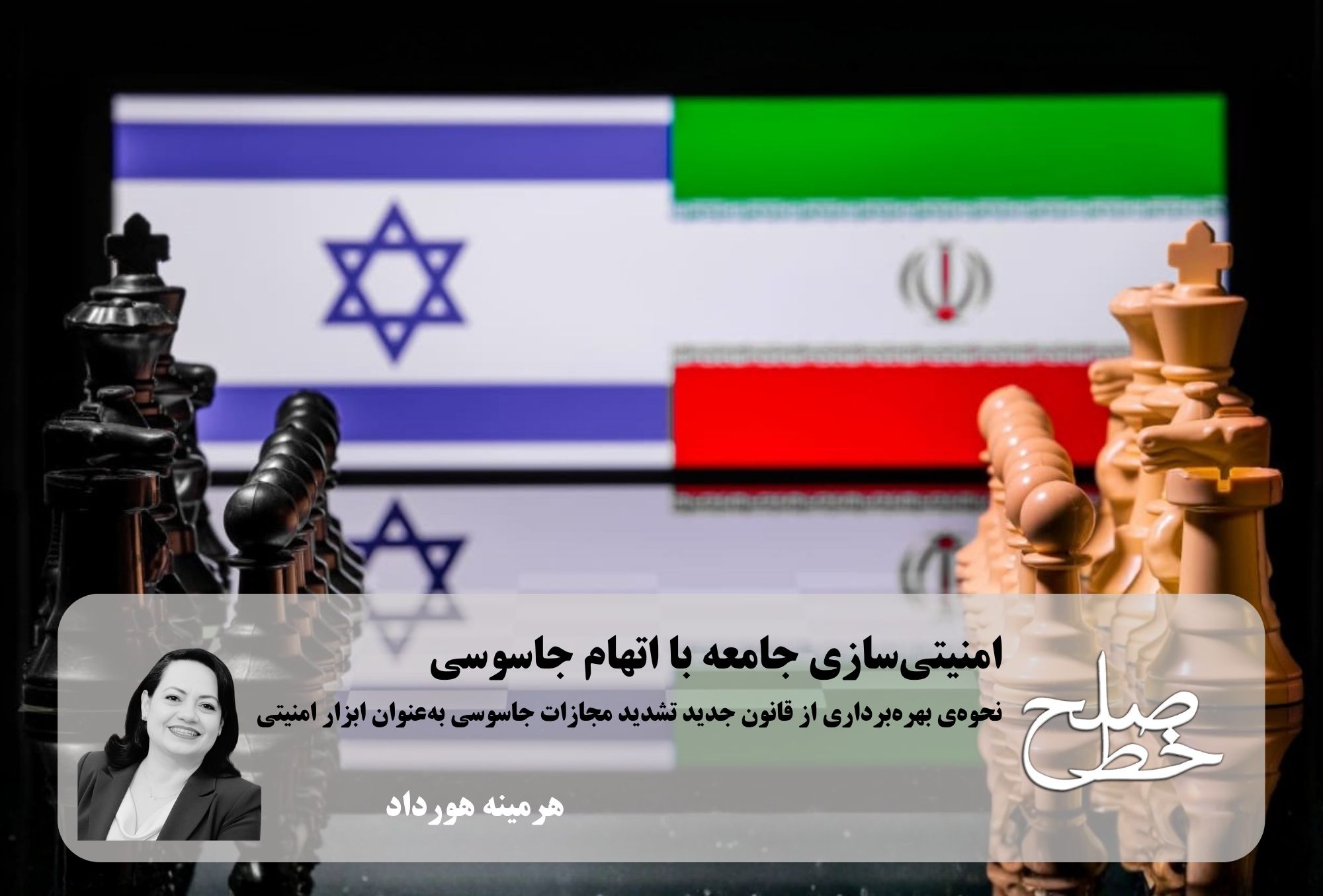
Securitizing Society Through Accusations of Espionage/ Hermineh Hourdad
Since its establishment, the Islamic Republic, as a phenomenon in the form and appearance of the government ruling Iran, has made one of its main actions emptying everything of its original meaning, placing its own desired meaning inside that form, and imposing it on society. The accusation of espionage is no exception to this rule; from the beginning of its establishment and its imposition on the country and people, it has used this type of accusation for greater repression. In this article, first, by examining the concept of espionage, we try to describe this concept — which has existed and continues to exist in political literature and in the political history of the world — so that we can then, through understanding reality, arrive at the realization of how the Islamic Republic turns every concept into a tool of repression and uses it to control society. In fact, what this article addresses, although not a new subject, is the lifting of the curtain from the Islamic Republic’s patterns of exercising power. Recognizing these patterns makes it possible, by decoding them, to delegitimize this security-based form of accusation and to disarm the Islamic Republic, at least in terms of conceptual exploitation.
In the contemporary world, national security has become one of the most fundamental pillars of the survival and continuity of governments. To preserve political authority, social stability, and control over the structure of power, states always try to identify and manage internal and external threats. In this context, laws related to security crimes, especially the crime of espionage, acquire a special place; because governments regard espionage not merely as a legal violation, but as a direct threat to their political and security existence. For this reason, in conditions of war, security crises, social unrest, or geopolitical tensions, the process of intensifying anti-espionage laws and increasing security punishments usually accelerates, and states use these laws as tools for deterrence, social control, and management of the political space.
Espionage, in its political and legal sense, means collecting, transferring, or disclosing confidential information for the benefit of a foreign power or against the national interests of a country. Throughout history, there have been numerous examples of famous and influential spies whose actions affected the world’s political and military equations. Klaus Fuchs was a scientist who transferred information from the American nuclear project to the Soviet Union and changed the balance of atomic power in the world. Kim Philby, a British intelligence officer, provided the Soviet Union with confidential Western information for years and became one of the most important intelligence infiltrators of the Cold War. Mata Hari was also tried and executed on charges of espionage during the First World War and later became a historical symbol of the infiltrating spy. These examples show that espionage can change the course of wars, political alliances, and even the global balance of power.
But alongside real espionage, the issue of the “accusation” of espionage has always been part of political history. In many countries and governments, especially in periods of crisis, political opponents, journalists, civil activists, intellectuals, or critics of the government have been labeled as foreign agents, infiltrating elements, or spies. In political science, this process is considered a form of securitization; meaning the transformation of a political or social disagreement into a security threat. In such an atmosphere, the political opponent is gradually removed from the position of critic and turned into a traitor. For example, during Stalin’s era, thousands of people were arrested, exiled, or executed on charges of espionage or cooperation with the enemy, while many of these accusations were never proven. In the United States, too, during the McCarthy era, an intense anti-communist atmosphere caused many people to be accused of cooperation with the Soviet Union without definitive evidence. These historical experiences across the world show that the accusation of espionage sometimes becomes less a legal case than a political tool for eliminating opponents, creating fear, and controlling society.
In political science theories, security is considered the most important duty of every state. To preserve their authority and political stability, states must constantly strike a balance between security and freedom. However, historical experience has shown that in conditions of war or severe crises, this balance usually shifts in favor of security. In such a situation, totalitarian governments mainly try to control any potential threat by expanding the powers of security institutions and passing strict laws. For this reason, the crime of espionage becomes one of the gravest political and security crimes during times of crisis.
During war, the importance of espionage increases severalfold. War does not take place only on the military battlefield; an important part of it unfolds in the fields of intelligence, media, psychological operations, and cyberwarfare. In the Second World War, the breaking of the Enigma machine’s code by Alan Turing’s team played an important role in the defeat of Nazi Germany. During the Cold War, too, the intelligence battle between the Intelligence Service and the KGB became one of the main dimensions of global rivalry. In the modern era, cyberattacks such as Stuxnet have shown that the concept of espionage has entered a more complex and digital stage.
For this reason, states in crisis conditions try to send a clear message to society and foreign enemies by intensifying anti-espionage laws. These laws are apparently passed with the aim of deterrence, protection of sensitive information, and combating infiltration, but in practice they can acquire broader political functions. When security punishments become harsher, the public atmosphere of society also moves toward caution, silence, and self-censorship. Out of fear of being accused of contact with the enemy or activity against national security, people distance themselves from expressing criticism, political participation, or even media activity.
Naturally, if an accusation of espionage is real and proven, it entails punishments. Throughout history, punishment for espionage has usually been very severe. In many countries, especially during wartime, spies have faced punishments such as execution, life imprisonment, solitary confinement, and lengthy interrogations.
Mata Hari was executed by firing squad in France, and Julius Rosenberg and Ethel Rosenberg were executed in the United States on charges of transferring nuclear information. In some cases, defendants have also been held for years in security prisons or subjected to intense psychological and media pressure. Sometimes, governments also publicize espionage cases extensively in order to display their security authority, both to send a deterrent message to society and to discredit opponents in public opinion.
One of the most important espionage cases in Sweden in recent years involved two brothers of Iranian origin named Peyman Kia and his brother Payam Kia, who were accused of spying for Russia’s military intelligence organization. Peyman Kia had worked for years in sensitive Swedish security institutions, including the country’s Security Service and military intelligence division, and had access to classified documents and sensitive national security information. Swedish prosecutors announced that the two brothers had provided confidential information to Russia’s military intelligence organization, the GRU, between 2011 and 2021. This case was recognized as one of the largest and most important espionage cases in Sweden’s contemporary history, because the main defendant was present at the heart of the country’s security structure and had gained access to sensitive information from within the security system.
In 2023, the Stockholm court sentenced Peyman Kia to life imprisonment and his brother to about ten years in prison. The court announced that his actions had caused serious damage to Sweden’s security and violated the trust of the state and the country’s security institutions. The importance of this case was not only in the issue of espionage, but also in the way Sweden’s judiciary handled it. The defendants were tried in a formal and relatively public court, had the right to access lawyers, were given the opportunity to defend themselves and appeal, and the judicial process lasted several months. This shows that even in serious security and espionage cases, many democratic systems try to preserve the principles of fair trial and judicial transparency; an issue that creates an important difference between democratic legal systems and authoritarian governments.
In many political systems, especially in conditions of crisis, the media play an important role in reproducing security discourse. When official media are controlled by power and are only its mouthpiece, they constantly speak of enemy infiltration, espionage networks, and foreign agents, and society gradually enters an atmosphere of suspicion and fear. In such an atmosphere, any political criticism or civil activity may be regarded as a security threat. This situation weakens the boundary between political opposition and treason and places the government in a position where it can carry out harsher measures under security justifications.
The History of Espionage and Accusations of Espionage in Iran: From the Rivalry of Foreign Powers to Security Repression
Iran’s contemporary history — especially over the past hundred years — has always been tied to the issue of espionage, foreign infiltration, and rivalry among intelligence agencies. Iran’s geopolitical position, oil resources, proximity to the former Soviet Union, closeness to the Persian Gulf, and role in Middle Eastern equations have made the country one of the major arenas of intelligence activity by foreign powers in the twentieth and twenty-first centuries. From the Pahlavi era to the Islamic Republic, the intelligence institutions of the United States, Britain, the Soviet Union, Israel, and other regional actors have always been sensitive to developments in Iran. In its entry on CIA activities in Iran, Iranica explains that even relations between the CIA and SAVAK in the 1340s and 1350s gradually became more complex, and the two sides, in some cases, monitored each other in Tehran as well.
During the Pahlavi era, the issue of espionage was understood above all in the context of the Cold War. Iran was America’s main ally in the region and stood against Soviet influence. The Tudeh Party, networks affiliated with the Soviet Union, British and American intelligence activities, and SAVAK’s role in controlling opponents were all part of the security history of that period. After the 1979 Revolution, the concept of espionage quickly entered the official discourse of the Islamic Republic. The occupation of the U.S. Embassy in 1979 was established under the title “den of espionage,” and from that time, the word spy became one of the most important security labels in the political literature of the Islamic Republic against opponents, critics, and people with foreign connections.
In the first decades of the Islamic Republic, accusations such as espionage, cooperation with foreigners, dependence on the West, contact with America, cooperation with Israel, or contact with hostile groups appeared in many political and security cases. During this period, the accusation of espionage did not only mean the transfer of confidential information; sometimes any kind of relationship with foreign institutions, media outside the country, human rights organizations, or international academic circles could be interpreted within a security framework. This is precisely the point at which the boundary between real espionage and political accusation becomes blurred.
For example, Amir-Entezam was arrested after the 1979 Revolution on charges of spying for America. This accusation was mainly based on documents obtained from the U.S. Embassy after its occupation. He always denied the charge, and many political and human rights activists considered his case an example of a political trial.
Abbas Amir-Entezam spent long years in prison and under house arrest and is referred to as one of the Islamic Republic’s longest-held political prisoners. His case is highly important in discussions related to accusations of espionage in the Islamic Republic, because critics of the government believed that the security and espionage accusation against him had more of a political nature than an intelligence one and created an atmosphere of suffocation among politicians of that era. These repressions cause some people, in order to protect their own survival, to adopt compromise and silence, while a larger number of people withdraw from work in one way or another. But these accusations in the Islamic Republic are not limited only to individuals in political positions or to political activists and well-known dissidents.
Over the past ten years, this trend of espionage accusations by the Islamic Republic has become more apparent and more widespread. Since 2014, the arrest of dual nationals, researchers, environmental activists, journalists, civil activists, and protesters on charges such as espionage, cooperation with a hostile state, or action against national security has increased. Human Rights Watch reported in 2018 that the Islamic Revolutionary Guard Corps had arrested at least 14 dual nationals or foreign citizens since 2014, and that in many cases courts accused them of cooperation with a hostile state without presenting public evidence.
One of the important examples of this trend is the case of Ahmadreza Djalali, an Iranian-Swedish physician and researcher. In 2016, during an academic trip to Iran at the invitation of Iranian universities to participate in scientific seminars, he was arrested in Iran, accused of espionage, and sentenced to death. United Nations experts announced in 2025 that his conviction was based on a confession reportedly obtained under torture, and that his judicial process was incompatible with international standards of a fair trial.
Another example is the case of environmental activists arrested in 2017 and 2018. A group of members of the Persian Wildlife Heritage Foundation, including Kavous Seyed-Emami and Morad Tahbaz, faced security and espionage charges. Kavous Seyed-Emami died in detention, and officials announced suicide as the cause of his death, but his family and human rights institutions questioned this account. A European Parliament report also referred to the arrest of Morad Tahbaz and other environmental activists on espionage charges.
The case of Ruhollah Zam is also one of the important examples of turning media activity, dissent, and political opposition into a security case. Zam, the director of the Amadnews channel, was arrested by the IRGC during a trip to Iraq in 2019 and transferred to Iran, and in 2020 he was executed on charges including corruption on earth. Reuters reported that he had been convicted because of his alleged role in the 2017 protests. Critics considered this case an example of a security response to media and political protest.
In 2022 and 2023, after the protests related to the “Woman, Life, Freedom” movement, the use of security charges became more widespread. Human Rights Watch wrote in its 2024 World Report that after the death of Mahsa (Jina) Amini, the Iranian government severely suppressed the protests, hundreds of people were killed and thousands arrested, and many activists, human rights defenders, minorities, and opponents remained in prison or were convicted after unfair trials on vague national security charges.
The case of Alireza Akbari, a former Defense Ministry official and Iranian-British dual national, also demonstrates the political importance of espionage accusations in recent years. He was executed in 2023 on charges of spying for Britain. The Associated Press reported that espionage trials in Iran are usually held behind closed doors, have little transparency, and defendants’ access to lawyers is limited. Britain called the accusations political and condemned his execution.
In recent years, especially after the intensification of tensions between Iran and Israel, accusations of spying for Israel have also gained a more prominent place. Amnesty International wrote in a 2025 statement that since June 13, 2025, at least 18 men had been executed on political charges, at least 15 of whom had been accused by officials of spying for Israel. The organization also emphasized that these repressions relied heavily on Revolutionary Courts; courts that, according to Amnesty International, lack sufficient independence and play a central role in national security cases.
On this basis, it can be said that in Iran’s hundred-year history, espionage has been both a security reality and a political tool over which many lives have been taken, and countless individuals have been not only politically eliminated but physically eliminated through the abuse of this accusation. On the one hand, because of its sensitive position, Iran has genuinely been an arena of rivalry among foreign intelligence services. On the other hand, governments, especially the Islamic Republic, have repeatedly used the concept of espionage to securitize political opposition. Over the past ten years, this pattern has intensified, and accusations such as espionage, cooperation with a hostile state, and action against national security have been used not only against individuals connected to intelligence cases, but also against dual nationals, academics, environmental activists, journalists, protesters, and civil activists.
The political result of this trend is precisely what must be highlighted in the article: the accusation of espionage in the Islamic Republic is not merely a judicial tool, but a tool for producing fear, creating distrust in society, discrediting opponents, and pushing a large part of the people toward silence and passivity. When the government presents the critic as a spy and the protester as a foreign agent, the aim is not simply to punish one individual; the main aim is to send this message to society that any protest, connection, civil activity, or act of speaking out can carry a security cost, even a deadly one.
The catastrophe takes shape when the boundary between real espionage and security accusation disappears. The broader and more ambiguous the definition of a security crime becomes, the greater the possibility of its political use. In such conditions, the government can interpret any kind of opposition, criticism, civil activity, or foreign connection within the framework of a security threat. This process gradually pushes society into an atmosphere of fear and distrust; an atmosphere in which people distance themselves from political participation in order to protect their personal security.
In recent years, in the Islamic Republic of Iran, accusations such as espionage, cooperation with a hostile state, contact with foreign intelligence services, and action against national security have become one of the most important legal and security tools in confronting political opponents, civil activists, journalists, and protesters. The government justifies these measures within the framework of defending national security and confronting foreign infiltration, but critics and many human rights institutions believe that in a significant portion of these cases, the boundary between a real security threat and political opposition has been weakened. From the perspective of these critics, the accusation of espionage is used in some cases not to confront foreign intelligence operations, but as a tool for securitizing society and controlling the political space.
In such an atmosphere, the political opponent or protester is gradually removed from the position of a social critic and, in official discourse, turned into a foreign agent, infiltrating element, or traitor. This process, in addition to legitimizing harsh judicial and security measures, also has a deterrent function at the level of society; because its implicit message is the increased cost of protest, criticism, and political participation. For this reason, severe security punishments, from long prison sentences to execution, are not directed only at the defendants in the cases, but are also considered a kind of political message to the whole society.
Regarding the timing of judicial proceedings for such accusations, the question also arises: does the execution or physical elimination of a spy truly produce security, or does it have more of a political and psychological function?
The answer to this complex question can be the pattern of the Islamic Republic government’s exercise of power. If someone has truly transferred confidential information, in many cases the act of transferring the information has already taken place before the arrest. That is, the information or communication network has already been transferred outside, and the physical elimination of the individual does not necessarily prevent its dissemination. In the modern world, information usually flows through networks, servers, communication channels, and among several people; therefore, eliminating one individual does not necessarily mean the complete stopping of the flow of information. Even in many famous espionage cases in history, states tried more to identify communication networks, data transfer routes, and the structure of infiltration than simply to eliminate one defendant.
From a practical and security perspective, the question arises whether the execution or physical elimination of an individual, even if they are truly a spy, can prevent the dissemination of information. In many cases, the answer is no; because the act of transferring information has usually taken place before the arrest, and information has been transmitted through various networks, connections, and channels. For this reason, in many intelligence systems around the world, the value of a living spy is considered greater than that of an executed spy, because they can reveal communication networks, methods of infiltration, and other related agents. For this reason, many political science analysts believe that the high speed of trials and the implementation of heavy sentences in security cases do not have only an intelligence function, but also political and psychological objectives. Through these sentences, governments try to send a deterrent message to the entire society; a message stating that any activity that can be interpreted under security concepts may carry an extremely heavy cost. In such conditions, punishment is not directed only at the defendant, but is also considered a tool for creating public fear, expanding self-censorship, reducing political participation, and pushing society toward silence and passivity.
The final consequence of such a process is the expansion of social fear, self-censorship, and the formation of a gray stratum among the people, dissidents, critics, and activists in all fields; a stratum that is not necessarily supportive of the government and does not have the ability or desire to stand in the ranks of opponents either, but chooses silence and passivity in order to preserve individual security and avoid political costs. From the perspective of political science, this situation is part of the strategy of preserving authority through securitization; a strategy in which the government, by highlighting and placing security threats on the agenda and expanding accusations related to espionage, seeks not only to confront foreign infiltration, but also to control society, reduce political participation, and manage the public space. As a result, anti-espionage law in such conditions is not merely a legal tool for protecting national security, but has become part of the mechanism for consolidating power and social control.
 Created By: Hermineh Hourdad
 May 22, 2026
Tags
Espionage Espionage for Israel Forty Days War Hermine Hordad Increasing the punishment for espionage Iran-US war peace line Peace Line 181 Spy The war between Iran and Israel. Twelve-day war