


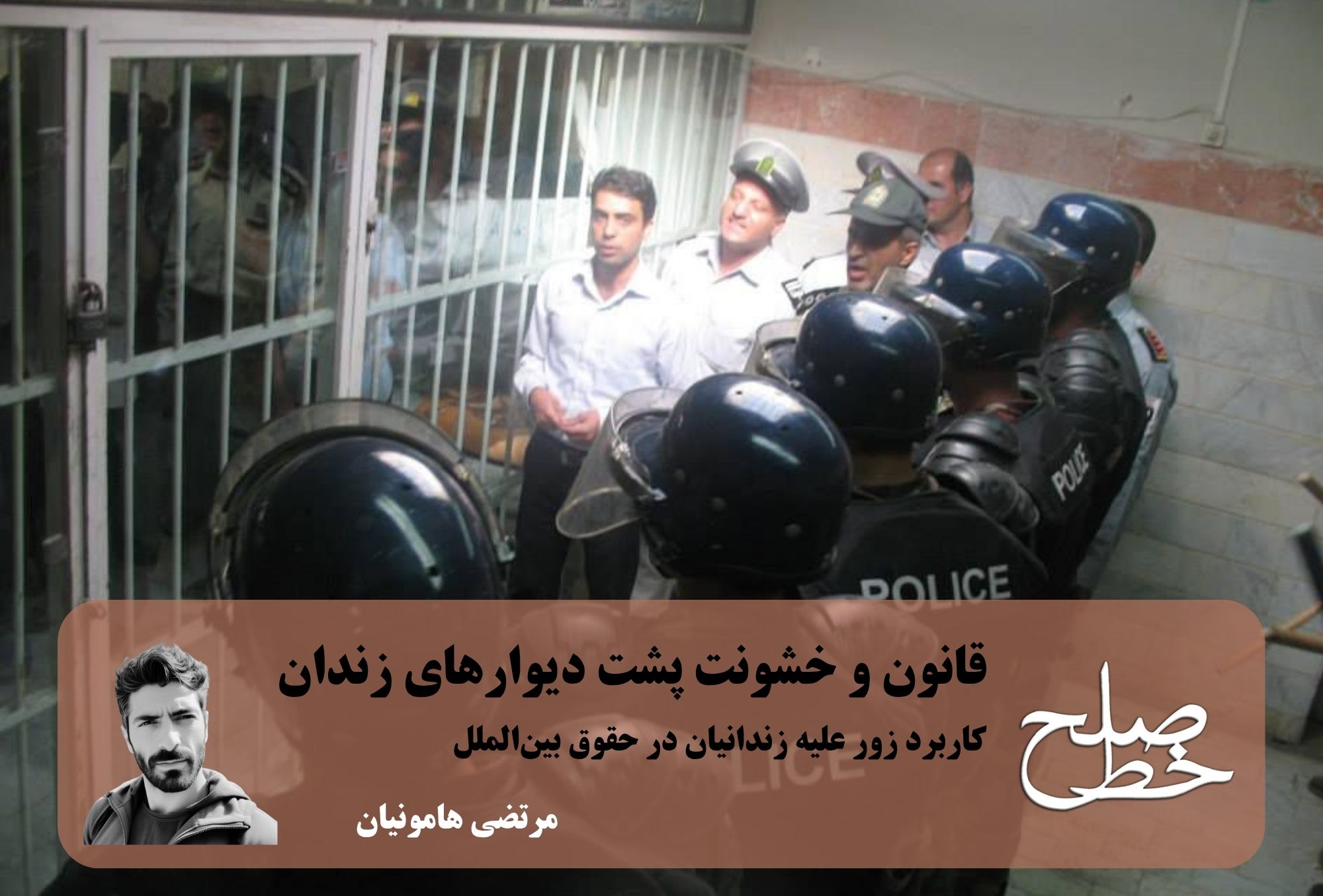
Law and Violence Behind Prison Walls/ Morteza Hamounian
It is no longer strange for officers to shoot at people in the streets and in the face of public protests. Of course, it was strange at one time; an air shot in the ceiling would scare everyone, wondering why the security officers had started shooting. But today, and especially after what happened in 2009, it is no longer strange. The number of casualties increases every time. It is as if the government’s repression officers, who once used batons more, now speak more in the language of firearms. In these circumstances, when shooting on the street floor, where there are hundreds of mobile phone cameras and onlookers, becomes so reckless and repetitive, one must ask what is happening behind the walls of the prison – where there are no cameras or independent witnesses – and what are the beatings and screams that cannot be heard from behind the high walls of the prison.
Prison is one of the most unequal situations in which a citizen interacts with the government. When attackers and security forces attack on the street, there is a place to escape, a street to which you can go and escape, and in short, perhaps you can find a refuge. But in prison, none of this is the case. You are between four walls and the one who threw you into prison. This is where the door closes and the person becomes dependent on the same structure that detained him for almost everything. Food, water, medicine, doctor, telephone, visits, going to the bathroom, and even turning on and off the light in your cell are in the hands of the same security force. It is in the hands of the prison guard. It is this inequality of power that has made the use of force in prison a very sensitive issue in international law.
The basic rule is: a person who is arrested or imprisoned is deprived of his freedom, not his humanity. Even a person convicted of the most serious crime does not lose the right to life, physical and mental health, and the right to human dignity. Article 10 of the International Covenant on Civil and Political Rights states that all those deprived of their liberty shall be treated with humanity and with respect for the inherent dignity of the human person. Articles 6 and 7 of the same Covenant also recognize the right to life and the prohibition of torture and cruel, inhuman or degrading treatment. Iran ratified the Covenant in 1975 and has been a party to it since March 1976, i.e., Farvardin 1355.
But this does not mean that an officer never has the right to use force. Suppose prisoners are fighting, targeting an officer, or attempting to commit suicide. They are trying to take hostages and resort to violence to escape. In such a situation, it is unrealistic to expect officers not to intervene physically. International law does not prohibit the use of force at all. The question is where force begins, how far it can go, and when it turns from intervention to control danger into violence and punishment.
The answer to this question is to be found in the United Nations Basic Principles on the Use of Force and Firearms by Law Enforcement Officials, adopted in 1990 at the Eighth United Nations Congress on Crime Prevention and the Treatment of Offenders. This document regulates not only policing on the street, but also specifically the treatment of detainees and prisoners by officers.(1)
How much force is permissible?
The starting point of this document is clear. Before resorting to force and weapons, the officer should use milder methods as much as possible. Force is permitted when other methods have failed or cannot achieve the desired legal goal. Simply put, beating, tying hands and feet, using a baton or shooting should not be the officer’s first response to any form of disobedience. This use of force has four basic pillars and principles: “lawfulness”, “necessity”, “proportionality” and “accountability”. These four headings well illustrate the general logic of international standards. The officer must act in accordance with the law. The use of force must be truly necessary. Its intensity must be proportionate to the danger that exists and, ultimately, the officer and the institution that employed him must be accountable for the consequences of their actions. (2) In fact, each of these terms limits part of the officers’ authority. Lawfulness means compliance with the laws of the country and international standards. The necessity for the use of force arises when there is no other solution to achieve the legitimate goal of the officers. The amount of force used must be equal to and proportionate to the level of threat, and ultimately, the officers and the government must be held accountable for any injury or death. (2)
The officer must have a reason for using force. The fact that beating is faster and easier is not the answer. Even protesting, swearing, or refusing an order alone does not authorize hitting a prisoner. The issue does not end with the beginning of the use of force. It must also be necessary to continue it. Suppose a prisoner attacks an officer or another prisoner and is unable to restrain him for a short time. But when the person falls to the ground, his hands are restrained or handcuffed, and he is no longer able to attack, the situation changes. Continuing to punch and kick at this stage is no longer to ward off danger and can turn into punishment and revenge. This punishment and revenge applied by the officer is itself a crime. Of course, in governments where humanitarian law and human rights prevail.
Another point is the issue of proportionality. The intensity of the force must be in line with the danger that exists at that moment. This has nothing to do with the accusation against the person or what ideological angle he has with the government. The intensity of the use of force should not be mixed with revenge or the release of personal or religious and cultural complexes. If someone attacks with a knife, for example, you cannot recklessly draw a firearm and shoot him to death. There must be an immediate risk of death or serious injury and there must be no less dangerous way to stop him.
Finally, there is the issue of resistance. The word alone does not clarify anything. Resistance can be an attack with a knife or simply refusing to walk. One must consider what the danger was, how many officers were on the scene, and whether a less dangerous option was possible. UN principles state that if the use of force is unavoidable, officers must exercise restraint, minimize harm, preserve life, and provide immediate medical attention to the injured. Injuries or deaths must also be reported as soon as possible. Nor can an emergency, political unrest, or orders from a higher authority justify the arbitrary use of force.(1)
Regarding firearms, Article 9 of the aforementioned UN document limits their use to exceptional situations. An officer may only use a firearm to defend himself or another against imminent danger of death or serious injury, to prevent a crime that seriously threatens the life of others, or to apprehend and prevent the escape of a person who poses such a danger. This is when less severe methods are not effective. The intentional use of a firearm to kill a person is also permissible only when it is absolutely unavoidable to save a person’s life. (1)
When it comes to prisons, the restrictions become even stricter. Principles 15 and 16 of this UN document state that officers should not use force against prisoners and detainees unless it is absolutely necessary to protect the security of the premises or the lives of the individuals in them. The use of firearms is also permitted only to defend themselves against an immediate threat of death or serious injury, or to prevent the escape of a prisoner who poses such a threat. (1) In other words, even simply escaping is not a license to shoot. An escaped prisoner is a violator of the law. But his right to life is in place. If he is unarmed, has escaped, and has not threatened anyone, he cannot be shot. Even a shot to the leg, as provided for in the Law on the Use of Weapons by Armed Forces Officers (3), does not guarantee that the injured person will survive. So, according to the UN document, and contrary to the laws of the Islamic Republic, it is not right. A bullet fired at the leg can also rupture a major artery or cause fatal bleeding. But the main question before the bullet hits the spot is whether the use of the weapon was inevitable at all.
Meanwhile, the Nelson Mandela Rules follow the same logic for prison administration. According to Rule 82, prison staff may only use force in self-defense, to prevent escape or to meet physical resistance to a lawful order, and its amount should not exceed what is strictly necessary. Incidents must be reported immediately, and staff who come into direct contact with prisoners should not be armed except in exceptional circumstances. (4) Even if it involves interrogation, the issue is clear. When a defendant is beaten for his email or mobile phone or computer password and is put in solitary confinement and subjected to various escapes, the question of proportionality becomes meaningless. There is no proportionate amount of beating to extract a confession. In such a situation, force has no legitimate purpose from the outset and can amount to torture or inhuman and degrading treatment. This is not absolute. No excuse is accepted in this context.
Iran and the realities behind prison walls
In Iran, on paper and in the legal regime, some of these restrictions have been accepted. The executive regulations of the Prisons Organization state that guards assigned to prisons must perform their duties without weapons. The same regulations prohibit the use of handcuffs and shackles, unless there is a risk of self-harm or harm to others. In such cases, necessity and proportionality must be observed, and the use of these devices must not last more than 24 hours. (5) Article 54 of the same regulations also requires recording the physical condition of the prisoner upon arrival. If there are signs of serious injury or damage, or if the prisoner says that he or she has been beaten, photographs of the injuries must be taken, the person examined, and the matter reported to the prison director and the judicial authority. (5) Of course, these are laws written on paper, the implementation of which can help clarify the situation of violence and what happened. But what is really happening is something else. The reality of the matter is structural and systematic torture, physical and psychological torture, forced confessions that sometimes lead to executions, and unofficial torture chambers that exist in Iran today. (6) In other words, reality is far from what is written on paper. The question is whether the doctor mentioned in the law can speak freely with a prisoner? Isn’t the doctor himself part of the security apparatus of repression? Basically, does anyone among the security, judicial, and judicial forces accept responsibility for beating the accused?!
The regulations also provide for the possibility for prisoners to file a complaint and request a meeting with the execution judge or the prison governor. (5) But the main issue is what happens after the complaint is filed. Are the camera images preserved? Does the accused officer still have access to the prisoner? Is the complainant protected from threats or informal punishment? Or is what is really happening is that the security guards rule the prison and the judiciary, and all these images and issues end up with them? The reality is the latter. In fact, these security guards are the bailiffs, the prosecutors, the judges, and the prison guards. The non-independent judiciary is a tool in their hands and nothing more.
The Iranian government has also made provisions regarding shooting at escaping prisoners. According to the regulations on the use of weapons, the officer must give the order to stop and may be allowed to shoot if initial measures are unsuccessful. The regulations also mention shooting in the air and targeting the lower body, and in some cases, shooting without going through the full process is permitted. (7) The problem here is that the main criterion should be the danger to life. If a prisoner is escaping but does not threaten anyone’s life, stopping him with a bullet is not in line with UN standards. Escape can be a crime or violation, but its punishment is not death. The order of warning and the location of the target cannot replace the principle of necessity. But in reality, prisoners are shot by prison forces for escaping. For example, on the night of February 10, 2020, four prisoners from the ordinary crime brigade of the “Greater Tehran” prison (Fashafoyeh) attempted to escape. However, three of these prisoners were shot by soldiers while crossing the prison wall, were injured, and were taken to the hospital. The fate of the fourth was not known. (8)
The gap between regulations and reality can be seen in reports published from Iranian detention centers and prisons. The UN Independent Fact-Finding Mission on Iran has documented cases of beatings, torture, threats, sexual violence, pressure to extract confessions, and deprivation or delay in medical treatment among some detainees. A significant proportion of these cases involved individuals who were arrested after protests and were already under the control of officers when the violence broke out. (9) Of course, the report cannot be generalized to all prisons and detention centers, as access to all of them was not possible. But it is a handful of examples, and the Islamic Republic’s record in this regard is also quite clear. In this case, no one is held accountable. The officer who used force himself writes the report, and the others confirm it. In other words, the accused, the investigator, and the judge are one and the same. The hands of the unfortunate prisoner who is subjected to violence are not tied anywhere. If there was accountability, the officers’ behavior would change and they would be more careful what they do next time. But when there is no accountability, the officers have their hands on the prisoners’ lives and do whatever they want.
Behind prison walls, there are few witnesses and the power of the government is great. The law must be applied more strictly there. The officer must either not use force or, if he uses force, he must be accountable for why. The principles of necessity and proportionality discussed above are not just two legal principles. They are two rational and moral foundations that create a boundary between the power of the government and the human body that is at its disposal. If this boundary is removed, the baton turns from a means of control into a means of punishment, the handcuffs from a means of security into a means of harassment, and the gun from a last resort to save life, in the ordinary language of exercising power. The prisoner is at the disposal of the government and the government is responsible for his life. For this reason, every blow that is unnecessarily struck, every shot that is fired without immediate danger, and every scream that goes unanswered behind prison walls is not just a story of an officer’s behavior with a prisoner. The story is what power does to a person when no one sees it. But when there is no accountability, the prison guard does whatever he wants. An example of this is the murder of Hoda Saber in prison in June 2011, who, according to the testimony of 64 of her fellow prisoners, was beaten by prison guards during a hunger strike and the resulting illness. (10) No one was held accountable for her murder, nor was there any proportionality in the treatment of her. This is the tradition of the government in the Islamic Republic, a government that considers itself the owner of the property and lives of its citizens and considers them lawful for itself.
Footnotes:
1- Basic Principles on the Use of Force and Firearms by Law Enforcement Officers, Boroumand Foundation Library, September 29, 1980.
2- Protocol on the Use of Force by the Police in UN Law, Fars News Agency, January 1, 1404.
3- Officers shooting at people; what does the law say about this?, Fararo, 2 February 2025.
4- United Nations Office on Drugs and Crime, United Nations Standard Minimum Rules for the Treatment of Prisoners (Nelson Mandela Rules), United Nations, 2015.
5- The Executive Regulations of the National Prisons Organization and Security and Educational Measures, approved on June 18, 1401 by the Head of the Judiciary, with the latest amendments and additions up to February 26, 1401, Test.
6- Dimensions of torture in Iran; “What we know is the tip of the iceberg”, Deutsche Welle Persian, Atfeh Chaharmahalian, July 25, 2021.
7- Executive regulations of Note (5) of Article (3) of the Law on the Use of Weapons by Armed Forces Officers in Necessary Cases, approved by the Council of Ministers on July 20, 2002, website: Davudabadi.ir.
8- Escape from Greater Tehran Prison, Iran Wire, February 12, 2020.
9- United Nations Human Rights Council, Report of the Independent International Fact-Finding Mission on the Islamic Republic of Iran (Fifty-eighth session, February 24-April 4, 2025). United Nations.
10- Reaction to the testimony of 64 prisoners about the death of Hoda Saber, BBC Persian, June 14, 2011.
 Created By: Morteza Hamounian
 July 23, 2026
Tags
Abuse and insult International Covenant on Civil and Political Rights Mandela's Rules Morteza Hamounian Peace Line 183 Prison guard Prisoners Prisoners' harassment Prisoners' rights Violence