


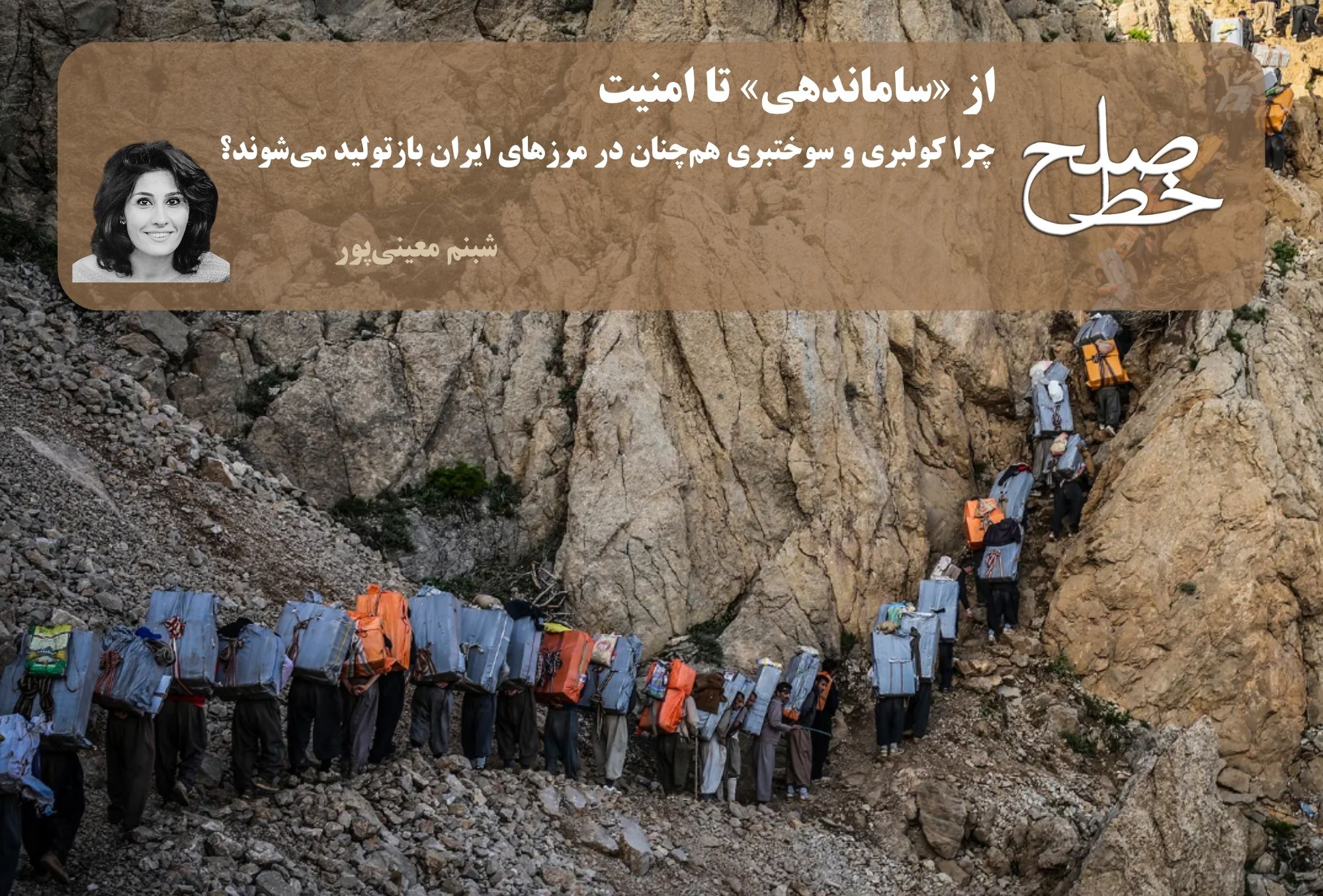
From “Organization” to Security; Why Do Kolbari and Fuel Carriers Continue to Reproduce on Iran’s Borders? / Shabnam Moeinipour
The passage of the “Law on the Organization and Supervision of Border Trade (Kolbari and Sailors) and the Creation of Sustainable Employment for Border Residents” in 1402 can be seen as a kind of official acceptance by the Islamic Republic that the Kolbari issue cannot be viewed solely in the context of smuggling or border control, and that the economic and livelihood conditions of border areas must also be considered in policymaking. The law itself sets the economic prosperity of border areas, strengthening the livelihoods of border residents, and creating sustainable employment as its goals, and in determining the annual import ceiling for provinces, it also foresees consideration of the level of deprivation and underdevelopment of the regions. However, more than two years after the passage of the law, reports of the killing of Kolbars on the western borders and Baloch fuel workers in the southeast continue. The position of UN experts on September 23, 2026, highlighted this tension again. How can we, on the one hand, pass a law to regulate the economic activities of border residents and obligate the government to create sustainable employment, but on the other hand, those who depend on the border economy for their livelihoods continue to be exposed to shootings, injuries, and death?
The answer cannot be found in law enforcement alone. The problem lies in a set of economic, social, and political factors that have shaped living conditions in some border areas over the years. Poverty and unemployment, uneven development, lack of investment and infrastructure, structural discrimination and deprivation, and the dominance of a security perspective over border management are all important in examining the roots of kolbari and fuel barbari. Until these factors change, the shape of cross-border trade may change and activities may be subject to greater supervision, but people’s economic dependence on risky activities will not be eliminated by simply changing regulations.
Kolbari : Career choice or product of lack of choice?
Kolbari cannot be analyzed as a typical profession that one chooses from among several job opportunities. Research on the Kurdish regions of Iran shows that for many kolbari, this activity begins when there is no other reliable economic option. In its 2024 research, Human Rights Watch identified poverty and unemployment as the main factors that lead people to turn to kolbari. In interviews with the organization, people explained that they turned to kolbari after failing to find a job or because the wages of existing jobs were low. Even having a university education was not necessarily a way out of this situation. This situation was also confirmed in the British Home Office report on kolbari. The report, published in 2025, introduces poverty, unemployment and the consequences of economic sanctions as factors that lead people in Kurdish regions to turn to kolbari and shows that this activity is not limited to adult men and that women and children also participate in it.
But the consequences of kolbari dependency are not limited to the family’s current livelihood situation. The 2024 report by the Center for Human Rights Defenders shows how kolbari dependency can become a cycle of economic deprivation. The lack of job opportunities leaves families dependent on kolbari income, and the precarious and precarious nature of the work also limits the family’s ability to improve their economic situation. This deprivation can be passed on to the next generation. In some families, children turn to kolbari to help make ends meet while studying, and in some cases, poverty and deprivation have led them to drop out of school. In such situations, the issue is no longer just the poverty of an individual or family, but the risk of poverty being passed on from one generation to the next.
This situation also poses a fundamental question to the concept of “free choice of occupation.” When an individual turns to hazardous work due to the lack of a reliable economic option to support himself and his family, to what extent can the choice of that occupation be considered free? Article 6 of the International Covenant on Economic, Social and Cultural Rights recognizes the right to work in relation to the possibility of earning a living through work that the individual freely chooses or accepts. Of course, not every economic hardship can be considered a violation of the right to work. The right to work does not simply mean having any source of income. It is linked to access to employment opportunities, just and safe working conditions, and the possibility of earning a living. Therefore, if public policy focuses only on regulating kolbari, without creating alternative employment opportunities, the form of activity may change but the restriction of economic choice will remain.
Unbalanced development and the border economy
It is an important question why, in provinces with significant potential in agriculture, tourism, border trade and natural resources, parts of the population still depend on risky border activities for their livelihoods. The report by the Center for Human Rights Defenders considers one of the reasons for this situation to be the inequality between the center and the peripheral regions of the country. The concentration of investment, infrastructure and economic opportunities in some areas, along with the lack of facilities and investment in other areas, has contributed to the persistence of this inequality. The fact that a province has natural resources or a favorable location for trade does not necessarily mean that its residents also have sufficient and sustainable job opportunities. When the local economy cannot provide such opportunities, the border itself becomes a means of livelihood.
In the southeast of the country, the type of activity is different, but its economic context is similar to that of kolbari. The difference in fuel prices between Iran and neighboring countries, along with the need for income for households, are factors that contribute to the continuation of fuel transportation. A 2023 Zamaneh Radio report shows that fuel transportation in Balochistan is part of a wider chain that, in addition to fuel carriers, also involves intermediaries, tank owners, and other fuel trade actors. According to the information gathered in this report, drivers and fuel carriers directly bear the risk of transporting fuel and being confronted by security forces, while some other people active in this chain may have a greater share of its benefits. Therefore, not all people involved in the informal fuel trade can be placed in the same position in terms of economic power, the amount of profit, and the risks they bear. In the case of kolbari, a distinction must also be made between kolbars and the wider informal trade network.
The Home Office report points to the hierarchical structure of these networks, which are often run by traders. The person carrying the goods over the mountain passes is in a different position from those who organise the trade and may be one of the least powerful links in the chain. If the focus of informal trade is on the person who carries the goods, the greatest pressure may fall on the person who bears the risk of the transport directly but has limited power in the wider structure of the trade. But uneven development alone does not explain the whole problem. It is important to ask why economic deprivation has persisted in some areas for so long and what is the relationship between this deprivation and the social and political situation of the population living in those areas.
Discrimination and structural exclusion in border areas
To understand the roots of kolbari and sokhtbari, one must also pay attention to the role of discrimination in the economic deprivation of border regions. Kolbari is prevalent mainly in Kurdish areas and sokhtbari in Baluchi areas. Of course, not all of the economic problems of these regions can be attributed to ethnic or religious discrimination. But in examining these deprivations, the possible role of discrimination and the effects of development policies cannot be ignored. The question is to what extent have the country’s economic and development policies played a role in creating or exacerbating existing inequalities. Discrimination does not always appear in the form of an explicit legal prohibition. Sometimes a policy that is apparently the same for everyone ends up in practice to the detriment of groups that have previously enjoyed fewer opportunities and facilities. A region that has faced years of lack of investment, infrastructure, educational facilities, and job opportunities may need more support and investment to reach a comparable level of opportunities. Real equality requires attention to these differences.
In its 2024 report on the Kolbars, Human Rights Watch examined their situation in the context of a long history of marginalization of Kurdish communities and economic deprivation. In its 2024 concluding observations on Iran, the UN Committee on the Elimination of Racial Discrimination expressed concern, in addition to economic and social inequalities in provinces inhabited by ethnic and religious minorities, about reports of disproportionate and lethal use of force against Kolbars and fuel carriers, mainly Kurds and Baluchis. The committee also called for reform of laws on the use of firearms, independent and effective investigations, and the provision of reparations to victims. The issue of inequality in the enjoyment of economic and social rights has also been raised in previous reviews of Iran by UN bodies. In its 2013 concluding observations (E/C.12/IRN/CO/2), the UN Committee on Economic, Social and Cultural Rights expressed concern about inadequate living conditions in areas inhabited by ethnic minorities and the lack of basic services in these areas. The Committee also expressed concern about land expropriation and forced evictions of residents as a result of some development projects, stressing that these measures have disproportionately affected some minority communities, including the Kurds and Baluchis. Regarding Sistan and Baluchestan, it noted the poor state of health indicators, access to water and sanitation services, and the lack of investment in health infrastructure in rural areas, and called on the Government to allocate more resources to improve this situation.
This issue is also important from the perspective of international law. According to article 2, paragraph 2, of the International Covenant on Economic, Social and Cultural Rights, States are obliged to ensure the enjoyment of the rights set forth in the Covenant without discrimination. Iran has also acceded to this Covenant and is obliged to observe it. The Committee on Economic, Social and Cultural Rights has emphasized in its general comment No. 20 that the elimination of overt discrimination from law is not sufficient to achieve equality, and that States must also pay attention to the discrimination that occurs in practice and the deep-rooted inequalities that prevent different groups from enjoying equal enjoyment of economic and social rights. Therefore, the issue is not only whether or not residents of border areas have the right to employment in law. It is also necessary to see to what extent they have access to employment opportunities, education, public services and social security in practice and whether these opportunities are comparable to those available in the more prosperous areas of the country.
This question also arises in the implementation of the Law on the Organization of Border Trade. Is the difference in the level of deprivation and underdevelopment of regions, as foreseen by the law itself, taken into account in determining the share of provinces and implementing employment programs? Do those who are more dependent on kolbari for their livelihoods actually benefit from employment programs? From a human rights perspective, it is also necessary to ask whether the implementation of these programs has taken into account the situation of groups who may face greater barriers to access to employment, including women, youth, and people with disabilities. If this law is to help reduce deprivation, it remains to be seen what change it will bring to the lives of those who have previously enjoyed fewer economic opportunities. Otherwise, border trade may take a more formal form, but the conditions that have made people dependent on kolbari and other risky activities will remain.
What did Law 1402 change?
The importance of the Border Trade Regulation Law is that it has created a five-year legal framework for a part of the border trade through kolbari and sailors. In this way, kolbari is no longer seen only in the context of combating informal trade, and the livelihood and employment of border residents have also entered policymaking in this area. The executive regulation has also specified who can be recognized as kolbars in this mechanism. Eligible residents of border counties in the provinces of West Azerbaijan, Kurdistan, Kermanshah, Sistan and Baluchestan, and South Khorasan are subject to this definition, and priorities have been considered for people with a history of kolbari, unemployed heads of households, and residents of counties with border bazaars.
In terms of border development, perhaps the most important part of the law is Article 3. According to this article, all customs and tax revenues generated from the implementation of the law are deposited in a special account with the national treasury and must be allocated 100% to the border province in addition to the funds foreseen in the annual budget. Of these resources, 60% are intended to strengthen the livelihoods and employment of border residents and create sustainable employment, 20% to develop the infrastructure of the border economy, and 20% to strengthen security infrastructure and combat smuggling.
The law has not limited itself to allocating these resources. The government has been tasked with developing and implementing, in cooperation with public and revolutionary institutions, a comprehensive and operational plan for the development of economic activities in border areas and the creation of sustainable employment for border residents. The law itself stipulates that this plan must be prepared based on land planning documents and considering the level of deprivation and underdevelopment of the areas, and that by the end of the fifth year of the law’s implementation, eligible border residents will enjoy stable jobs and sufficient income, along with appropriate social security. The executive regulations have also tasked the working group responsible for implementing the law, in cooperation with relevant agencies, to develop a comprehensive plan for the development of sustainable and quickly profitable employment in the affected areas and submit it to the Council of Ministers.
Therefore, creating sustainable employment is not just a general goal in the text of the law, and a specific task has been set for planning in this area. If the goal of the law was only to organize and formalize kolbari, its success could be measured by the number of registered people, the volume of imported goods, or the amount of customs revenue. But when the law itself aims to create sustainable employment and sufficient income for border residents, its success should also be measured based on these goals. However, predicting these goals in the law does not mean that they will be realized in practice. The main criterion is what change the implementation of the law has made in the employment, livelihood, and social protection of border residents.
Does organizing also reduce dependence on kolbari?
A distinction must be made between regulating kolbari and reducing the need for kolbari. Registering kolbari, establishing formal routes, and establishing customs procedures can help make cross-border trade more transparent and traceable and reduce some of the informal trade. But none of these will create alternative jobs on their own. An activity may become more formalized administratively, while the individual is still forced to do the same risky work due to the lack of other economic opportunities. If, after five years, kolbari has become more observable and formalized, but border households still depend on it for their livelihood, one must ask to what extent the goal set by the law itself of creating sustainable employment, sufficient income, and adequate social security has been achieved. From this perspective, the social protection status of kolbari also becomes important. The executive regulation on seafarers explicitly stipulates that if the vessel owner does not take steps to cover the social security insurance of the seafarers, the vessel will be deprived of the privileges of seafaring. However, in the case of kolbars, a similar mechanism for insurance coverage against risks such as injury, disability or death during kolbar work is not foreseen in this regulation.
This is despite the fact that the law itself stipulates that, by the end of the five-year period, eligible border residents will have stable employment and an adequate income, along with an adequate social security system. If an individual is identified as a kolbar in a formal framework but does not have effective protection in the event of injury, disability, or death, formalization of the activity alone will not eliminate their vulnerability. This issue is also related to Article 28 of the Constitution. In addition to the right to choose a job, this principle obliges the state to provide individuals with the opportunity to work and equal conditions for obtaining jobs. Article 29 also considers social security to be a universal right. Therefore, the issue is not just how kolbars are carried out. It is necessary to ask whether those who depend on this activity for a living have access to suitable job opportunities and effective social protection.
Where do fuel consumers fit into this law?
One of the important limitations of Law 1402 is that its commercial mechanism focuses on the import of goods through kolbari and sailors, while fuel transportation, in its common form in Sistan and Baluchestan, mainly involves the transfer of fuel from Iran to Pakistan and other areas across the border. Therefore, the inclusion of Sistan and Baluchestan in the list of provinces covered by the law does not mean that the issue of fuel transportation is also considered in this framework or that a solution has been foreseen for it. This difference is important because kolbari and fuel transportation are not a single phenomenon from a legal and economic perspective, but they share common grounds. In both cases, groups of border residents resort to risky activities to earn a living and, in addition to the risks arising from the work itself, face the risk of shooting, pursuit, and clashes with security forces.
In a statement on September 23, 2026, UN experts described Kurdish kolbars and Baloch fuel carriers as among the most economically marginalized groups in Iran, emphasizing that they resort to transporting goods and fuel across border areas when other ways to support their families are very limited. The experts also reported that at least 13 Baloch fuel carriers were killed from January to August 2026 in connection with shootings, pursuits, and other actions by military and security forces. A 2023 report by Radio Zamaneh also documented cases of children and adolescents entering fuel carriers and dropping out of school to help support their families. This shows that the consequences of economic dependence on fuel carriers can go beyond the family’s current income and livelihood and limit educational opportunities for the next generation.
Fuel transportation, of course, has not been entirely outside the scope of government policy. For example, a 2023 Radio Zamaneh report noted the implementation of the “Razzaq” plan from 2020 and its impact on the routes used by fuel carriers. But the existence of such plans alone does not indicate that the livelihood problems of fuel carriers have been resolved or that alternative economic opportunities have been provided for them. The main issue is the extent to which fuel transportation policies pay attention to the economic and livelihood conditions of the people of Sistan and Baluchestan. If public policy focuses primarily on controlling the informal transfer of fuel—without providing other economic opportunities for households dependent on this income—the way fuel transportation is carried out may change, but the factors that have made people dependent on it will remain. Addressing the fuel transportation issue, therefore, cannot be achieved by regulating fuel transportation alone or tightening border controls. Such policies must be accompanied by measures to reduce economic deprivation, create sustainable job opportunities, and support families whose livelihoods depend on this activity.
The tension between development policy and security policy
Law 1402 pursues two goals simultaneously, the implementation of which can have different consequences for border residents. On the one hand, a large part of the revenue generated by the implementation of the law should be spent on strengthening the livelihoods and employment of border residents and developing the economic infrastructure of border areas. On the other hand, some of these same resources are intended to strengthen security infrastructure and combat smuggling, including blocking unauthorized border crossings and routes. These two goals are not necessarily incompatible with each other. The government can regulate border trade and combat smuggling. However, restricting informal livelihoods without simultaneously creating alternative economic opportunities can increase economic pressure on border residents.
If a route that a part of the local population uses to make a living is closed, but the alternative employment opportunities that the law provides for are not yet available, the result for a family whose income depends on that route will not be simply a “business settlement.” The family’s source of income may disappear before a replacement is found. In such a situation, the individual is caught between two pressures. The formal economy does not provide sufficient opportunities to make a living, and at the same time, the ways in which they previously earned a living become more limited or risky.
For this reason, the timing of policy implementation is important. If reliance on kolbari is to be reduced, the creation of sustainable employment opportunities, social security and the necessary infrastructure cannot be postponed indefinitely. These measures must be implemented simultaneously with, and, where the closure of, informal routes directly affects household livelihoods, before them. Otherwise, the costs of the transition from the informal to the formal economy may fall most heavily on those households that are least able to bear the loss of their income. This is particularly important in areas that already face economic deprivation and limited access to employment opportunities.
When the issue of livelihood reaches the right to life
The September 23, 2026, statement by the UN experts takes the issue of kolbars and fuel carriers beyond the realm of livelihood and trade, and also raises the issue of the use of lethal force and the protection of the right to life. According to information received by the experts, since the beginning of 2026, at least 12 kolbars have been killed by border forces or the Revolutionary Guards. In the two months before the statement, the experts had received seven reports of kolbars being killed by direct fire from border guards, at close range and without warning. According to these reports, some of them were not even carrying any goods when they were shot. At least 13 deaths of Baloch fuel carriers were reported between January and August 2026 in connection with shooting, pursuit, and other actions by military and security forces.
But behind these statistics lie implications that directly link livelihoods to health, social protection and the right to life. In the case of Madih Kermani, according to information released by UN experts, the 44-year-old man left his home in Marivan on July 28 and did not return. He was reportedly not carrying any belongings when he was shot. Authorities told his family that he died after falling from a height on the border, but according to a statement by UN experts, forensic evidence showed that he had been shot in the head. The case of Milad Tabad illustrates another dimension. After being shot in the head, he lived with the consequences of this injury for nearly a year and died on August 18, 2026. He was hospitalized in intensive care for months, but his family, unable to afford further treatment, were forced to take him home and care for him themselves. This case shows that the consequences of a border shooting are not limited to death at the scene. A serious injury can leave a family facing long-term medical and care costs, along with reduced or lost income, making their financial situation even more difficult.
UN experts were also clear on this point. Even if a person is suspected of transporting goods in violation of customs regulations, such behavior does not in itself pose a threat to the lives of others and cannot justify the use of firearms. According to international standards on the use of force and firearms, the intentional use of deadly force is permissible only when it is absolutely unavoidable to protect life. Therefore, a distinction must be made between two legal questions. One question is whether the passage of the person or the goods he is transporting was in accordance with the regulations. The other question is whether, in those circumstances, the use of deadly force against him was necessary to protect life. The possible illegality of the transport of goods does not alone justify the use of deadly force.
Access to justice and compensation
In the case of kolbars, deprivation is not limited to a lack of economic opportunities. Access to justice and redress is also part of the problem. Human Rights Watch documented in its 2024 report cases where kolbars faced serious obstacles in pursuing legal action and receiving compensation after being injured by gunfire or landmines. In some cases, complaints against officers resulted in restraining orders, and in other cases, individuals reported that they had not received all or part of the amount of compensation they were ordered to pay. In one case, a kolbar who had lost his sight as a result of shooting by border guards reported that he had not received any compensation despite being ordered to pay blood money. In another case, a person who had lost his leg in a landmine not only received no compensation but was also prosecuted for illegally crossing the border.
These cases demonstrate that victims may face legal obstacles beyond the physical and economic consequences of the incident. These findings raise important questions about effective access to justice for kolbars and their families. If an individual is alleged to have been injured or killed as a result of unlawful use of force, their economic status, place of residence, or ethnic or religious affiliation should not affect the ability to file a complaint, conduct an independent and effective investigation, and access to compensation. Even in cases where the border crossing was carried out in violation of regulations, this potential violation should not prevent the review of the legality of the officers’ actions or the consideration of the rights of the injured individual.
Poverty and economic deprivation play a significant role here as well. Poverty can not only push an individual to engage in risky work, but also limits the family’s ability to pursue legal action, pay for medical expenses, and recover lost income in the event of an accident. If there is no way to sue and receive compensation, the family may have to deal with the economic consequences of the accident for years. In their September 2026 statement, UN experts, referring to the situation of kolbars and fuel carriers, emphasized the need for accountability for these incidents. They called for deaths caused by security forces to be investigated promptly, independently, and impartially, and for the families of the victims to have access to truth, justice, and compensation. Therefore, an assessment of the situation of kolbars and fuel carriers should not focus solely on the number of deaths and injuries. It is important to ask how many of these cases have been independently and effectively investigated, what the results of the investigations were, and to what extent have the victims and their families had access to effective compensation.
From border security to border security
In border policymaking, security is usually defined by controlling territory, preventing smuggling, and monitoring movement. These are the duties of the government, but if border security is separated from the security of those who live in those areas, an important part of the issue is ignored. For a family in Marivan, Baneh, Sardasht, or Saravan, security is not just about controlling the border and preventing smuggling. Security means having job opportunities and income that do not force a person to cross the mountains at night or drive a fuel-laden vehicle on dangerous routes to pay for food, housing, and the education of their children. Security also means that if an individual is injured or unable to work, their family is not left without income and social support. The presence of armed officers at the border should not pose a threat to the lives of others. Likewise, where they live, their ethnic or religious affiliation, and their economic status should not determine their access to job opportunities, public services, social support, and justice.
From this perspective, the persistence of kolbari and fuel bartering cannot be seen as simply a matter of border control. It is directly related to the distribution of resources, regional development policies, equality of opportunity, and the government’s responsibility for the economic and social rights of the people. Law 1402 has as its goals strengthening the livelihoods of border dwellers and creating sustainable employment, along with regulating border trade. This provides a yardstick for assessing its success. If, at the end of the five-year period of the law, border trade has become more formal and its supervision has increased, but residents of these areas continue to depend on kolbari for their livelihood, the mere implementation of administrative mechanisms cannot be considered as achieving the goals of the law. What is important is achieving the developmental goal of the law: providing eligible border dwellers with stable jobs, sufficient income, and appropriate social security.
The situation is different for fuel carriers. Fuel carriers are not directly covered by Law 1402. Therefore, it is necessary to separately examine what policies are in place to reduce households’ dependence on this activity and whether they are provided with safe and accessible economic opportunities. Of course, reducing economic deprivation and creating sustainable employment takes time, but protecting human lives cannot be postponed until future development plans are implemented. In the short term, the deliberate use of lethal force should be limited to cases where it is absolutely unavoidable to protect lives. Cases of death and injury should also be investigated independently and effectively, and victims and their families should be able to seek legal action, receive compensation and receive the necessary support. In the long term, reducing dependence on fuel carriers and kolbari requires investment in the local economy, infrastructure, education, social security and the creation of employment opportunities with adequate incomes. If the economic deprivation of these regions is also linked to discrimination and structural inequality, development policies should also address reducing these inequalities and removing barriers to equal access to resources and opportunities.
Ultimately, the problem of kolbari and fuel barbari cannot be solved simply by choosing between “regulation” and “confrontation.” The main criterion is whether the policies adopted, in addition to regulating and controlling border activities, create conditions in which people are not forced to accept serious risks to earn their living. We can speak of solving this problem when a border dweller, in order to stay in his hometown and have a normal life, does not have to choose between unemployment, migration, and work that may cost him his life.
 By: Shabnam Moinipour
 October 23, 2026
Tags
"Smuggling and fuel smuggling" Am Nan Border Border guards Fuel tester Kulbars Paragraph peace line Peace Line 186 Shabnam Moeinipour Sukhtabar Uncontrolled shooting ماهنامه خط صلح