


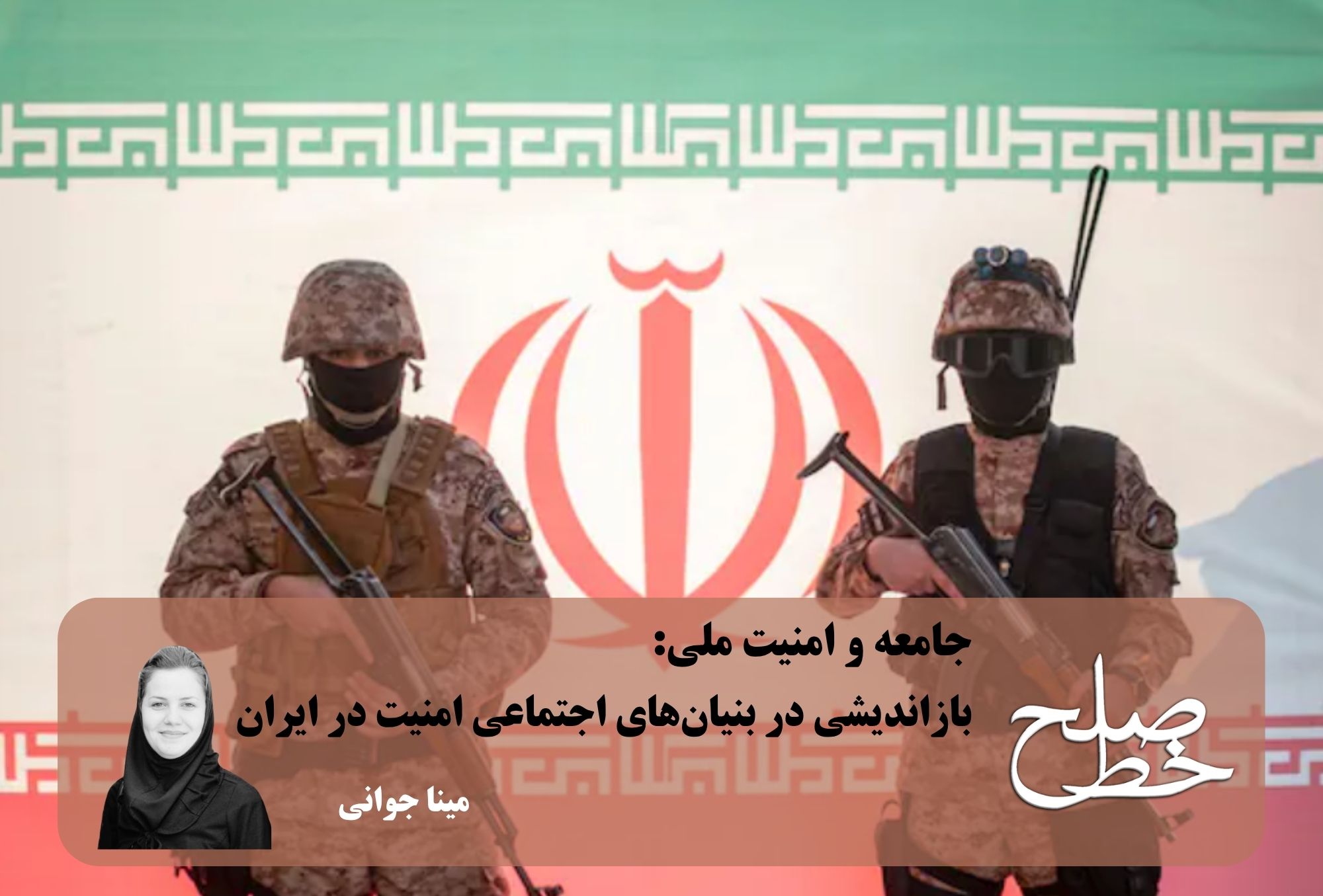
Society and National Security: Rethinking the Social Foundations of Security in Iran/ Mina Javani
In periods of heightened external threats, the concept of national security naturally becomes the focus of public policymaking. In such circumstances, the expansion of state authority, the strengthening of security institutions, and the restriction of certain civil liberties are often justified by invoking the “necessity of security.” This logic is based on the assumption that national security is a commodity that takes precedence over other political and social values; as if by ensuring security, the realization of other rights and freedoms will also be possible. However, this assumption has itself been less and less questioned.
The new literature on security studies and political sociology shows that national security is not simply the product of the accumulation of hard power or the expansion of state security capacities, but is also based on a set of social and political relations. States produce security not in a vacuum, but in the context of society. Public trust, social capital, political legitimacy, civic participation, and the guarantee of citizens’ rights and freedoms are not just normative values, but capacities that enhance a society’s ability to confront crises, mobilize resources, and maintain cohesion in the face of threats. From this perspective, society is not simply a matter of security; it is one of the fundamental sources of national security.
The issue becomes more complex when the logic of threat becomes the dominant framework of governance. In this situation, the boundary between “protecting society” and “securitizing society” gradually blurs, and the question arises whether the expansion of the logic of security always leads to the strengthening of national security or whether it may also weaken some of the social foundations of security by eroding public trust, limiting the public sphere, and weakening social capital. In other words, to what extent does national security depend on the capacity of the state to exercise power and to what extent on the capacity of society to generate trust, cooperation, and cohesion?
This question is of particular importance for Iran, given its exceptional geopolitical location, continuous experience of repression, and external threats. The purpose of this article is not to deny the necessity of national security, but to rethink its social foundations. The main argument of this article is that sustainable national security, in addition to deterrence and defensive capabilities, requires a society with trust, participation, civil rights, and a sense of belonging to the political order; because security, before being produced solely at the borders, is shaped by the quality of the relationship between the state and society.
National Security as Discourse, Subjectivity, and Conflict over “Society”
In this article, national security is considered not as an a priori and established reality, but as a discursive and historical construction; a construction in which the distinction between “security” and “threat” is formed within a network of political, institutional, and expert discourses and is temporarily fixed in each historical period. In this sense, national security is not a neutral or self-evident concept, but the result of ongoing processes of meaning-making and contestation over the definition of situations of danger, survival priorities, and modes of intervention.
In this approach, the state is no longer understood as a rational actor against external threats, but rather as a regime of meaning production through which the social world is rewritten in terms of security categories. In this process, what is called “national security” is always the result of a kind of selection and elimination: some phenomena are elevated to the level of threat, others remain in a natural and unproblematic state, and some forms of social action are located on the border between the two. For this reason, security is not a state, but a way of seeing and organizing the social.
In this framework, society is also not a monolithic and fixed whole, but a set of multiple subject positions that are unequally seen and represented in the discursive field of security. “Society” sometimes appears as a source of cohesion, solidarity, and social capital, and sometimes as a potentially problematic domain that requires management, control, or reorganisation. This duality is not a reflection of a neutral social reality, but rather the product of the temporary fixation of a particular discursive order in which some forms of biosocial possibility emerge and others are marginalised.
From this perspective, the question of “society in relation to national security” can be formulated as an epistemological and political one. This absence is not the empirical absence of society, but rather the absence of certain forms of social subjectivity from within the dominant security discourse. In other words, the problem is not the absence of society, but rather a particular way of its visibility and invisibility; a way in which only certain forms of collective action, political participation, and public expression are capable of becoming “valid” within the framework of national security.
In this context, civil liberties and citizenship rights can be analyzed as a set of mechanisms for the production of subjectivity. Freedom of expression, the right to assemble, the possibility of social organization, and the rule of law are not just a set of legal rules, but are regimes that enable the emergence and consolidation of social subjects. These subjects enter the public sphere through these mechanisms, represent themselves, and participate in the process of producing meaning and politics. In contrast, processes of securitization can redefine some of these forms of subjectivity as “impossible,” “undesirable,” or “threatening,” thereby shifting the boundaries of what can be expressed.
The relationship between national security and society cannot be formulated in terms of an external relation or simple opposition. It is internal, productive, and always incomplete. Security in this sense is not only the protection of the existing order, but also the determination of the limits of what can be said, seen, and acted upon. Any formulation of national security also carries with it a kind of policy of demarcation between different forms of social life; a policy in which some forms of social life are recognized and others are suspended or marginalized.
From this perspective, society in national security is not an “outside” or “subject” but a “contested inside”; a space in which meaning, power, and subjectivity are simultaneously produced and challenged. The main issue is not to add society to security analysis, but to rethink the very way society is seen within security discourse; a rethinking that shows that national security is simultaneously a political project, an epistemological mechanism, and a permanent arena of conflict over the definition of the social.
How does society produce security?
In Iran, national security cannot be explained under a single logic or a coherent institutional apparatus. What is established in the name of security is more the result of the unstable coexistence of several different regimes of order production; regimes that each have their own logic and, in many cases, do not complement each other, but constantly create friction. In this sense, security is not a “situation”, but a fragile balance between heterogeneous ways of governing social life.
At the first level, the issue comes down to the dichotomy between formal order and lived order. In Iran, a significant part of security is produced not at the level of macro-decisions, but in the everyday context of social life; in the repetitive patterns that are formed in economic, urban, and even informal interactions. This level of order emerges from habit, experience, and repetition, creating a kind of practical predictability. But this lived order is always in a state of incomplete overlap with institutional order. The result is the formation of a kind of structural gap in which society moves simultaneously inside and outside the formal logic of security. It is this gap that makes the experience of security in Iran fragmented and uneven.
At a second level, security in Iran is strongly tied to the issue of time; not calendar time, but time as a biosocial experience. Security is established when the future can be imagined and extended to some extent. In situations where economic, administrative, or even normative rules are faced with sudden, multiple, or interpretable changes, this temporal extension is disrupted. In such a situation, the main issue is no longer the external threat, but the gradual erosion of the possibility of imagining the future; an erosion that undermines security from within, even in the absence of overt crises.
At the third level, civil society in Iran is in a paradoxical situation. On the one hand, civil, professional, and informal networks play the role of a kind of “distributed social sensor”; a mechanism that registers changes in public trust, social gaps, and latent tensions before any official institution. On the other hand, these same networks are redefined at many points within the security logic, and some of their mediating capacity is limited. This situation has a structural effect: the more compact the civil field becomes, the slower the system’s sensitivity to social change becomes, and the distance between society and official mechanisms increases.
At the fourth level, social trust in Iran should be understood not as a cultural characteristic, but as a historical outcome of the experience of the distribution of power and costs in crises. Trust is formed when social actors can experience a kind of continuity in the “logic of fairness”; that is, they perceive that the burden of crises, decisions, and consequences are not distributed completely asymmetrically. Wherever this perception is weakened, trust does not go beyond the level of everyday relationships and is not consolidated at the structural level.
In sum, security in Iran can be seen as the result of the intersection and overlap of four logics: the everyday production of order at the societal level, the rupture in social temporality, the paradoxical role of civil society, and the unstable perception of justice in the distribution of costs. What shapes the security situation is not the dominance of one of these logics, but the constant tension between them; a tension that transforms security from an established concept into a living, unstable, and constantly reconstructive process.
Civil Liberties and Restructuring Mechanisms of National Security Perception
Continuing the previous argument, civil liberties can be analyzed not as a “sphere against security” but as part of the internal logic of the production of national security, a logic in which security is not an end state but rather the temporary effect of regulating the relationship between social observability, the distribution of subjectivity, and the management of temporal instabilities. In this framework, the liberty/security dichotomy is less an analytical distinction than a consequence of the consolidation of a particular formulation of governance in which control and stability are taken as preconditions for security, rather than as potential sources of it.
At a first analytical level, civil liberties can be considered as a condition for the possibility of “producing reliable social knowledge.” The issue of security, before being related to the level of objective threats, returns to the level of threat detection and formulation. Any security system inevitably relies on a network of information, narratives, and representations, the quality of which determines the accuracy of the detection of critical situations. In this sense, freedom of expression, the circulation of information, and the possibility of criticism are mechanisms through which the social field is transformed from a mono-narrative or compressed state into a multi-focal state of observation. This multi-focality does not mean increasing chaos, but rather reducing systematic error in threat perception.
At a second level, civil liberties can be understood in relation to the logic of the production of political subjectivity. Subjectivity here is not a natural presupposition, but the product of legal and discursive mechanisms that determine what kind of activism is capable of entering the public sphere. The more limited these mechanisms are, the more the social field moves towards a kind of subjectivization in which the complexity of social actions is reduced to limited and predictable forms. This reduction may create a kind of perceptual order in the short term, but in the long term it reduces the system’s capacity to understand the real diversity of social actions, thereby increasing the risk of security decisions.
At a third level, civil liberties can be analyzed as a mechanism for regulating “heterogeneous social time.” Society does not have a single time, but rather consists of several overlapping temporal rhythms: economic time, political time, cultural time, and the time of lived experience. Security is most stable when these rhythms can be accommodated to a minimal level of symbolic harmony. By making it possible to express the diversity of asynchronous experiences and narratives, civil liberties prevent the accumulation of temporal dissonances at the latent level. In the absence of this possibility, dissonances are not eliminated but are transferred to the level of sudden crises.
At the fourth level, civil liberties can be analyzed as a mechanism for the “non-security demarcation of the political.” Every system of governance inevitably redefines some social issues in terms of security, but the extent of this redefinition determines the overall quality of security. The more limited the public sphere, the greater the tendency to transfer issues to a security logic, which leads to the expansion of areas that are formulated in terms of a logic of control rather than a political solution. Civil liberties at this level create a kind of capacity for separation that allows some conflicts to remain at the level of political dialogue and not be pushed to the security level.
Civil liberties can be considered part of the “epistemological and temporal infrastructure of security.” They are not simply individual rights, but mechanisms that allow for more accurate threat detection, understanding the complexity of social subjectivity, regulating structural asymmetries, and preventing the excessive expansion of security logic. In this perspective, the weakening of civil liberties leads not to increased security, but to the production of a kind of perceptual and institutional compactness in which threats are recognized later and interventions become more costly and less precise.
Concolusion
This paper attempts to move the relationship between society and national security beyond a linear, state-centered relationship and to rethink it as a multi-layered, social construct. The central argument is that national security is not a product of the coercive or institutional capacities of the state, but rather of the way society is organized, the quality of social relations, and the ways in which meaning is produced at the public level. From this perspective, society is not on the margins of security, but within the process of its production.
The analysis showed that security in Iran cannot be understood as a stable and uniform state, but rather as the result of the unstable coexistence of several logics: lived order and institutional order, heterogeneous temporalities of social experience, the dual position of civil society between social sensitivity and securitization, and finally, the unstable perception of justice in the distribution of collective costs. These internal tensions make security not a fixed achievement, but a constantly reproducing process.
In this framework, civil liberties also transcend the level of a set of political rights and are redefined as internal mechanisms of security production. By increasing social observability, subjectivity, regulating temporal asynchronies, and preventing the compression of issues in the logic of security, these liberties play an important role in reducing perceptual errors and increasing the accuracy of governance systems. Thus, the relationship between freedom and security is not antagonistic, but structural and intertwined.
Ultimately, it can be concluded that sustainable security at the national level does not simply require increasing control instruments or strengthening hard capacities, but also requires maintaining and strengthening social and civic infrastructures that allow for the generation of trust, accurate threat identification, and non-security management of conflicts. In this sense, society is not the subject of security, but rather the condition of its possibility; a condition whose weakening, rather than increasing security, leads to the production of deeper insecurities at the social and institutional levels.
Footnotes:
1- Balzacq, T. (Ed.). (2010). Securitization theory: How security problems emerge and dissolve . Routledge.
2- Balzacq, T. (2005). The three faces of securitization: Political agency, audience and context. European Journal of International Relations, 11 (2), 171–201.
3- Foucault, M. (2007). Security, territory, population: Lectures at the Collège de France, 1977-1978 (M. Senellart, Ed.; G. Burchell, Trans.). Palgrave Macmillan. (Original work published 2004)
4- Giddens, A. (1991). Modernity and self-identity: Self and society in the late modern age Stanford University Press.
5- McDonald, M. (2008). Securitization and the construction of security. European Journal of International Relations, 14 (4), 563–587.
 Created By: Mina Javani
 July 23, 2026
Tags
Civil liberties Civil society Iran-US war National security peace line Peace Line 183 Security The war between Iran and Israel. War