


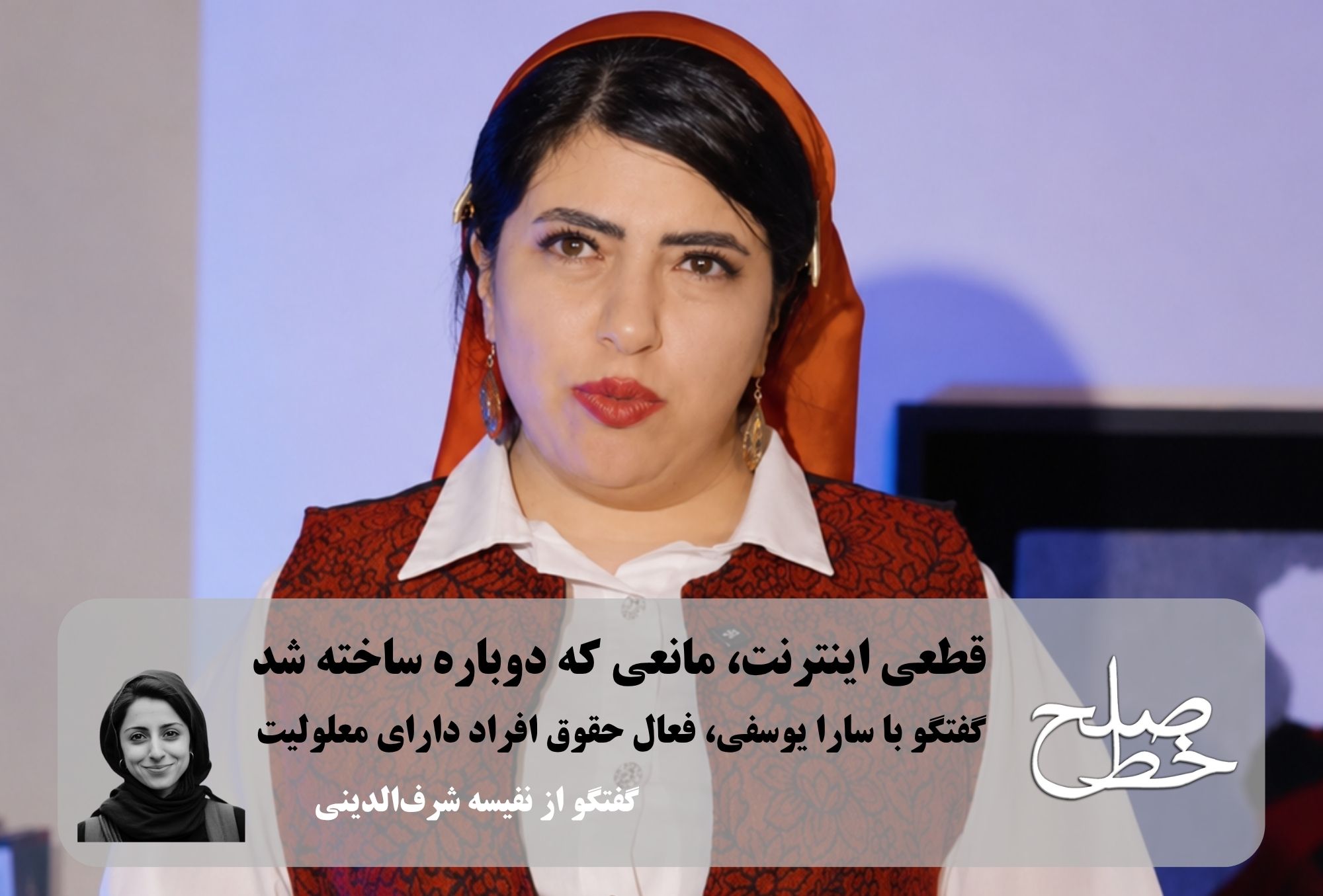
Interview with Sara Yousefi, Disability Rights Activist, on Internet Shutdowns During Wartime/ Nafiseh Sharafaldini
In recent years, digital technologies, the internet, and AI-based tools have played an important role in increasing independence and accessibility for persons with disabilities. For many of these individuals, screen readers, navigation apps, online services, social networks, and smart tools are not merely conveniences, but essential tools for work, education, communication, and even carrying out daily tasks. For this reason, disruption or restriction of internet access can have an impact beyond a technical problem and affect the independence, employment, and social participation of persons with disabilities. In this regard, we spoke with Sara Yousefi, a disability rights activist, digital marketing and SEO specialist, and digital accessibility advocate, about the role of technology in the lives of persons with disabilities and the consequences of internet shutdowns and restrictions for this community.
Below is the full text of this interview:
Please introduce yourself and tell us what type of disability you have and what activities you carry out in the field of disability rights.
Hello, I am Sara. I am 38 years old and studied software engineering. When I decided to study this field, I had low vision and used Braille. At the same time, my vision was gradually decreasing. At the age of 21, right between the associate-to-bachelor’s entrance exam, I completely lost my sight.
The first time I started my own business was in 2014 (1393). I have been working in digital marketing and SEO for years now.
Since the COVID period, people’s presence in cyberspace became more prominent, and startups and applications gained a stronger place. During that same period, this question also became more prominent: what share do blind and low-vision people have in these services, and to what extent can they use different applications, websites, and platforms? At least in the projects I worked on myself, I tried to observe accessibility principles. A few years ago, I published a video on Instagram in which I had a suggestion for the Tapsi team and spoke about Tapsi’s accessibility for blind people. In Tapsi’s profile settings, there is an option where you can specify that you have a wheelchair or cane, or that you are hard of hearing or deaf, but they had not considered blind people there. After registering a ride, low-vision and blind people had to inform the driver that they had a visual impairment so they could find the car. If it was a crowded place, finding the car was truly difficult. It had happened many times that the driver said, “Ma’am, I was waving. Didn’t you see me?” There would also be problems when getting out. When the driver does not realize that you cannot see, they may drop you off at the wrong location, and that creates trouble for someone like me who cannot see, especially if my destination is unfamiliar.
My goal is to raise awareness and familiarize businesses with the concept of accessibility so that websites and software are designed in a way that people with specific conditions—blind people, hard-of-hearing and deaf friends, and friends with physical-mobility disabilities—can work with them easily and use their services.
What does an ordinary day in your life look like? What obstacles do you experience because of infrastructural and urban conditions?
My day starts with my phone, laptop, reviewing websites, and producing content. The main challenges begin when I step outside the house. The city has not been designed for us. Sidewalks have not been adapted. I wonder why an institution like the municipality is unfamiliar with its own duties, and why passages have not been adapted for the movement of people with specific conditions. Even in a city like Tehran, which they say has the most facilities, we have sidewalks in terrible condition, and crossing them is difficult for someone like me, or someone who uses a wheelchair, or elderly people. Of course, there are sometimes special tactile paths for blind people on sidewalks, but many times they are not standard or reliable. I remember once the blind path went straight into a utility pole!
Another issue is travel agencies, which officially want to erase us from society. In many of them, requesting a wheelchair and lift is not possible, and special services are not considered for blind people, which makes traveling alone difficult for us.
Another challenge for blind people is the neglect of our banking system. You go to the bank, and they say you must introduce a trusted person, and they ignore your own personality and judgment, under the pretext that someone might want to cheat you; and if you have banking work, you definitely have to make someone else wait around for you. Another issue is that when I want to use my ATM cards, I cannot tell them apart. If banks marked the cards in Braille or in raised form to show which bank they belong to, it would be easier for us to identify them, but for now, this has not happened.
In Iran, our banking system, our startups, and various businesses do not take persons with disabilities into account. For example, in Tehran, I have seen only two restaurants that had Braille menus.
On the other hand, we also have cultural challenges; for example, people park their cars and motorcycles in front of bridges, ramps intended for pedestrians and persons with disabilities, and places meant for passage, and this creates problems for us.
Or when I want to order a taxi through ride-hailing apps, when I select the “has a disability” option, many drivers cancel the ride after seeing this option and do not accept blind passengers or passengers with wheelchairs; and this is despite the fact that when the passenger has a disability, ride-hailing apps do not take commission from the driver.
When I walk with a cane in the metro or on the sidewalk, I realize that people do not pay attention to the cane. When my orientation and mobility instructor was teaching me how to use the cane, she said, “Do not think the person coming toward you sees you. Most people are not paying attention.” Now the lower part of my cane is slightly bent; the reason is pedestrians who passed carelessly and in a hurry, hit it, and caused it to bend. Sometimes, especially in the metro, someone has passed by me quickly and my cane has caught on their foot, and my cane has been thrown several meters away.
Sometimes people want to help, but unintentionally make things harder for us; someone has come up suddenly, grabbed my hand, pulled me along, and started rushing off. Someone who has no idea where I want to go. Of course, they do this with good intentions, but we definitely need them to ask us before helping. Of course, I do not blame them, because our media and education system have not taught people how to behave with a person with a disability.
Do you use smart technologies and digital tools to make daily life easier? How do these tools help you?
Yes, very much. The more persons with disabilities become familiar with technology, the better their quality of life becomes. Because I am very active on Instagram, many people often wonder how a blind person can work with a phone or laptop. There are now software programs that help us. On both computers and phones, there are programs called TTS voice engines and screen readers, which have the ability to read any text displayed on a monitor or phone screen, except image-texts. Of course, there are even solutions for image-texts. These programs support English, and fortunately domestic companies have also developed complementary tools that make it possible to use Persian, and through those programs I can use the computer and phone.
Screen reader programs on laptops and phones allow me to do SEO work and be active on social media. Online shopping apps, audio navigation tools, and programs that use artificial intelligence to read text on images, goods, restaurant menus, banknotes, and so on also help me in many places. Overall, artificial intelligence helps me a lot. For example, just this morning when I wanted to go out, I asked Gemini to see whether my shoes were dirty or not!
On the days when Iran faced widespread internet shutdowns, what changes occurred in your daily life?
I truly felt paralyzed and helpless. As I said, I depend on the internet, and especially artificial intelligence, for many of my tasks. When the internet was cut off, the independence I had worked for years to achieve was suddenly taken away from me, and I once again became dependent on others for the smallest tasks. All my work projects also stopped, and I effectively became unemployed. During that period, I mostly read books and tried to keep myself busy with other things. There was no other choice.
During the war, the issue of the “national internet” and a kind of dual access to the internet was raised again; meaning that one group had access to the global internet and another group did not. How did you experience this situation, and what impact did it have on the lives and work of persons with disabilities?
Many persons with disabilities do freelance and online work, because for many of us, commuting in the city and finding in-person employment is not easy. For this reason, when the internet is cut off, our income may be cut off completely as well. Tiered internet increases the discrimination that already existed, because persons with disabilities are usually not among the groups that have white SIM cards and access unrestricted internet. In addition, when the internet becomes national, many rehabilitation tools that connect to servers outside the country stop working, and our daily life becomes more difficult.
During the crisis, did you find alternative ways to communicate with your audience, friends, or support networks, or did some communications effectively become inaccessible? What is your view of domestic applications?
When the internet was cut off, many communications really were cut off too. There were friends I was in contact with through Instagram, and I had no news of them during that time.
As for domestic applications, their main problem is that unfortunately they do not have proper accessibility. For example, the “Bale” application, which worked during the internet shutdown, is really not accessible and has many bugs. Among domestic applications, accessibility has been considered to some extent more in the private sector. Even the website of the State Welfare Organization itself is not suitable at all. Even its login stage is not accessible. When a responsible institution like the State Welfare Organization is in this condition, what can be expected from other platforms?
In your opinion, to what extent do Iran’s communications and digital infrastructures take the needs of persons with disabilities into account?
Around the world, many websites have accessible versions, but in Iran, unfortunately, this is not the case. In Iran, the number of service websites and applications that have properly observed accessibility standards is low, and they usually do not consider the group that uses screen readers. In Iran, many people are still not even aware that a blind person can work with a computer and phone. Nevertheless, applications like Snapp, Tapsi, Bazaar, Divar, and others decided at one point to observe accessibility, but a major flaw they had was that when they released updates, this accessibility would disappear. And on the other hand, we have well-known software programs that are not accessible at all; for example, the Digikala application, which I cannot use on my phone at all. Overall, unfortunately, Iran’s digital space has still not recognized persons with disabilities as users.
Thank you for the time you gave to Peace Mark Monthly Magazine.
 Created By: Nafiseh Sharafaldini
 June 22, 2026
Tags
Accessibility Digikala Digikala Entrepreneur Individuals with disabilities Internet outage Internet outage Iran-US war National internet peace line Peace Line 182 Rights of the disabled Sarah Yousefi Tepsi The war between Iran and Israel. War