


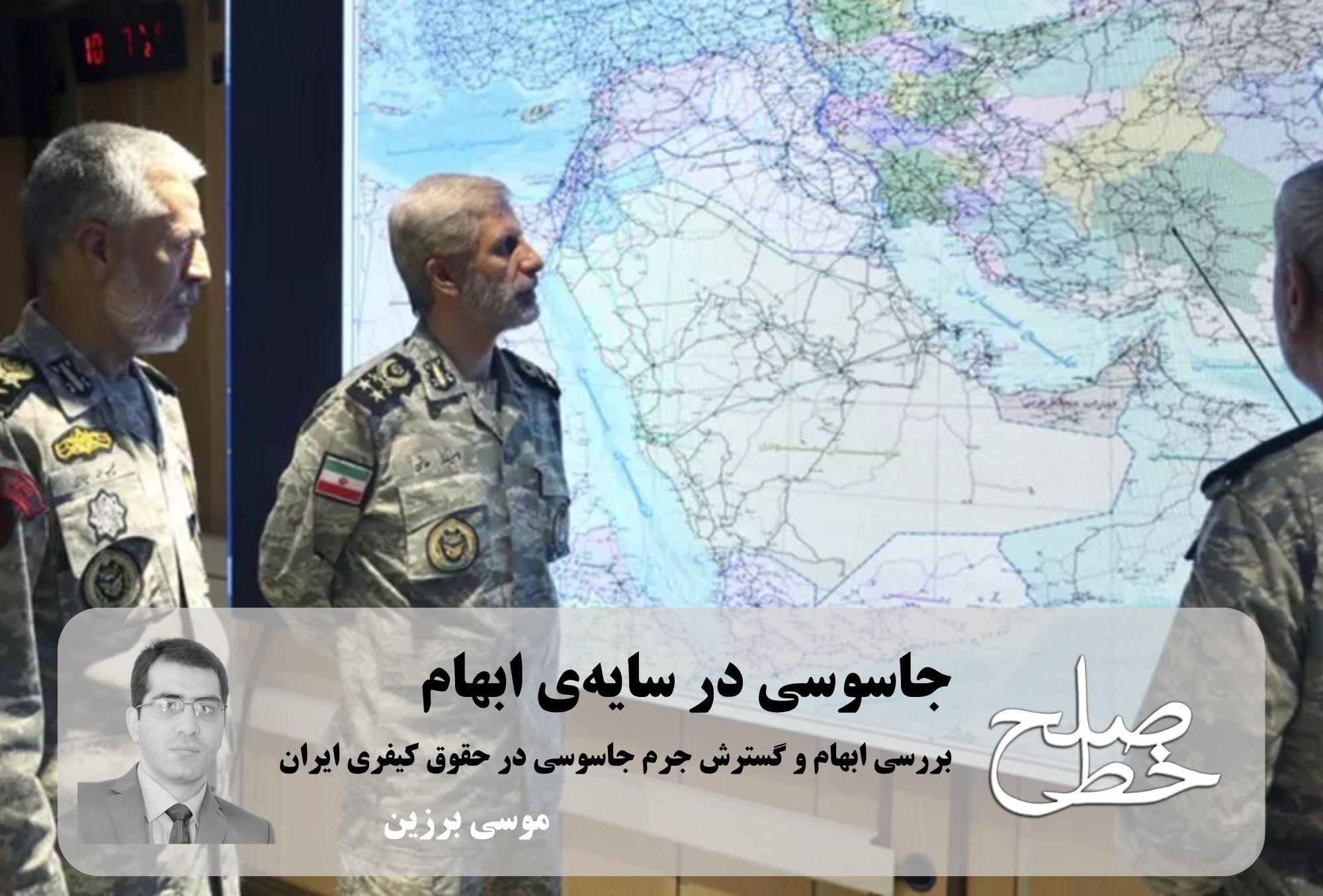
Examining the Ambiguity and Expansion of the Crime of Espionage in Iranian Criminal Law/ Mousa Barzin
After the 12-day war between Iran and Israel, the number of cases related to espionage and cooperation with hostile states increased significantly. The atmosphere in the country after the war became highly securitized, and the government tried to show that a significant part of the damage and blows suffered had resulted from intelligence infiltration and the activities of spy networks. In those days, officials repeatedly stated that Israel had been able to carry out some of its operations more accurately through domestic agents or access to sensitive information. This made “espionage” one of the main focuses of security and judicial crackdowns.
But the reality was that the Islamic Republic’s security and intelligence failures could not be compensated for merely by arresting and punishing citizens. Protecting information is a complex and specialized matter that depends on professional security structures, proper information management, training of personnel, and strict oversight of sensitive institutions. Nevertheless, after the war, it appeared that the government preferred to manage a significant part of this crisis through criminal and judicial channels. For this reason, not only those accused of direct contact with Israeli security services, but also people who published images of attacks and bombings, reported on developments in the war, or even reposted non-confidential information online faced accusations related to espionage and security cooperation.
At that time, the securitized approach toward media and cyberspace also became more intense than before. In practice, the boundary between “news reporting” and “intelligence cooperation” gradually became blurred, and we witnessed many citizens being accused, in one way or another, of cooperating with Israel merely because they published news related to the war. It was in this atmosphere that, in October 2025 (Mehr 1404), the “Law on Intensifying Punishment for Espionage” was adopted; a law that expanded the scope of the crime of espionage far beyond what it had been and, at the same time, introduced many vague and interpretable concepts into Iran’s criminal law discourse.
Before this law, the most important legal basis for the crime of espionage was Article 501 of the Islamic Penal Code. Under this article, anyone who knowingly provides documents, maps, secrets, or decisions related to the country’s domestic and foreign policy to unauthorized persons is sentenced to imprisonment. Although this article itself was open to interpretation, one general principle had been accepted in Iranian criminal law and in many other countries: information that is the subject of espionage must be “confidential” and “classified.”
Put simply, if information is not confidential in the first place and the general public can access it, its transfer or publication should not be considered espionage. The very philosophy behind criminalizing espionage is exactly this: preventing the disclosure of sensitive information that threatens national security. But the new law has effectively erased this boundary to a large extent. In this law, in addition to the word “espionage,” phrases such as “intelligence cooperation,” “security cooperation,” “direct and indirect assistance,” and “strengthening or consolidating a hostile state” have entered the law, without any precise and clear definition being provided for them.
This has turned the concept of espionage from a specific and limited crime into a very broad and flexible title. Under the new law, it is no longer necessarily required that a person have transferred confidential military documents. Even publishing a news item, giving an interview, engaging in media activity, offering political analysis, or publishing an image of military attacks may, at the discretion of security institutions, be categorized as “intelligence cooperation” or “strengthening the enemy.” In reality, the law has been written in such a way that its interpretation depends largely on the views of security agents and judges.
One of the most important flaws of this law is precisely this broad ambiguity in its concepts. The law does not specify exactly what is meant by “security cooperation,” or what action constitutes “indirect assistance.” It is also unclear what exactly “strengthening” or “legitimizing” Israel means and what kinds of conduct could qualify as such. Could publishing a report on war damages be considered strengthening the enemy? Is speaking to foreign media intelligence cooperation? Could criticizing the government’s foreign policy be interpreted as legitimizing a hostile state? The law gives no clear answers to these questions.
This ambiguity opens the way for broad interpretation of the law. In criminal law, one of the most important principles is that a crime must be defined precisely, clearly, and without ambiguity so that citizens know what conduct is considered criminal. This is called the principle of legality of crimes and punishments. But in this law, many terms are so general that almost any conduct could, under certain circumstances, fall under them. For this reason, many concerns have arisen that, in practice, this law may become a tool for targeting journalists, political activists, social media users, and critics of the government.
The second major flaw of the law is the severity of its punishments. A significant portion of the articles of this law prescribe the death penalty, including for conduct that lacks a clear definition. For example, Article 2 of the law states that any security, economic, financial, or technological action that leads to the “strengthening” or “consolidation” of Israel may result in the death penalty and full confiscation of property. This issue is highly noteworthy from the perspective of criminal law. In many countries, even in serious espionage cases, the death penalty has either been abolished or is applied only in exceptional circumstances during wartime. But in Iran’s new law, because of the ambiguity in the definition of the crime, the range of conduct that may carry the death penalty has become extremely broad. For this reason, some jurists believe that this law violates the principle of proportionality between crime and punishment.
Ultimately, it appears that the most important consequence of the Law on Intensifying Punishment for Espionage is the expansion of a security-oriented approach into various areas of social and political life. When a concept such as espionage is defined so broadly and ambiguously, the boundary between a real security threat and ordinary political or media activity disappears. The experience of many countries has shown that lasting security cannot be achieved solely through harsher punishments and increased repression. Genuine confrontation with intelligence infiltration requires, above all, strengthening professional security structures, increasing public trust, and respecting the principles of the rule of law. Otherwise, the boundless expansion of the concept of espionage may lead not to greater security, but to the restriction of civil liberties and increased legal insecurity in society.
 Created By: Mousa Barzin
 May 22, 2026
Tags
CIA Espionage Espionage for Israel Forty Days War Iran-US war Mossad Mousa Barzin peace line Peace Line 181 Spy The war between Iran and Israel. Twelve-day war