


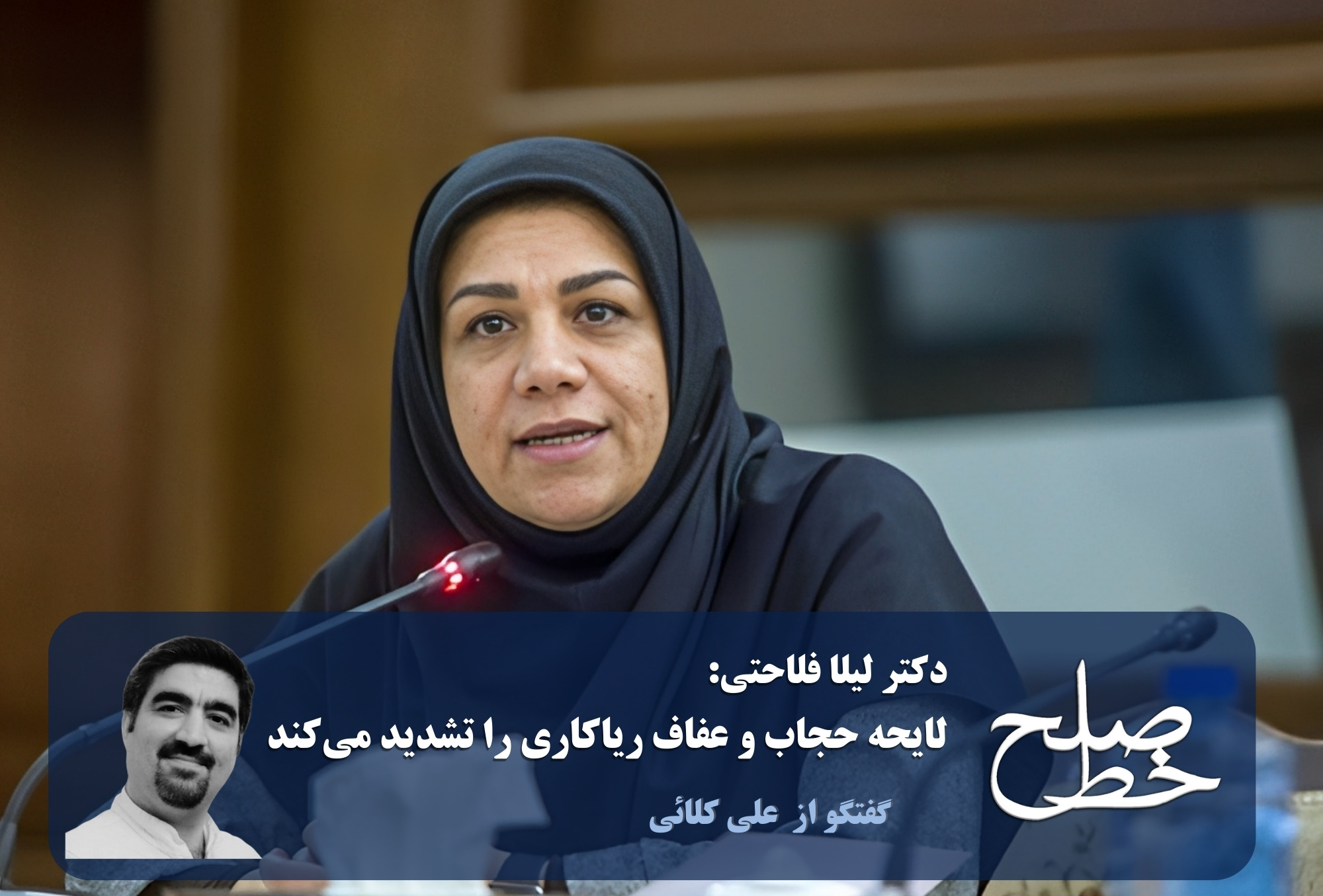
Dr. Leila Fallahati: The Hijab and Chastity Bill Intensifies Hypocrisy / Ali Kalai
“This draft explicitly addresses violations of citizens’ rights in certain places. This is part of the remarks made by Leila Fallahati, a professor at the Cultural and Social Studies Research Center and a member of the Ministry of Science, Research and Technology Institute, in an interview with Khatt-e-Solh magazine. The topic of the conversation with Ms. Fallahati is about the bill “Supporting Families through Promoting the Culture of Chastity and Hijab”, which is known as the “Hijab and Chastity” bill. This bill was sent from the judiciary to the government and eventually to the parliament, but with many changes by the Judiciary and Legal Commission of the Islamic Consultative Assembly, it was published and discussed in the open session of the parliament for approval. Leila Fallahati, the former Director General of International Affairs at the Office of Women and Family Affairs of the Presidency, in an interview with Khatt-e-Solh about this bill, critic
You can read the detailed conversation of the monthly “Peace Line” magazine with Leila Fallahati, professor at the Cultural and Social Studies Research Center and member of the Ministry of Science’s Institute of Studies below.
What do you think is the main reason for proposing such a bill in the current circumstances?
Since the 1970s, the issue of hijab has been taken seriously into consideration in the cultural policies of the country. At the highest level, we have seen laws passed in the Supreme Council of Cultural Revolution in 1976 and 1984. In 2009, we also had a comprehensive law for the development of hijab and chastity, which had nearly 304 articles and involved 25 institutions in the country. Regarding these 25 institutions, we can mention the Ministry of Roads – which may seem unrelated and far-fetched to us. I want to say that this law, which was approved by the Supreme Council of Cultural Revolution and obligated all of these 25 institutions and organizations to implement it, was very extensive and comprehensive.
The events that happened last year and unfortunately the negative approach of the structure and cultural system towards the issue of hijab – which had been reduced to a matter of morality by the Guidance Patrol – turned into a crisis. This law that is currently being passed, continues the same trend and is not a sudden phenomenon in our country.
ه دادن
It means continuation.هات
Alas
Are the same legislative trends influenced by events of the past year?
Last year’s events raised the level of involvement of institutions. The difference with this law is that the previous laws were approved under the Supreme Council of the Cultural Revolution. This law is currently being approved by the Parliament. When it is approved at this level, it has much broader requirements and higher authority. Its difference with previous actions is this.
How much does this bill comply and align with the Constitution, citizens’ rights, and gender equality?
From the perspective you mentioned, it seems to me that this draft is a bit hasty. Because in some places, it explicitly violates citizens’ rights. For example, it can withdraw fines from centralized accounts. It can confiscate passports or issue travel bans. All of these are contrary to the spirit of the constitution.
In the approach to gender justice, the most important issue that I can mention is that this bill diminishes the issue of women. It seems that only women are the subject of discussion for the legislators. While there have been changes in men’s attitudes and in many cases, it is these men who demand a different type of clothing for their wives or recognize the right to choose clothing for their children. It seems that our legislators have no attention to cultural and moral changes in Iranian society and are extremely neutral and biased; assuming that men have no issues with this law. While in many events in the past year, it was observed that it was these men who were advocating for these rights and the right to choose. This is a very important issue. That is why I believe that from a gender justice perspective, this law only diminishes the issue of women and only addresses men in one clause; targeting men’s clothing and saying that if men wear shorts above the knee… it is still a violation of women
Of course, our politicians are only women. But with the intensity of negative and radical treatment that has been raised in this draft, they do not see beyond the issue. 32 articles in this bill address punishments and crimes. These 32 articles show that the system is going to deal with this issue radically. Well, who is beside women? Father, brother or husband, and generally male family members. This alone can exacerbate the problems. This issue, despite the fact that the legislator has only targeted women, helps men to stand by women in this matter. That is, in addition to the possible harms it may cause, due to the severity of punitive measures and low-level treatment, it can strengthen the stubbornness of men, who despite not even believing in this issue, should stand by women to uphold these rights.
تعبیرها از نظر شما درست است
In the explanatory document, such as nudity and semi-nudity, the family-centered Islamic lifestyle and other interpretations are mentioned, but the intention of the legislator is not explained. Do you think these interpretations are correct?“سلام، من از ایران هستم”
“Hello, I am from Iran.”
Does lack of transparency in the law and open-handedness of the enforcer not help?
Definitely and without a doubt, one of the flaws of this draft is that a large volume of statements has been considered based on public reports. For example, it has been said that we want to hold training courses and train disciplinarians who will go and report. However, we do not have complete control over the mental and psychological state of these disciplinarians, and often this can lead to them treating people poorly. Additionally, terms such as “nudity” have different meanings for each person, and someone may reject a report based on their own interpretation and create a problem for them, even if that person is not actually exhibiting nudity. Unfortunately, this bill is heavily involved with ambiguous and non-classifiable concepts. The bill that the government received from the judiciary and proposed had 15 articles and compared to this parliament bill, it created fewer problems. However, what has been raised in these 70 articles is truly concerning and without a doubt, it can create crises that may be worse
برداری کند
You mentioned the discussion of guidance. Some say that this bill will turn the police into photographers and videographers.“سلام دنیا”
“Hello world”های دارد
He has taken away. What is your opinion? Does he have any duties?
Hey
Is police entry into such matters allowed?
The issue of our law enforcement force’s behavior is a result of the 1989 law. It had defined so many duties for the police that they were even responsible for monitoring the entry and exit of women’s salons. We know that our police have their own conflicts and the country’s security priorities go beyond this issue. This new bill introduces a mechanism called “officer” and in order to prevent any personal preferences, it states that I will allocate a three-month training course for the officer. But how can a person become an officer with just a three-month training course and get involved in such a discussion? Surely their involvement in this matter will result in issuing penalties, creating files, and making the situation even more complicated and dangerous. In my opinion, if I were to make a prediction, the number of issues we had with the morality police may have been much more controlled than what is currently predicted, and the crisis that this system can create seems severe to me.
۱۰
Article 10۲
432
This draft has raised the issue of fame or social influence. Why do you think in recent laws, those who have social influence are constantly being targeted?
If we look at the content of this bill, the legislator has tried to control any capacity that may have an impact on the style of influence. This means that the issue is not only the influencer and their influence. The issue is their normativity. We even see that for the media, they have defined issues and for the radio and television, the Ministry of Guidance or the Fashion and Clothing Working Group have also defined tasks. My view is that the legislator has tried to control every outlet and possibility that may have an impact on the normativity of clothing. In fact, the level of crimes that have been considered for these groups is astonishing, as it even predicts the issue of confiscating passports in this bill, which is very concerning and a clear violation of citizens’ rights.
In my opinion, this bill is very rushed. What the government had sent was not more than 15 articles. Turning it into 70 articles and with this approach seems very hasty and will have serious consequences.
۱۰
Article 10۰۲۱
2021 مجلس شورای اسلامی
The bill states that the Ministry of Guidance and the Secretariat of the Islamic Consultative Assembly.“سلام، من از ایران هستم”
“Hello, I am from Iran.”ک روز
One day
The Supreme Council of Cultural Revolution is responsible for reviewing the impact of implementing this law and reporting to the Legal Commission of the Parliament. Ultimately, who is responsible for implementing this bill? Is it specified in the bill?
If we compare it to the past, the Ministry of Guidance had heavy and extensive duties in previous laws. The process in these laws has always been that the law is proposed, approved, and announced, but the issue of implementation quality and reporting has also been raised. In the 2009 law, the reporting system was followed in the Cultural Commission of the Parliament and the agencies were obliged to be accountable in the commission in many cases at the ministerial level. But now it is the Legal and Judicial Commission that is supposed to report. This means a legal perspective, merely a punitive and radical perspective. The weight of the bill also shows this. The style of this commission’s perspective is also different from the Cultural Commission. This means that previous perspectives were more prescriptive, cultural, and focused on deepening beliefs and values. But in this bill, it seems that the legislator has become disappointed with prescriptive approaches and has turned to negative approaches. Regarding the Ministry of Culture and Guidance, the
که
Is an annual budget deficit effective in drafting such a bill? Considering that“سلام، من به دنیا خوش آمدید”
“Hello, welcome to the world.”ه
That clause
Hey۲۲
Second Article 22۰۰
7000
It says that the resources obtained from the implementation of this law should be spent in the form of annual budgets to address social damages and so on.
The important issue here is that our cultural and social policy makers, after two decades of official discussions in society about social harms – if I may be very clear – have taken a step forward in escaping and reducing the major issue of social harms to hijab. This means that issues such as theft, obscenity, addiction, and the like all have their roots in hijab and now we want to use the resources resulting from the implementation of this law to address the problems caused by social harms. This type of escape forward is highly ambiguous to me. For example, the Social Affairs Organization, responsible for addressing social harms, is under the Ministry of Interior. But the bill does not clearly state that the resources obtained will go to the Social Affairs Organization under the Ministry of Interior for addressing the harms.
It seems that even the legislator has come to the conclusion that cultural issues are not being addressed and the only solution is a controlling method.
This section also refers to the issue of family-oriented leisure time, which these resources are not allocated in the annual budget to address the problem.
Over the past decade, the cost and income of households and their economic basket have decreased due to economic blockages, beyond the issue of hijab. Today, families are sacrificing their health and well-being in order to provide for their basic needs such as food and housing expenses. Creating a family-centered leisure time in this situation would only create opportunities and privileges for certain groups who have access to these exclusive centers. The majority of our families do not have the opportunity to use these centers.
Does the fate of this bill and discussions like it not lead towards the fate of satellite laws and the like? How enforceable is such a bill and law in general?
We had this experience with video and satellite. The important expectation from the legislator – even if they do not want transparency in this regard – is to at least review the effectiveness evaluation reports of that law in 2010. In the 2010 law, it was said that you cannot have an open kitchen. I hope that those who have drafted this bill have also evaluated the effectiveness of that 2010 law and have seen its effectiveness in the cultural and executive sectors. The implementation of the 2010 law has been reduced and simplified by the Ministry of Guidance. It is interesting that in that law, it was emphasized that the police force is obligated to use trained and educated forces, but it has been implemented in lower levels. I want to say that a specific review shows how successful the 2010 law has been, so we can expect the same from this radical bill. In my opinion, this bill will only intensify corruption and underground lifestyles, which we have also encountered in our
Thank you for the time you have given us in the monthly publication of the Peace Line.
 Created By: Ali Kalaei
 August 23, 2023
Tags
Ali Kala'i Compulsory hijab Gender discrimination 2 Hijab Leyla Falahati Mahsa Amini peace line Peace Line 148 The bill of chastity and hijab Unveiling Violence Woman, freedom of life پیمان صلح تبعیض جنسیتی