


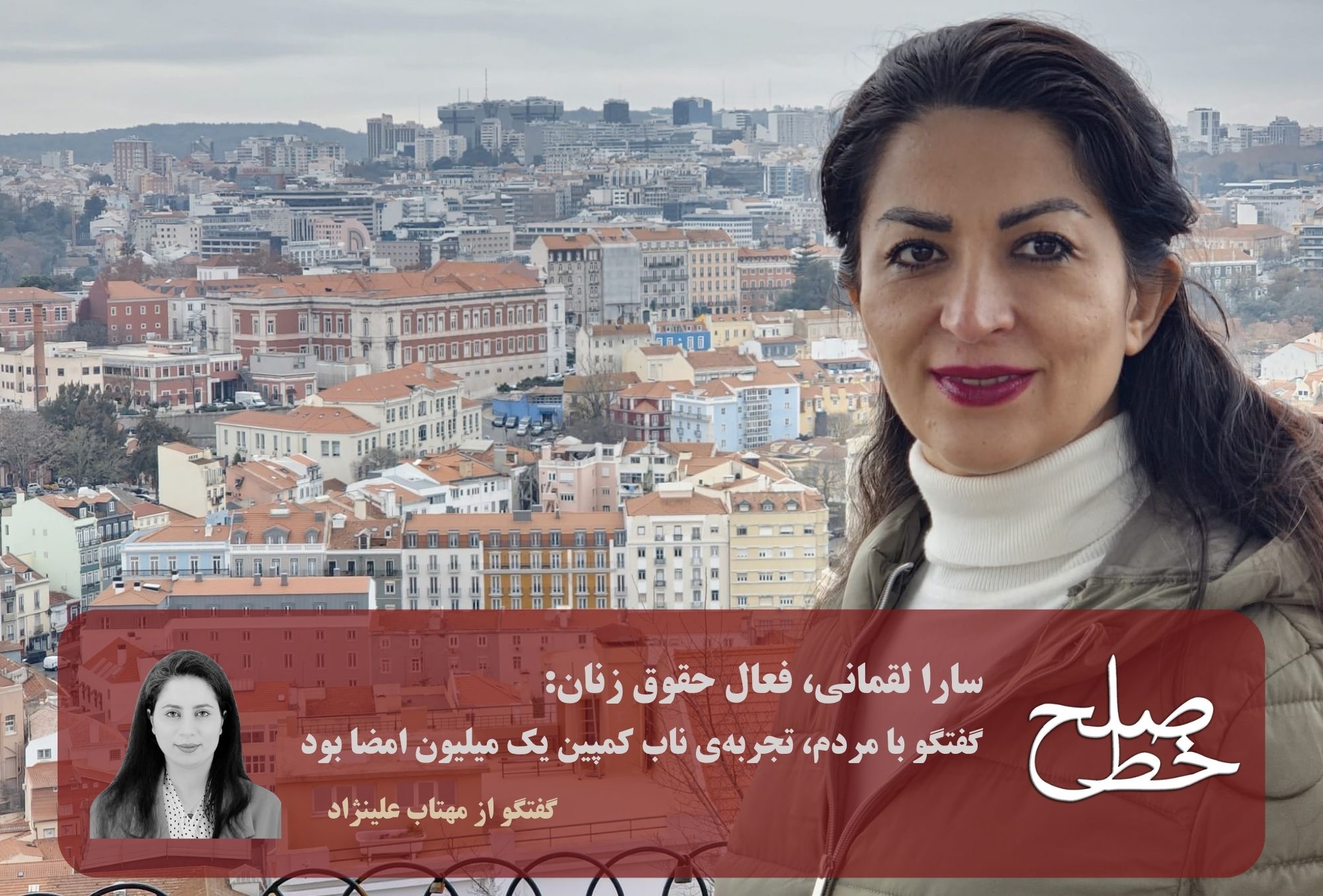
Sara Loghmani: Talking with People Was the One Million Signatures Campaign’s Most Unique Experience/ Mahtab Alinejad
On the twentieth anniversary of the formation of the “One Million Signatures Campaign to Change Discriminatory Laws,” revisiting this experience has once again taken on particular importance. Launched in September 2006 (Shahrivar 1385) with the aim of reforming laws that discriminated against women, the campaign did not limit its activities to collecting signatures. Through direct dialogue with people, education in various areas related to women’s issues, and the expansion of a network of volunteers, it became one of the significant experiences of civil activism within Iran’s women’s movement—an experience that was also accompanied by arrests and pressure on its activists.
This prompted Peace Mark Monthly Magazine to speak with Sara Loghmani, a researcher in the field of women’s studies and one of the campaign’s core members, and ask her to recount the campaign from within. Her account ranges from workshops that were sometimes held in volunteers’ homes and networks that developed among different cities, to coalitions between women’s groups and student, labor, and teachers’ activists. Looking back across two decades, she also discusses the legacy of this experience and its relationship to the “Woman, Life, Freedom” movement—a path that, in her account, has moved from demanding changes to discriminatory laws toward highlighting women’s right to bodily autonomy and freedom of choice.
Below is Peace Mark Monthly Magazine’s full interview with Sara Loghmani, a researcher in the field of women’s studies:
Ms. Loghmani, how did you join the One Million Signatures Campaign, and what responsibilities did you take on?
At the time the campaign was taking shape, NGOs—including women’s organizations, other groups within the student and labor movements, and even local organizations—were in the process of being formed and consolidated. We had also established an NGO called “Hastia Andish.” We were a group of young people working in the field of women’s issues. We published a periodical, had a blog, and tried to hold educational workshops at universities. I was a member of the education group there and conducted workshops. These workshops were mostly about sex and gender and gender equality.
Then the issue of the campaign was raised among various NGOs and different women’s groups. We also decided to join, and we devoted a significant portion of Hastia Andish’s human resources and our time to the campaign. Because I had experience in education and conducting workshops, I joined the education section from the very beginning. Our education section worked by holding workshops for new volunteers who wanted to join the campaign, teaching them what the campaign’s demands were and why it sought to change these laws. We also taught them how to communicate, how to observe security precautions, and how to protect themselves.
At the beginning, which part of this method of activism was new to you and different from your previous experiences?
One was this very close, face-to-face contact with people in the streets and alleys, which was an entirely new phenomenon. I think this may have been the most distinctive experience for all of us in the campaign. Completely at random, in the street, on the bus, in the metro, at work, or among relatives—wherever we went, we had a sheet of paper in our hands and would start conversations with people.
Previously, when we held workshops, the people attending had consciously decided to come, sit down, and receive training. But here, for example, we would go directly to a park and begin talking to people, and a discussion would take shape. Sometimes people would gather around, and large groups would form. It was a very special and unique experience. Even now, I think that after the campaign we never again experienced this kind of unmediated experience in quite the same way.
You have emphasized that the objective was not merely to collect signatures and that a signatory was supposed to become an activist. In practice, what happened after obtaining a signature? How did you remain in contact with people, and what led some of them to begin collecting signatures themselves?
One of our actual objectives was to collect one million signatures. But the path involved a great deal of trial and error for us, and it was unknown territory. We did not know how easy it would be, how long it would take, how much time it would require, or, for example, how strongly the government would oppose us. We knew none of these things, and they gradually became clear to us along the way. We realized that the work was extremely difficult, that repression would become very severe, that the government would not tolerate such work so easily, and that it would harass us and put us under enormous pressure. Many of the activists lost their jobs.
Nor was our intention necessarily that every single person had to become an activist. But we very much welcomed it. We would certainly suggest that if someone was interested, they could join the campaign themselves. The campaign’s work was very clear and precise: what it was, what it did, and what it wanted. If people agreed with the path the campaign had taken, they could easily become members. No particular organization or specific location was required.
So very often, after signing, people would say, “We want to collect signatures too.” A group called the Volunteers Group was formed. We had a media group, an education group, and a finance group that collected membership fees, because we did not receive money from anywhere. We also had a Volunteers Group and a Cities Group, bringing together people from different cities. Initially, it had only been Tehran, and we truly did not imagine that it would expand to this extent.
The Volunteers Group’s task was to keep new members connected with one another. There were no particular social media platforms at the time. We had email, telephone, and things like that. These people would then be referred to the education group. In cities such as Yazd, Isfahan, Rasht, Tabriz, and many others, we would tell them that however many people they had recruited, we would arrange and coordinate a meeting. The education group would then travel there and hold a workshop for them.
Sometimes people would simply sign, thank us for our efforts, and leave. Sometimes they would not sign and would say it was pointless. And sometimes they would say, “We want to volunteer too.” We genuinely had nowhere to hold our workshops. Even many of the few NGOs that had existed previously had had their offices sealed and could not provide us with a fixed location. At that time, there were not even many cafés around the city. As a result, workshops were held in people’s own homes. Someone who volunteered might say, for example, “I can host a workshop in my home.” We would give the address to the other new volunteers and tell them to gather at that person’s home on a particular date. We would go there and provide the training.
Another thing we did was distribute the campaign forms and the booklets we had reproduced among members, and they would naturally find their way into different groups. For example, someone who knew media work would become active in the media group. Someone else might be able to take photographs, write reports, or write material for the website and would do that. As a result, many members entered and became active in other sections after that single signature.
We also maintained contact with one another. Members in other cities sometimes arranged gatherings among themselves. For example, they would meet at someone’s home in a particular city. I also remember that campaign activists in Rasht invited activists from several other cities, and we all went there and shared our experiences. If someone in one city encountered a security problem, people from other cities would travel there. Likewise, when signatures had been collected in different cities and people came to Tehran, they would stay at one of our homes. They would stay for one or two nights and hand over the signatures. This chain of communication among members was fully maintained, and the environment was very open for people to join.
I even remember that we held the campaign’s anniversary at one woman’s home. She was a woman we had met completely by chance on the street in Gisha, and she made her home available to the campaign. We held the anniversary there. In the photographs that remain, when you look at them, you can see the campaign banner hanging in this woman’s home. Her name was Akram. Very often, when we did not have anywhere to hold new workshops, we would go there and tell her, “We’re coming to your house to hold a workshop.”
When someone agreed with the campaign’s demands but was unwilling to put their name under the statement, how did you talk with them? Based on your own experience, did concerns about the consequences of signing, distrust of the outcome, or other reasons influence this decision?
It certainly happened that someone thought the work would have no result, or simply did not believe in it. This happened quite often. Some people simply could not believe that laws so strongly against women and children existed, or that the statistics were so high. For example, child marriage, filicide, honor killings for which a father faces no serious criminal punishment, restrictions preventing women from leaving the country, or how difficult divorce-related issues are for women.
The problem is that society has placed so much emphasis on mahr that all these anti-woman laws escape people’s attention. In response to all of them, mahr is brought up instead. It is good, of course, that mahr exists. But it does not compensate for these things; mahr itself creates an inequality for men. Although I personally believe that given the unequal laws, women still need mahr. But whenever we discussed these issues, if someone opposed us, they would say, “But there is mahr, nafaqah, and things like that.” There was a great deal of ignorance about the consequences of these issues.
Another example is that when we held a workshop in Baluchestan, we realized that it was very common and customary there, for example, to throw three pebbles on the ground and thereby pronounce a woman triply divorced. Just like that, without any legal mechanism, they would divorce a woman. Or there were cities where polygamy was very common, or where child marriage was highly prevalent. For us as well, traveling to other cities—especially border cities or deprived areas—showed us just how visible the consequences of these anti-woman laws were in people’s lives.
There were also cases in which someone was afraid and would not sign. That was absolutely no problem. We applied no pressure at all. We would say, “Take the booklet, read it, and talk with the people around you. If you want, contact us. If you want, sign it and send it to us.” Whenever they changed their mind, they could contact us. We had a website, and we also gave people our telephone numbers.
There were also people who opposed us. At most, we had a booklet in which we had explained all the laws, and we would give it to them. We tried not to let things become confrontational. We would say, “Take the booklet and read it yourself. If you want, investigate it yourself and see what these laws are like.” But these are things that are genuinely happening.
How were volunteers prepared to face opposition, ridicule, or tense arguments? Were difficult experiences while collecting signatures discussed somewhere so that others would know what to do in similar situations?
First, I should say that these are experiences I genuinely remember. The campaign was very extensive. Some other campaign activists may remember different experiences or memories, or may know about things of which I was completely unaware. I am only recounting what I personally remember or what I remember from conversations with friends. This is not the whole story.
On the website, we had a section called “Koocheh be Koocheh” (“Street by Street”). Members would write their memories and accounts there so that others would know what they might encounter. It was a very important section of the website. Every so often—as I mentioned earlier—we would hold gatherings, come together, and tell one another about our experiences.
Sometimes, for example, a metro officer would come and detain campaign activists, and the situation would escalate. I even remember that in some cases people would stand up, defend the activist, and rescue them, refusing to allow the officer to take them away. Our first detainee, Zeinab Peyghambarzadeh, was arrested in the metro. She was collecting signatures there when a metro officer detained her. She was taken to Evin Prison.
Every so often, we held gatherings in different cities. Members in the cities held their own gatherings. Those of us in Tehran had our gatherings as well. We would visit them, and they would come to our homes. We traveled to Yazd, Shiraz, and Isfahan and stayed for several days. It was not only our communication with the public that was face-to-face; our communication with one another was also genuinely and completely face-to-face. We would go to one another’s homes and stay for several days; we collected signatures together and exchanged experiences. It was truly a unique opportunity for us to be together.
To what extent did the campaign depend on circles of friends and acquaintances in order to expand? Were you able to reach groups that had no previous connection with women’s rights activists? Can you describe an experience in which such a connection was established—or, despite your efforts, failed to take shape?
The campaign was both highly dependent on circles of friends and acquaintances and also had a great many volunteers who began as complete strangers and later became acquaintances and active members. Some of them are activists even now and remain active individuals. In other words, they essentially began their activism with the campaign.
In my view, one extremely important development that occurred through the campaign was coalition-building: a coalition among different women’s groups. This ranged from us, as an independent NGO, to political women’s groups and religious women’s groups. I remember that we held a meeting in Azam Taleghani’s office. Some of the activists also held meetings and discussions with women members of parliament, women’s charitable groups, and charity organizations—different groups working in different fields. They had not necessarily engaged in shared dialogue with one another before then. But because of the campaign, they reached agreement on certain fundamental issues—namely, discriminatory laws. So yes, different women’s groups genuinely formed a coalition with one another.
I do not remember any group that opposed the campaign. There may have been groups that did not devote much time to it or did not do anything in particular, but I personally do not remember any group that was opposed. It makes no sense to be a women’s rights activist and want to oppose demands concerning discriminatory laws. Moreover, following this coalition, the campaign created an opportunity for genuine coalitions to form among different movements.
Before then, women’s groups and student groups were active but did not have any particular relationship with one another. The campaign, however, led people such as Bahareh Hedayat and Mahdieh Golroo from the student movement to join the campaign, to the point that it was no longer easy to distinguish whether they were now activists in the women’s movement or in the student movement. Many of the activists were students who were active within the Office for Strengthening Unity or other student groups, and they then brought the campaign with them into student spaces.
On the other hand, the labor movement was very active at the time. The labor movement genuinely joined the campaign as well. I remember, for example, Shahla Entesari. There really was no longer any boundary. I say this with certainty. In the context of the campaign, the boundaries between these movements disappeared, and an extraordinary coalition took shape. I can also mention teachers’ groups. This experience was one of the most unique things the campaign managed to bring about: coalition-building. It is something we lack today and struggle with. We quickly arrived at clear and specific demands, reached agreement, and then it simply followed its own course like a river.
So I can say that yes, in that sense, we had not really worked jointly with other movements before, nor had they worked jointly with us. But the campaign led us to undertake joint work. We were able to work together with student activists—for example, the Office for Strengthening Unity—with labor activists, teachers, and even women activists working within government institutions. This was not something on which everyone necessarily agreed. Working with the governmental sector in particular was not something everyone supported. But members were entirely free to act.
For example, if someone wanted to go to Qom, speak with religious authorities, and call them, they could do so. I remember that the journalist activists would even call the offices of maraji and ask them, “Would you be willing for your daughter to marry a man who already has a wife?” They kept calling. Or they found the telephone numbers of members of parliament and distributed them among members, and everyone would call. For example, regarding polygamy, they would tell them, “You have to repeal this law.” I even remember that, jokingly, they would tell them, “Don’t worry, just make sure it isn’t retroactive so it won’t apply to you.” Eventually, we started receiving repeated messages telling us to stop. Our phones were ringing constantly. Everyone was calling us about polygamy and child marriage. An extraordinary form of communication had genuinely developed, and we were putting enormous pressure on members of parliament.
As a final question, when you place the campaign alongside the “Woman, Life, Freedom” movement today, what specific connections do you see between them, and where do you see a rupture? What evidence helps us understand this relationship without reducing the experience of the new generation to merely a continuation of the campaign?
I think history is deeply interconnected. Everything is like a series of pieces that occur one after another, and you cannot separate them or cut them off from one another. Even the campaign itself took shape because of earlier activities and experiences. Women had been placed in certain circumstances and had reached that stage. There were also experiences coming from countries similar to ours. The very idea of the campaign came from a country such as Morocco, where something similar had taken place. They had Islamic laws as well. Of course, they had a monarchy that actually changed some laws as a result of these activities. But in Iran, it was completely and severely suppressed. Then came 2009 (1388), when almost all civil activity was brought to a halt.
I think that in addition to raising public awareness, the campaign brought something else with it. At the time, if the media talked about women and wanted to raise an issue concerning women, they unquestionably had to mention the campaign.
One development was the issue of conditions stipulated within marriage contracts, which became very common. I remember that at the time, in Tehran, we knew at most two or three notary offices that were willing to formally register conditions within marriage contracts for brides and grooms. The others refused and, through their own patriarchal behavior, actually obstructed people. In other words, if a husband and wife went in and said, “We want to register conditions within our marriage contract,” they would say no. We knew only two or three notary offices and would give their numbers to others so they could go there.
Through what happened in the campaign, we reached the conclusion that since changing the laws was so difficult—because with the non-dynamic Islamic jurisprudence that exists, changing these laws is simply impossible in many areas—we should instead focus on conditions within marriage contracts, which already existed. We held workshops on these conditions and taught people to first raise the issue with their spouse, fiancé, boyfriend, or family. Then we would go and educate notary offices. In other words, we advocated and demanded that they accept these conditions and formally include them in documents for brides.
We identified notary offices willing to do this and explained the matter to them so that they would become informed and overcome their fear. They were very afraid. They always thought—and they had indeed experienced this—that the groom’s or bride’s family might come and smash the windows of the notary office, demanding to know why they were doing this and registering such conditions.
We also prepared brochures about this issue, because the exact wording of these marriage-contract conditions must be legally precise. Otherwise, they are of no use. In the marriage document, there are a number of provisions that are signed, with things such as education, employment, and travel written into them, and both parties sign them. Everyone thinks that this is sufficient. But these are entirely symbolic and ceremonial. They absolutely have to go to a notary office and have an official document drawn up. In other words, this cannot be done at a marriage and divorce registration office, and that document cannot be prepared there.
This process reached a point where obtaining these conditions had become normalized to a very considerable extent, and we had also persuaded many notary offices to accept them, and we would refer people to those offices. They did not mind receiving money for registering these conditions either. When demand increases, their fear diminishes, and at the same time it becomes a new service they can provide. We distributed these brochures about marriage-contract conditions very widely, in many different places.
Now I want to connect this to “Woman, Life, Freedom.” Twenty years have passed since the campaign. At that time, it is true that we spoke in the statement and the booklet about freedom of dress, but we did not focus on hijab to the same extent that we talked about polygamy, child marriage, the right to divorce, and restrictions on women leaving the country. The reason was that we needed a very broad coalition among the public—that is, among the broader body of society.
Let us go back a little. The Revolution had taken place, and we had gone through the suffocating decade of the 1980s (1360s). We had gone through the war. The very concept of an “NGO” had only recently appeared, and discussions of grassroots institutions and advocacy had begun. At the same time, the Guidance Patrol had emerged. The reality is that we did not emphasize bodily rights and hijab as much as the other laws. This was because the women’s movement was still a young movement. Of course, a hundred years had passed since the Constitutional Revolution and a great deal of activism had taken place. But because of the 1980s, the Revolution, and the war, the movement had only recently emerged from private circles and was just beginning to show itself again in the public sphere.
The point is that twenty years ago, the broader public did not have the view of the body and optional hijab that it has today. That is precisely why the Guidance Patrol was able to operate for so long. The government opposed satellite television so intensely—was it able to stop it? The government opposed the internet so intensely—was it able to stop it? It could not. It could not even stop parties or alcohol. But it was able to maintain the Guidance Patrol for years and to a very significant extent. That was because, up to a certain point, part of the public supported it and went along with it. We must not forget that.
The struggle women waged over bodily rights, and for which they shed blood in the Woman, Life, Freedom movement, is still continuing. In the end, we shed blood over hijab. No matter how much we say the environment has changed, women are still struggling. The change we see exists because of that struggle. The law has not changed, and nowhere has it been declared that hijab is a matter of freedom and personal choice. Any woman you see anywhere without a headscarf is still struggling. This was a much larger step that women took, and it took twenty years.
I would put it this way: in our time, there was opposition to hijab too, and a great deal of it. That opposition also existed among campaign members themselves. But it was still an individual act and had not yet become a collective one. Some campaign members still would not appear without hijab and would wear headscarves. They even wore headscarves at our own meetings. It was still a habit.
After all, we have to take into account that we were children of the 1980s. We were the generation that had been taught since childhood that if your hair showed, in hell you would be hung from a tree by those very strands of hair while fire burned beneath your feet. We went to sleep every night with that nightmare. You cannot compare those girls with the children of those girls. The young people who took to the streets in 2022 (1401) were the children of the campaign generation. You cannot compare these experiences with one another.
I doubt that any little girl in school today hears that she will be hung by strands of her hair, for example. But we were seven or eight years old and went to sleep every night with this nightmare, while living in much more traditional and restrictive families and in a much more closed society.
Gradually, the internet arrived. Girls and women began using profile pictures. They posted profile pictures without hijab. Then Instagram arrived, and they posted photographs there without hijab. It had only just become possible to publish a photograph of yourself without a headscarf in informal and virtual spaces. Then came the White Wednesdays campaign launched by Masih Alinejad, which opened up a space. If there had been no internet, it could not have happened. It created a space in which you could go somewhere safe, film yourself, and publish it.
Then came Vida Movahed. Vida Movahed carried out an individual act by standing on that utility box, ten or eleven years after the campaign.
What I mean is that I myself raised a criticism of the campaign, and I am also answering my own criticism: society had to travel this path in order to arrive at bodily rights. When Vida Movahed carried out that act, it truly was called a revolution. It became known as the “Girls of Enghelab Street.” But even that act was still individual. Did anyone dare, even for a moment, to take off their headscarf and take a photograph? How many sentences have been issued merely for taking such photographs? How many people were sentenced to twenty years, twenty-four years, and sentences like these? Do young people today know that Saba Kord Afshari received a twenty-four-year sentence because she had removed her headscarf? There are several other friends of mine whose names I cannot remember who received heavy sentences simply because they took off their headscarves for a moment and took photographs. This was only about ten years ago. Then this process reaches the Mahsa movement, where the issue becomes the woman’s body and a woman’s autonomy over her own body.
What I mean is that if the broader body of society does not come along, this cannot move forward. I believe social and popular movements take their path and their steps only as far as they know society will accompany them. If they move further ahead, they will be left alone. The campaign managed to move forward effectively because it had brought the broader public along with it, and that itself was a very significant achievement.
Even now, conditions within marriage contracts are discussed and there is awareness about them. Of course, there is still work to be done. I hope a day comes when the laws themselves are equal and women do not have to struggle to obtain a document merely to have equal rights.
This is where we arrive at the “Woman, Life, Freedom” movement, where the issue is the body and bodily rights. Even women who themselves wear hijab and believe in it support the demand for hijab to be optional. For example, Sedigheh Vasmaghi removes her headscarf. Something like that would have been unimaginable ten years ago when Vida Movahed carried out her act, let alone twenty years ago.
The pace of society’s social development is truly extraordinary. We are under so many different pressures—government pressure, sanctions, war, and a thousand hardships—that sometimes we forget how progressive our society is, how well it functions, and how rapidly transformations take place within it. I am certain that history will be proud of us, every single one of us.
Thank you for the time you gave to Peace Mark Monthly Magazine.
 Created By: Mahtab Alinezhad
 September 23, 2026
Tags
Mahsa Movement Peace Line 185 Sarah Loghmani Woman Women's movement Women's rights