


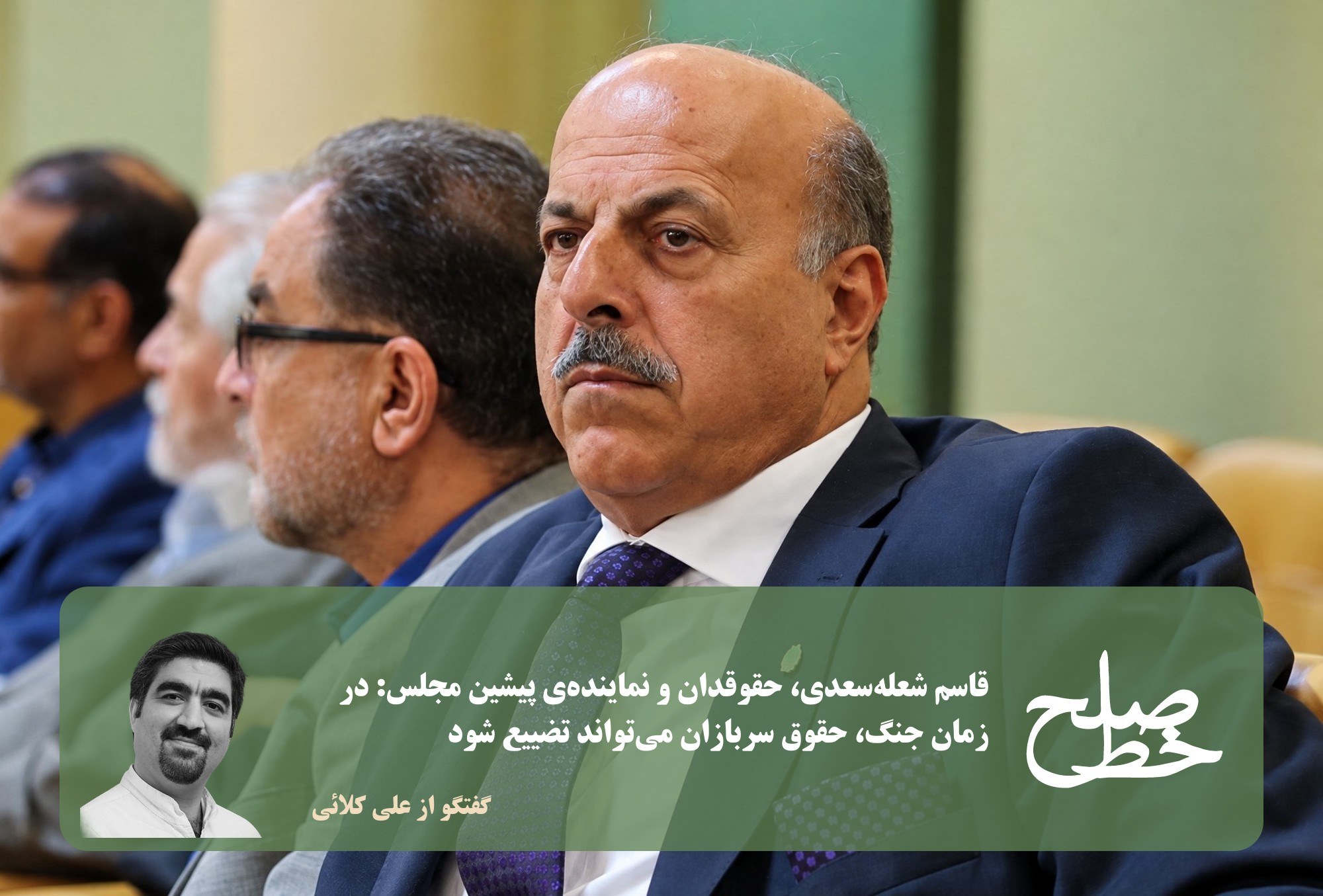
Qasem Sho’leh-Saadi: In wartime, soldiers’ rights may be violated / Ali Kolaei
In Iran, conscription in wartime is no longer merely about spending part of conscripts’ youth in service; it becomes intertwined with their right to life. The killing and injury of a number of conscripts following air strikes on barracks and military centers in recent wars has brought the legal and human dimensions of compulsory military service into sharper focus—from the government’s responsibility to protect soldiers’ lives and the possibility of criminal prosecution of officials if negligence is established, to the right of the families of fallen soldiers to seek justice.
These issues led Khat-e Solh Monthly to speak with Dr. Qasem Sho’leh-Saadi, a jurist and a member of the third and fourth terms of the Islamic Consultative Assembly. Emphasizing commanders’ responsibility to protect the lives of those under their command, Dr. Sho’leh-Saadi believes that some of their decisions are punishable even without proof of intent. He also discusses the possibility of claiming compensation for psychological harm caused by wartime service if fault is established, and the likelihood that individuals’ rights may be violated due to the application of special procedural rules in military courts during wartime.
You can read the full interview below:
Given the limited duration of conscripts’ military training, what is the government’s legal responsibility for deploying them to war zones and for their being killed or injured? Can inadequate training serve as a basis for establishing fault and the criminal liability of decision-making officials?
In the current situation, the government can be considered at fault and responsible in all areas. A government that cannot provide security, food, and healthcare for its citizens faces the same problem in the military sphere. More developed countries generally have professional armies and do not have conscription in this form. Of course, in Europe, given the threat from Russia, the issue of making military service compulsory has been raised. This issue also exists in Israel. Naturally, when governments face acute conditions, they turn to conscripts. But the necessary preparedness must largely be put in place in peacetime, because in wartime there is not much opportunity for it.
If you recall, during the eight-year war, a large portion of the deployed forces were volunteers and ordinary people who were sent to the front even without training. In wartime, such things happen, and in my view the government cannot be blamed on that basis. But there are other cases that can be called treason—for example, Operation Karbala-4, which had been compromised. Mohsen Rezaei, the then commander of the IRGC, was informed that the operation had been exposed, yet he insisted it had to be carried out. As a result, several thousand of our forces were martyred. In such cases, there is criminal liability. Even if we do not call it treason and the commander’s intent is not established, it is still a major violation that is punishable.
On the other hand, if a conscript, on the order of a superior commander, commits an act that is considered a crime under the law, who bears criminal responsibility? Can carrying out a superior’s order remove the soldier’s criminal liability?
This question does not have a single, definitive answer, because it may truly be impossible for a soldier to determine whether an order given to him is lawful or unlawful. Of course, you must also consider the position of the higher commander who issues the order. This is where the chain of command comes in. Also, everywhere in the world there is a slogan among armies and armed forces that says: “the army does not ask why.” This does not mean that if, for example, a colonel gives an order to a subordinate—who might be a captain or a major (not necessarily a conscript)—and says, do such-and-such, that subordinate has no right to ask questions. For the subordinate to carry out the task accurately, he needs to ask questions, be briefed, make the appropriate decision, and see whether the order is lawful or not. Where they say “the army does not ask why” pertains to a political authority’s decision addressed to the country’s military authority. Georges Clemenceau, the French politician who served as France’s interior minister and prime minister from 1906 to 1909 and also from 1917 to 1920, has a famous saying. He says war is too important to be left to the generals. That is, war must also be conducted under the country’s political management. In other words, whenever the country’s political leadership says you must fight, the army cannot object, and whenever that political leadership says peace must be made, the army must comply. This view may seem extreme, but it is correct.
In cases involving the death of conscripts, how can one prove a causal link between officials’ decisions or negligence and the soldier’s death—especially when the direct cause of death was a military attack by the opposing side?
All actions can be attributed to the outside and to the party that attacks. In my view, a more fundamental discussion is needed—one that also applies to Iran today: whether the government in power is lawful or not. If the government is lawful, many of these matters can be taken out of the criminal realm. But if it is a government like today’s in Iran—unlawful, having come to power through a coup and remained there—the issue is different. In my view, since 1368 (1989) this government has been unlawful; that is, Ali Khamenei, while lacking the legal qualifications, usurped the position of Supreme Leader and became commander-in-chief. If we examine the issue from this legal angle, all decisions made have been contrary to law, and every action taken has been harmful to the country. Part of that is precisely the issue of soldiers who may be harmed in war, or ordinary people who are harmed in domestic protests by these same soldiers. It is like someone who sits behind the wheel and drives but has no driver’s license. Any accident that occurs, the person at fault is the one who drove without the required license.
Under the Code of Criminal Procedure, what rights do the families of conscripts killed in war have to file a complaint, request judicial investigations, access case information, and pursue the cause of their children’s deaths?
This is a general matter. Since the judiciary has general jurisdiction, any complaint can be referred to it. In this specific case involving military personnel, if an offense has occurred within the scope of their professional military duties, the matter falls under the jurisdiction of the Armed Forces Judicial Organization. But if military officials, like other people, commit an ordinary crime, that falls under the jurisdiction of the judiciary, not the Armed Forces Judicial Organization.
There are exceptions here as well. For example, for those who hold general officer rank (brigadier general and above), their crimes must be tried in Tehran—like members of parliament, whose charges must be addressed in Tehran. The reason is that political figures have supporters and opponents. If they were to be tried in their own constituency, all their opponents could file various complaints against them every day, and instead of doing their work in parliament, the representative would have to be in court daily. In other words, these exceptions exist for such reasons regarding local jurisdiction for hearing crimes.
Can severe psychological harm arising from wartime service conditions, if fault of responsible persons is established, serve as grounds for claiming compensation or filing a criminal complaint?
For compensation, certainly. In matters of compensation, issues are governed by a general law called the Civil Liability Law. That is, in matters such as usurpation, causation, and destruction of property, a person is inherently liable to compensate for the damage. For example, if someone deliberately breaks another person’s window intending to harm them, that is vandalism and has a criminal aspect. But there are times when a stone kicked up from under a car hits the window of a neighboring house. The driver did not intend to throw the stone at that window. Or when children are playing ball in an alley and the ball hits people’s window and breaks it. In such cases, compensation is certainly the responsibility of the person who caused the damage. But if it happened with malicious intent, the matter has a criminal aspect. And when there is no malicious intent, at minimum the issue is payment of damages and compensation, which is part of general legal principles and is known as the Civil Liability Law.
So the legal challenge here is establishing malicious intent?
In all crimes, three elements are required for a crime to occur. First, the act or omission must be defined as a crime by law, or a specific punishment must be prescribed for it—this is the legal element. Second is the material element: the person commits an act or fails to do an act, and in either case it constitutes a crime. For instance, when someone kills another person, the act of killing is the material element. Or a nurse who is supposed to give a patient an injection and deliberately does not—this is an omission and is a crime. The third element, which completes the crime, is intent—the same thing I mentioned—such as deliberately throwing a stone at a place where the person wants it to hit and cause damage; that is, there is intent.
There are also some crimes in which intent is inherent and does not require separate proof. For example, someone who shoots with a gun and kills a person is not asked whether they had intent or not, because intent is inherent in the act of obtaining a weapon, firing, and killing the person.
Even in this matter there can be exceptions. I myself had a legal case in which there was an elderly man whose son-in-law had raped his other daughter—that is, the sister-in-law of that son-in-law. The father-in-law decided to kill his son-in-law. He then picked up a gun, but someone else was killed. Here, his intent was not to kill that other person; he wanted to kill his son-in-law. This is not considered premeditated murder. Or a hunter intends to shoot game but hits a person. This is an instance of manslaughter, or what is called mistaken killing.
So, overall, to commit a crime, three elements are necessary: the material element, the mental element—which is intent—and the legal element, meaning the law has defined that act as a crime and set a punishment for it.
If, during an air strike, a soldier leaves the barracks or his duty station to save his life, can he invoke the state of necessity under the Islamic Penal Code? In wartime, how is the boundary determined between the necessity of preserving life and the obligation to perform one’s duty?
In war there is always the danger of being killed, and at the front this cannot be raised. If we were to accept this as a rule, everyone would be permitted to flee and abandon their post and desert.
Even in this recent war, we saw forces present in a barracks in a city being targeted from above by drones or missiles. That is, these soldiers are not in a trench; they are serving in their own barracks.
Commanders must make the necessary arrangements to protect the lives of their personnel and to safeguard the military equipment in that barracks. But despite that, in war damage is still inflicted. We now see that the Americans have all their military equipment fully in place, yet even so we see that Americans also suffer harm in war. Therefore, this cannot be considered a lawful justification for desertion.
Do wartime conditions lead to restrictions on the defense rights of conscripts who are subject to criminal prosecution? For example, does wartime provide legal justification for detention without due process, restricting access to a lawyer, or extracting confessions under pressure?
In wartime, special regulations are always put in place. We even have wartime military courts, which are held by the armed forces themselves (the Armed Forces Judicial Organization). Everywhere in the world, in wartime we have special regulations that differ from normal conditions. The main difference is that, first, they do not take long, and second, in some cases they are single-instance. Under these conditions, people’s rights can be violated.
At the beginning of the interview, you referred to a professional army. In the Sixth Majles, efforts were made to reform the conscription system, which faced opposition from the Guardian Council and then the Expediency Discernment Council. In 1400 (2021) as well, parliament tried to move toward a professional military service model. Why do such plans reach a dead end? I ask this in light of your experience serving in the third and fourth terms of the Islamic Consultative Assembly.
I believe that since 68 (1989), because the system is invalid and unlawful, all institutions derived from the leadership are also invalid and unlawful, including the Guardian Council and the parliament. Their decisions are also wrong and void. I am not aware of the reasons for the Guardian Council’s rejection of that bill. The Guardian Council must review parliamentary legislation on two bases and reject it if it conflicts with either. One is nonconformity with Islamic criteria, the determination of which rests solely with the Guardian Council’s jurists and is within their exclusive competence. The second is nonconformity with the Constitution. In that case, the entire Guardian Council, according to its own bylaws and the number present in the session, can review and reject or approve a bill.
During the leadership of Ali Khamenei, a supervisory board was established that is not provided for in the Constitution. This board is an arbitrary creation; it has been mandated that upon the passing of a law by the parliament, the legislation must be sent to this board in addition to the Guardian Council. If this High Supervisory Board determines that the legislation contradicts the Leader’s views, they will reject and return it. Their argument is that, according to Article 110 of the Constitution, the general policies of the system fall within the exclusive jurisdiction of the Leader. Therefore, these legislative acts must not contradict his views.
In the third and fourth terms of the Islamic Consultative Assembly, in which you yourself were present, were these discussions about professionalizing the army or the rights of conscripts not raised?
No. Nothing was raised. Interestingly, at that time we wanted to legislate on the ranks of the IRGC members, but they would take offense and say, did we come for pay and rank? Because they were influenced by the early atmosphere of the Revolution and the war. A few years later, on a flight, I was traveling with the commander of the IRGC in Fars Province. I asked him whether he was the senior military commander of the region or the commander of the Fars Army. He gave an interesting answer. He said we have two senior commanders: me in the IRGC and him in the army. But if one were to be senior, it would be me. I asked why. He said because I received my rank on the third of Sha’ban and he on the fifteenth of Sha’ban—meaning I am twelve days senior to him. This was the same person who, in the early days, when rank and pay were discussed, said he was being insulted.
When was this?
I do not recall the exact date. It was when I was a member of parliament.
Thank you for your time in providing the Peace Line monthly magazine.
 By: Ali Kalaei
 November 22, 2026
Tags
Air strikes on barracks Ali Kala'i Commanders’ responsibility Conscripts Military court Mohsen Rezaei Operation Karbala-4 peace line Peace Line Monthly Peace Mark 187 Qasem Sho'leh-Saadi The right to seek justice