


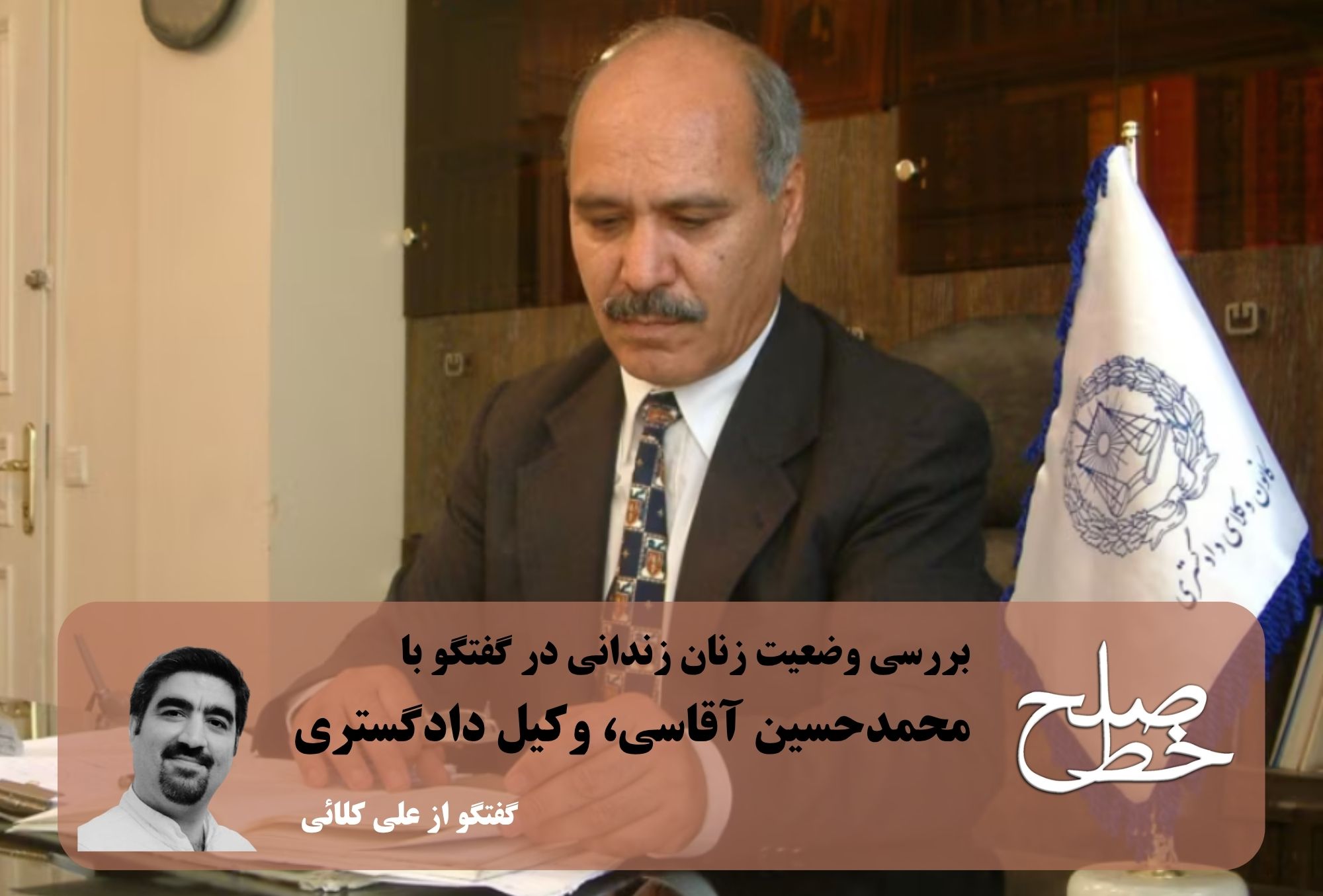
Investigating the situation of imprisoned women; Interview with Mohammad Hossein Aghasi, lawyer/Ali Kalaei
Reports over the years have revealed that some women prisoners are denied medical treatment and other legal rights. The continued publication of these reports highlights the gap between prison regulations and their practice, raising the question of to what extent human rights standards, including the Bangkok Rules, are being observed in Iran, and whether the special needs of women and the principle of using prisons as a last resort are being taken into account? In this issue of the Peace Line, we have reached out to Mohammad Hossein Aghasi, a lawyer, to examine this issue. He believes that Iran’s penal policy in practice is far from the Bangkok Rules approach.
In an interview with Peace Line, this lawyer discusses the legal responsibility of prison authorities in cases of medical negligence, the possibility of demanding blood money and arsh, the situation of imprisoned mothers, and the difficulty of proving complaints related to violence. He considers the lack of implementation of regulations and the lack of effective investigation to be the main problems, and emphasizes the difference in treatment between ordinary prisoners and political and security convicts.
You can read the details of the monthly Peace Line interview with Mohammad Hossein Aghasi below:
In recent years, there have been numerous reports about the denial of medical services to some female prisoners. From a legal perspective, where is the line between “administrative negligence” and “violation of the fundamental rights of prisoners”?
Basically, in prisons, prison directors, despite having regulations and rules, do not commit themselves to fully complying with the regulations related to prisoners and are not bound by them. They sometimes make decisions as punishment for prisoners that lead to the deprivation of prisoners of some of their legal privileges and rights. It cannot be said that their actions are legal. What you asked and the comparison that was in your question, in this practice and in relation to prisoners, cannot be a legal and legal discussion. Rather, it sometimes goes back to the self-centeredness of the prison officials.
Do you mean that the issue is more of an administrative error?
Yes, there is administrative negligence. But there is no one to look into them. We can rely on them in cases where what a person has done is against the legal standards and regulations and its effects are clear. For example, I had a prisoner client (Mr. Mohammad Nourizad) who was taken to solitary confinement for three days and suffered a lot. While the head of Evin Prison had no right to do such a thing to him. But no one looked into it and the requests were not successful.
With that said, isn’t this more than administrative negligence and closer to violating the prisoner’s fundamental rights?
These are not fundamental rights. Rather, they are regulations and rights that are established by the legislator or senior officials such as the head of the judiciary to observe the condition of the prisoner, or things that are generally stated in the laws. They apply these to prisoners in ordinary cases. In some cases, they refuse to provide them to the prisoner as a punishment for violating the regulations. Fundamental rights are things that are, for example, mentioned in the constitution or in the laws. These things that you listed are not fundamental rights.
If a female prisoner suffers physical or psychological harm due to a lack of proper facilities or a delay in treatment, which institution is legally responsible?
An institution that has not fulfilled its duty in this regard. There are many different people and officials in prison who have different duties. Sometimes this official is the prison guard officer, sometimes the ward lawyer, and in some cases, the prison health officer who did not make the right and legal decision and, for example, opposed sending a prisoner out of prison for treatment. It remains to be seen who is the hierarchy that was informed of this female prisoner’s discomfort and did not report it, or who is the higher authority that did not act accordingly. I currently have a case in which the failure to take a prisoner to a health facility on time in Tehran’s large prison caused her death. I have filed a complaint on behalf of her family against the prison officials, and the case has been under review for two years. It is not clear how long this case will take. The answer to your question is that it remains to be seen who opposed sending the prisoner to a health facility and who is responsible.
In such a situation, is it possible to claim damages?
This is a criminal offense. I have filed a complaint about the case I mentioned, and the case is under investigation. If such negligence leads to death, it is the District 27 Prosecutor’s Office in Tehran, the Criminal Prosecutor’s Office, where the complaint must be filed for investigation. The forensic doctor will also investigate. If it is determined that negligence was committed and that it was not intentional, the person will be sentenced to pay blood money and specific penalties. If it is intentional, it is murder. Of course, it is usually difficult to prove that the prison authorities deliberately refused to send a patient – who had a dangerous illness – to medical centers.
What if it does not result in death, but rather in psychological or physical harm?
If it is proven that this complication is due to the fault or negligence of the prison authorities, an expert determines the difference in the blood money between a healthy person and a person who contracted this disease due to the fault or negligence of the prison authorities. This difference in blood money is called “Arsh”. In this case, that amount of Arsh must be paid to that prisoner by those persons.
Of course, this is very difficult to prove. If it is proven – which is usually rarely possible – then the person who failed to fulfill his duty is responsible.
Can it be said that Iran’s prison system is designed primarily based on the needs of men and therefore does not meet the needs of women?
I believe that there are provisions for each of them. But the fundamental problem is the lack of adherence of prison officials to the regulations. That is, there are regulations and they are sufficient. But it is the issue of applying, enforcing, and following these regulations that creates problems and inconveniences.
The Bangkok Rules emphasize that imprisonment should be a last resort for many women. Does Iran’s penal policy in practice deviate from this approach?
There is definitely a gap. Of course, I distinguish between ordinary cases and human rights and security cases. But usually, in general, those conventions and regulations are not followed. Our regulations are completely different and separate from some conventions and equivalents that have been developed to respect human rights and the rights of prisoners. I do not consider the existing regulations to be sufficient.
In the case of imprisoned mothers, to what extent do you think children’s rights are taken into account in judicial decisions and the implementation of punishment?
In public courts, they do indeed comply. But in courts hearing cases involving the government and the system, this issue is not given much attention.
Does this mean that we have a dichotomy here between general courts and revolutionary courts?
Yes, and this is very clear.
What is the reason? Can you explain further?
Unfortunately, I have an excuse here, and expressing some issues could cause me problems.
Understandable… The question is, what consequences does the mother’s imprisonment have for the child’s interests and rights?
When a child’s mother is in prison, she cannot provide for her child’s essential needs for his or her growth and upbringing. When the mother is in prison, this child is deprived of much kindness, affection, and family life, and there is no doubt about that.
If a female prisoner alleges sexual harassment, violence, or degrading treatment by officers, do you consider the current complaints handling mechanism to be independent and reliable?
In regular prisons, if he can prove it, yes, it will be investigated. I have had cases regarding this issue. But in some prisons that are closed and the facilities are not available, it is less likely to be proven and it is rare for someone to be punished.
What is the difference between a regular prison and a closed prison?
Prisons for security and human rights convictions are somewhat more closed.
In many cases involving imprisoned women, poverty, domestic violence, or economic dependency are seen as a background to the case. Does Iran’s criminal justice system pay enough attention to these factors as contexts for crime, or does it focus solely on punishment?
In prison, a character file is created for every prisoner, defendant, and convict who has been sentenced to heavy prison sentences. This is built into the law so that when the presiding judge issues a sentence, he can determine, in terms of the prisoner’s psychological and spiritual character and economic and social background, to what extent the prisoner committed the crime of his own free will and choice. Whether his crime was the result of excess or a cult of personality or some other issue. This is usually observed in the case of ordinary prisoners. Of course, this does not mean that all judges give effect to this issue.
Is the situation different here regarding political and security prisoners and the prisons that you called closed?
Yes, the situation is different there.
If you were tasked with drafting an amendment to improve the situation of women prisoners today, which right would you prioritize? For example, access to treatment, limiting solitary confinement, expanding alternative punishments, or creating an independent oversight body? Why?
Certainly, pre-conviction and pre-commitment investigations; especially investigating some families where women are the heads of households. This issue must be done effectively. In the current state of our society, despite what is stated in the preamble of the Constitution, this is not being done. Even before these financial crises caused by the war and some other issues affected society. At that time and before the war, these issues were not observed. If we really want to reform society, the necessary investigations must be carried out before an individual is drawn and driven towards crime. This issue is stated in the preamble of the Constitution, but it has never been addressed.
In the past decades, the status of women has been discussed many times in Iran. We have Women’s Day in Iran and the status of women is regularly honored in official forums. Is what is happening in women’s prisons in Iran commensurate with this respect for the status of women? What can be done to improve the situation?
In short, when officials or the government give a lot of speeches and promote a topic, you should know that there are shortcomings in that area. In some cases, our regulations and constitution have been unkind to women’s rights. In the regulations enacted after the constitution, we also have many injustices regarding women’s rights; so that women are further oppressed. I have always said and addressed this in my interviews that women are really being oppressed in this area.
Thank you for your time in providing the Peace Line monthly magazine.
 By: Ali Kalaei
 July 23, 2026
Tags
Bangkok Rules Death in prison Prisoners' harassment Prisoners' rights Sexual harassment Women Prisoners