


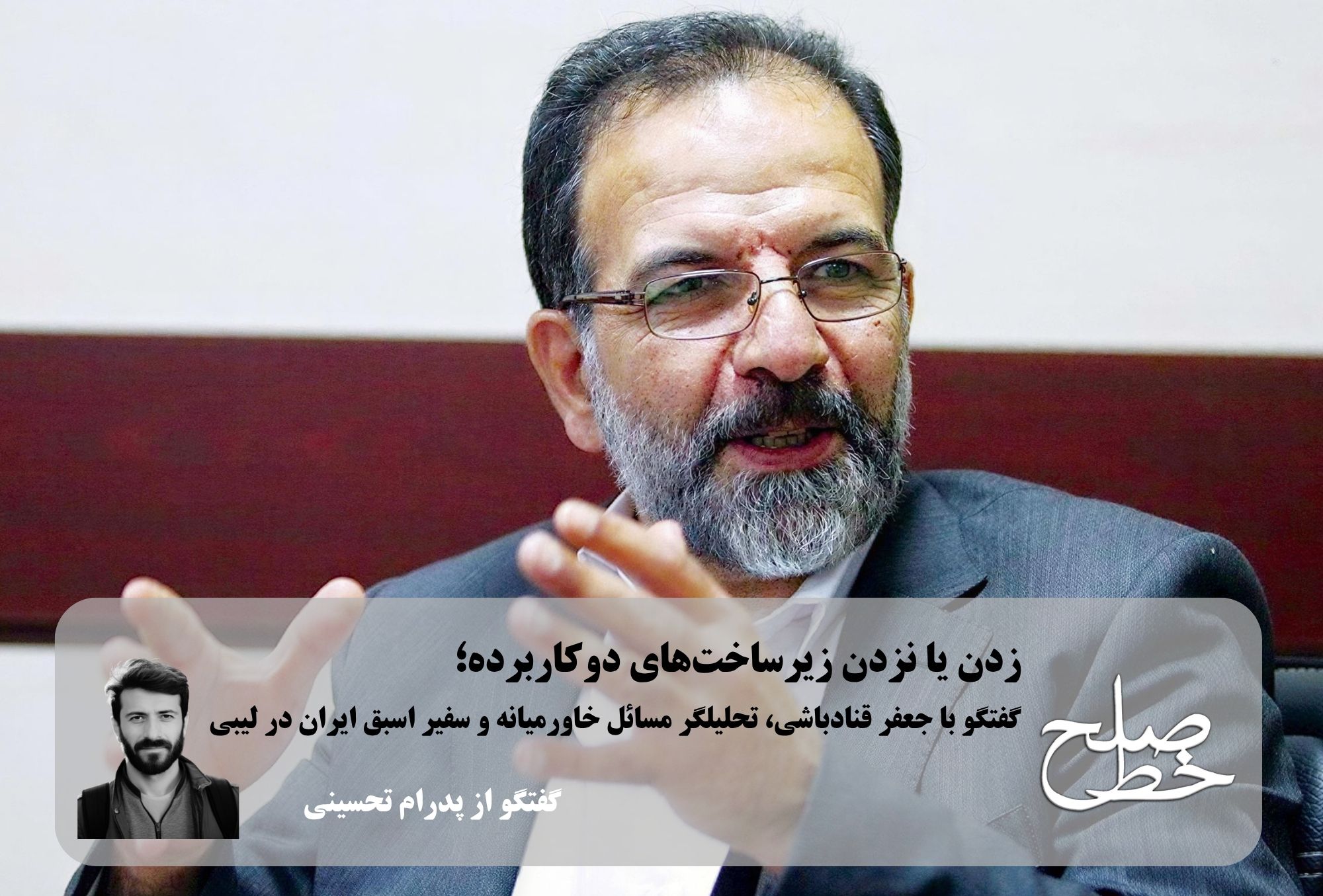
To Strike or Not to Strike Dual-Use Infrastructure: An Interview with Jafar Ghanadbashi, Former IRI’s Ambassador to Libya/ Pedram Tahsini
Dual-use infrastructure refers to a set of physical, networked, systemic, and technological assets that are originally designed and operated for civilian and peaceful purposes, such as transportation, energy, communications, or industrial production; but because of their strategic nature, broad coverage, high capacity, or embedded technical capabilities, they can also be used in conditions of crisis, war, or geopolitical competition for military, defensive, and security purposes. The main feature of these infrastructures is that, alongside their civilian functions, they also have the capacity to become part of the tools of national power.
In the technical and engineering sphere, dual-use infrastructures include networks, protocols, and hardware built to provide public services, such as the internet, telecommunications satellites, or the electricity grid; however, their technical layers can also be used in cyber operations, electronic warfare, or disruption of the other side’s infrastructure. In the economic and logistical sphere, roads, railways, ports, airports, oil and gas pipelines, and power plants are among the most important examples of this concept; infrastructures that in peacetime form the basis of trade, transportation, and energy supply, but in wartime can become supply lines, support centers, and routes for transferring forces and equipment. Likewise, in the space sector, satellite launch systems and ground stations designed for weather research or commercial telecommunications also have reconnaissance, imaging, and military support capabilities, and for this reason are considered dual-use infrastructure.
The interview with “Jafar Ghanadbashi,” a Middle East affairs analyst and former IRI’s Ambassador to Libya, was conducted to examine this very issue: whether, despite the diverse and civilian functions of these infrastructures, targeting and destroying them in wars and military conflicts can be justified.
Mr. Ghanadbashi, as you know, in international humanitarian law, the criterion for identifying “dual-use infrastructure” has a specific definition. First, I would like to know your definition of this concept. Can the mere possibility of military use of an industry, or its effects, turn it into a legitimate target?
For a target to be considered legitimate, its “real and direct participation” in military activities must be proven; otherwise, the mere possibility of military use is not sufficient. Many facilities in different countries have dual use; that is, they both meet the public needs of people and potentially acquire military uses. Even the simplest matters may be exploited in war; for example, a bakery may supply bread for a military barracks, or a slaughterhouse may provide the meat needed by soldiers. Therefore, the main criterion is proving the effective role of that industry or infrastructure in war and in enhancing military capability; otherwise, anything can be interpreted. This issue is especially used by Israel, which is skilled in distorting and reversing events, in order to appropriate everything to its own benefit and, in reality, place everything under this interpretation.
Based on the definition you provided, to what extent can Iran’s petrochemical industry be considered an example of dual-use infrastructure?
This issue depends entirely on interpretation and understanding, as well as knowledge of the products produced by that petrochemical facility. Petrochemicals produce diverse products with multiple applications, which may also play a role in the sphere of military capability. But the extent to which these products affect the enhancement of military capability and the ability to fight must be examined precisely. The reality is that some of our military equipment and even weapons obtain part of their materials from petrochemicals. On the other hand, these same petrochemicals also meet people’s daily needs, such as vehicle fuel or raw materials for clothing and clothing buttons. The main importance lies in the manner of interpretation. Israel and the United States sought to return Iran to the Stone Age by destroying all of Iran’s infrastructure; therefore, it is natural that, in order to invert realities, they use any definition and example to present what exists in reverse.
In your view, is categorizing petrochemicals as dual-use fundamentally wrong?
The petrochemical facilities operating in Iran under current conditions have no direct role in enhancing military capability. Although they may play a role in the medium or long term in building military equipment and tools, in the current situation in which we are engaged in war and continuing it, they have no such role whatsoever. Therefore, attributing military use to them is a kind of incorrect interpretation and reversal of realities aimed at weakening our achievements, and this is an incorrect example-making.
In recent months, plastic industry activists have complained about disruption in the production and supply of raw materials and rising prices. From the perspective of international law, if this disruption is caused by an attack on or damage to key infrastructure, how is the legal responsibility of the state or attacking party assessed?
Naturally, in armed conflicts, a series of crimes are defined that are considered war crimes. Attacks on hospitals or attacks on sectors that constitute people’s public infrastructure are among these crimes. An enemy that carries out such an attack is obliged to pay compensation. The destruction of such facilities and infrastructures that have public-use aspects is considered an international crime, and in the practice of international courts, after wars, compensation is usually paid for the reconstruction of these very infrastructures. Therefore, the attacking party is responsible for compensating the damage.
How is the principle of proportionality in the law of war applied to economic and industrial infrastructure? Can this principle justify an enemy attack on infrastructure vital to people’s lives?
In the case of Israel, which openly and plainly disregards international rules and treaties and speaks of stealing countries’ wealth, these cases are part of the major crimes they commit. Through reversal and distortion, they even portray the [Minab] school as a military target; just as they have announced that they want to destroy Iran. Naturally, they will target any industry under the same pretext. Under such conditions, a new mechanism must be defined with the presence of a judicial panel and a team of trusted experts to verify every claim and determine whether that industry truly had a military role or not; otherwise, in their claim, they may define anything as an industry that helps the war, even drinking water or the air soldiers breathe! This is while the principle of proportionality in international law explicitly states that even legitimate military objectives must not cause disproportionate harm to civilians, but Israel practically ignores this principle.
In recent years, the concept of dual-use infrastructure has expanded to areas such as data centers, ports, airports, and petrochemical industries. Does this trend not create the risk of expanding the circle of legitimate military objectives? Is this conceptualization correct?
The reality is that many infrastructures are inherently dual-use. For example, the metro can be both a military shelter and a means of public transportation, or the railway is used both for moving passengers and for transferring war equipment. All countries create dual-use infrastructure in order to save costs and investments, so that both people’s needs are met and defensive support can be used in wartime. This issue in itself is not blameworthy or undesirable. But regarding Iran, the United States and Israel have openly announced that they intend to pressure the people and force them to overthrow the system; therefore, their definitions have completely moved away from conventional international concepts, and their goal is to exert maximum pressure on the people, and they have based their macro policies on this.
Considering the dependence of packaging, pharmaceutical, food, and many business industries on polymer materials, can the current widespread shortage of plastic in the market be considered merely an economic issue, or should part of it be attributed to the indirect human effects of war on civilians?
Certainly, the war and the damage inflicted on our facilities have affected the supply of the country’s needs and created some shortages, and this is clear. In addition, generally when a war begins, behaviors change, holidays occur, and disruptions arise in the transportation process, all of which also have an impact. Part of the current shortages is also related to the turbulence created in the economy, and the enemy’s goal is for us to face shortages and problems in every commodity. Therefore, these shortages have both economic roots and indirect human effects of war on civilians.
Has the expansion of the concept of dual-use infrastructure to industries such as petrochemicals blurred the boundary between military and civilian objectives to such an extent that the principle of distinction in international humanitarian law faces a serious challenge?
It is not that the concept itself creates a new challenge, but naturally, in drafting the executive regulations for this law, new necessities arise. For implementing international law, both in pursuing and prosecuting criminals and in preparing invoices related to compensation, we will need new protocols and new regulations. Especially given the war that began alongside sanctions and major crimes in cities, we need a new perspective on this war and the drafting of indictments appropriate to it. The Islamic Republic of Iran, in order to bring its claims, needs various experts in different fields so that it can vindicate its rights based on international laws and create the grounds for punishing the criminals or receiving compensation from them.
Thank you for the time you gave to Peace Mark Monthly Magazine.
 Created By: Padram Tahsini
 June 22, 2026
Tags
Dual infrastructure Dual-use infrastructure Infrastructure Iran-US war Iranian Ambassador to Libya Jafar Qanadbashi Launcher Military base Pedram Tahsini Petrochemicals The war between Iran and Israel. War