


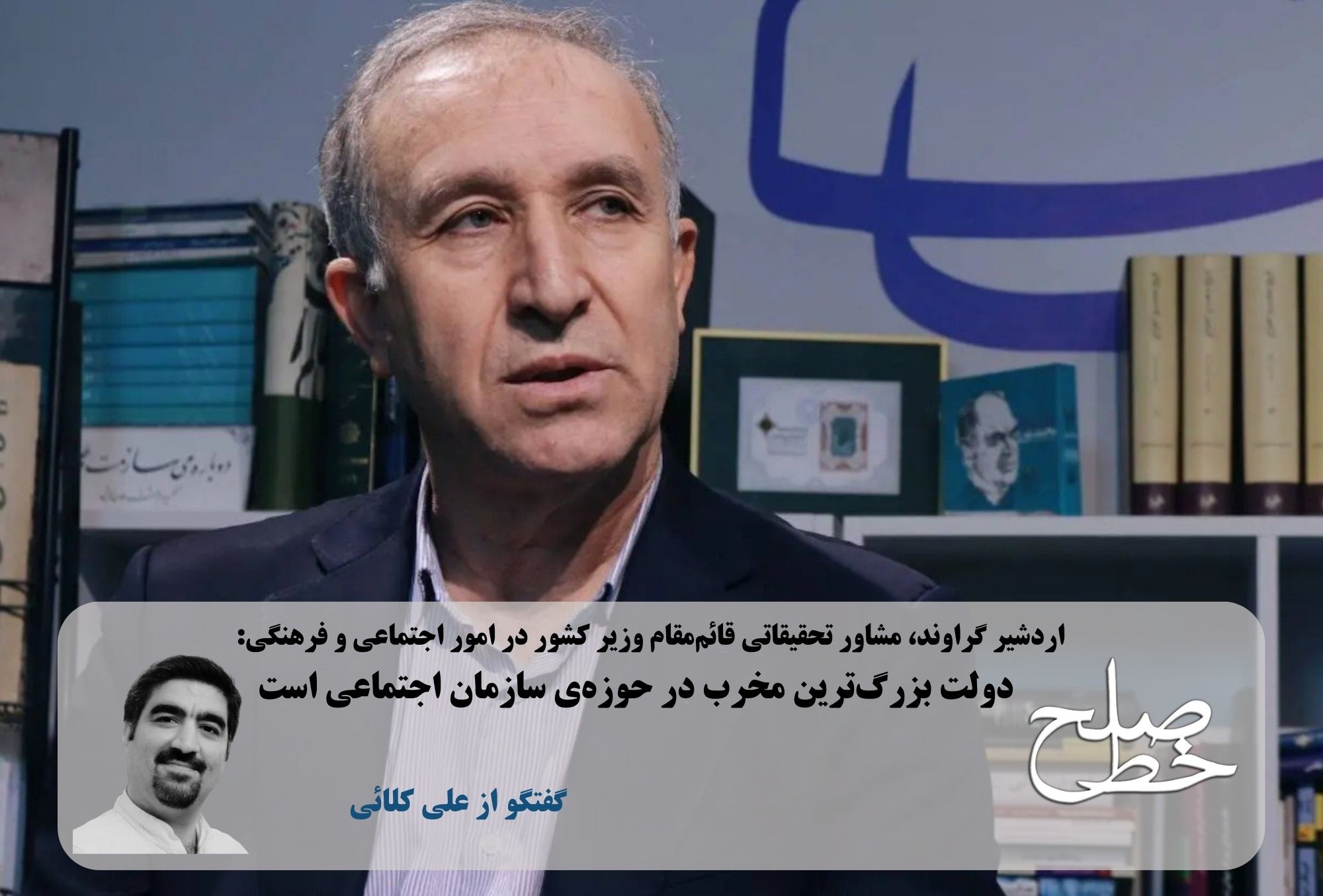
Ardeshir Garavand: The government is the greatest destroyer in the field of social organization/Ali Kalai
In Iran today, inequality is no longer limited to the gap in income or lifestyle, but rather this inequality and class differences have taken on new dimensions and found new practices. The question is: how have these gaps formed and in what direction are they taking Iranian society? Are we still faced with traditional patterns of inequality, or are we faced with new formulations of social classification?
These questions and other challenges in this area prompted the Peace Line Monthly to speak with Dr. Ardeshir Garavand, sociologist and research advisor to the Deputy Minister of Interior for Social and Cultural Affairs. Dr. Garavand, who previously directed the Social Affairs Monitoring Center of the Ministry of Interior, will explore the structural roots of inequality, the role of governance and the media, and the future prospects for Iranian society. This social researcher, who is also an advisor to the Iran Chamber of Commerce’s Corporate Social Responsibility and Governance Commission, draws on his field experiences to paint a clear and worrying picture of the country’s class and social transformations; a picture that not only challenges today’s reality, but also contains serious warnings about the future of this land.
You can read the full interview with Dr. Ardeshir Garavand from the monthly magazine Peace Line below.
How has the face of class inequality in Iran changed today compared to previous decades? Are we facing a new form of social classification or a continuation of old patterns in a new form?
I think the same pattern we had before has continued and perhaps even intensified. Inequality in Iran has generally been territorial inequality. Territorial inequality has existed in Iran since the Pahlavi era. This territorial inequality is due to the sources of oil money that have been brought in and concentrated in certain areas of Iran. This has also led to the allocation of huge resources to those regions of Iran. This regional inequality has itself become a prerequisite for the production of that stratified inequality. This means that this regional and territorial inequality has itself created inequality. The reason for this was the government’s and states’ access to monetary and financial resources, meaning that this territorial inequality had already led to class inequality, and it was mostly due to the central government’s access to oil resources.
Please explain this territorial inequality further. What does it mean?
In the planning discussion, we have a rule that says that you must observe territorial balance. This means that resource distribution and land management should be such that people are not forced to move from their homeland to access better opportunities. The planning program before the revolution was able to create a balance at a time, but this issue coincided with the revolution and it was unable to do so. When he couldn’t, he essentially became the driving force behind the revolution in Iran. That is, the driving force of the revolution in Iran was the same regional inequalities that had turned into slums and marginal settlements. Basically, the revolution drew its human resources from those same regions and strata, because so much of the population had moved and gone to the outskirts of the cities that they were basically exposing inequality. This regional inequality means that before the revolution, provinces and regions such as Lorestan, Ilam, Kermanshah, Sistan and Baluchestan, parts of Kohgiluyeh and Boyer Ahmad, and Kurdistan were out of focus, and they are out of focus after the revolution. The problem here is that the population of these areas has moved to other parts of the country, such as Isfahan, Tehran, Mashhad, and other provincial centers, over the past sixty years. This means that in the provinces outside the government’s attention, we have had a system of poverty production, both before and after the revolution, a system that is constantly producing poverty, and because the volume of these is also large, they are constantly intensifying.
On the other hand, monetary and financial resources related to oil, both before and after the revolution, have been in the hands of a two-three percent class. We have a very wealthy class that resides in centers of power like Tehran. The same group present in the centers of power, because they feel insecure, are seeking access to more resources. This means that this inequality, the prerequisite for which is territorial inequality, existed and has now turned into stratified inequality. Those who come from other cities to provincial centers, or from other provinces to areas like Tehran, do not gain access to more resources, but only make ends meet. During the years since 1395, approximately 12 million Iranians have been displaced. What is the reason? The reason is access to livelihood and life resources. The problem here is that until governments solve and correct the prerequisite and fundamental problem mentioned earlier, this class gap will grow wider and wider. This means that those areas that are poor and send immigrants must be reformed so that the immigration of those citizens does not create a double inequality. That is, for example, a person in Lorestan province may be able to live on 5 to 10 million Tomans, but the same person in Tehran cannot live on 30 million Tomans. In such a situation, that person suffers from a double inequality. It is true that he has gained access to resources, but he is transformed from a poor person into a deprived and rebellious person. I think that the Pahlavi and Islamic Republic governments were not successful in reforming the aforementioned prerequisite, and after the revolution, unfortunately, we forgot why we had the revolution.
In your opinion, what are the new symbols of this class or, as you would call it, stratification in Iran? For example, in the past, perhaps the type of car, travel, or things like clothing, places to go to, schools, and the like were not clear indicators of this class and strata distinction, but today, these things themselves have become symbols of class and strata differences..
I think that in the current situation, the media has been very successful and strong in promoting lifestyle. This media includes radio, television, and social media. But in response to your question about icons and symbols, I think the issue focuses more on the use of tools and facilities of livelihood, meaning furniture and carpets in homes, rather than the shape of clothing and the like. Also, a large portion of these icons are essentially fake, meaning they may be branded, but they may also be fake. In contrast, the top few percent no longer pretend to be financially wealthy, because their resources are beyond your and my imagination, and even the borders of the country. Among politicians, it has become an icon and symbol of how much they welcome and send off. In few places in the world do you see leaders, ministers, and officials so eager to please the crowds at their pulpits. The same thing happens to these citizens. The problem here is how much they look at me, meaning everyone craves to be seen. Some people finance this desire with loans, some people have the financial resources needed for this and finance it, and some people finance it by force.
You mentioned social networks. What role do you believe social networks play in this process? Have they made class divisions more visible and discontent greater, or, conversely, have they created a new kind of “class imagination” that temporarily calms people?
You see, these media are like a lot of tiny punctures in the tires of a car that can neither be repaired nor can you walk on them. In my opinion, these tiny punctures destroy that energy of social reform, meaning that these networks, like Instagram, become places for petty demonstrations and insults, and then the evacuation happens. Once the evacuation happens, the person thinks that his heart has cooled down. These social networks, such as Instagram, while seemingly increasing social participation to improve matters, in reality they are destroying that general social participation.
What is your reason for this?
In order to fix something, there must be strong potential. Suppose they see someone and want to punch them in the face, but instead, with four curse words on Instagram, the person is evacuated and says that these curse words are enough and leaves the other person alone. It’s the same in the fields of economics and politics. One has to go and engage with the issue and participate, but the work is over with four curse words. I believe that social media like Instagram has made us so accustomed to snacking that we have neglected the main promises of life.
Is this the same imagination that calms people down and was in my question?
That’s exactly it. This means that these networks themselves have become a contributor to corruption in the world. Some say that these networks help expose corruption, but in my opinion, these social networks have created a petty gluttony that only serves to exacerbate our weaknesses. Look, right now there are many bloggers on Instagram who just swear, while this energy of swearing could be channeled into political, social, and economic activity. This was also more successful and effective for the social system. Of course, I am not an expert in the media and am only offering my understanding.
From an economic perspective, which structural factors (e.g., economic policies, wealth concentration, inflation, housing, and employment) have had the greatest impact on deepening inequality?
In my opinion, the biggest and first culprit in this area is the country’s governance system. It is not clear to us whether we have a government and a government, or a government in which there is a government. In every country, we have five actors in every field, including the government, the private sector, the public, international institutions, and non-governmental organizations and institutions such as charities. This means that in various fields, from the economy to the environment to social areas, these are the main actors. Above these five actors, there must be a government that divides activities among these five actors. The government refers to organizations such as the Planning and Budget Department, Environmental Protection, the Central Bank, and the country’s social organization. This means that these four organizations and governance systems must be independent of those five actors. What exists is that in the Islamic Republic of Iran, the government is just a big contractor, and this big contractor only sees the interests of himself and his allies rather than the people. What is its symbol? The symbol is that when the government changes, everything from the school waterman to the minister and other officials also change. In this situation, if the Islamic Republic’s governance had independent control over those four institutions, corruption such as the Ayandeh Bank corruption would not have occurred. The government could no longer tell the Environmental Protection Agency that I will build petrochemicals wherever I want and there is nothing you can do. In the social sphere, social organization is in the hands of the government, and the government itself is the greatest destroyer in this sphere. On the other hand, there is a planning organization that must prepare the national, provincial, and city planning plan and give it to five actors and ask them to implement it, but this planning organization is within the government. The public and the private sector are both tied to it and the government, and the government sees them as competitors. This is what happens when the work of activists in organizations ends in prison.
So if I want to simplify the issue, I can say that there must be a governance that has four institutions in place. The Planning Organization, the Central Bank, the Environmental Protection Organization, and the country’s social organization. This governance should tell the five actors, one of which is the government, to come and divide the work, and let each actor do the work related to his or her area. The government, the private sector, and other actors should also receive their own budgets to do their work. But we have now created a government that is bigger than the people, the government, and all these actors; for example, we have three and a half million people employed in the agricultural sector and 300,000 to 350,000 employees of the Ministry of Agricultural Jihad. So what kind of joke is this? The outcome of this is that the government has everything at its disposal, resulting in the corruption that we are facing. In my opinion, the biggest problem with this country is its governance model. That is, we must separate the “state” of the Islamic Republic from the “government” of the Islamic Republic. The government of the Islamic Republic should become a contractor like all other contractors, with a regulatory role given that it is a larger player. As long as those four institutions remain within the government, there is no hope of reforming anything in this country.
In such a governance situation as you have outlined, given the role of the government and the lack of independence of its four institutions, issues such as chronic inflation and rising prices of essential goods have emerged. What impact has this had on the consumption patterns of classes and strata? Can we say that diet has become a new class indicator? This is in a situation where some people have the opportunity to consume meat, poultry, and fish, while others are completely deprived of them.
You see, our resources are dependent on oil, and we have not developed any other areas at all. This means that we have not developed sectors such as agriculture, industry, and trade. This oil is also in the hands of the government and government officials. Who has access to this? Those who are either in the government, receive government benefits, or are government employees. This means that at least government employees have a fixed salary at the end of the month, which is provided in this way. This entire population is about four to five million people. These are the four to five million people who definitely have an income at the end of the month, the rest of the people do not. You see that people come and go to restaurants on Enghelab Street or Fatemi Street in Tehran, and these restaurants are full of people, and these are the same group that I mentioned; the group that is present in Tehran and other parts of the country, has money, and can afford to rent. This group also lives in these wealthy areas and is the one who uses these facilities. On the other hand, those other twenty-four or twenty-five million households do not have stable and reliable jobs, especially those in agriculture who live with extraordinary risks. In my opinion, and based on what I said, our food sector has basically been destroyed and people’s tables have really become smaller. The small group that has access to food and access are the ones who have access to the resources of stratification in the country.
Considering what you have said so far, can we still speak of an entity called the “middle class” in Iran?
In my opinion, the middle class is the bane of political regimes, especially those that are not democratic. Basically, governments see it as in their best interest that this class not exist and have no desire for it to exist. This is despite the fact that if the government is democratic, the existence of this class is to its advantage. But when the government is not democratic and there is rent and corruption in it, the existence of such a class is not in their interest. In post-revolutionary Iran, during the Hashemite and Khatami eras, a group of people were able to create a middle class through literacy, education, and access to government financial and monetary resources. The most important of these groups were university students and university professors, but now the highest income for a university professor is about one hundred million tomans, which for lower ranks, such as instructors, reaches thirty, forty, or fifty million tomans per month. This means that the highest-ranking university staff earn less than a thousand dollars a month. That is, in today’s situation and by international standards, even these are no longer considered part of the middle class. This means that in Iran today, we do not have a middle class in terms of income – according to international indicators. The point here is that, given inflation and the price of goods in Iran, costs are equal to those paid in Europe and in euros. So, considering what was said, we no longer have a middle class or stratum in Iran. At best, it can be said that the middle class in Iran has reached the bottom of its capabilities.
By this middle class, do you mean the economic middle class? Because we can also define the cultural middle class.
The late Dr. Ali Shariati used to say, “Tell me where you eat and I’ll tell you how you think.” The problem here is that the issue of employment and people’s conflict with their livelihoods has also destroyed the potential for protests in Iran. You see, the brain has to work, and the brain works in its free time. Someone who has not finished earning a living cannot think at all. I think we no longer have a cultural middle class. We can’t buy books, we can’t watch movies, because we don’t have the opportunity. Our university professor in Iran goes to work at Snap in the evening, and our teacher sells trinkets in the evening; when do these people have time to read books? Now, if you ask me, who lives this way, when was the last time I read a book? I can’t remember. If you ask me when was the last time you watched a movie at leisure or went to a museum, I don’t know. But ten years ago, I could have bought books for my children from the Book City at the price of that day, two to three million tomans. The two or three million tomans at that time have now grown to thirty or forty million tomans, and I don’t have the money to do such a thing. Many of this cultural group are also looking to take their content to virtual spaces like YouTube so they can add a few rials to their livelihood. In my opinion, all layers of the stratum and the eroded middle class are collapsing, and it will take years for Iran to recover.
Some believe that today’s Iranian society is witnessing the formation of a theatrical and symbolic class, a class that gains legitimacy mostly through the display of consumption (in cyberspace and real space) . To what extent do you consider this perception to be correct?
You see, in 1970, the 1960s, and even the 1970s, our legitimacy was to have a book under our arm. This book under his arm was a sign of being a calculating person. The situation is the same now, meaning that people are killing themselves to wear fake clothes from a brand. In my opinion, this is more of a mental illness and needs to be treated. My saying mental illness is not an irrelevant statement. Now you can see how much sedative and antidepressant medication is used in Iran, how much painkillers are used in Iran, and how many of us are addicted in Iran. Also, how many people visit psychiatrists and counselors, and how many suicides do we have in Iran? This situation shows that we are an impoverished, depressed nation with a very high suicide rate. The situation is that because there is no way to escape from poverty and helplessness, people choose to flee. The Iranian people are the most secretive and lenient people in the world. This proverb, along with “keeping a slap in the face red,” has been and continues to be in our history and culture. I want to say that these behaviors are the result of our economic, social, cultural, and political illness, otherwise what reason would there be for someone who takes a deputy position somewhere to show it off every day on Instagram? Or when we ask someone why they bought the sofa? He replies that because everyone has it. When we ask him, “So what does it matter that everyone has it?” He says it’s embarrassing, so don’t do it. Later, it turns out that he bought the furniture in installments, at double its cash price. In my opinion, the governance system is sick and the people are sick too.
Given the picture you presented, saying that governance is sick and people are sick, and also considering the spread of poverty and economic insecurity, what has happened to concepts such as self-esteem and spirituality among the lower classes and the underprivileged?
What is self-esteem a product of? It is the product of the capabilities and opportunities provided to an individual. For example, someone working in a media outlet says that if this outlet doesn’t work, there are 100 other outlets that I can go and work with and get my salary, but when they see that there are none and there is a need for this income, they are forced to put up with whatever happens in that outlet. Self-esteem is when the means of livelihood are available and the individual is encouraged by them. When this foundation is not provided for us to be encouraged by, we can no longer have that self-esteem. That’s what I’m saying is the reason for all this depression. The problem here is that our youth have no vision. I myself came to the University of Tehran in 1989 and started my studies. From that year to this year, 36 years have passed. I myself cannot live and breathe in Tehran right now. No matter how much we tell the government to organize immigration in a way that prevents so many immigrants from coming to Tehran, no one listens and it seems like their ears are plugged up. Even if they do, they say that they can’t do anything. Now the president says that I can’t do anything, so the question is, what do you do in that position? In short, “I don’t see much hope for reform.”
Finally, if we want to look to the future, if this trend continues, what kind of class or cultural system will Iranian society move towards?
Leave aside everything I’ve said so far. What I want to say is the product of my 57 years of age, plus the fact that I have lived in nomads, villages, third- and second-tier cities, and metropolises. I have also done research, and I say this statement from the bottom of my heart. Among the managers and rulers of the Islamic Republic of Iran, we basically do not have anyone who can roll up their sleeves and make reforms. Because these were born in the 1920s and 1930s, and at that time, 75 percent of the fathers and mothers of those who are now presidents, ministers, lawyers, or in other positions were farmers and ranchers. The per capita land ownership at that time was six hectares for each household, meaning that these fathers saw the world as limited to agriculture, pasture, and livestock. No one had the right to enter or leave their pasture. Basically, they saw goodness as limited and limited. That’s why there was a lot of theft at that time. For example, our Lurs would say to give a girl to a boy who can go and throw a calf on his back and run away in a way that even the dogs of the village can’t catch, because their livelihood was limited to that piece of land and that pasture. They have not learned from their fathers the perspective that “good” is discoverable and that new good can be discovered. They see everything within the confines of their land and pasture. These are children of limited means of livelihood and limited conceptions of goodness, and they lack the ability to discover the new world, which is why they only know how to steal and embezzle.
But who is my hope now? It is for those born in the 80s and 90s. These are the children of our generation who have been educated. These are the children of cyberspace, which has created new values. These are the children of the technological age. They advance the work with the development of science. So, until the generation over fifty years old in the Islamic Republic, whose children were and are illiterate and uneducated farmers and ranchers, become extinct, there is no hope of reforming anything.
In 2019, I gave a speech somewhere and said that you must liberalize the hijab, otherwise people will liberalize it. Everyone was upset and we were reprimanded. But who released this veil? These seventies and eighties. I see the vision as close as possible. I don’t want the Islamic Republic to go. I want the Islamic Republic to be reformed so that the world understands that knowledge, literacy, and thinking differently can save a country. Money is not necessarily the savior. If it were, the oil revenue of about $700 billion during the Ahmadinejad era would have saved us. I believe that “as long as the age group of fifty and above in the Islamic Republic is in the lowest position, there is no hope for reform.”
Thank you for your time in providing the monthly magazine Peace Line.
 Created By: Ali Kalaei
 November 22, 2025
Tags
Ali Kala'i Ardeshir Garavand Embezzlement expensive Inequality Middle class Oil money Paragraph peace line Peace Line 175 Poverty and inequality Social networks Social security 2 Social stratification Swelling فساد ماهنامه خط صلح