


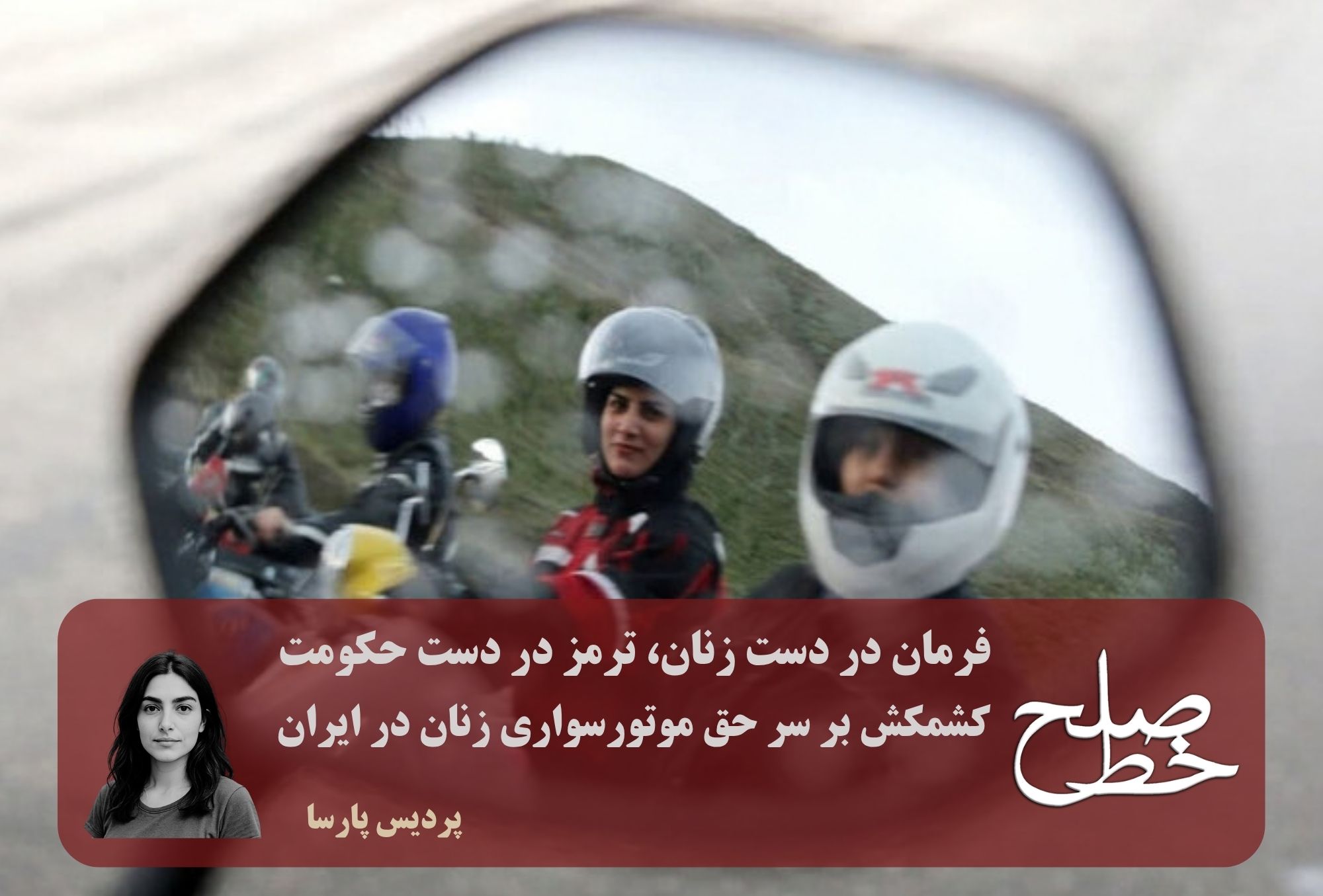
Women at the Helm, the Government on the Brakes/ Pardis Parsa
Today in Iran, motorcycles and electric scooters have evolved from recreational vehicles or means of transportation associated with particular social classes into essential tools for earning a livelihood and for fast, inexpensive transportation. Nevertheless, the absence of a single, transparent procedure for issuing licenses to half of the country’s population has pushed women motorcyclists into informal spaces and exposed them to irreparable legal, criminal, and insurance-related risks.
The issue of women riding motorcycles in Iran has become one of the most tangible and symbolic arenas of confrontation between women’s civil rights and traditional structures of control. Preventing women from taking the handlebars of motorcycles has long since moved beyond the framework of a simple traffic, administrative, or even legal issue, acquiring profound social, political, and feminist dimensions.
This phenomenon offers a precise dissection of an effort to keep women out of the active public sphere and restrict their independence. In recent decades, with sweeping changes in lifestyles, mounting economic pressures, and the emergence of new urban needs, the necessity of using inexpensive and fast means of transportation has become increasingly pronounced for all segments of society. Yet Iranian women, in seeking to meet this basic need, encounter a barrier of unwritten rules, restrictive interpretations, and contradictory government policies. This report examines the social, political, and critical roots of this prohibition and women’s civil resistance to it.
Why Do Women Need Motorcycles?
A look at Iran’s current economic conditions and social structure shows that motorcycle riding is no longer a luxury pastime for women, an individual pursuit of excitement, or merely a gesture of protest; rather, it has become an economic and practical necessity. Runaway inflation and the astronomical and unprecedented rise in passenger car prices have effectively made access to a private car impossible for a large portion of the middle and lower classes. Under these circumstances, motorcycles have emerged as the only affordable and accessible option for independent mobility.
On the other hand, the public transportation system in Iran’s major cities is not only worn out and inadequate, but also wastes a considerable amount of citizens’ time because of heavy traffic congestion. For a female head of household, a working student, or a woman living on the outskirts of a city, the time and cost of transportation are vital considerations.
Moreover, at a time when new occupations such as online couriers, ride-hailing applications, and delivery networks account for a large share of the labor market, depriving women of motorcycle licenses effectively means systematically excluding them from this accessible and high-demand job market. This discrimination not only targets women’s freedom of movement, but also severely undermines their financial independence and economic empowerment, keeping them trapped in a cycle of economic dependence on men.
Why Is the Political System So Afraid of Granting This Simple Right?
The answer lies in the psychological and sociological image of the “woman motorcyclist.” A motorcycle is inherently a vehicle that exposes its rider to public view, direct contact with urban space, and the experience of speed. Sitting at the handlebars of a motorcycle requires a certain degree of boldness, agency, control, and mastery over both the machine and the surrounding environment. This image of an active, independent woman in control fundamentally conflicts with the traditional, confined, and obedient image that the official structure seeks to reproduce and promote as the “ideal woman” in society.
From a spatial perspective, a woman riding the subway or a bus is situated in an enclosed, controlled, and often gender-segregated space. A woman riding a motorcycle through the streets, however, breaks down the boundaries of gender segregation and takes possession of public street space. Furthermore, the physical posture involved in riding a motorcycle has long been perceived in traditional patriarchal cultures as conflicting with reductive definitions of “modesty” and “chastity.” The government is concerned that normalizing this image will make control over women’s bodies, their physical presence in the streets, and the regulation of their clothing more difficult than before. In fact, the prohibition on women riding motorcycles is part of a broader strategy to restrict women’s physical presence in arenas regarded as symbols of power and control.
The government in Iran has repeatedly demonstrated that it views any retreat in the face of women’s civil demands concerning public space—whether access to stadiums, cycling, or motorcycle riding—as an “identity threat” and the beginning of a domino effect. The underlying fear is that if women today gain the right to command the streets on motorcycles, tomorrow they will break through broader boundaries of social, political, and ideological control.
A Brief Review of the Legal and Religious Deadlocks
Despite the issue’s broad social dimensions, the official justification for preventing women from riding motorcycles has always been wrapped in legal and religious rationalizations. Legally, the core of this prohibition can be traced to the note to Article 20 of the 2010 “Law on the Handling of Traffic Violations,” which stipulates: “The issuance of motorcycle driving licenses for men shall be the responsibility of the Law Enforcement Force.”
Many legal experts believe that because nowhere in Iran’s criminal laws has motorcycle riding by women been criminalized, under the fundamental principles of “permissibility” and the “presumption of innocence,” women have a legal right to use motorcycles, and the inclusion of the word “men” in the law merely constitutes an administrative gap rather than an inherent prohibition. Nevertheless, the Law Enforcement Force and the Traffic Police, adopting an intensely textualist and patriarchal interpretation, argue that because the legislature did not mention women, they have no obligation to issue them licenses.
This legal deadlock has even reached the courts. In a historic case, a first-instance branch of the Administrative Justice Court in Isfahan, following a complaint filed by a woman motorcyclist, issued a progressive ruling requiring the Law Enforcement Force to issue her a license, reasoning that driving is not contingent upon gender. This victory, however, was short-lived. An appellate branch of the Court, taking a conservative approach and citing the detailed parliamentary deliberations, overturned the initial ruling and effectively blocked the path of individual legal action.
From a religious perspective as well, traditional Islamic jurisprudence does not regard the act of a “woman mounting a riding animal” as inherently forbidden. Nevertheless, conservative religious institutions invoke a principle known as “secondary rulings” to argue that because such conduct in contemporary society attracts the attention of non-mahram men or violates norms of public chastity, it should be avoided.
Civil Resistance and the Pathology of a Prohibition
Restrictive laws have never been able to halt social realities. The continuation of the current state of limbo has led to the emergence of a form of everyday civil resistance within the sphere of women’s urban transportation. The refusal to issue licenses has not dissuaded Iranian women from riding motorcycles; instead, it has pushed them toward circumventing the rules.
Numerous reports indicate that women’s interest in learning to ride motorcycles is increasing sharply. Many women informally teach other women to ride motorcycles in parks on the outskirts of cities. Many women also wear loose clothing and full-face helmets to conceal their gender identity on the streets and avoid having their motorcycles impounded by police.
Yet this forced civil disobedience comes at a heavy price for women. Women who are compelled to ride motorcycles without licenses are deprived of third-party insurance coverage. If a traffic accident occurs on the dangerous streets of Iranian cities, even when a woman motorcyclist bears no responsibility whatsoever, the absence of an official license creates numerous legal obstacles to receiving compensation and diya. If she is found responsible for the accident, the lack of a license and insurance protection can lead to severe penalties and the imposition of enormous costs on her personal assets, which can be financially devastating for many of these women. By refusing to establish a legal framework for women’s motorcycle riding, the government has effectively left them in an extremely vulnerable and dangerous position.
Champions Who Have No Right to Travel Through the City!
One of the bitterest and, at the same time, most ironic contradictions concerning women’s motorcycle riding in Iran is the profound and unjustifiable gap between policies governing “competitive sports” and “civil rights in the public sphere.”
While the Traffic Police considers women riding motorcycles on city streets illegal and takes coercive action against them, the Ministry of Sports and the Motorcycle and Automobile Federation maintain an organized institutional structure for women motorcyclists and regularly hold national championships in various motocross and racing categories.
Iranian female athletes not only compete on domestic tracks but, with the government’s full approval, are sent as official representatives of the Islamic Republic to prestigious international competitions. Young Iranian women such as Hasti Rezaei have participated in women’s world motocross competitions, while the Federation proudly announces the dispatch of women to Asian Cup competitions and loudly promotes these achievements as symbols of Iranian women’s capabilities.
This policy duality conveys a profoundly contradictory social message: an Iranian woman is permitted, while observing Islamic dress requirements, to raise the country’s flag at international racetracks, skillfully control powerful 250cc motorcycles, and receive praise from officials; yet that same national champion does not have the right to ride a lightweight urban motorcycle through the streets of the capital to do her daily shopping or get to work.
This institutionalized paradox demonstrates that the principal obstacle to women riding motorcycles in Iran is not women’s physical inability, lack of skill, or even insurmountable religious barriers. Rather, the central problem is the government’s unwillingness to accept women’s independent, uncontrolled, everyday presence in the city’s public sphere. A racetrack, as an enclosed, isolated, and controlled space, is considered permissible for women motorcyclists, while the street, as a public arena and a site for the manifestation of civil power, continues to be regarded as an exclusively male domain.
A Crisis of Governance and Multiple Voices Within the Government
At the broader policymaking level, the issue of issuing motorcycle licenses to women has become a symbol of inefficiency and conflicting voices within the governance structure after decisions are made. Different institutions within the government have adopted completely contradictory approaches toward this civil demand. In recent years, the Cabinet, through a number of resolutions, required the Law Enforcement Force to establish the necessary infrastructure for women’s training and testing. Officials from the Ministry of Interior and the Presidential Office’s Vice Presidency for Women and Family Affairs also officially announced that legal and religious obstacles had been removed and that the government was seeking to regulate women’s motorcycle riding.
These efforts within the government, however, immediately encountered firm resistance from other centers of power. Conservative members of the Islamic Consultative Assembly condemned these resolutions, arguing that the government had no right to circumvent enacted laws by issuing regulations and that any change concerning the authority responsible for issuing licenses required the submission of a formal bill and approval by parliament. Meanwhile, higher-level institutions such as the Women’s Social and Cultural Council, adopting an intensely traditionalist perspective, initiated efforts to overturn the government’s supportive resolutions, arguing that the issue was contrary to the identity and cultural interests of society.
This constant passing of responsibility among the government, parliament, cultural institutions, and the Law Enforcement Force demonstrates the absence of unified political will to resolve social issues. Turning basic citizenship rights into an instrument of factional competition and institutional conflict has left women’s demands stranded in a bureaucratic labyrinth.
The Lived Experiences of Women Motorcyclists
Being deprived of the protective umbrella of the law has placed women motorcyclists in a precarious and highly stressful position. “Liana,” a 25-year-old Tehran resident who travels from home to work by motorcycle every day, tells Peace Mark Monthly Magazine about her fear of encountering the police: “Even though the police have never confronted me, I still get stressed and lose my composure whenever I come across police officers on my route. That is why I often take side streets or longer routes just so I won’t run into the police.”
The contemptuous looks of some citizens impose an additional psychological burden on women, even though motorcycles are not a form of entertainment for many of them, but rather a means of making everyday life easier. “Golara,” a 44-year-old employee who rides a motorcycle in Tehran, also tells Peace Mark Monthly Magazine: “There have been times when someone has seen me riding a motorcycle and cursed or insulted me, although a lot of the time people also encourage us or say that we have made the city more beautiful. Look, I didn’t buy a motorcycle to drive at high speeds or weave through traffic. I bought one so that I could spend more time with my family and less time stuck in traffic. In the early days, putting up with people’s stares was harder for me than riding the motorcycle itself. Every time I got on the motorcycle, I thought someone was about to say something nasty to me again or the police were going to stop me. But little by little, I got used to these comments and my fear went away. A lot of people think that we women motorcyclists are trying to prove something, but that is not the case for me at all. I am a working woman with limited time; why shouldn’t I have the same means of getting around that a man has?”
In addition to avoiding traffic, exorbitant prices and high fares are also an important reason young women and students are turning to motorcycles. “Sharareh,” a student living in Shiraz, tells Peace Mark Monthly Magazine: “I could only afford to buy a motorcycle in installments. At first, I never imagined that one day I would actually ride a motorcycle myself through the busy streets of this city. Once I learned, I realized how much easier it made getting around and how much my expenses had gone down. But there is always one concern with me: I know the law is not equal for women and men. Without a license, if any accident happens, I will be considered the one at fault from beginning to end, even if I did nothing wrong. That is truly unfair.”
On the other hand, officials commonly cite statistics on accidents involving women motorcyclists in an attempt to demonstrate that they lack sufficient skill and use this as a justification for the restrictions. Recently, the police commander of Isfahan Province reported that 18 women motorcyclists had died in accidents during the first four months of the year and emphasized that because they did not have licenses, no insurance compensation would be paid to them. Many women motorcyclists, however, believe that these reports are one-sided and seek to conceal deficiencies in formal training.
Liana tells Peace Mark Monthly Magazine in this regard: “These reports are completely one-sided. Motorcycle safety has nothing to do with being a woman or a man. If anything happens to a male motorcyclist on the street, no one questions his skills, but now they announce the number of women who have died to show that women lack skill. Teenage boys have been doing wheelies on the streets without licenses for years and no one bothers them, but now they only want to stop women from riding motorcycles. If women are given access to proper training and licenses, women actually ride much better than men.”
Sharareh says: “These days in Shiraz, a lot of women take their children to kindergarten and school on motorcycles, do their shopping, and go to work. Women actually ride much more cautiously, wear helmets, don’t do wheelies, their motorcycle exhausts don’t make the deafening noises that men’s do, and overall they obey the rules.”
What is taking place today on the streets of major cities is no longer merely a symbolic demand; rather, it is an unavoidable response to structural economic pressures, the traffic crisis, and women’s vital need for independence. The legal vacuum and the refusal of the relevant institutions to issue licenses to women have merely erased the issue from official procedures, while in practice this restrictive approach has pushed women into informal spaces and deprived them of the most basic rights of citizenship, including psychological security, insurance coverage, and judicial protection. At the same time, the stark contradiction between the government’s support for women motorcyclists on racetracks and its coercive treatment of them on public roads clearly demonstrates that systematic resistance to this phenomenon is rooted neither in safety concerns nor in insurmountable religious barriers, but in an effort to preserve exclusivity and exercise control over the manner of women’s physical presence in public space.
Nevertheless, everyday civil resistance and the continued presence of women motorcyclists demonstrate that social and customary transformations do not wait for administrative amendments. By accepting legal and social risks, Iranian women have asserted their agency across the body of the city and are establishing a new and undeniable practice. This confrontation on the ground has placed the policymaking structure before an inevitable reality: the continuation of exclusionary policies in the face of the definite economic and social needs of half of society will sooner or later lose its effectiveness. The country’s legal and executive system will have no choice but to adapt itself to changing social norms and accept women who have taken control of their own mobility and independence in urban space.
 Created By: Pardis Parsa
 September 23, 2026
Tags
Compulsory hijab Driver's license Hijab Motorcycle peace line Peace Line 185 Women's motorcycling Women's rights