


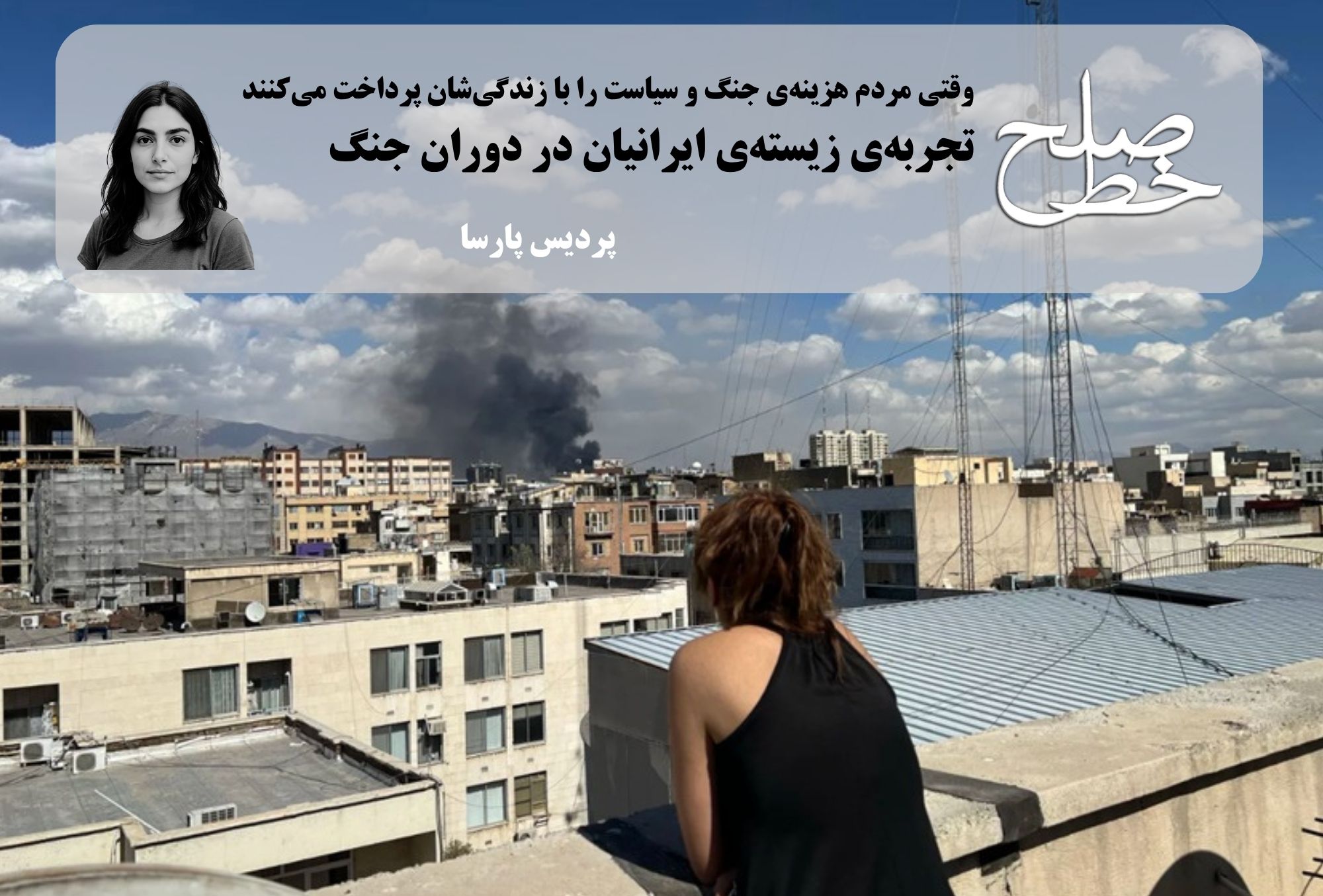
The lived experience of Iranians during the war/ Pardis Parsa
The outbreak of war between Iran, the United States, and Israel was the inevitable consequence of years of ideological adventurism and tension-generating state policies that have consistently prioritized political survival over the safety, welfare, and lives of citizens. This war once again stripped away the illusion of “security” — a claim that for years had been sold to the public as the system’s sole achievement in suppressing civil demands. With all its naked violence, war penetrated the homes, memories, and everyday lives of people who had already been struggling for survival under the pressures of sanctions and mismanagement.
This article is an attempt to approach the more tangible and human layers of war: a narrative of people who have found themselves hostages to grand political policies; defenseless citizens caught in the middle of fire, grappling not only with the fear of foreign missiles, but also with internal incompetence, communication blackouts, and the government’s indifference toward their lives. For the people of Iran, the experience of this war was a bitter confrontation with the reality that, in the equations of power, their lives and mental well-being hold the least value.
Helplessness, Anxiety, and Terror
The accounts reveal how absolute insecurity and fear of death have shattered the normal rhythm of life. In circumstances where the government has provided no effective infrastructure to protect civilians and has left them defenseless against the consequences of its own policies, people are carrying the heavy burden of anxiety and terror alone.
“Irandokht,” a young teacher in Tehran, told Peace Mark Monthly Magazine about her experience on the first day of the war:
“On 9 Esfand, the day the war started, my friend called me and said there had just been an explosion. At the time I was at the school where I teach. I was confused for a few seconds, but when the school decided to close, I waited to make sure all the students got home safely. Parents had all rushed there in panic and chaos had broken out. All the streets were locked in traffic, and parents were running long distances on foot to reach their children.”
“Alireza,” a 48-year-old mechanical engineer, also described his horrifying experience in an interview with Peace Mark Monthly Magazine:
“It was three in the morning when missiles hit about two hundred meters from our house. I was literally thrown out of bed onto the floor. They fired five or six missiles. The window frames came loose. The electricity went out. The first thing I did was bend over my son, because I was certain everything was collapsing and the house was coming down on top of us. Even now, remembering it upsets me. I kept thinking none of us would survive.”
“Ali,” a private mathematics tutor living in Zaferaniyeh, spoke about the anxiety that overwhelmed him during the war days:
“The moment they hit Zaferaniyeh, I was awake. First the sky turned blue, then there was a terrifying sound. Instinctively, I grabbed my cat under my arm first, then dragged my parents out of the building. You can’t imagine the amount of stress I went through. During those days my jaw constantly hurt because of severe stress. Sometimes it would tense up so much it felt locked. Toward the end, I had started relying on sedatives. I also felt sorry for my cat. Whenever they attacked, I would hold my cat and cover its ears, but it could still feel the vibrations and the poor thing was terrified.”
“Baharak,” a 27-year-old painter, told Peace Mark Monthly Magazine about her sense of helplessness and despair:
“I’m a painter. Before all this happened, I was working on a painting project with my teacher, but after the war I can no longer return to who I was before. I go to the studio and sit there trying to continue my previous project, but whenever I paint, all that fills my mind is corpses, blood, and rubble. I can’t concentrate on my work. I even think to myself: what significance do my paintings have in this situation? What use are they? I’ve become completely detached from the person I was before the war. I no longer have the strength to do anything; I can’t even read two pages of a book.”
“Sara,” a 25-year-old woman living alone in Tehran, tries as much as possible to return to her normal life. Nevertheless, even experiencing small and ordinary pleasures fills her with guilt. She described her experience as follows:
“Honestly, because I’m so scared of all the explosion sounds, I put earbuds in my ears and watch TV series so I won’t hear anything. I also felt guilty, like: people are dying and you’re watching series, listening to music, craving ice cream, getting up in the middle of the night to go eat ice cream! But if I don’t do these things and distract myself, I’ll collapse. I was in a long-distance relationship, and after the war started and the internet was cut off, our contact was completely severed. That poor guy had no news of me for a long time; he didn’t even know whether I was alive or dead. I know that amid everything happening, my relationship matters the least, but that relationship was my source of hope and happiness in life. After all, I also have the right to have the bare minimum in my life. We’ve reached a point where wanting the basic necessities of life — our jobs, our relationships, our small pleasures — should make us feel ashamed. It’s as though we are always condemned to think about things bigger than ourselves and are never allowed to think about our own lives and happiness even for a moment.”
“Yasaman,” 33, who lives in Tehran, added:
“It’s mostly overthinking that torments us. One night I was checking how far the blast radius of an explosion could reach and wondering what would happen to me if they hit the building at the end of our alley. Because of all these thoughts, at night I can maybe sleep two or three hours. Since they usually strike at night, I’m genuinely afraid to sleep. For me personally, the most horrifying day was the morning after they hit the oil depot. I woke up at six-thirty in the morning and looked outside through the window. Outside was black from the smoke; you couldn’t even see the sky. I have asthma. This situation created such an intense feeling of fear and suffocation in me that I tried to manage it, because if I had a panic attack I wouldn’t have been able to control my asthma. After that day, for an entire week everything around us was covered in black soot. I never imagined I would go through experiences like this in my life.”
Post-Traumatic Stress Disorder (PTSD): The Endless Reconstruction of Nightmares
Many interviewees were suffering from post-traumatic stress disorder. In PTSD, the mind obsessively reconstructs the traumatic experience, as if the event is happening repeatedly in memory. Those affected feel threatened and unsafe even in ordinary life. They may suffer from recurring nightmares, sudden anxiety attacks during the day, or intense reactions to certain sounds, images, and situations.
“Farnaz,” a 40-year-old resident of Tehran, told Peace Mark Monthly Magazine:
“At around three-thirty or four in the middle of the night they struck near us. If I hadn’t known it was an explosion, I would honestly have thought there was an earthquake. The whole house shook. For a while afterward, every sound made me literally jump two meters into the air! After some time, I started distinguishing sounds — like, this is anti-aircraft fire, this is a CG motorcycle, this is thunder. That was how I tried not to be afraid.”
“Sonia,” who lives on Sanaye Boulevard in Shiraz, said:
“Our house is near Sairan. On the first day of the war they struck around our neighborhood several times, so strongly that the blast wave violently flung open the windows and raised clouds of dust. You could hear screams from the neighbors’ houses. I went into the back room and crouched on the floor. When the explosions ended, all the neighbors got into their cars and left. Our alley and the surrounding streets became completely deserted — not even a bird was flying. I saw two fire trucks parked in front of Sairan. Until the end of the war, they hit Sairan maybe four more times. The next time was around 2 a.m. I was in bed when I heard the whistling sound of a missile launch. I put my pillow over my head and took cover, worried that it might accidentally hit my house. Then there was a huge explosion that shook the entire house, flung open the windows violently, and filled the house with the smell of burning. When the airplane sound faded away, I finally dared to get up and close the living room windows. The smell of burning lingered in the house until the next day. Several neighbors’ windowpanes had shattered from the blast wave. Since they weren’t home, I called them and informed them. In the following days I constantly imagined they were about to strike again. My brain wasn’t functioning properly from stress, and I always had headaches. A few nights later there was a heavy storm with constant thunder and lightning; with every thunderclap I thought they were attacking again. I couldn’t sleep until morning. Every small sound outside made me think they were striking again and my heart would start pounding. The sound of a car exhaust, a garage door slamming shut, or a window banging was enough to scare me out of my mind. Even now I constantly tell myself: don’t be afraid, there’s a ceasefire now, they won’t attack anymore — but I still sometimes hear explosion sounds in my head.”
“Tanaz,” 36, a resident of Tehran, also described her experience:
“It was one Friday morning that became truly terrifying. The bunker-buster strike they carried out in Manzariyeh. There was a sound like an airplane beforehand. The ground started shaking, then there was a massive sound followed by many explosions for a long time. In those situations, you genuinely don’t know what to do anymore. Then the fear stays inside you. The night there was thunder and lightning, I was terrified to death. The flashes in the sky made me think for a moment that they had launched a nuclear attack, but then I realized it was lightning. On New Year’s Eve they were attacking while I was watching the anti-aircraft fire, and at the same time I could also see the city’s fireworks. I was seeing both at once, and honestly it was terrifying. Everything has become frightening for us. I think it will take a very long time before we return to normal.”
Diverging Perspectives
The government’s propaganda machine is trying to turn the war into an opportunity for renewed allegiance, while a large portion of society, exhausted by these policies, sees this war as a prelude to the overthrow of the Islamic Republic. Some people are worried about damage to the country’s infrastructure; some try to do something to help; and others grieve for the lives lost.
“Maryam,” 35, who recently returned to Iran after living abroad, stated in an interview with Peace Mark Monthly Magazine:
“I was in London during the previous war; this time I’m here. No matter where Iranians are, their hearts melt for their country, especially when the internet gets cut and you have no news of anyone. It’s very hard. I have a religious family who lean toward the government. The difference in our views has caused another war inside our house. Every night at eight they go outside chanting slogans, and I simply cannot understand them.”
“Sima” described people’s reactions to the war in this way:
“Imagine planes flying overhead while several people below are clapping, whistling, and cheering for them. On the other hand, loudspeakers pass through the streets every night blasting revolutionary music and shouting government slogans, while Basij supporters organize car convoys in support of the Islamic Republic. Meanwhile, another group chants ‘Long live the Shah’ and anti-government slogans. I mean, the confrontations have become much more tangible during this period.”
“Elaheh,” 45, a mechanical engineer living in Shiraz, spoke to Peace Mark Monthly Magazine about her sense of usefulness during the war:
“I work in the oil industry. Our work is gasoline production. During the war, despite the danger of my workplace, it mattered to me to be there because I felt useful there, and that gave me a sense of worth. I wanted to help keep life moving forward even under these conditions. During that time, my job took on a completely different meaning for me, and all the boredom and exhaustion I might previously have felt toward my work disappeared entirely.”
“Siamak,” 42, a resident of Tehran, believes that because military and security infrastructures are embedded within urban areas, ordinary citizens have effectively become human shields and their lives are disregarded as “collateral damage.” He continued:
“Many people are being killed who are innocent, who support no one, or who are simply doing their jobs. I heard they hit the Rey City Cultural Center with three bombs. At first I thought, well, there must have been some government official or Basiji there, but meanwhile a number of innocent people in a cultural center were killed. They struck the electricity distribution company — the photos showed it completely destroyed. I’m in news channels related to electrical workers, and I found out apparently ten people were on duty there and working when they were killed. All of them were electrical engineers. They weren’t military personnel, intelligence agents, or Basijis.”
International Internet Shutdown
The government, which has always considered the free flow of information its greatest threat, once again plunged people into complete darkness and media isolation in the middle of the crisis by cutting off the international internet. This digital siege was not merely a violation of freedom of expression; it was a final blow to the already half-dead digital economy, the livelihoods of freelancers, and even patients’ access to medicine and treatment — a silent crime whose damages were no less devastating than wartime missiles.
“Leila,” 28, a graduate of English literature, told Peace Mark Monthly Magazine about losing her job:
“I teach language classes on international platforms. Or at least I used to! Every time the internet was cut, I lost some of my students. The internet connection after 18 Dey was terrible, and because of that I lost more students. And now that we’ve had no internet for two months, my account is completely gone. This was my only source of income. I don’t know any other work. I constantly think to myself: if this situation continues, how am I supposed to pay my installments and cover my expenses? This amount of anxiety is destroying me.”
“Shahram,” an entrepreneur, said:
“I’m an entrepreneur who sold my car to pay my employees’ salaries, but in the end today I had no choice but to lay everyone off until the internet is restored and maybe we can return to work. I gave up the office so I could use the deposit money just to survive for a few months. My friends who are CEOs or own companies are also in terrible condition. My close friend has a ten-person company that I don’t think will survive. They have ruined our entire lives and livelihoods!”
“Amirhossein,” a freelancer in digital marketing, described his situation in an interview with Peace Mark Monthly Magazine:
“I started in 2019 and despite sanctions and all the country’s small and big problems, before the war I managed to build a small team of seven or eight people and work on projects together. The projects had just started flourishing, their numbers were increasing, and we were beginning to get foreign projects when the internet was cut off and our business collapsed. Our previous projects were delayed and our credibility was ruined. Not only do we have no income, we’re also paying penalties for project delays.”
“Mehriz,” who studied handicrafts, spoke about her work:
“For two years I’ve been working in ceramics. I make, paint, and sell handmade ceramic dishes with love. All my income came through online sales and my online shop. My Instagram page was finally gaining momentum when suddenly everything was destroyed. From Esfand until now I haven’t earned a single rial. The price of raw materials has increased by 40 percent, and my sales have dropped to zero. All my plans and hopes were washed away.”
The internet shutdown has also affected patients and people with disabilities.
“Sajjad,” who has a physical-motor disability, described his situation:
“I’m physically disabled, and because I can’t do physical work, I spent two years working hard and spending money to learn forex trading. After two years of training, I was just starting to succeed when the internet was cut and all my efforts were destroyed. Because of my physical condition, I can’t actively participate in society, and all my connection with the world was through the internet and global social networks. In addition, my education, shopping, medicine research, medical treatment process, entertainment, and almost all my needs were met through the internet. For two months now, apart from watching films and series, I can’t do anything else. At 29 years old, every night I go to sleep hoping I won’t wake up tomorrow.”
“Solmaz,” a 28-year-old woman living in Tehran, has a younger brother with epidermolysis bullosa, commonly known as butterfly disease. The skin of people with butterfly disease is extremely fragile, and even the slightest touch or impact can cause deep and painful blisters and wounds. Solmaz’s brother requires specialized and continuous dressings, and the overwhelming costs of treatment and dressings fall on her shoulders. The specialized dressings needed by patients like her brother to prevent infection and reduce pain are imported and extremely expensive. According to Solmaz, before the internet shutdown she had a dollar-based income and was able to cover both her own and her family’s expenses, but the internet blackout cut off her income and worsened her family’s hardships. Solmaz told Peace Mark Monthly Magazine:
“My younger brother has butterfly disease. His monthly dressing costs can reach forty million tomans. His dressings need to be changed almost every other day. During the years I worked online, my income was enough that we had no problem buying his dressings, and I personally bought them and took care of him. Now that I can’t work, we don’t have enough money to buy these dressings, and last week I even sold my laptop so I could buy enough dressings for him — and then it turned out the dressings were fake. This child cries so much from pain that I would give up my entire life just to lessen his pain a little.”
“Setayesh,” 30, is hard of hearing. She described her difficulties during this period:
“I’m hard of hearing and use hearing aids. The Signia hearing-aid app depends on international internet access, and I used international internet to check my hearing-aid charger and operate the microphone of my hearing aid. I used the microphone to listen to films or voice messages, but now that doesn’t work without unrestricted internet either. My own work was SEO and website and page content production, but after all this happened I was fired and now I’m unemployed. And the situation is such that it’s impossible to find work. Honestly, there’s no joy left in life for me anymore.”
***
The people whose voices are reflected in this text are not merely victims of a military conflict; they are victims of a system that has sacrificed ordinary life, free internet access, employment, and even patients’ life-saving medicine to its endless adventurism. All of these narratives bear witness to one painful truth: the greatest and longest war imposed upon this society has been the struggle to reclaim the “right to live” from the grip of a government that seeks its survival through repression.
 Created By: Pardis Parsa
 May 22, 2026
Tags
"Collective dream" Bombardment Iran-US war Non-military Pardis Parsa peace line Peace Line 181 The war between Iran and Israel. Trauma US Army War