


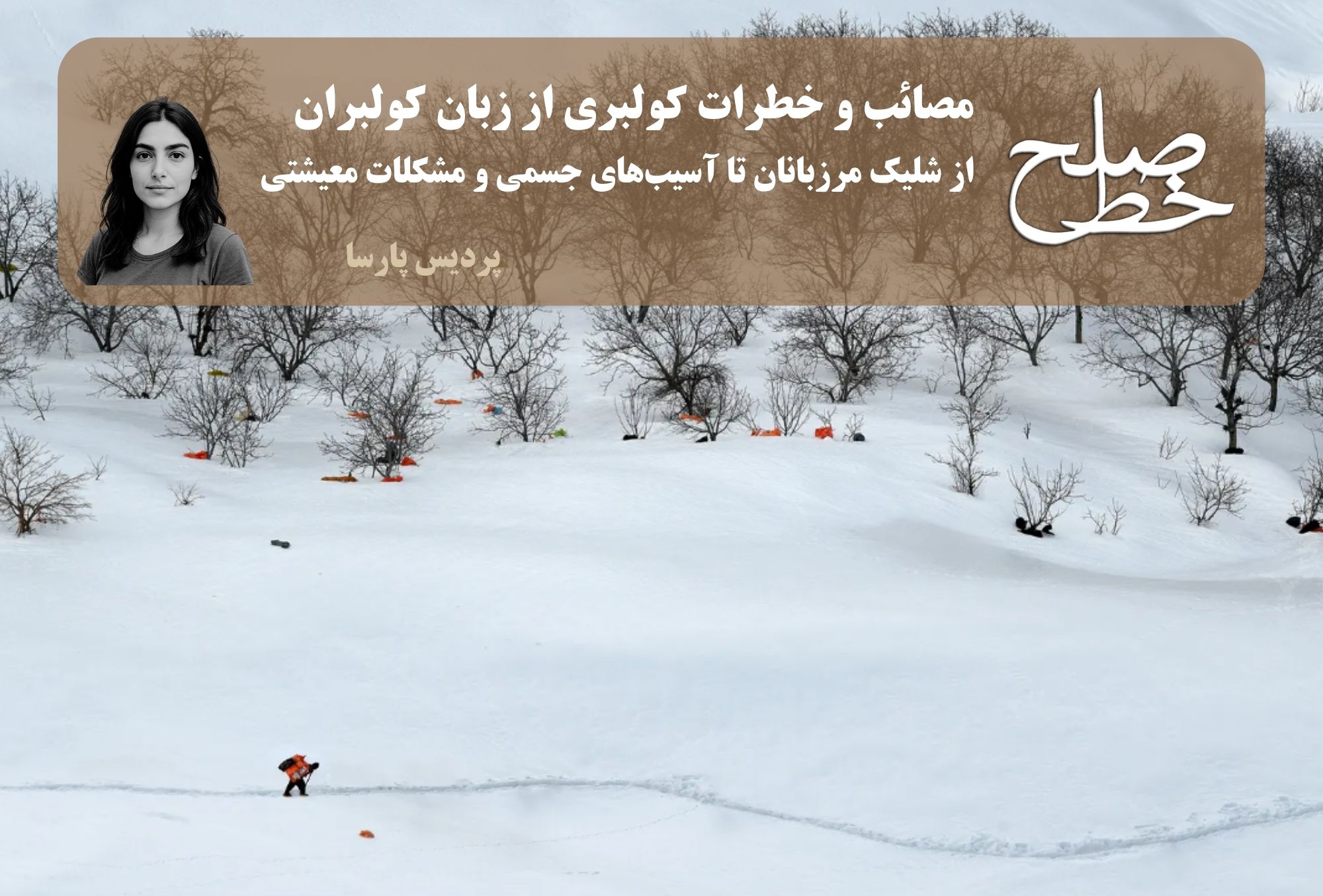
The hardships and dangers of kolbari, as told by kolbaris/Pardis Parsa
The phenomenon of kolbari has become one of the most painful manifestations of the informal economy in the western and northwestern borders of Iran in recent decades. Kolbari is mainly prevalent in the provinces of West Azerbaijan, Kurdistan, Kermanshah and Ilam. Field estimates show that about 70 thousand people are kolbari in the provinces of West Azerbaijan and Kurdistan alone, and the largest number of kolbari has been reported in cities such as Baneh, Marivan, Sardasht, Piranshahr and Paveh.
Environmental imperatives and economic problems
The government’s de-development policies, especially in Kurdish areas and among non-Persian and non-Shiite communities, have contributed to the spread of this phenomenon. Years of deprivation from sustainable investment, historical insecurity, and the dominance of a security perspective in these areas have limited the formation and expansion of sustainable economic activities. The lack of industrial infrastructure and production workshops, the weakness of the tourism industry, and the stagnation of agriculture have also reduced formal employment opportunities. In such circumstances, the lack of effective support policies and development programs has pushed many border residents into the informal economy, and kolbari, despite its life-threatening risks, has become one of the few ways to earn a living for thousands of families. “Arman,” a young man living in Baneh who recently graduated, narrates the reason for his entry into this profession as follows: “I could not find any other job, there was no work or business that I could do. “Right around the time I graduated, my father had an accident and lost his job, and we had no source of income. After all, I had to somehow support our family of five.”
Farid, who has a bachelor’s degree in literature and a teaching background, describes the situation as follows: “There are many who are educated and work as kolbaris because they have nowhere to go. If they don’t work as kolbaris, they will die of hunger. Now that I am unemployed, I have no choice but to work as kolbaris, but people see kolbaris as illiterate and criminals.”
Mohammad, who is 45 years old and lives in Oraman, told the Peace Line: “I have been working as a kolbari for five years. I started working as a kolbari because I was unemployed. Before that, I would go out of Kurdistan, where there is no work, never has been, and in southern Iranian cities like Bandar Abbas and Asaluyeh I would do construction work and work on a labor ship. I would go seasonally. I would go mostly in the winter and return in the spring and work on the farm until the fall, then I would go back to Bandar Abbas, Asaluyeh, and Tehran to earn a living.”
“Qadir,” a 50-year-old resident of Baneh who has been a kolbari for a long time, also told the monthly newspaper “Hat Sohl”: “You introduce me to a job that has a moderate income and is permanent and has a future, I will do it without hesitation. At least I do not fear for my life. By God, kolbari is not a job. After all, what kind of job is this that if you continue for 5 years, you will get a thousand diseases. With that physical strength, a mule can carry less than a quarter of its own weight, and after 5 years, all its joints swell. Now, we, who carry at least half of our own weight with each kolbari load, will be destroyed after a few years.”
Encounter with armed forces and border guards
The greatest danger that kolbars report is encountering armed forces and border guards. First-hand accounts of kolbars’ encounters with military forces reveal extrajudicial killings and the disproportionate use of firearms. Many of the military forces stationed at the border are also conscripts who do not have the necessary training to use weapons. Mohammad recounts his observations of targeted shootings as follows: “Maybe I have been shot at several times, but it is as if God was not pleased with my death. Sometimes they did not shoot intentionally. Once when they shot at me, I heard one of them say loudly: Alireza, shoot him, Alireza. Sometimes they shoot directly at the person himself with the intention of killing. For example, I have seen only one or two shots fired and they hit the kolbar in the head or back, killing him on the spot. It must have been intentional. “So why do they sometimes fire ten shots and they all hit the surroundings, but sometimes they fire one or two shots and they hit directly in the head or between the shoulder blades?”
“ Masoud,” a resident of Sardasht, was himself a victim of these shots. He describes the moment he was targeted in detail: “When we realized we were ambushed, we dropped our loads and scattered, everyone went in different directions. One of my friends ran in one direction and I went in the opposite direction. First they shot him, the bullet hit his shoulder. Then they shot me. The first bullet hit my thigh and I fell to the ground… Suddenly, a soldier appeared above me. He pointed his rifle at me. I begged him not to shoot, but he did. The second bullet hit my upper chest. The bullet broke a few of my ribs before exiting my body, perhaps because the soldier was above me. Anyway, I lost a lot of blood.”
Qadir told the Peace Line: “Even recently, they are using hunting weapons to help the government evade the law, but later they say that our forces do not use these weapons, so we did not attack. I even heard from the Kolbars that they are now planting mines on the border line to prevent the Kolbars from crossing.”
Apart from direct fire, military forces may create conditions for the kolbars that lead to their injury or death. “Hasan,” a 55-year-old resident of Marivan, told the monthly magazine “Line of Peace,” “Once this year, we were returning. I was a little behind the others, a couple of turns higher than the others. It was almost morning but it was still dark. I saw the officers from above pushing a large rock towards our path. As the rock rolled down the mountain towards the others, another kolbar and I shouted, ‘Take shelter.’ Each kolbar took shelter under or next to a rock or cliff. One kolbar took shelter next to a rock, but part of his load and body were outside. The rock was going in another direction when it suddenly hit a rock and changed direction towards him. We were a little higher up, so no matter how much we shouted, ‘Take shelter,’ someone didn’t hear us, and finally the rock hit the part of his body and load that was outside. We said, ‘He must have been crushed.’” “It was a big rock, probably weighing more than a hundred kilos. When we went, we saw that he was unconscious but still alive. We took him down. Later it turned out that his right arm and leg were broken in three places each. Soldiers do a lot of this. They don’t care.”
Another example of creating deadly conditions is ambushing and following the Kolbars. When the Kolbars learn that there is an ambush, they do not enter Iranian soil and wait until the ambush is resolved. This time may be several days. In such conditions, they have neither food to eat nor shelter. Abdullah explains: “I remember once we were ambushed for two nights and two days. We had no food and only a few people had a few biscuits with them, which I did not have either. During those two nights and two days, I did not eat anything except water. The weather was also very cold. Many were close to dying from the extreme cold and hunger, but after 48 hours we were able to cross and return. They all left their loads, but I brought mine.”
Another issue that the kolbars face is mistreatment and degrading treatment by the guards. Payam, 26, says: “One night we were crossing the hill. There were two paths, one up and one down. All the kolbars took the upper path, except for me and four others. The lower path would have reached our destination an hour earlier. Three soldiers caught us on a cliff. They said we had no post tonight, but they woke us up and sent us here because of you. Then they forced us to go naked in the snow and beat us.”
Physical and mental exhaustion
Kolbars carry loads that are sometimes as heavy as their own weight. Torn tendons, severe joint wear, herniated discs, and broken bones from falling off cliffs are common and unavoidable problems for kolbars. Ibrahim, a 29-year-old resident of Oraman, told the Peace Line about the hardships of kolbar work: “The first time I went to kolbar, I had a nosebleed under the weight of the load, and since then, every time I have a heavy load, my nose bleeds.”
Abdullah says: “I have a torn ligament in my right shoulder. I had to have my legs operated on twice because I fell from the mountain. This year I also had an MRI and the doctor said that due to the great pressure on my back, two of the discs pressed on my spinal cord and spinal stenosis occurred. Because of the dangers that exist, when we walk, we think about whether we will return safely or whether we will be shot or whether we are going to fall from the mountain or get lost in the snow. The same thoughts apply to family members. My mother always cannot sleep well until I return.”
These injuries create many problems for the kolbars in the absence of insurance protection. Hassan explains: “Being a kolbar is a job that does not have insurance or pensions, and when we have an accident, we have to pay for the treatment out of our own pockets. We kolbars risk our lives out of necessity and for a bite of bread. If an accident happens to us, we will no longer be able to work and we will lose our already meager income.”
“Zahed,” a 32-year-old resident of Sardasht, suffered a spinal cord injury after being shot. He describes his condition as follows: “Believe me, the night I was shot, they fired from three to four meters away from me. There were five of them and they fired a volley. When I regained consciousness in the hospital, I was very surprised that I only received one bullet. Before this incident, I had never even had an injection… But what now? I can’t go anywhere. I was a rabbit in the mountains, and now I’m stuck like this, and my legs have atrophied and nothing is left of them except for two bones.”
On the other hand, many kolbars are afraid to go to medical centers when they are injured or harmed, and most of them refrain from going due to fear of arrest.
Qader recounts his experience as follows: “When the officers were following us, my left foot suddenly slipped on wet plants and I fell off a cliff. My load was still on my shoulder. After I fell, I realized that my left foot was broken. The officers stopped trying. But then I was afraid to go to the hospital; I was afraid that they would arrest me there. When my family insisted on taking me to the hospital, I was always afraid that they would come and arrest me. Every time someone came through the door, I thought it was them; because they put everyone they arrest in the black dirt.”
Kolbar teenagers and seniors
Due to the difficult economic situation, many more vulnerable groups, such as teenagers and the elderly, have also turned to kolbari. “Ribwar,” who is now 27 years old and has studied up to middle school, recounts the bitter memory of his first experience at the age of 13: “We were halfway through the journey when I regretted it, I was crying all the time. Another boy was with us, who kept encouraging me, until he put my load on his shoulder and said, ‘Come now.’ I could barely walk up the path without the load. My hands were numb from the extreme cold. I kept telling myself that this was the first and last time. A few days later, Kak Ali called again and said, ‘Are you not coming?’ I said, ‘I can’t.’ He said, ‘Come, we will help you.’ I went and I became a kolbar.”
Kolbari directly deprives children of their right to education. Ribovar told the Peace Line about his dropout: “I went to school, but I wasn’t a bright student. My father really liked me to study. I was in my second year of middle school and I went to Kolbari at night, and when we returned in the morning, it was school time. I overslept several times and either went to school late or didn’t go. After that, our principal scolded me and I never went back to school.”
On the other hand, the elderly are much more vulnerable due to their physical weakness. “Ahmed,” an elderly kolbar, describes his situation as follows: “This work is good for the young, but for me, who am old, it is very difficult. I am always the last to arrive at my destination. I cannot carry the load like the young, my load is always half theirs. I also get half of their money and it does not cover my living expenses. On the other hand, when they come after us, we cannot run away like the young, and we are left stranded and we hear curses from the other kolbars for blocking their path.”
 By: Pardis Parsa
 October 23, 2026
Tags
Border Fuel tester Kulbar Kulbars Kurdistan Labor Paragraph peace line Peace Line 186 Sistan and Baluchestan Smuggling goods Sorrow of bread Sukhtabar ماهنامه خط صلح