


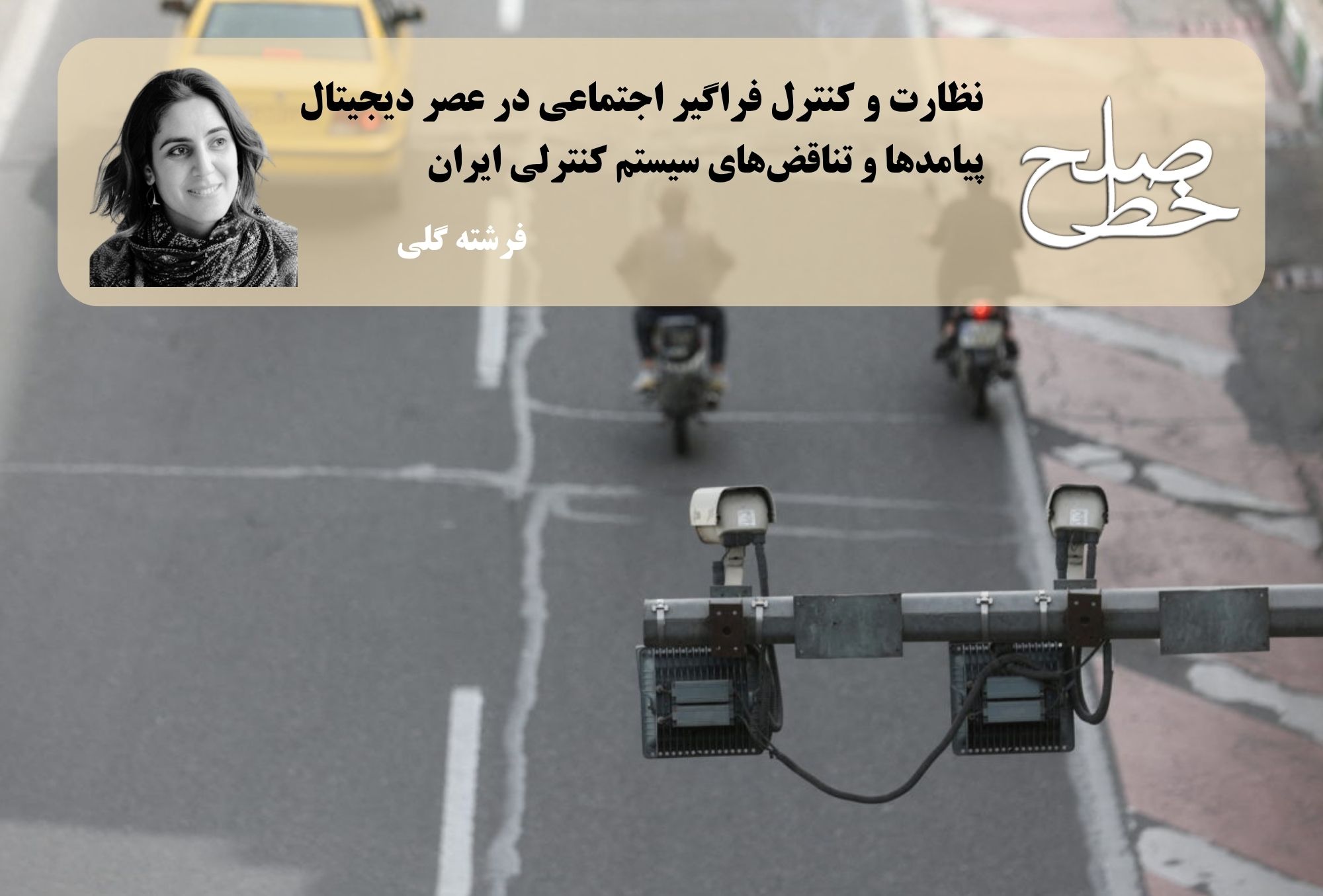
Pervasive Social Surveillance and Control in the Digital Age/ Fereshteh Goli
In recent years, the Islamic Republic has taken major steps in using new technologies for social surveillance and control. This trend, rooted in global developments and what the government regards as domestic needs, has been pursued at different speeds during different periods, but what has turned it into a prominent issue is the increasing acceleration it gained after the nationwide protests of 2022 (1401). At that time, the authorities faced unprecedented challenges in controlling the streets and managing public discontent, and this made the need for more advanced tools apparent to the government. Today, this surveillance system has become a complex, multilayered, and largely invisible network formed through a combination of urban cameras, public reporting applications, identity databases, and artificial intelligence algorithms. This network monitors citizens not only in the physical space of streets and squares, but also in the digital sphere, and seeks to guide individual and collective behavior within prescribed frameworks by creating a sense of constant surveillance. Of course, the issue of mass and digital surveillance is not unique to any particular country or political system and exists in different forms and for various purposes in all countries—from liberal democracies to authoritarian systems. Iran is not alone on this path and has studied and adopted models such as China’s Skynet and Sharp Eyes projects and Russia’s SORM system; although, given its own cultural, political, and social context, it has created a unique combination.
The Urban Camera Network: The Law’s Sleepless Eyes
The metropolis of Tehran is the most densely covered area in terms of the number of surveillance cameras. Unofficial estimates and media reports indicate that after the 2022 (1401) protests, tens of thousands of new cameras were installed or planned for streets, squares, main and side roads, city entrances and exits, metro stations, bus terminals, commercial complexes, and even some residential and office buildings. This network has also expanded in other major cities such as Mashhad, Isfahan, Shiraz, Tabriz, and Ahvaz and is connected to provincial command centers and the central headquarters in Tehran. Recent reports refer to plans to add approximately 15,000 smart cameras with license plate recognition, facial recognition, and behavioral analysis capabilities in Tehran. Nevertheless, the reality on the ground differs considerably from the announced figures. Various sources estimate the operational rate of Tehran’s cameras at around 30 percent, and many of them are inactive because of technical defects, shortages of specialized personnel, maintenance problems, or insufficient funding. (4)
These cameras have a dual and multilayered function. Their visible layer is under the control of municipalities and the traffic police and is used for traffic management, recording driving violations (speeding, running red lights, driving in restricted lanes), monitoring air pollution, and tracking vehicles without valid technical inspections. The more concealed layer is under the control of security institutions. Reports by human rights organizations and international media indicate that images from these cameras are used to actively search for women deemed improperly veiled or not wearing the form of covering desired by the government in public streets and on major roads. Facial recognition software has been installed at entrances to Amirkabir University of Technology to identify women who do not comply with the approved dress code. Citizens often point to the contradiction between security promises and reality. (1) (4)
Public Reports: Digital Citizen-Informants
The “Nazer” application, developed by the Law Enforcement Force, is one of the most controversial technology-based tools of social control and has been made available to “hijab monitors.” Users can record the location (via GPS), date, time, and license plate number of a vehicle associated with a hijab violation. The report is sent instantly to police servers, and after initial verification, a warning text message is sent to the vehicle owner; if the violation is repeated, the vehicle will be impounded. This mechanism reduces the police’s operational burden and creates a sense of universal surveillance. Within the framework of the Noor Plan—the renewed enforcement of compulsory hijab—at least hundreds of women have been arrested based on reports from this application or similar methods. This practice has created an atmosphere of fear, anxiety, and self-censorship, particularly among women and young girls, and has limited many of them from moving through public spaces. Legal experts warn that such surveillance also creates a basis for false reports and personal retaliation. (1) (4)
On the other hand, the 197 system, launched in 2014 (1393) as the public oversight center of the General Inspection Office of the Law Enforcement Force, has a different function. Citizens can call 197 or use the “Police Man” application to register praise, complaints, criticism, or requests regarding police performance. Critics believe that the system is influenced by hierarchical structures and usually does not produce effective results in cases involving structural violations or corruption.
Digital Identity and Databases: The Brain Behind the Scenes
What turns the camera network and public reports into an integrated and intelligent system is the infrastructure of identity databases. By combining e-government data, mandatory SIM card registration, vehicle, banking, and biometric information (fingerprints and facial images), Iran has to some extent compensated for its lack of advanced artificial intelligence tools. The most important of these infrastructures include the Population Information Database of the National Organization for Civil Registration and the national smart ID card, which contain citizens’ identity and biometric data; the Hoda system, used for digital identity verification; the Sana judicial authentication system; driver’s license and passport databases; and banking network data. Two key systems, “Shahkar” and “Hamta,” are pillars of this network. Shahkar links every active SIM card to a specific national identification number and enables security agencies to quickly connect any phone number to a person’s physical identity and track calls, messages, geographical location, and online behavior. The Hamta system, meanwhile, uses the unique IMEI identifier to register, authenticate, and manage the activation and transfer of ownership of SIM-enabled devices, linking each device to its SIM card and registered owner. Combining these systems with camera footage and public reports gives security institutions an almost complete picture of citizens’ daily lives, social relationships, and consumption patterns, raising serious concerns about privacy and the potential misuse of data. (2)
The Experiences of China and Russia and Iran’s Use of Them
China is the pioneer and largest practical laboratory of comprehensive technology-based surveillance. The Skynet project (since around 2005) and Sharp Eyes (since 2015) have created a network of hundreds of millions of cameras. Estimates of the number of these cameras range from more than 200 million to more than 700 million, many of them equipped with facial recognition, behavioral analysis, and movement prediction capabilities. The main strength of the Chinese system lies in data integration: camera images are instantly combined with mobile phone information, national identity databases, banking records, travel data, and public reports. Through the Grid Management structure, this system divides the country into small surveillance cells and operates with citizen participation in reporting. The social credit system also operates more on the basis of blacklists and targeted restrictions than on a single nationwide score. China is the largest exporter of these technologies, and companies such as Hikvision, Tiandy, and Huawei have exported their equipment to Iran and other countries. (3) (5)
Russia, through the SORM system, has provided security services with direct and continuous access to all telecommunications and internet traffic. This system monitors telephone communications, messages, emails, and social media activity. Facial recognition networks, particularly in Moscow, use hundreds of thousands of cameras and systems such as Sfera to identify protesters, political opponents, and even individuals subject to military service. In protests in recent years, these systems have played a key role in the rapid arrest of demonstrators. Strict data-retention laws have further strengthened this surveillance. (6)
Iran has benefited from both models. Chinese companies such as Tiandy, Hikvision, and Huawei have supplied hardware equipment and surveillance infrastructure. According to investigative reports, including those by Forbidden Stories and its partners, from around 2019 to 2021 Iran acquired the Russian facial recognition software FindFace, owned by NtechLab, through intermediary companies and used it in security institutions. This software has a high capacity for facial recognition, even under poor lighting conditions. Technical cooperation in the fields of artificial intelligence, big data analysis, and cybersecurity has also been reported between Iran, China, and Russia. Iran’s combined approach—camera + public reporting + database—clearly resembles the Chinese model, compensating for the shortage of advanced domestic technology through data integration and citizen participation. (2) (3)
Challenges and Contradictions
Despite large-scale investments, the system’s operational effectiveness is limited. The inactivity of a significant proportion of cameras—with only around 30 percent active in Tehran and an even worse situation in other areas—the incomplete recording of violations and crimes, and citizens’ dissatisfaction with the failure to provide actual security show that this network functions more as a display of power and a tool of political and social control than as a guarantee of public security. Professional criminals are often aware of the system’s blind spots. (4)
From a legal perspective, Iran lacks a comprehensive personal data protection law. The Research Center of the Islamic Consultative Assembly has identified the absence of such a law as one of the country’s main problems in the field of cybersecurity. Article 25 of the Constitution refers to the protection of privacy but does not specifically address digital data, video surveillance, and the challenges of the information age. The Personal Data Protection Bill has remained unresolved for years. This gap grants institutions broad authority to collect and use data without transparent oversight and leaves citizens’ rights vulnerable.
On the other hand, the social and psychological consequences are profound. Because of fear of being identified by cameras and the Nazer application, many women experience serious restrictions on urban mobility, the use of public transportation, and presence in public spaces, which some describe as “informal house arrest.” During the 2022 (1401) protests, camera images were used to identify and arrest protesters, which intensified self-censorship and reduced collective participation. Heavy dependence on technologies imported from China and Russia also brings security risks—vulnerability to cyberattacks or infiltration—and economic risks—foreign currency outflow—and threatens the system’s operational independence. The interaction of these factors paints a picture of a society that may appear orderly from the outside but internally faces hidden tensions and the erosion of social capital. (1)
Ultimately, technology in Iran has become a dual-purpose tool for social control. The network of urban cameras, public reporting applications, and identity databases has created an integrated system that claims to possess an accurate picture of citizens’ behavior in both physical and digital spaces. Nevertheless, this system faces serious challenges regarding operational efficiency, legal gaps, harmful social consequences, and technological dependence. What distinguishes it is its combined approach: integrating cameras as the eyes, public reports as the ears, and identity databases as the memory and analytical brain.
The fundamental question remains unanswered: are the enormous financial, social, psychological, legal, and technological-dependence costs of this system proportionate to its measurable security achievements? The answer to this question will determine not only the future of Iran’s surveillance policies, but also the quality of urban life, the level of social trust, and social capital. Creating a sustainable balance between security requirements and preserving the fundamental rights and freedoms of citizens is a necessity without which technology, instead of becoming a tool for development and awareness, will turn into a chain of restriction and control.
Footnotes:
1- Iran: UN Fact-Finding Mission Says Government Has Continued Systematic Repression and Escalated Surveillance Following Protests, Office of the United Nations High Commissioner for Human Rights, March 14, 2025.
2- Abdelilah, Alexander and Metzeau, Frederic, Iran’s Eyes: How the Government Secretly Monitors Its Citizens, Forbidden Stories website, March 3, 2026.
3- Tightening the Net: China’s Infrastructure of Oppression in Iran, ARTICLE 19, February 9, 2026.
4- Iran Rapidly Expands Surveillance Camera Network Across Cities, IranWire, December 3, 2025.
5- Peterson, Dahlia, How Does China Harness Data Fusion to Make Sense of Surveillance Data?, Brookings Institution, September 23, 2021.
6- Borak, Masha, Researchers Spotlight Russia’s Opaque Facial Recognition Surveillance System, Biometric Update, June 21, 2024.
 Created By: Fereshteh Goli
 August 23, 2026
Tags
Censorship Social control Surveillance camera