


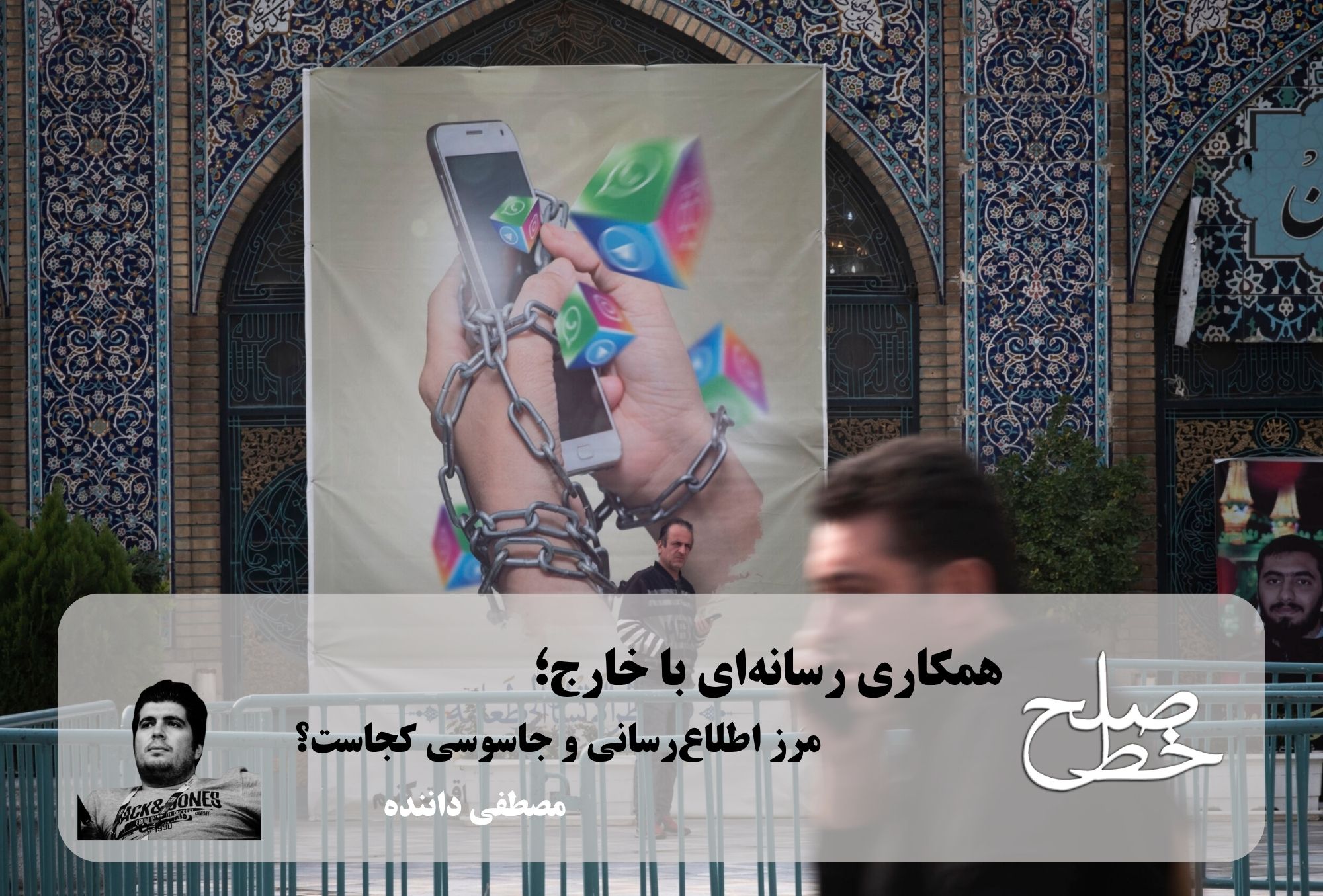
Media Cooperation with Abroad: Where Is the Boundary Between Reporting and Espionage?/ Mustafa Danandeh
During the two twelve-day and forty-day wars, the relationship between “media activity” and “national security” in Iran entered a new stage. A stage in which sending a video, publishing a report, or even speaking with media outlets outside the country can be interpreted under concepts such as “cooperation with a hostile state” or “espionage.”
The new law intensifying punishment for espionage and cooperation with Israel and hostile countries has also made this concern more pronounced and has raised the question of whether any transfer of information to cross-border media can be considered an instance of espionage.
This question is not merely a theoretical legal debate. In recent months, there have repeatedly been reports of people being arrested on charges of sending images, videos, or information to Persian-language media outlets outside the country or Telegram channels such as “Vahid Online.” This very issue has made the boundary between “reporting” and “security action” more ambiguous than ever.
To answer this question, one must first pay attention to a fundamental principle in law: “the principle of legality of crime and punishment.” According to this principle, no conduct is a crime unless the legislator has clearly, precisely, and unambiguously criminalized it. As a result, if concepts such as “media cooperation,” “sending information,” or “assisting a foreign media outlet” enter the security domain without clear definition, the ground is prepared for broad and arbitrary interpretations. This is an issue that can seriously challenge citizens’ legal security.
In the classical legal definition, espionage usually refers to the knowing and purposeful transfer of confidential or classified information for the benefit of a foreign state; information whose disclosure would harm the country’s military, political, or economic security. Therefore, the element of “confidentiality of information,” as well as “intent to engage in security cooperation,” plays a fundamental role in many legal systems. But when this definition is expanded to include any kind of transfer of news, images, or narratives to foreign media, the boundary between “journalism,” “citizen journalism,” and “espionage” becomes blurred.
This ambiguity takes on greater importance in today’s Iran, especially during periods when the country enters a state of security tension, widespread protests, or military conflict. After wars and security crises, governments usually become more sensitive to the circulation of information and try to impose stricter control over news data and media narratives. The Islamic Republic is no exception to this rule and has always welcomed closing, seizing, and restricting. In such circumstances, the security-oriented view of the media intensifies, and any transfer of information outside the country may be interpreted within security frameworks.
But the important issue is that Iran’s media structure is fundamentally faced with extensive restrictions. Many international media outlets do not have permission to operate freely in Iran, and official domestic media also face various levels of censorship and limitation. In such an atmosphere, a significant part of reporting on domestic events is carried out not through official journalists, but through citizens who send their images, videos, or information to Persian-language media outside the country or to news channels on social networks.
A media outlet like the Islamic Republic of Iran Broadcasting, which has extensive reach in Iran, is free and accessible to the public, tries to be only the voice of the government. Not even those who support the Islamic Republic but have different views on foreign and domestic policy have the right to express their opinions on television.
This situation becomes especially more important during internet shutdowns or widespread disruptions. During periods when free access to information is restricted, citizens effectively try to transmit news and images outward through any possible channel so that the narrative of events does not remain exclusively in the hands of official media. In such circumstances, many people send news and images not with the motive of security cooperation, but simply with the aim of reporting and making their voices heard by the world.
Defenders of a strict approach believe that under conditions of information warfare and regional tensions, media can become tools of psychological operations for hostile states, and the transfer of certain information may serve security objectives. The main issue, however, is whether any kind of media contact can be considered potentially security-related without a precise definition of the limits of the crime.
The experience of many countries shows that security laws pose the greatest danger to media freedom when their concepts are ambiguous and open to interpretation. If the law does not draw a clear distinction between “criticism,” “reporting,” “media activity,” and “security cooperation,” the danger arises that the authority determining the crime will not be the explicit text of the law, but the interpretation of security and judicial institutions.
In the case of the Islamic Republic, this concern is also tied to another structural issue: the prominent and decisive role of security institutions in judicial and decision-making processes. Critics have repeatedly pointed out that in political and security cases, the interpretation of security institutions can, in practice, carry more weight than the limited interpretation of the law, and this very issue increases the risk of the expansion of arbitrary measures. In such an atmosphere, even legal ambiguities may be interpreted not in favor of citizens’ freedoms, but toward expanding the scope of security intervention.
On the other hand, such ambiguity can have a strong chilling effect on the activities of journalists and even ordinary citizens. In an atmosphere where the boundary between reporting and a security accusation is unclear, individuals may refrain from publishing any information or contacting media outlets in order to avoid judicial risks. The result of such a situation will be the further restriction of the free circulation of information, the spread of self-censorship, and the increased dependence of public opinion on the official narrative.
Ultimately, the main issue is not simply defending or opposing a particular law, but the larger question of how a balance can be struck between “preserving national security” and “preserving freedom of information.” National security cannot remain sustainable without public trust and media transparency; just as media freedom cannot be completely indifferent to security considerations. But this balance is possible only when the law is precise, limited, transparent, and predictable — not so broad that every media action or every sending of images and news can be placed under a security title and, ultimately, “espionage.”
 Created By: Mustafa Danandeh
 May 22, 2026
Tags
Espionage Execution Forty Days War Iran-US war Media freedom peace line Peace Line 181 Security charges Spy The war between Iran and Israel. Twelve-day war