


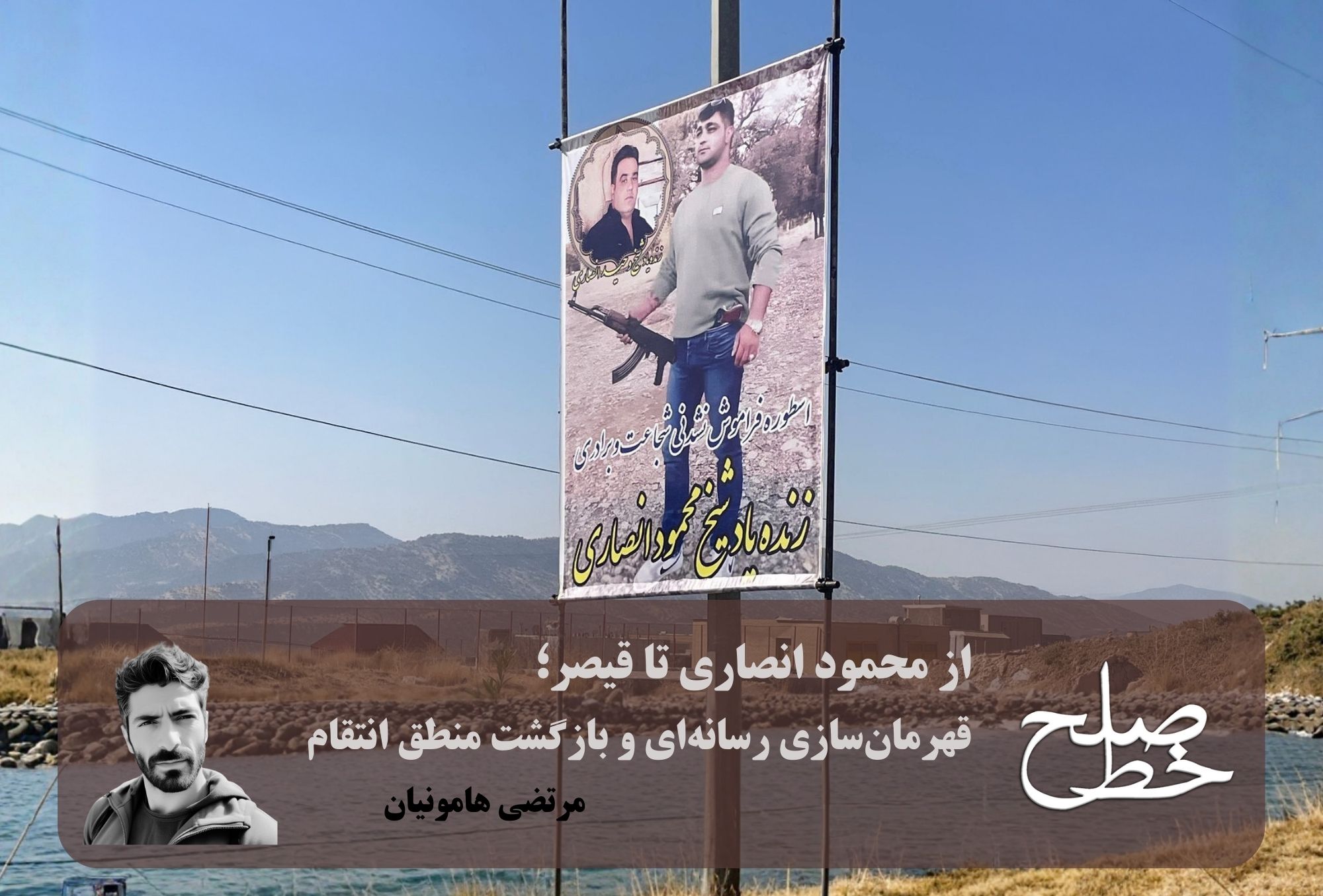
From Mahmoud Ansari to Qaisar; Media Heroism and the Return of the Logic of Revenge / Morteza Hamounian
In Yasuj, the capital of Kohgiluyeh and Boyer-Ahmad province, a doctor is murdered. The accused of the murder says that this doctor (Masoud Davoudi) is to blame for his brother’s death and that he committed medical negligence. So he takes action and kills the doctor. The accused of the murder is sentenced to self-retribution by the court and is executed in public. But this is not the end of the story. The doctor’s murderer is buried and buried as a brave and heroic person. As if he had not committed a murder. The funeral and the events that followed are a source of surprise for many observers. To the extent that a doctor named Somayeh Alyani writes on X-Network (formerly Twitter): “The behavior of the people of Yasuj in the funeral of the murderer of Dr. Davoudi and making him a hero sent an unsafe message to the medical community, the consequences of which for the people of Yasuj will be the migration of doctors from this province and the reduction of access to specialists for the people of this city.” (1)
The name of the executed murderer who was buried with a large crowd of people is Mahmoud Ansari. In the videos released from his funeral, he is introduced as “Sheikh Mahmoud Ansari.” The mourners call him “Sheikh Mahmoud Baghirat” and, clapping their hands, they mourn his body, shouting “May your soul rest in peace.” Gunshots can be heard during Mahmoud Ansari’s funeral. It is as if Mahmoud Ansari is a murderer who has been executed and is being buried. Social media accounts also covered the event. An account called “Motrah Kon” on the Instagram platform posted a video of the ceremony, admitting that it is against welcoming a murderer, but in the upper right corner of the video, Sheikh Mahmoud Ansari is introduced as a lion man from the Boyer Ahmad clan. A large banner has also been published in memory of the executed person, and the writings on the banner have dubbed him an “unforgettable legend of courage and brotherhood.” Social media has published both the banner and videos of the funeral. In fact, social media has come to the rescue this time to make a full-fledged hero out of a murderer. This is the nature of social media, they represent an event, but this time this representation itself has led to the production of a heroic image of this murderer. The story does not end here, it is not only social media that is helping to change the role of Mahmoud Ansari, from clerics to parliamentarians have also come to the aid of this process.
The funeral of Mahmoud Ansari is underway and people are gathered. In the middle of it, a preacher with a white turban is giving a speech. He says that everyone dies and Agha Mahmoud will die too. Then he talks about the rightness of death and its legitimacy. Someone on the sidelines says that Mahmoud Ansari died with honor. A local preacher says at Mahmoud Ansari’s grave that after the death of our brother (referring to a patient who died due to medical negligence), if you had sympathized with us (meaning the authorities), this incident (i.e. the murder of a doctor in Yasuj) would not have happened. Someone is standing aside and saying well done. (2) The mere presence of those wearing turbans alongside the mourners of the executed murderer is a serious issue in itself. The fact that a well-known figure in a government that claims to be Islamic stands next to the family of an executed person and speaks about that execution, and of course, no news is published afterwards about the dealings of the security and law enforcement agencies, the special court for the clergy, and the like with that preacher, indicates that this preacher himself felt safe for his presence. This presence confirms and reinforces the heroic image created of the executed person. The presence of this preacher in the meantime was shocking enough and had aroused surprise that another piece of news came: Mohammad Bahrami, a representative of Boyer Ahmad, Dena, and Margoon in the Islamic Consultative Assembly, had gone to Mahmoud Ansari’s house to express “sympathy” with his family. Ehsan Badaghi, a journalist, published this news on his X account and wrote that he initially thought the news was a joke, but that the presence of the MP in the meeting with the family of the murderer of Doctor Yasouji was true as an “expression of sympathy.” He asked if such an act is not sympathy, then what is it called, and considered the MP’s explanation of this behavior “necessary.” (3) Let’s read this news again: The government MP, who should normally be a defender of the values, legal structure, and value system of the government, went to the house of an executed person and “expressed sympathy” with his family. That is, the official government representative went to the house of a person who broke a law and was punished by the judicial structure of this same government and “sympathized” with his family because of that person’s punishment. Something that could perhaps only happen in a country like Iran.
In this regard, the Medical System Organization has sent a letter to the Speaker of the Parliament to address this action. (4) In this letter, Mohammad Raeeszadeh, the Director General of the Medical System Organization, considered Mohammad Bahrami’s action to be contrary to the dignity of the legislative body and stated that such behavior could affect the sense of job and psychological security of doctors. In this letter, Raeeszadeh warns that the public release of these images, in addition to seriously offending Dr. Davoudi’s family, has raised concerns that “local considerations and relationships” could overshadow the limits of legal and ethical responsibilities of officials, an issue that, in his view, is “harmful to the dignity of the Parliament and the psychological security of the medical community.” (5) On the other hand, Ahmad Ariainejad, a representative from Malayer and a member of the Parliament’s Health and Treatment Committee, in response to this issue and the action of his colleague, Mohammad Bahrami, said: “This is a bad move. If someone does something wrong and we behave in a way that confirms or condones that person’s mistake, the rest of society has been oppressed and persecuted. Therefore, we must be careful about our own behavior.” (6) Meanwhile, the office of Mohammad Bahrami, the representative who participated in the condolence ceremony for the murderer, announced in a statement: “This meeting was held entirely within the framework of a humanitarian and social action and has nothing to do with supporting or approving an illegal act.” (6)
To better understand this action, let’s review the behavior of this member of parliament and the reactions that followed: “The member of the Islamic Consultative Assembly visited the family of the murderer and sympathized with them.” Usually, people sympathize with someone who has either been wronged or whose pain is similar to our own. But here, the member of parliament, who should be a representative of the rule of law, has resorted to such unconventional sympathy. The head of the Medical System Organization and the member’s own colleague have protested, and the member has said in a statement that his visit was conducted within a “humane” framework and is not an endorsement of an illegal act. Readers and listeners must determine whether this action by the member of parliament is an endorsement of an illegal act or not. As the saying goes: “The listener must be wise himself.”
What happened in the meantime can be examined, that a person committed an act against the law at the level of murder and this person was punished by the judicial system of the same country (regardless of whether we consider the functioning of the judicial system to be fair or not). In a structure where the rule of law prevails, the elements that officially or unofficially represent this rule of law should, as a rule, defend the legal ruling or, if they object, protest the processes and forms. But “sympathy” with the family of the executed person is another matter. An event that can be understood differently, given the reflection of this execution in cyberspace and its detailed funeral. The actions of that cleric and parliamentarian are in fact a strain against the wave of false heroism and conformity with the prevailing emotional atmosphere, meaning that instead of obeying the official and legal narrative, everyone from social media activists to these two officials have based their actions on a narrative in which the murderer is the hero, and they give credibility to this narrative with their actions. These credentials can be analyzed at three levels: The first level is the revenge-oriented culture that washes away blood with blood, in this narrative a brother who takes revenge on his brother is considered a hero, a “sheikh” is added to his name, and he becomes a zealous person who has preserved the honor of his family and clan. The second level is the issue of structural distrust in the supervisory and judicial institutions in this area, that no one deals with different doctors and that the medical system and the judiciary are of no use, so the brother of the deceased person must take action. The third level is the gap that has occurred between official values and local values, and the representatives of official values have also become subordinate to local values. Finally, the link between the media and officials in this case is not accidental but rather a type of synergy and symbolic validation. First, the media creates a narrative of a hero, and then the officials implicitly confirm it with their behavior. The result of this cycle is the weakening of the legal order and the transmission of a dangerous message to the medical community and other professional groups. The problem here is that if society considers revenge to be a natural right and the officials do not distance themselves from the narrative of revenge, individual violence becomes an effective tool of demand.
The case of Dr. Davoudi and Mahmoud Ansari is more than just murder and execution of the murderer. It is an example of the confrontation between legal justice and vengeful justice, between the official narrative and the local narrative, and between media power and official responsibility. The way in which government institutions and the media deal with it is an important test for the credibility of the legal order and the future of the professional security of specialized groups. A test that, if the country’s legal rule does not emerge victorious (which is unlikely), will become a green light for other Mahmoud Ansaris, who, if they are wronged, will take action themselves and get their rights. This is where the emperors (according to Masoud Kimiai) find their water bottles in the bathrooms of the nobles, and blood is washed away with blood, and stone is not left on stone.
Footnotes:
1- The funeral of a murderer and several questions, Hamshahri Newspaper , November 15, 1404.
2- A cleric’s strange statements about Dr. Davoudi’s killer, Tabnak , November 14, 2025.
3- A parliament member’s strange sympathy for the family of a murderer + photo, Tabnak , December 24, 2025.
4- See: The story of a member of parliament consoling the murderer’s family, Khabar Online , December 26, 2025
5- Reactions to the presence of Boyer Ahmad’s representative at the home of the killer of Doctor Yasoji, Mehr News Agency , December 27, 2025.
6- The strange presence of a member of parliament at the home of the doctor’s murderer! + Photo, Hamshahri Online, December 27, 2025.
 Created By: Morteza Hamounian
 December 22, 2025
Tags
Caesar Distrust in relationships Doctor Yasouj Ethnic prejudices Execution Honor or dignity Judiciary Kohgiluyeh and Boyer-Ahmad Province Mahmoud Ansari Masoud Davoudi Medical ethics Medical malpractice Morteza Hamounian Murder Navab Street peace line Peace Line 176 Personal revenge Prejudice Revenge Shameful Sheikh Mahmoud Ansari Violence Yasuj فساد ماهنامه خط صلح