


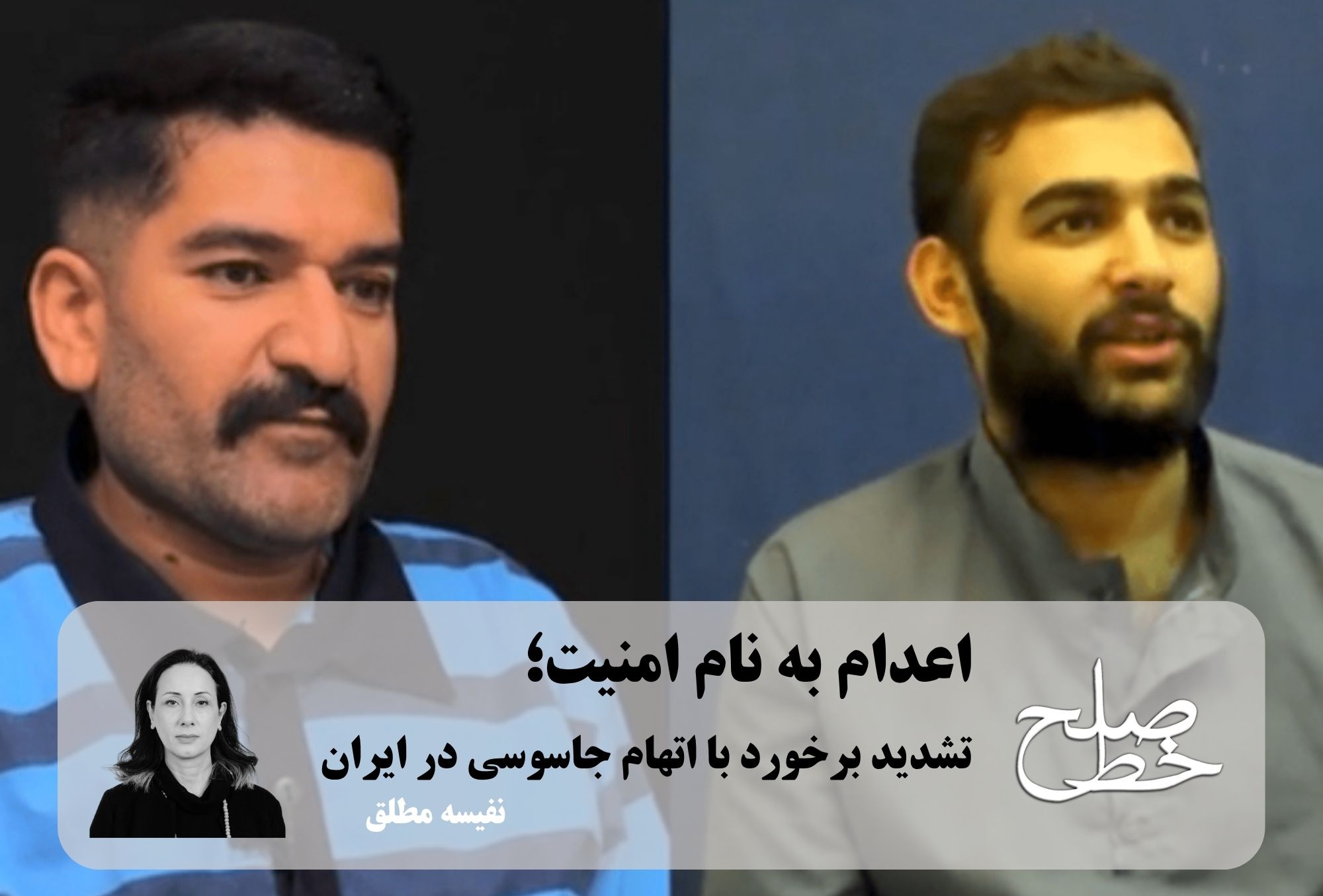
Execution in the name of security; Intensification of the crackdown on espionage charges in Iran/ Nafiseh Motlagh
Following the escalation of military tensions and attacks by the United States and Israel, the judicial process of dealing with charges of “espionage” and “collaboration with hostile states” in Iran has entered a new phase. What is more controversial than the laws themselves is the way they are implemented: expedited proceedings, lack of transparency, and limited access for defendants to standard defense procedures, factors that have raised serious questions about the observance of fair trial.
On the other side of these tensions, Israeli media have reported the arrest of two Israeli Air Force soldiers on charges of intelligence cooperation with Iran; a case that is being reviewed with access to a lawyer and through legal procedures, and despite the death penalty being foreseen in the country’s laws, there has been no report of such a sentence being carried out so far. In contrast, in Iran, a similar charge can quickly lead to the final punishment. In one recently announced example of the execution of death sentences, two prisoners named Yaqoob Karimpour and Nasser Bekerzadeh were executed immediately after the verdict was confirmed by the Supreme Court after being tried on charges of “intelligence cooperation and espionage” for Israel; a difference that is more than anything due to the quality of the trial.
According to news and information published by the HRANA news agency, from March 29, 1404 (since the beginning of the conflict between the United States and Israel and Iran) to May 31, 1405, at least 34 executions on political and security charges have been carried out. Human Rights Watch has also emphasized that the Iranian authorities have carried out death sentences on an unprecedented scale in 2025, while at the same time, citing national security considerations, they have resorted to mass arrests and suppression of protests. Human rights organizations consider this trend to be a sign of the use of the death penalty as a tool to control society by creating a climate of fear and intimidation.
Globally, Iran is one of the leading executors of the death penalty, second only to China. This is while more than two-thirds of the world’s countries – including many Muslim-majority countries – have either abolished the death penalty or have not carried it out for years; for example, Turkey and Uzbekistan have abolished it, and countries such as Morocco and Algeria have suspended it for decades. In such a situation, the continuation of the death penalty in Iran places it among the minority of countries that still widely use the punishment.
This situation is despite clear principles on the right to life and a fair trial in both domestic law and international documents. The Iranian Constitution emphasizes the inviolability of life and dignity of individuals and the right to a fair trial in Articles 22 and 34, and Article 35 guarantees the right to a lawyer. At the international level, the Universal Declaration of Human Rights and the International Covenant on Civil and Political Rights also emphasize the right to life and the need for a fair trial. In such a framework, the hasty execution of death sentences – especially in security cases – can be considered a violation of these principles.
The increase in executions is reminiscent for many of a critical period in Iran’s contemporary history; after the 1979 Iranian Revolution, a wave of widespread executions took place, culminating in the 1988 Iranian executions. The comparison is a warning about a repeating pattern in which crisis has led to a decline in legal standards.
Meanwhile, the silence or limited and selective stance of civil society and human rights organizations has also become controversial. Some analysts believe this situation is due to political priorities, where opposition to the policies of the United States or Israel takes precedence over defending the rights of Iranian citizens. The result of such an approach is the weakening of public trust, the formation of a sense of insecurity, and the growth of extreme right-wing political ideas.
Ultimately, what is taking shape in Iran today is not simply an escalation of a criminal policy in response to external tensions, but rather a sign of a dangerous shift in the boundary between security and justice. The way in which cases of “espionage” and “collaboration with hostile states” are handled will reveal whether the rule of law remains the standard of action or whether the logic of urgency is taking its place. At the same time, the silence or selective responses of civil society and human rights organizations are taking this crisis beyond the level of a domestic issue and turning it into a test of the validity of universal concepts of justice and human rights. Ultimately, what is at stake is not just the fate of the accused, but the quality of the future that is built on trust, a sense of security, and a belief in justice.
 Created By: Nafiseh Motlagh
 May 22, 2026
Tags
Espionage Execution Forty Days War Iran-US war Peace Line 181 Spy The war between Iran and Israel. Twelve-day war