


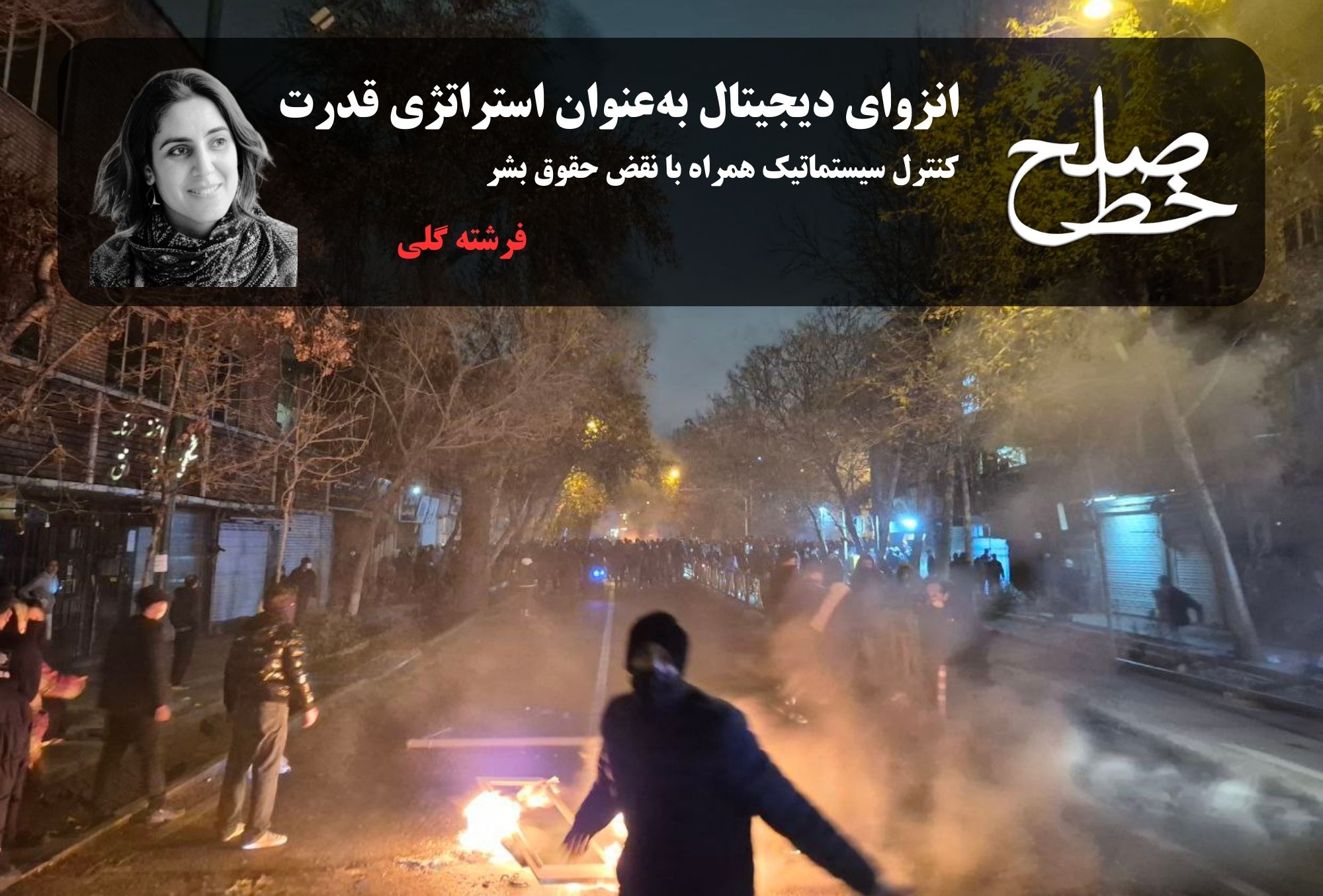
Digital Isolation as a Power Strategy/Fereshte Goli
…and suddenly, total darkness and a heavy silence of ignorance about what had happened on the streets of Iran. Everything was a sign of a disaster. All communication and information channels had been cut off. News was passed around, with a multitude of worrying and frightening speculations broadcast from satellite news networks. On January 18, 1404, one of the most severe digital blackouts in the country’s contemporary history occurred. An action ordered by the Supreme National Security Council and implemented by the Ministry of Communications, which not only cut off the semi-blocked and filtered access to the outside world, but also officially paralyzed large parts of people’s lives. In addition, complete ignorance of news and events, to the disruption of essential services such as banking, transportation, and even daily shopping, prevailed, and in a word, the country was shut down.
People were suddenly deprived of access to all social networks, messengers (WhatsApp, Telegram, Instagram), email, Google search, and even internet calls. Even calls to landlines and mobile phones, especially to those outside the country, were disrupted and cut off. This situation initially began with targeted slowdowns and disruptions in areas where public protests had taken place and intensified, and then turned into a complete blackout. On the other hand, this disconnection led to an increase in the feeling of isolation, fear, and collective anxiety. Many Iranians abroad also suffered from insomnia and severe anxiety because they could not communicate with their loved ones at home. From paying bills to shopping, modern life in Iran has become heavily dependent on the internet, and its outages, like power or water outages, disrupt basic services. Online banking systems, card readers, payment apps (such as Up, Top, 724), and even some ATMs went down. People lined up to withdraw cash, and many shops closed due to the inability to receive electronic money. Money transfers, bill payments, online shopping, and even many people’s salaries were halted. Online taxi apps, digital maps, and even some metro and bus payment systems were disrupted. Mail and delivery of goods were down by up to 60 percent, and many home-based businesses that operated through the mail were paralyzed. Online classes and even corporate emails were cut off. Many companies were forced to furlough employees without pay, and freelancers, designers, video editors, and programmers lost their income. Daily losses were in the billions, and Iran’s digital economy was hit hard. Estimates put daily losses at between $35 million and $37 million, and online sales fell by up to 80 percent. The Tehran Stock Exchange crashed, draining a huge amount of liquidity from the market. Small and medium-sized businesses, which make up a large portion of digital employment, were shuttered; Travel agencies, immigration companies, online stores, and even exports and imports were disrupted. In short, the situation was apocalyptic.
Prolonged internet disconnection acts like forced isolation and destroys coping mechanisms for stress. Anticipatory anxiety (fear of repeated disconnection), depression, panic attacks and even PTSD-like symptoms became common after the internet’s partial return (due to the sudden influx of news and images). At a societal level, trust between individuals declined, family relationships were damaged and social discontent increased. Even after the internet’s partial return, restrictions continued, and many were still confined to the slow and inefficient national internet. For example, internet shutdowns have had devastating effects on educational institutions and the cognitive development of young people. According to a report published in The Times, the interruption of information flow at critical times such as exam season creates a kind of “academic psychosis” that is tied to the fear of failure and future destruction. In a way, it can be said that disconnecting the internet, even under the pretext of preventing cheating in exams, is the real result of a jump in students’ anxiety levels and impaired cognitive functioning. In this situation, students who rely on the Internet for research and coordination suddenly find themselves in an information deadlock, leading to feelings of helplessness and extreme stress. This academic obstacle is not an educational problem, but a psychological attack that can lead to long-term frustration. The first consequence is the development of a feeling of “being left out”; a state accompanied by constant worry about falling behind on important news, fear of missing out on opportunities, and a sense of instability in daily life.
The human mind is designed to predict and control the future to some extent, and when the flow of information is suddenly interrupted, this ability to predict is disrupted. Shutting down the global Internet, although it may weaken the ability to organize and transmit the message of protests to some extent in the short term, is not a decisive tool for completely preventing social discontent. Experience shows that this action changes most processes, deepens discontent, and activates alternative communication channels. From this perspective, shutting down the Internet is more of a temporary tool for crisis management than a sustainable solution for managing social discontent; a tool whose psychological and social costs, especially for scientific and professional groups, cannot be ignored.
In this sense, the internet shutdown in Iran is no longer just a tool to control protests, but has itself become an all-encompassing crisis in people’s lives. From ignorance and isolation to the paralysis of essential services, it carries heavy human, economic, and social costs that continue beyond the period of the shutdown.
The experiences of November 2019, 1401, and today in January 2025 show that society’s dependence on the Internet and digital tools has become so deep that shutting it down is like cutting off a vital organ. This situation paints a bitter picture of the conflict between the control of power and the daily needs of the people.
The internet shutdown in Iran is one of the most severe human rights violations in recent years. It was not only a tool to control the protests, but also a systematic and massive violation of human rights in its own right. Reputable international organizations such as Amnesty International, Human Rights Watch, and UN rapporteurs have described the shutdown as a means to cover up widespread crimes, prevent documentation of violations, and restrict freedom of expression and access to information. Covering up crimes and creating a climate of impunity was one of the main goals of the internet shutdown, preventing the publication of images, videos, and real reports of the violent suppression of protests. As usual, the shutdown allowed the government to spread its official narrative unchallenged, while people inside the country were denied access to real news.
Article 19 of the International Covenant on Civil and Political Rights states that the Internet serves as a primary means of communication, expression and information. The total shutdown deprived people of the ability to share experiences, peacefully protest and access foreign news. This measure constitutes widespread censorship and information suppression. Without the Internet, it became almost impossible to coordinate protests, inform and support each other; this isolated the protests and made repression easier. Families could not check in on each other, internet connections were cut off and even landlines were restricted in some areas. This isolation was particularly damaging for minorities and political prisoners. As noted earlier, medical appointments, access to records and ordering medicine were disrupted; in the emergency situation following the crackdown, this could have put the lives of the injured at risk. Disruptions in digital services crippled the economy and left many without income; This is a violation of socio-economic rights that indirectly affects human dignity. The long-term psychological and social harms of the prolonged shutdown exacerbated feelings of isolation, fear, and collective insecurity. People were left in an informational darkness; rumors replaced reality, and social trust declined. Mental health professionals have described the situation as akin to “enforced isolation,” leading to severe anxiety, depression, and PTSD symptoms. Even after the partial return of the internet, severe restrictions (such as whitelisting sites) continued, and many were still confined to the slow national internet. This policy further eroded public trust in the government and deepened discontent. Internet shutdowns in Iran have become more than a technical tool of control; they have become a systematic strategy for violating human rights. This is a dangerous shift toward “permanent digital isolation,” which can isolate society from the world and make repression easier. Repeated experiences prove that such a policy has not only not silenced protests, but has also accumulated dissatisfaction and deepened the human rights crisis. On the other hand, after the weak return of the international Internet, reports indicate a “fundamental change” in the filtering model and the implementation of a “new architecture” after the repression. The “Filterban” group, based on the analysis of network experts, has written that the Iranian Internet has not simply suffered from periodic disruption or outages, but rather evidence shows that the network is entering a new architecture. The Shargh newspaper also said in a report, quoting several experts, that what Internet users in Iran are experiencing these days is a “suspended, eroding and unpredictable situation” and the result of a “fundamental change in Iran’s filtering model.” Filterban’s report on the state of the Internet in Iran, which has been down since January 8, following widespread street protests, states: “Cloudflare radar data shows that after the widespread outages in January, the Internet usage pattern no longer resembles normal periods, with traffic rising and falling erratically.” According to the report, citing experts, these fluctuations could be “the result of aggressive tests on the network; tests that allow the Internet to switch between three states of intelligent monitoring, targeted disruption, and guided shutdown.” The report concludes that “what users are experiencing is not a random disruption but a sign of a structural redesign of the Internet.” The report, published in the newspaper’s February 5 issue, describes the state of the Internet in Iran as follows: “The Internet is connected, but it doesn’t work. Filtered messengers open, but they stay on ‘updating.'” Filter breakers connect, but two minutes later they fail without warning.” Shargh newspaper’s “Eroding Internet” report describes part of the users’ experience using the Internet and writes: “According to six network and communication infrastructure managers and experts, the Islamic Republic is moving from a traditional filtering system based on IP blocking and nationwide blackouts to a more sophisticated and intelligent model.” These network managers say that this new model “focuses on identifying traffic patterns, protocol types, and connection behavior instead of direct blocking; a model that is very similar to China’s filtering system, but with localized tools tailored to Iran’s infrastructure.” Shargh writes in its report that some of these managers even claim that the filtering system of the famous Chinese company “Huawei” has now been “implemented” in the country’s communication network. The report adds that the result of this change is an Internet that is “apparently connected,” but has become unusable for a large portion of users; A situation that, according to some experts, is even “more restrictive” than whitelisting, and in return imposes “less political cost” on the government.(1)
In recent months, especially since January 1404, network and Internet experts in Iran say that the method of controlling and filtering the Internet has changed a lot. Previously, filtering was simple, meaning they would either completely block a site and IP or, at critical times, disconnect the entire country’s Internet, but now the new method has become much smarter and more hidden and resembles the systems used in China and Russia. The Internet appears to be connected, but in reality it does not work or becomes very slow and unstable, meaning the connection starts. For example, the page opens, but then the speed drops sharply, photos and videos do not load, or it suddenly disconnects and reconnects. Instead of directly blocking sites, they disrupt the protocols, that is, the Internet communication languages, such as QUIC, which YouTube and Google use. This is done with advanced tools such as deep packet inspection, which even detects encrypted traffic. They can change the state of the internet quickly, meaning sometimes it’s a normal state with old filters, sometimes a targeted disruption state where the internet becomes erosive and annoying, and sometimes a severe outage like the 19 days of complete outage after December 18. The result for users is that the internet is connected, but it has become very difficult and frustrating to use. Downloads of filter breakers and proxies have increased many times over, and many say this new method has made the control more permanent and difficult to circumvent.
Officials from the Ministry of Communications and the CEO of the infrastructure company say that no fundamental changes have occurred in the architecture of the Internet and that the disruptions are temporary and beyond their control, and that rumors such as a classed Internet or whitelist are not true, but network experts and sites such as Filterban, with real data such as Cloudflare and Netblocks statistics, say that these changes are real and that Iran’s Internet is entering a new and erosive control model that aims to restrict without much noise. In short, Iran’s Internet is either completely disconnected or completely free. Now it is connected most of the time, but practically unusable or very weak. In other words, instead of taking action like what they are planning to implement in France, to control cyberspace and protect vulnerable groups from the harms of this space, and instead of straightening their eyebrows, they want to cut off their entire heads! I must emphasize that the adaptation (or leveling) of Internet use means the establishment of different restrictions and access based on age, maturity level or age group of individuals. Its main goal is to protect children and adolescents from inappropriate, harmful or dangerous content (such as pornography, extreme violence, sexually explicit content, or addiction), without excessively restricting the freedom of adults and ultimately that the continuation of this situation could lead to “absolute digital isolation”, with advanced surveillance, complete dependence on domestic platforms and ongoing economic damage. In the long term, this approach will make protests more difficult, but will deepen social discontent and paralyze the digital economy, unless fundamental political changes occur.
Footnote:
1- Sarabpour, Sunita, Eroding Internet, Sharq Newspaper , February 14, 2025.
 Created By: Fereshteh Goli
 February 20, 2026
Tags
Angel flower Censorship Crime against humanity Criminal Internet Internet outage Massacre 1404 peace line Peace Line 178 Repressive institutions Suppression The Di 1404 Uprising Uprising of 1404 ماهنامه خط صلح