


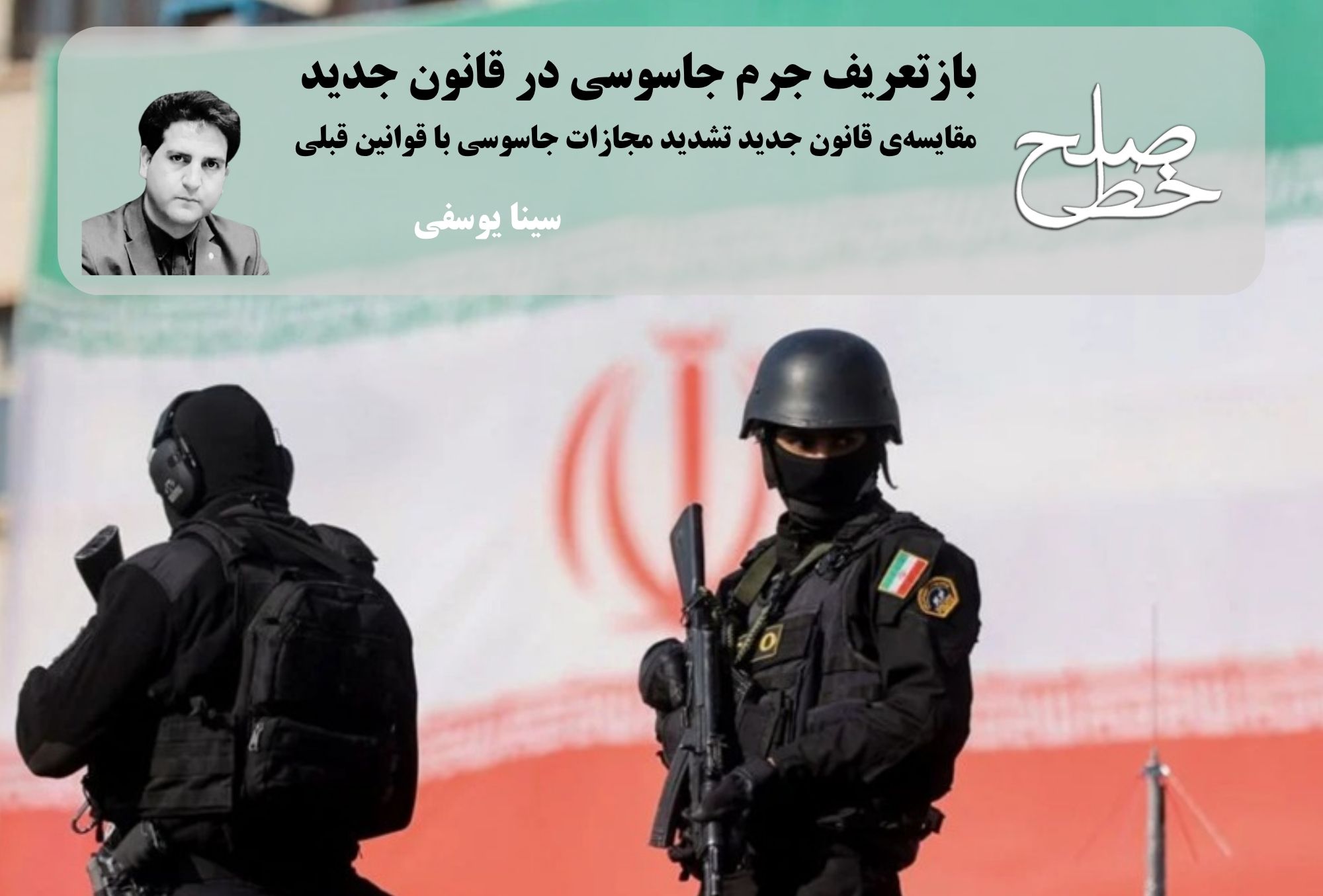
Comparing the New Law on Intensifying Punishment for Espionage with Previous Laws/ Sina Yousefi
In contemporary criminal law systems, the crime of espionage has always been classified among the most serious offenses against national security, because it concerns attacks on the fundamental interests of the state and the disclosure of information that may endanger the country’s political, military, or diplomatic security. However, the gravity of this crime has never meant that it is exempt from the foundational principles of criminal law. On the contrary, the more severe the punishments and the broader the criminal consequences, the greater the need for lawmakers to adhere to principles such as clarity, certainty, strict interpretation, and the predictability of criminal laws.
In recent years, especially in the shadow of intensifying regional tensions, the expansion of security conflicts, the increase in popular protests, and the ruling establishment’s growing concern over information and media warfare, the Islamic Republic of Iran’s criminal policy has gradually moved away from the traditional model of confronting espionage and toward expanding the scope of security crimes. The “Law on Intensifying Punishment for Espionage and Cooperation with the Zionist Regime and Hostile States Against National Security and Interests” should be understood as a product of this political and security atmosphere. Although this law was apparently adopted with the aim of countering foreign threats and controlling new forms of intelligence cooperation, in practice it has significantly expanded the concept of “espionage,” transforming it from a classic crime based on the transfer of confidential secrets into a fluid and expansive concept within the sphere of national security.
Under previous laws—especially Articles 501 to 505 of the Islamic Penal Code, the Ta’zirat section—the concept of espionage, while not free from ambiguity, was still based on relatively specific elements. The main focus of these provisions was access to, acquisition of, or transfer of classified information and documents for the benefit of a foreign state or foreign persons, and the material element of the crime was generally understood as the disclosure of secrets or direct intelligence cooperation. In fact, espionage in its classical sense required a specific relationship between the perpetrator, confidential information, and a foreign party.
But the new law has transformed this traditional framework. Under this law, criminalization no longer concerns only the transfer of confidential documents or direct intelligence cooperation; rather, a diverse range of communicative, media-related, and technological conduct has also been placed within the realm of security threats. Sending images and information to “hostile” media, using certain communication tools such as satellite internet, or even indirect cooperation with persons and institutions connected to hostile states are all analyzed within the new legal structure under the logic of confronting espionage and security cooperation. The result of this development is that the traditional boundary between espionage, media activity, political action, and cross-border communications has largely faded, and the scope of the crime of espionage has extended into areas that previously did not essentially fall within the framework of classic security offenses.
This conceptual expansion becomes even more concerning when accompanied by the broad ambiguity of the terms and concepts used in the law. The new law is filled with expressions such as “hostile state,” “hostile media,” “undermining national security,” “strengthening or legitimizing,” and “human-media.” These concepts lack precise, narrow, and predictable definitions. Moreover, the legislature has entrusted the determination of certain examples to bodies such as the Supreme National Security Council and the Ministry of Intelligence. This means that whether a state is “hostile” or a media outlet is “hostile” is not determined in the text of the law, but through subsequent decisions by executive and security institutions.
This situation is seriously questionable from the perspective of the foundational principles of criminal law. According to the principle of legality of crimes and punishments, citizens must be able, in advance and solely by referring to the law, to identify the boundaries of criminal conduct and foresee the criminal consequences of their actions. Yet in this law, part of the legal element of the crime has effectively been placed outside the approved text and made dependent on announcements and interpretations by administrative and security institutions. Such a structure not only weakens the principle of certainty in criminal law, but also increases the possibility of broad and arbitrary interpretation in the process of prosecution and adjudication; something that, especially in security offenses, given the severity of punishments and procedural restrictions, can have significant effects on citizens’ rights and freedoms.
At a broader level, the new law can be seen as a sign of a shift in the Islamic Republic’s criminal policy from “criminal law based on the occurrence of crime” toward a kind of “risk-oriented criminal law.” In the classical model of criminal law, criminal intervention usually concerned conduct that specifically and actually harmed a legally protected interest. But in the new approach, the legislature’s focus is less on the realization of actual harm and more on controlling the “possibility of danger” and preventing conduct that may in the future be deemed to have security implications. For this reason, the scope of criminalization has expanded into areas whose connection to the traditional concept of espionage is questionable.
This tendency is not, of course, unique to Iran. In many legal systems, especially after the expansion of cyber threats, hybrid wars, and information conflicts, a form of security-oriented expansion of criminal law can be observed. However, the essential difference is that in most of these systems, the expansion of security tools is accompanied by precise oversight mechanisms, restrictive definitions, and broad fair trial guarantees. In the recent law, by contrast, the expansion of the scope of criminalization has coincided with the expansion of the powers of security and judicial institutions, while some procedural guarantees have been restricted—from shortening the deadlines for objection to allowing pretrial detention to continue until the judgment becomes final. In such a situation, there is a risk that the concept of espionage, instead of remaining an exceptional and limited criminal title, will become a flexible tool for broader intervention in communications, media, and civil actions.
An examination of the Law on Intensifying Punishment for Espionage shows that the main transformation brought by this law is not limited merely to increasing the severity of punishments, but lies in the redefinition of the concept of espionage and the shifting of the boundaries of criminal-security law. In the context of specific political and security conditions, the new law has sought to organize a range of new informational, media-related, and communicative threats under the language of national security. Yet this conceptual expansion simultaneously raises important questions about the limits of criminal intervention, the status of the principle of legality of crimes and punishments, and the relationship between security and public freedoms.
The broader and more fluid the concept of espionage becomes, the more difficult it will be to distinguish between genuinely security-related conduct and political, media, or social actions. For this reason, the main issue in confronting this law is not simply supporting or opposing security policies, but how to preserve a balance between security necessities and the fundamental requirements of criminal law; a balance whose absence has led to the weakening of judicial security and the reduced predictability of the criminal justice system.
 Created By: Sina Yousefi
 May 22, 2026
Tags
CIA Espionage Espionage for Israel Execution Mossad National security peace line Peace Line 181 Sina Yousefi Spy