


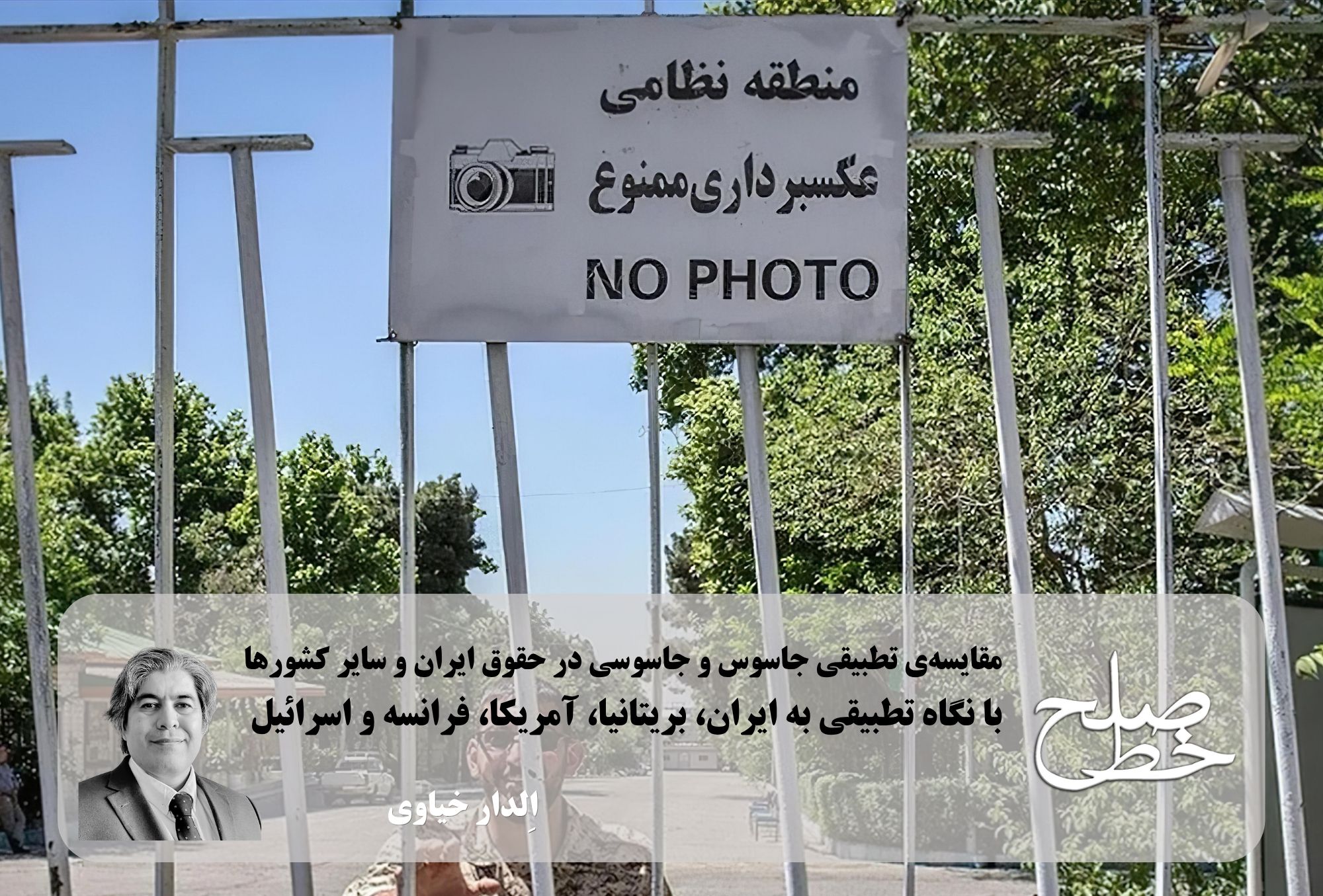
Comparative Comparison of Spy and Espionage in the Law of Iran and Other Countries / Eldar Khiavi
The public atmosphere in Iran has become heavy and frightening in recent months with the news of the successive executions of individuals convicted of espionage. The term “espionage” is not a common term in public opinion, especially in times of war, external threat, or security crisis. This charge is linked to the security of the country, the lives of the people, territorial integrity, military secrets, and the preservation of public order. If someone knowingly and intentionally provides sensitive information to the country’s enemy or hostile state, we are facing one of the most serious crimes against public security. But for this very reason, the handling of such charges must be accompanied by the highest level of accuracy, transparency, the possibility of defense, and legal oversight.
However, an important question is facing the Iranian legal community: When the judiciary does not provide an adequate and assessable explanation of the proceedings, the evidentiary grounds, the method of discovering evidence, the accused’s access to a lawyer, and the grounds for issuing a verdict, how can the legal community criticize and analyze such decisions? Isn’t it that the philosophy of criminal law is to protect the security of society and its members? And isn’t it that the prosecutor, as a representative of the public good and the people’s lawyer for maintaining order and security, must be accountable to society for his actions?
The main question of this article, however, is substantive and precedes the criticism of the proceedings: “What elements does the crime of espionage have in terms of criminal law, how does Iranian law define and punish it, and what is the approach of other legal systems, including Britain, America, France, and Israel, in defining and punishing this crime?” The answer to these questions is the starting point for analyzing the proceedings and the manner in which relevant decisions are issued; because until the elements of the crime, the type of information, the moral element, the connection with a foreign government, and the standard of proof are clarified, it will not be possible to legally assess the charge of espionage.
Iranian Law: From the Old Law to the New Espionage Law
In the Islamic Penal Code, the penal code section, the crime of espionage is mentioned in several scattered articles. Article 501 stipulates that anyone who knowingly and intentionally provides plans, secrets, documents, or decisions related to the country’s domestic or foreign policy to unauthorized persons or informs them of their contents, in a manner that constitutes espionage, shall be sentenced to one to ten years in prison. Article 505 also considers collecting classified information with the aim of disrupting the country’s security and providing it to others to be a crime. Article 508 considers cooperation with foreign governments hostile to the Islamic Republic of Iran, if the person is not declared a warlord, to be punishable by one to ten years in prison. Article 509 also stipulates that if crimes against domestic or foreign security occur during wartime, the perpetrator shall be sentenced to the most severe punishment for the same crime.
Thus, in the traditional framework of Iranian law, espionage was usually defined by several elements: the presence of sensitive information or documents, the knowledge and intent of the perpetrator, the lack of authority of the addressee to access, and the connection of the act to the security of the country. But the new Iranian law of 1404/2025 has taken the path much more seriously. The UN fact-finding mission report says that the law “Intensifying the Punishment of Espionage and Collaboration with the Zionist Regime and Hostile States Against National Security and Interests,” passed in October 2025, automatically classifies espionage and collaboration with a hostile state as “corruption on earth,” a title that can carry the death penalty.
This change is very important from a penal policy perspective. The previous law mainly provided for imprisonment, unless the conduct amounted to war, corruption on earth, or more serious crimes. The new law has reportedly expanded the scope of making espionage and collaboration with a hostile state a capital offense. The legal risk is that if concepts such as “collaboration,” “intelligence activity,” “hostile state,” “national interests,” or even sending information to foreign media are interpreted too broadly, the line between actual espionage and political, media, or civic activity becomes blurred.
Material and moral elements of the crime of espionage
From a criminal law perspective, espionage is inconceivable without a “material element” and a “spiritual element.”
The material element usually involves one of the following behaviors: obtaining confidential information, entering prohibited areas, photographing or mapping sensitive facilities, maintaining classified documents, transmitting information to an unauthorized person, communicating with a foreign intelligence agent or service, or providing means and facilities for enemy intelligence activity.
The moral element is more important. The accused must know that the information is classified or security and must have intentionally obtained, retained or transmitted it. In more serious crimes, specific intent must also be established; such as intent to harm national security, intent to aid the enemy, or intent to benefit a foreign state. In Iranian law, Article 501 uses the phrase “knowingly and intentionally”; in Israeli law, Articles 111 to 113 of the Criminal Code use phrases such as “knowingly” and “intended to injure national security”; and in British law, the National Security Act 2023 emphasizes that a person must act for, on behalf of, or with the intention of benefiting a foreign power and must know or ought to know that his conduct would harm the security or interests of the United Kingdom.
Comparative table: Definition and punishment of espionage in five countries
| Definition or structure of crime | Spiritual element | The main punishment | Country |
| Transferring secrets, documents, maps, or information related to domestic/foreign policy or classified information to unauthorized persons; collaborating with a hostile foreign government | Knowledge and intent; in extreme cases, intent to aid the enemy or harm security | In the Penal Code: One to ten years in prison for Articles 501 and 508; more severe punishment in times of war; according to the new 2025 law, some instances of espionage or collaboration with a hostile government can result in death as corruption on earth. | Iran |
| The National Security Act of 2023 has three pillars: obtaining or disclosing protected information, obtaining or disclosing trade secrets, and assisting a foreign intelligence service. | Acting for, on behalf of, or with the intention of benefiting a foreign power; knowing or reasonably likely to know of harm to the security or interests of the United Kingdom | For protected information, a maximum of life imprisonment; for trade secrets, a maximum of 14 years; for aiding a foreign intelligence service, a heavy penalty depending on the type of conduct. | United Kingdom |
| 18 USC § 794 covers the collection or transfer of defense information to or in aid of a foreign government. | Intent or sufficient reason to believe that the information will be used to the detriment of the United States or for the benefit of a foreign government | Long or life imprisonment; execution is possible in certain circumstances, including information related to nuclear weapons, war plans, defense systems, or cases that lead to the death of an American agent. | America |
| The French Penal Code distinguishes between treason and espionage; the application of Articles 411-2 to 411-11 is treason if committed by a Frenchman or a French soldier, and espionage if committed by others. | Liaison with a foreign power to create hostility, aggression, harm the fundamental interests of the nation, or transmit sensitive information | Depending on the behavior: from 7, 10, 15, 20 or 30 years of criminal imprisonment to life imprisonment in very severe cases such as surrendering part of the territory or armed forces. | France |
| Articles 111-113 of the Israeli Penal Code criminalize transmitting information to the enemy, espionage, and aggravated espionage; secret information is also defined. | Knowledge of transmitting information, or intent to harm national security; in aggravated cases, intent to harm national security | From 3 years for negligently transmitting useful information to the enemy to 10, 15 years and life imprisonment for aggravated cases. Some wartime security crimes in Israeli law, such as aiding the enemy in war, can be punishable by death or life imprisonment, although executions in Israel have been very rare. | Israel |
Espionage in time of war
In all legal systems, time of war or armed conflict is an aggravating factor. The reason is clear: information that in normal times might be merely sensitive or classified can, in times of war, directly lead to the targeting of facilities, reconnaissance of forces, sabotage, assassination, cyberattack, or the failure of defensive operations.
Iranian law explicitly recognizes this in Article 509: Crimes against internal and external security committed during wartime are punishable by the most severe penalty for the crime. In American law, federal law provides for the death penalty, in limited circumstances, for certain types of espionage related to national defense. In France, serious conduct related to a foreign power, such as inciting hostility or providing the means of aggression, carries very severe penalties. In Israel, wartime security crimes, particularly aiding the enemy, can be subject to the most severe penalties under certain circumstances.
However, the fundamental principle is this: war creates a defensive necessity, but it does not eliminate a fair trial. Even in wartime, an accusation of espionage must be proven by admissible evidence, and not simply by a confession, a confidential report, or an allegation by a security agency.
5. Judicial investigation, discovery of the reason and the necessity of the presence of a lawyer
In espionage cases, evidence is often confidential, technical, and security-related: encrypted correspondence, cell phone data, financial transactions, foreign communications, counterintelligence reports, classified files, images of sensitive locations, or confessions from the accused. This very confidential nature increases the risk of error, forgery, security misperceptions, or selective use of evidence.
Therefore, the court must at least consider these questions:
Was the information truly confidential or security-related? Did the defendant know that it was confidential? Was the communication external, intelligence-related, or merely media, academic, family, or business communication? Did the transfer of information actually occur or was it merely an alleged intention, suspicion, or pretext? Was the confession obtained in the presence of a lawyer and without pressure? Did the lawyer have the opportunity to study the file, object to the expert report, and plan an effective defense?
In Iranian law, Article 35 of the Constitution recognizes the right of parties to choose a lawyer, and Article 36 allows for the sentence and execution of punishment only through a competent court in accordance with the law. Article 48 of the Criminal Procedure Code also speaks of the right of the accused to request the presence of a lawyer from the beginning of the period of surveillance. However, the provision of Article 48 in security cases restricts the right to freely choose a lawyer and limits the accused to lawyers approved by the head of the judiciary during the investigation phase, an issue that human rights organizations and lawyers have considered an obstacle to independent defense.
The risk of turning espionage charges into a tool of repression
Actual espionage, especially in times of war, is one of the most dangerous security crimes. But the very gravity of the charge also means that it has the potential for political abuse. When the definition of espionage is broadened and behaviors such as communicating with foreign media, sending images, criticizing the government, civic activism, or contacting international institutions are included under the heading of “collaborating with the enemy,” the security crime can become a vehicle for silencing dissent.
This risk is greater in systems where:
1. The files remain confidential;
2. An independent lawyer is not present from the beginning;
3. Television or security confessions replace judicial evidence;
4. Courts do not publish the full text of the reasons;
5. The concepts of national security, enemy, cooperation, and corruption on earth are interpreted broadly;
6. The death penalty is carried out swiftly and irrevocably.
In international reports on Iran, the main concern is precisely this: the new Espionage Law 2025 may, due to its broad wording and the possibility of broad interpretation, also expose peaceful or media activities to death-defying charges. The UN Fact-Finding Mission has pointed to this risk and called it concerning from the perspective of fair trial, the principle of legality of crime and punishment, and the prohibition of arbitrariness in the death penalty.
delayed
In comparative law, espionage is a serious crime in all countries. Iran, the United Kingdom, the United States, France, and Israel all criminalize the acquisition or transmission of sensitive information for the benefit of a foreign government or enemy. The main differences are in the scope of the definition, the severity of the punishment, the transparency of the proceedings, the right of access to a lawyer, and the judicial control over security evidence.
In Iran, the previous law relied mainly on imprisonment and aggravation in times of war, but the new law has led the way to a wider range of executions in cases of espionage and collaboration with hostile states. From the perspective of defending national security, it is understandable that espionage in times of war or serious conflict deserves a very severe criminal response. But from the perspective of criminal law and judicial justice, no charge, even espionage, should result in the death penalty without an independent investigation, testable evidence, the presence of a lawyer, the possibility of an effective defense, and a reasoned verdict.
In recent Iranian cases, because the details of the arrest, interrogation, reasons, expert reports, and defense have not been made public, an outside observer cannot confirm or deny the veracity of the charges. For precisely this reason, any death sentence in an espionage case must be accompanied by the highest level of judicial transparency, respect for the rights of the defense, and the possibility of independent evaluation; because a mistake in such a case is not only a violation of justice, but also irreparable.
 Created By: Eldar Khiavi
 May 22, 2026
Tags
Espionage Iran-US war peace line Peace Line 181 Spy The war between Iran and Israel. Twelve-day war