


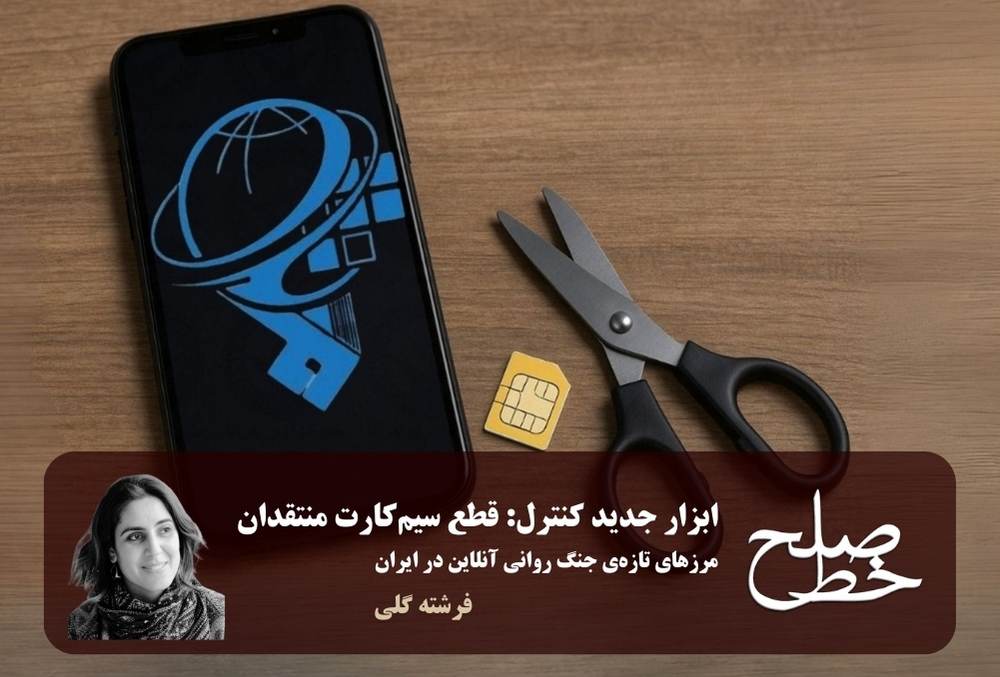
New Control Tool: Critics’ SIM Card Disconnect/ Fereshteh Goli
Nowadays, having a SIM card is one of the necessities of life in the digital and virtual world, and any deprivation of this right for anyone can be considered a tragedy. The International Telecommunication Union (ITU) has emphasized the importance of access to communication tools as a human right in several official documents, especially in the World Summit on the Information Society (WSIS) Declaration of Principles, titled “Communication as a Human Right,” which emphasizes equal and non-digital access to information and knowledge. Now imagine being summoned and ordered to either delete your social and political criticisms published online or publish content in support of the government, otherwise your SIM card will be confiscated and blocked, and you will not only be deprived of being present in that space, but also restricted from all access, including banking and other services. You won’t even be able to register a new SIM card in your name. In the current circumstances and in today’s communication world, these restrictions are like a nightmare that puts your entire life
A while ago, one of the critics of government policies, who was said to be the son of one of the ministers of the government, Seyyed Mohammad Khatami, suddenly and without any explanation, started tweeting in support of the government, especially the so-called “value-based” forces. After 20 tweets, the content of his tweets returned to its previous pattern. This has also happened to some other users, and some of them have even been forced to delete many of their previous tweets and posts to prevent their SIM cards from being blocked. This is while the only law that allows a judge to issue such orders (blocking SIM cards) is based on Article 247 of the Criminal Procedure Code and some unenacted laws on chastity and hijab and the document of transformation and excellence of the judiciary (3), although no specific law has given permission for such action.
Since April 1403 and after the approval of the document of transformation and excellence of the judicial power, the judicial institution has gained access to citizens’ registry, banking, and mobile phone information. However, these two laws and documents, regardless of the presence or absence of individuals in judicial courts, and solely based on the presence or absence of hijab, or the publication of a post on social media, give the judicial authority the ability to impose certain restrictions and make the execution of these restrictions faster and easier in case of need for implementation of a sentence. On the other hand, we know that the new bill that the government had presented to the parliament with urgency from the judicial power for controlling the virtual space, was returned due to criticisms from jurists and political activists. Therefore, it seems that this behavior should be categorized as self-serving or arbitrary actions, as until now, no official institution has taken responsibility for it. It is similar to the hijab text messages that were sent to people by
The story becomes even more terrifying when it is reported that SIM cards have been cut off without prior notice and suddenly, without any possibility of compensation for the owner of the SIM card. This means that after being cut off, the user must first contact the operator to find out the reason for the disconnection. Of course, the operator will direct the owner of the SIM card to judicial and security authorities, so that through repeated inquiries to these institutions, they can find out which security authority issued the order for the disconnection. What is interesting is that everyone knows that this process has happened without a judge’s order, court proceedings, or the issuance of a notification or summons. In other words, these arbitrary actions are not only trampling on, but also trampling on all human and citizenship rights. Despite the questioning and concern raised by some social and political activists and lawyers, no clear and transparent response has been received from any government or security institution, adding to the ambiguity and concerns. It seems that
In this regard, Ali Mojtehadsadeh, a lawyer and prosecutor, told the Vokalpress website: “Personally, when I heard about this issue, my assumption was that we were really facing a joke and how could such a thing be possible?! I am truly sorry that such issues exist! … In this matter, multiple principles of the constitution, including Article 36, have been clearly violated. This article states that the verdict and its execution must only be carried out through a fair court and in accordance with the law. Article 4 of the Criminal Procedure Code also includes the same process and emphasizes the principle of innocence. Any restrictive action, deprivation of freedom, and intrusion into the privacy of individuals, except by order of the law and under the supervision of judicial authorities, is not permissible and in any case, these actions should not be carried out in a way that violates the dignity and status of individuals. Article 7 of this law also makes the stages of the trial
At the end of this note, it may not be unkind to have a review of what is referred to as human and fundamental rights. Human rights, which are often mentioned in international documents, consist of:
1- Civil and political rights: includes the right to life (prohibition of arbitrary execution), prohibition of slavery and torture, freedom of thought and expression, freedom of religion and conscience, equality before the law (no discrimination based on race, gender, religion), the right to political participation (to be elected and to vote), and the right to a fair trial.
2- Economic, social, and cultural rights: including the right to fair work and wages, the right to social security (insurance, retirement), the right to free education and upbringing, the right to access housing, food, and healthcare, the right to participate in cultural life.
3- Collective Rights: Including the right to self-determination (for nations), the right to a healthy environment, and the right to sustainable development.
These rights are recognized in important documents such as the International Covenant on Civil and Political Rights (ICCPR) and the International Covenant on Economic, Social and Cultural Rights (ICESCR). Considering all the cases mentioned under the name of citizens’ fundamental rights, it must be said that blocking citizens’ SIM cards without clear legal reasons violates their fundamental rights and may be in conflict with human rights principles and even domestic laws in Iran.
Violation of Human Rights from an International Perspective.
Article 12 of the Universal Declaration of Human Rights declares the prohibition of arbitrary interference with privacy, stating that blocking a SIM card without just cause is a violation of this right. Article 19 of this declaration also refers to the right to freedom of expression and information, stating that cutting off digital communications can be a violation of this right. Article 17 of this charter also emphasizes the right to property, stating that blocking access to a SIM card, especially without following legal procedures, is a clear violation of this right. Therefore, if blocking SIM cards is used as a collective punishment, political censorship, or under the guise of restricting access to information, it is a gross violation of human rights.
Violation of human rights from the perspective of domestic laws.
This issue is in clear and tangible conflict with internal laws and the constitution. In Article 22, it is stated that the dignity, life, property, rights, housing, and occupation of individuals are inviolable, except in cases where the law prescribes otherwise. Therefore, if the blocking of SIM cards is outside the framework of the law, it would be a violation of this principle. In Article 25, it is also stated that inspection and opening of letters, recording and disclosing telephone conversations, disclosure of telegraphic and telex communications, censorship, non-communication and non-delivery of them, eavesdropping, and any form of espionage is prohibited, except by order of the law. Therefore, cutting off telephone communications without a court order is a violation of this principle. Additionally, in Article 34, it is stated that seeking justice is the right of every individual and anyone can refer to competent courts for this purpose. But in this case, after the blocking, there
In summary, blocking citizens’ SIM cards without a judicial order is a clear violation of freedom of speech and citizen rights. This seemingly arbitrary action undermines public trust in legal institutions and promotes a climate of fear and self-censorship in society, as well as hindering free and constructive dialogue in the public sphere and free flow of information. This practice must be stopped and any restrictions should only be imposed through transparent legal and judicial processes. Additionally, a mechanism should be put in place to compensate and be accountable to affected citizens.
Notes:
1- International Telecommunication Union (ITU). (2012). Communications as a Human Right.
Document.
Background of the World Conference on International Telecommunications (WCIT-12).
2- Disconnection of SIM cards, implementation of a plan to suppress the widespread uprising of citizens.
Filterban.
“8th of Aban month, 1403.”
Document.
Transformation and advancement of the Judiciary Power, Center for Parliamentary Research, 1st of Ordibehesht month 1403.
4- Cutting the SIM card; an illegal act as punishment, without a court hearing!
“Voklapers.”
October 13th, 2024
 Created By: Fereshteh Goli
 August 23, 2025
Tags
Censorship Cut SIM card Fire extinguisher Journalists Peace peace line Peace Line 172 SIM card Suppression The war between Iran and Israel. Twelve-day war War ماهنامه خط صلح