


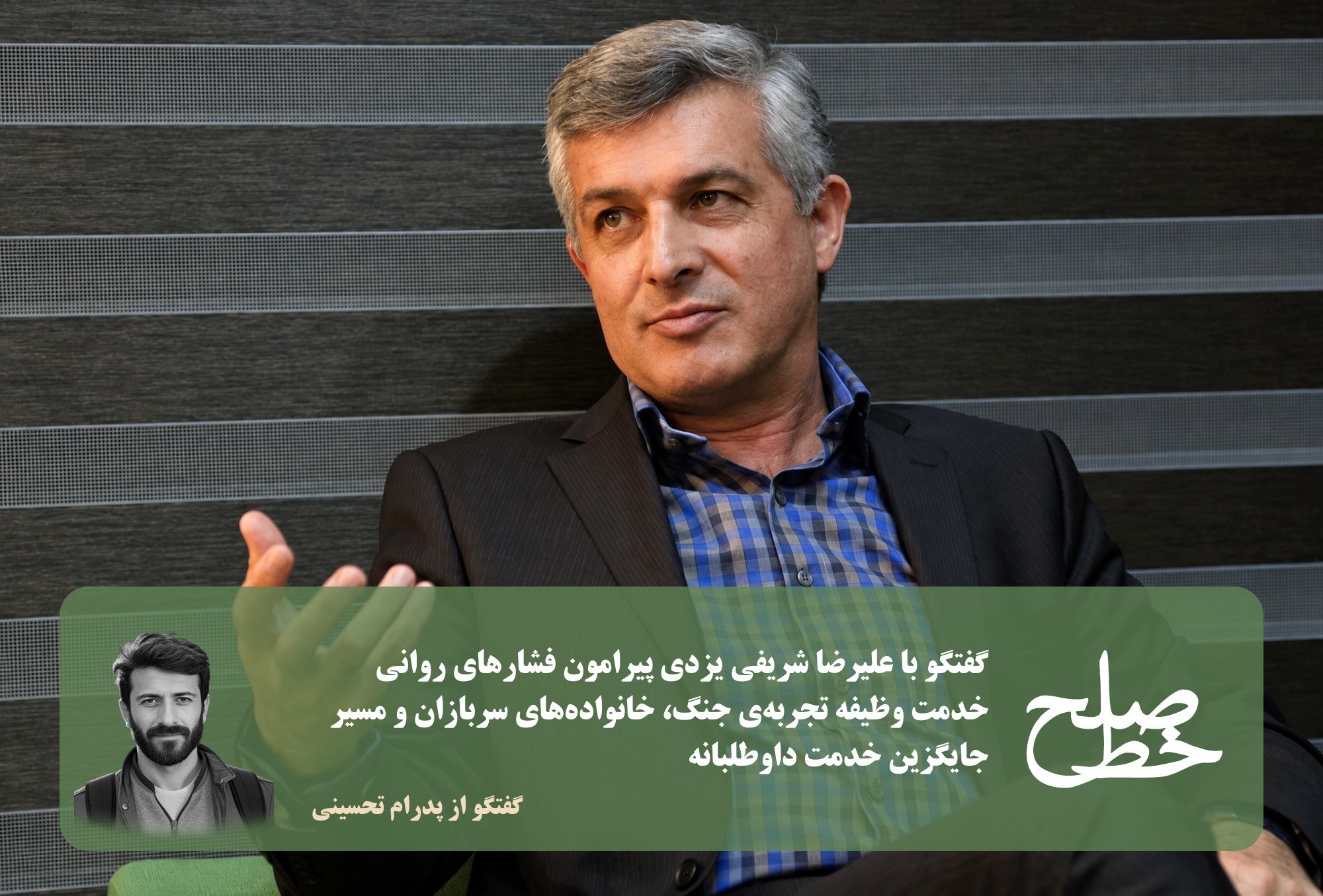
An Interview with Alireza Sharifi Yazdi on the Psychological Pressures of Compulsory Military Service / Pedram Tahsini
Although compulsory military service is implemented to ensure security and national defense, it can have serious consequences for the lives, mental health, and future of young people and their families. Forced presence in a military environment with rigid regulations and limited autonomy may lead to anxiety, depression, and a sense of powerlessness—pressures that are exacerbated in wartime conditions by the fear of death and injury, while also impacting the soldiers’ families. Naturally, the experience of military service is not uniform for everyone, as conditions of service, personal skills, and educational background all play a role.
To examine this issue, Khat-e Solh Monthly sat down with Dr. Alireza Sharifi Yazdi, a sociologist and social psychologist. This conversation explores the psychological repercussions of conscription and war, the conflict between military orders and moral convictions, the pressures placed on families, and the potential to mitigate these harms by transitioning toward a voluntary, professional military.
What impact does compulsory military service have on the mental health of young men, particularly when an individual is forced against their will to spend an extended period in a military setting with rigid regulations and limited autonomy?
This issue presents a paradox. Today, we have an international track record spanning roughly a century. The paradox lies in the fact that a country inevitably requires human resources to maintain security across various domains. Naturally, the capacity that needs to be generated must primarily be sourced from the youth. Secondly, there is a prevailing principle that it is the governance system’s responsibility to prepare a substantial portion of society for exceptional circumstances—namely, when the country faces danger, such as the situation we currently confront where an adversary seeks to attack. To achieve this, compulsory military service was instituted in most countries worldwide. In many nations, conscription was not limited to men; women were also subject to it. This was true before the 1979 Revolution in Iran, where women predominantly served through the Literacy Corps, the Health Corps, and the Extension Corps. Those two years of service counted toward their professional work experience, as the majority were absorbed into government institutions, and these two years were calculated as part of their thirty-year civil service career.
Over time, however, many countries realized that this compulsory service lacked the requisite quality. This leads directly to your question: when individuals are drafted by force, first of all, efficiency is low. Second, individuals undergo psychological strain and develop problems. Third, when trained personnel are required, those given, for instance, a single year of military service lack the requisite capability to maintain security and mount resistance, meaning they have to be retrained. Consequently, extensive research was conducted in this area.
I can answer your question as follows: numerous psychological disorders—such as depression, which is the most prevalent, alongside anxiety, obsessive-compulsive tendencies, and social withdrawal—either emerge or worsen during this period. Unfortunately, substance use—ranging from cigarettes to other narcotics—frequently begins during this stage. In fact, compulsory military service represents a major gateway to substance abuse, especially smoking; university dormitories are another, though that is beyond our current focus.
Another problem these individuals encounter is the disruption of the natural trajectory of their lives. When someone is forced to work and serve in a military setting for two years, many regular, everyday routines are naturally disrupted, both in terms of livelihood and emotional well-being. The point here is that the system has attempted to compensate for part of this issue through legislation—by reducing the duration of service, applying special conditions, or granting exemptions to specific individuals. However, contemporary studies indicate that, for instance, a group of individuals whose parents are divorced and whose mother is the legal guardian receive an exemption, even though evidence shows the family is still supporting them, not the other way around. Or cases involving aging parents, where the argument of parental elderly care is raised. When people enter the service, they observe these disparities. An acquaintance, relative, neighbor, or friend is exempted on such grounds, even when they are not genuinely caring for their parents and the parents still support them financially and emotionally. Meanwhile, another young man is compelled to spend two years of his life in military barracks simply because there happen to be two or three sons in his family. Naturally, this breeds deep frustration, a sense of failure, and undermines expected productivity. This subsequently leads to delayed marriages and, in a country currently grappling with sub-replacement fertility, results in delayed childbearing.
Another major challenge is the economic burden imposed on the armed forces with minimal return in efficiency. For all these reasons, the world has shifted its approach: transitioning away from compulsory conscription toward voluntary military service.
Meaning professional military service?
Yes, voluntary service. By providing occupational and financial incentives, this model creates an environment where individuals willingly choose military service as a career path. Because they remain in the armed forces for an extended tenure, there is ample time to acquire the requisite military skills. Studies show that the world’s leading militaries now rely on voluntary enlistment—or professional soldiering, as you mentioned—and have achieved highly favorable outcomes.
When a conscript finds himself in a combat zone without having chosen war, what psychological pressures does he endure? How does the fear of death and injury, or being compelled to inflict harm on others, affect him?
You pointed to someone who did not volunteer—a conscript thrust into a war zone without personal choice. The crucial point here is our experience during the eight-year war. During the Iran-Iraq War, we had two distinct forces on the front lines, and I had the privilege of being there myself. One category comprised the formal armed forces in the conventional sense, which at the time primarily meant the regular army (Artesh). The second category consisted of the Basij forces deployed by the IRGC.
Were you a Basij volunteer or a conscript yourself?
I was a Basij volunteer. One could readily compare these two forces both then and now. Of course, given the unique conditions of the war and the early post-revolutionary period, even many of our conscripts went to the front willingly and of their own free will—though certainly not all. The coexistence of these two tracks clearly demonstrated that much of the self-sacrifice, positive breakthroughs, and operational capabilities were generated by volunteers. Among conscripts, anyone who could leverage nepotism or connections attempted to avoid deployment to the front, and among those sent, some deserted. Nevertheless, there were also conscripts who displayed extraordinary valor on the battlefield.
My point is that during wartime—and this is corroborated by international experience—during eras of conscription, evidence from various countries showed that when war breaks out, desertion rates soar and enthusiasm for combat remains notably low. Many participants subsequently suffered from a spectrum of psychological conditions, including post-traumatic stress disorder (PTSD), depression, anxiety, and similar afflictions. Such psychological disorders are inherently endemic to armed conflict; after a war concludes or soldiers return from the front, they grapple with these struggles for years. For two full years afterward, whenever I heard a motorcycle engine, I would instinctively duck, thinking it was machine-gun fire. Such reactions occur universally, yet their intensity is significantly lower in those who volunteered. An individual coerced into combat performs with lower operational efficiency, which exponentially magnifies these psychological traumas.
When a soldier feels completely stripped of agency and control over his life, what psychological repercussions follow? For instance, when he has no say regarding his deployment station, living conditions, or even the degree of peril he confronts, how does this affect his sense of autonomy and individual identity?
The reality is that the foundational philosophy of conscription is to mobilize all capable national human resources—predominantly youth—to endure adversity in times of crisis and defend national sovereignty and independence. Consequently, in earlier eras, soldiers were transferred multiple times across distinct climates during their two-year service—from tropical and frigid regions to remote outposts and urban centers—to foster adaptability. In response to your question, when an individual feels subjected to sustained coercion, their agency is stripped away and their personal freedoms are curtailed. Reactions vary depending on personality type: some withdraw into severe, pathological introversion, becoming completely alienated from their environment. Another group channels the resulting anxiety into anger, manifesting aggressive behavior. Studies demonstrate that several of these individuals develop severe pathological aggression and depression during or after service. These pressures typically crystallize when a person possesses virtually no autonomy and is compelled to perform tasks they neither desire nor endorse. Under such circumstances, even individuals without pre-existing mood, behavioral, or attitudinal disorders become far more vulnerable. For those with genetic or environmental predispositions to mental health issues, such as personality disorders, these conditions can be triggered or exacerbated. As a result, the stress derived from these environments severely impairs personal efficacy.
Can conscripts in wartime conditions sustain long-term psychological damage even without direct engagement in combat? How might such trauma manifest in their personal lives, family relationships, and future careers?
Relatively few empirical studies have addressed this issue in our country. However, in nations frequently engaged in foreign conflicts—such as the United States, the United Kingdom, and similar states—research shows that veterans often remain unable to psychologically rehabilitate themselves for extended periods after a war. Secondly, they frequently experience severe disruptions in intimate relationships with spouses and children when attempting to build a family later in life. Furthermore, global studies reveal that individuals under such severe strain—whether they saw direct combat or not, as observed in our own country—exhibit markedly elevated divorce rates. The capacity of these individuals to sustain healthy family dynamics is inevitably damaged, giving rise to persistent domestic crises.
When a soldier finds that military orders clash directly with his personal moral values and beliefs, what internal conflict does he face? Can this dynamic precipitate guilt, shame, or moral injury?
When people are placed in such circumstances—including soldiers—they experience a profound value conflict. A value conflict arises when an irreconcilable chasm opens between external expectations and internal convictions. The primary detrimental consequence of this dynamic is the fragmentation and erosion of human identity; the immediate casualty is personal identity: ‘Who am I really? What do I stand for?’ This occurs because one is forced to execute external dictates and submit, knowing that disobedience incurs reprimand, blame, and harsh punishment. This duality generates immense inner turmoil. It parallels the experience of children taught, indoctrinated, or coerced into a set of values and norms at school that sharply conflict with their family’s culture—such as a school imposing mandatory hijab on a girl whose family holds no belief in the practice. This duality causes severe disorientation. Furthermore, when internal conflict—or more precisely, a paradox—takes root within a person, it predominantly surfaces as depression and aggression, as it produces intense anxiety that easily converts into volatile anger and hostile behavior. This is by no means short-lived; it does not merely manifest during military service. Rather, it is a phenomenon capable of overshadowing an individual’s entire life, whether they wish it or not.
You mentioned the family. What psychological toll do the families of conscripts bear during times of war? Given the persistent anxiety regarding the fate of a son, husband, or brother, what support systems can be implemented to ease this burden?
This is a pivotal discussion. Research consistently indicates that the psychological pressure borne by soldiers’ families—particularly parents and spouses—can in certain cases surpass that experienced by the soldiers themselves. Remarkably, studies show that despite not being positioned at the direct center of the conflict, their vulnerability is heightened. Their primary concern revolves around physical harm befalling their child, even when less attuned to psychological trauma. This persistent dread establishes fertile ground for psychological distress. In families with pre-existing risk factors, the incidence and severity of various disorders can sometimes exceed those observed in the active service members themselves.
What forms of support can be provided, and how can these families be effectively assisted?
Over the past few years, commendable support mechanisms have emerged. Looking at the long-term, structural horizon, the optimal remedy is undoubtedly replacing compulsory conscription with a voluntary, professional military. However, examining medium-term remedies, the primary imperative is bolstering counseling centers across barracks, bases, and law enforcement facilities. I know firsthand that meaningful steps have been taken in this domain; although their ultimate efficacy requires rigorous evaluation, qualified professionals serve as psychologists and counselors there, and this infrastructure must be reinforced first.
In the short term, perceived discrimination must be minimized to the greatest extent possible. Currently, individuals possessing personal connections, privileged circumstances, financial means, or elite social status secure noticeably easier military assignments for their children, whereas those lacking such resources or refusing to exploit them endure far harsher postings and prolonged separation from their families. Furthermore, financial stipends for conscripts must be enhanced, as current military compensation is completely out of step with the prevailing rate of inflation.
If this financial compensation is augmented and the length of service shortened—pending the legal framework for a voluntary or professional force—all these interventions can yield tangible improvements. Preparing families through orientation programs, facilitating structured communication channels, granting frequent family leaves, and assigning postings closer to home are all viable, impactful measures that can mitigate the severity of these challenges.
Thank you very much for generously sharing your valuable time with us.
 By: Padram Tahsini
 November 22, 2026
Tags
Alireza Sharifi Yazdi Compulsory military service peace line Peace Line Monthly Peace Mark 187 Pedram Tahsini Professional army Soldiers' Families Soldiers' Mental Health Voluntary Service War