


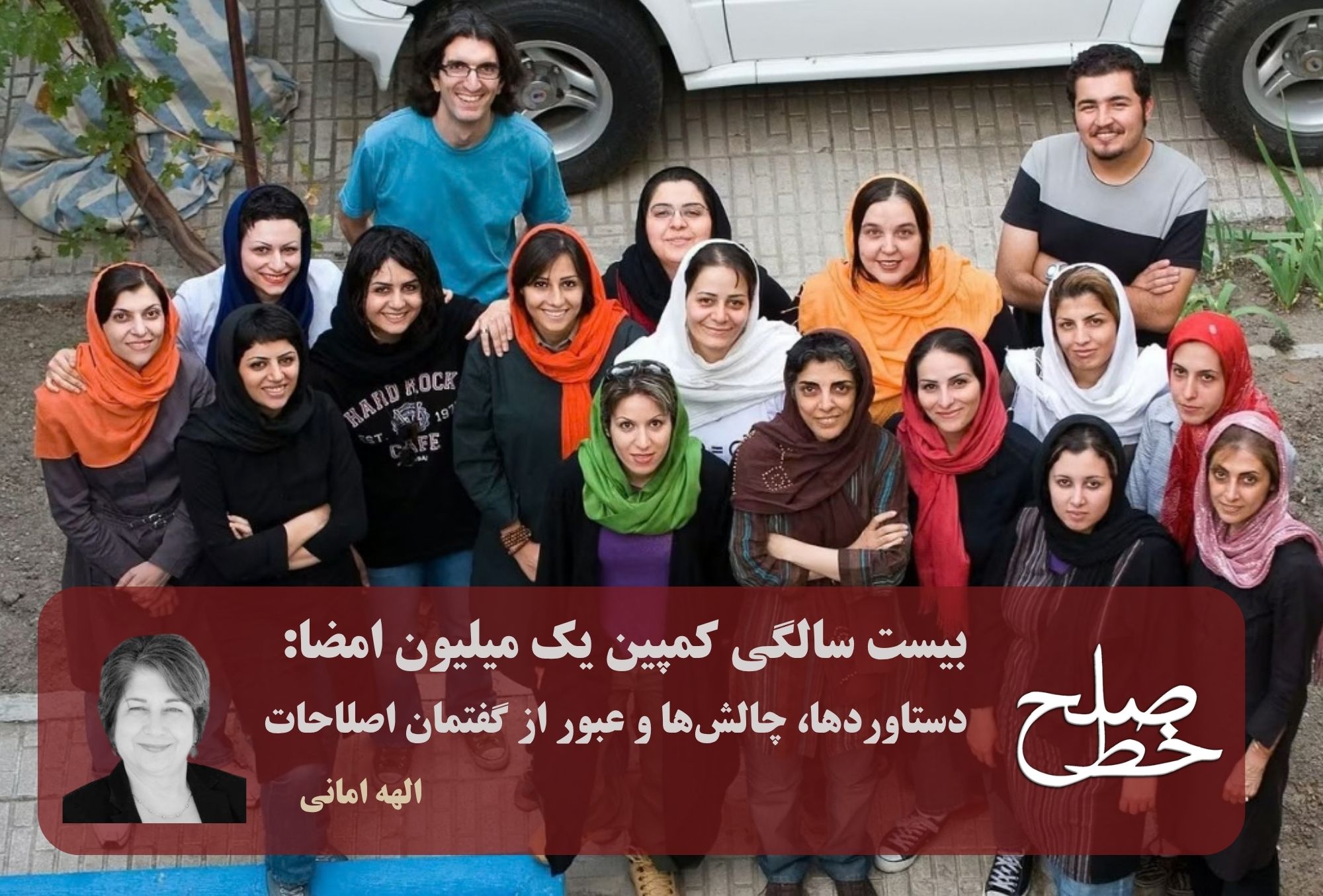
The Twentieth Anniversary of the One Million Signatures Campaign: Achievements, Challenges, and Moving Beyond the Reformist Discourse/ Elahe Amani
The One Million Signatures Campaign in Iran cannot be understood without considering the experience of the women’s movement in Morocco in the early 1990s. Iranian women activists drew inspiration from the Moroccan experience, particularly its use of large-scale signature collection as a tool for social mobilization, raising public awareness, and creating pressure to reform discriminatory laws. Nevertheless, the One Million Signatures Campaign was not simply a copy of the Moroccan experience; rather, it redefined and localized this model within Iran’s entirely different political, legal, and social conditions. Comparative research also shows that the Moroccan experience was an important source of inspiration for Iranian activists, but differences in the political structures and opportunities of the two countries profoundly affected the trajectories and outcomes of the two movements.
The Moroccan campaign, initiated by the Union de l’Action Féminine (UAF) in the early 1990s, specifically took shape in 1992 as the One Million Signatures Campaign within the struggle to reform the Moudawana, Morocco’s family law. Polygamy was one of the important and key provisions challenged by the campaign, but the movement’s principal and structural objective was to transform and reform the entire body of family law. The union’s activists sought gender equality in all dimensions of married life, and their demands encompassed four key areas: “severely restricting or abolishing polygamy and making it conditional on court authorization,” “abolishing the father’s right of compulsory guardianship in his daughters’ marriages (jabr),” “reforming divorce laws and granting women the right to petition for divorce,” and “setting the legal age of marriage at 18 for both girls and boys.”
The aim of collecting one million signatures was to demonstrate the breadth of social support for reforming family law and to create political pressure for change in Morocco. This experience gradually became part of a longer process of legal reform that ultimately led to the reform of family law in 2004.
Morocco’s family law, the Moudawana, is currently undergoing a historic transition and a new phase of fundamental reform. Although the prevailing legal framework remains the version of the Moudawana reformed in 2004, extensive new legal reforms concerning family law have been drafted and are passing through the final stages of the legislative process.
The current proposed reforms to Morocco’s family law have generated intense social and political debate throughout the country. Conservative and Islamist groups argue that the 2004 family law reforms went as far as they could without violating sacred religious texts and call for the preservation of traditional family structures. By contrast, progressive women’s NGOs, women’s rights advocates, and feminists believe that although the advances made in child custody, guardianship, and the division of family assets following separation or divorce are historic and significant, the failure to guarantee full equality in inheritance rights, fully criminalize child marriage, and eliminate legal exceptions demonstrates that, under the shadow of Sharia law, the system continues structurally to reproduce and reinforce patriarchy.
In Iran, too, the general principles of the One Million Signatures Campaign explicitly emphasized that the campaign’s demands were not opposed to Islam, and Ayatollahs were even consulted and their implicit approval obtained. In this respect, there were fundamental similarities between the two campaigns. Both movements attempted to transform a complex and structural demand concerning women’s rights into a specific, understandable demand in which the general public could participate. “One million signatures” was not merely a number; it was intended to become a symbol of the breadth of social support for reforming discriminatory laws. In both experiences, collecting signatures was connected to awareness-raising and social mobilization, and the objective was not merely to gather signatures but to create dialogue about women’s rights and transform a legal issue into a public and political one.
Another important similarity was the use of rights and law as an entry point into the struggle for gender equality. Moroccan activists focused on reforming family law, while Iranian activists addressed a range of discriminatory laws concerning marriage, divorce, custody, inheritance, nationality, testimony, diya, polygamy, and other areas. In both cases, law was criticized not merely as a collection of legal regulations but as one of the instruments through which gender inequality is reproduced.
Another important similarity was the attempt to create a connection between human rights, gender equality, and an Islamic context. Moroccan activists sought to frame family law reform in a way that could also engage with Islamic culture and tradition. In Iran, activists in the One Million Signatures Campaign likewise emphasized that their demands were not an opposition to Islam, but rather an attempt to reform discriminatory laws and bring the law into alignment with social realities and society’s demands for equality. Catherine Sameh’s research shows that the Iranian campaign consciously used a human rights discourse within an Islamic framework (“Islamic human rights”) and emphasized the indigenous and internally rooted character of Iranian women’s struggle.
Despite these similarities, the differences between the two experiences are historically and strategically far more important and substantial. The first and perhaps most fundamental difference was the political structure and the degree of political opportunity in the two countries. In Morocco, despite political restrictions, the political environment gradually opened to dialogue and reform, and ultimately the Moroccan monarchy became one of the influential factors in advancing reforms.
In Iran, the campaign began its activities at a time when civic and political space had become more restricted, and aside from the disastrous 1980s, civil society activists also faced arrest, interrogation, restrictions on holding meetings, censorship, and security pressures. The comparative research of Valentine Moghadam and Elham Gheytanchi emphasizes precisely this difference: in Morocco, political opening and opportunity made cooperation between the women’s movement and official institutions possible in pursuit of legal reform; in Iran, the closed political environment pushed the women’s movement more toward grassroots activism and the creation of independent women’s networks, although these were not independent NGOs either, but were largely government-organized non-governmental organizations (GONGOs).
Another fundamental difference was the role of Morocco’s King Mohammed VI in the reform process. Family law reform in Morocco ultimately became possible with the king’s political and religious support. Although the women’s movement and civil society played important roles in generating pressure and changing public discourse, the final reform of Moroccan family law could not have proceeded in the same manner without the king’s support. For this reason, the Moroccan experience cannot simply be regarded as a model of “bottom-up mobilization”; it ultimately represented a combination of social pressure from below and political support and intervention from above. Comparative research has likewise emphasized that Morocco’s 2004 reforms depended to a considerable degree on the king’s support.
The King of Morocco is not merely the country’s political leader; he also holds the high religious title of “Commander of the Faithful” (Amir al-Mu’minin). Under the Moroccan Constitution, the king is recognized as the “Protector of Islam.” This position enables the monarchy to oversee the country’s religious structures and institutions, appoint members of the High Council of Ulema—the only body authorized to issue binding fatwas—and, to a considerable extent, determine the boundaries of religious interpretation and ijtihad. Although Moroccan society is not secular either, the discourse surrounding interpretations of Sharia law in the Islamic Republic of Iran differs significantly from that in Morocco.
Naturally, no similarly powerful actor existed in Iran who possessed both the religious legitimacy and political power necessary to advance reforms while simultaneously supporting the campaign’s demands.
Even if we regard the idea of securing parliamentary support—which many considered impossible—as a valid possibility, the legislative process in the Islamic Republic faced other obstacles, including the Guardian Council and other political and legal structures. The path from public support to legal reform was therefore far more complicated. This structural difference largely explains why similar models produced different outcomes in the two countries.
Another difference concerned the relationship between social mobilization and the institutions responsible for deciding on laws. In Morocco, the women’s movement was able to enter institutional discussions during the process of legal reform and, at later stages, engage with decision-makers through meetings, coalitions, expert work, and lobbying.
In Iran, the One Million Signatures Campaign was fundamentally a bottom-up movement, and its access in 2006 (1385), during Mahmoud Ahmadinejad’s first presidential term, was far more limited. For this reason, one of the most important strengths of the One Million Signatures Campaign—its ability to create grassroots networks and train and mobilize activists—was simultaneously unable, because of the dogmatic and regressive beliefs and politics of those in power in Iran, to bring about the opening that activists had hoped for.
There were also differences in the scale and scope of the demands. The Moroccan campaign focused primarily on reforming family law. This thematic focus enabled Morocco’s One Million Signatures Campaign to pursue a relatively specific legal demand over a long period. By contrast, Iran’s One Million Signatures Campaign targeted a broad range of discriminatory laws, from marriage, divorce, and polygamy to inheritance, nationality, diya, testimony, and laws related to violence and honor killings. On the one hand, this breadth was a strength because it demonstrated that gender discrimination in Iran was not an isolated or limited issue, but was rooted in a legal structure based on a fundamentalist and extremist interpretation of Islam. On the other hand, it made the simultaneous realization of such a broad range of reforms more challenging.
Another difference lay in organizational methods. In Morocco, the campaign operated within political conditions and an environment that provided greater opportunities for public organizing, civic activity, and interaction with political institutions. In Iran, because of the closed political environment and more severe restrictions, activists were compelled to create a more flexible and decentralized structure. Face-to-face dialogue, person-to-person communication, legal education, and the creation of local networks therefore became central elements of the Iranian One Million Signatures Campaign’s strategy. This method was used not only to collect signatures but also to raise awareness and transform ordinary citizens into participants and social activists.
Indeed, this very difference meant that “one million signatures” did not have the same meaning in Iran as it did in Morocco. In Morocco, large-scale signature collection became an important lever for political pressure and ultimately formed part of a broader process of legal reform. In Iran, although the numerical target of one million signatures was not achieved within the specified period, the process of collecting signatures itself became a tool for public education, network-building, increasing legal awareness, and cultivating a new generation of activists. Of course, many gender-equality activists and feminists believed that even if one million signatures had been collected, initiating reform of family laws was not inherent in the nature and essence of the Islamic Republic. The value of the Iranian campaign therefore cannot be assessed solely on the basis of the number of signatures collected or the extent of legal reforms achieved.
There is an important “paradox” here. The Moroccan experience demonstrated that, under suitable political conditions and opportunities, a broad campaign for legal reform can move from social mobilization to legal reform. The Iranian experience demonstrated that even when this path is blocked, the same kind of mobilization can create a social infrastructure for the women’s movement. In other words, in Morocco, the campaign was able to channel a significant portion of its energy from social mobilization into legal reform; in Iran, most of the campaign’s energy necessarily went into building the movement and, insofar as possible, preserving the campaign’s network under conditions of repression. From this perspective, comparing the two experiences should not lead to the simplistic conclusion that the Moroccan campaign was “successful” and the Iranian campaign “unsuccessful.” Such an assessment disregards the differences in political structures and the opportunities available to the two movements. The comparative study by Valentine Moghadam and Elham Gheytanchi demonstrates precisely that the success or failure of women’s movements does not depend solely on their strategic choices; political structures and opportunities determine the extent to which a movement can translate its demands into policy and legal change.
From a historical perspective, perhaps the most important difference is that the Moroccan campaign was able to connect bottom-up mobilization with a political opportunity from above, while the Iranian campaign was largely compelled to organize from below in the absence of such a political opportunity. This very difference gives the Iranian experience a distinct significance. Perhaps the most important lesson from comparing the two experiences is that the power of a campaign lies not merely in the number of people who join it, but in its ability to transform awareness into participation, participation into organization, organization into coalition, and ultimately coalition into political power and measurable change. The Moroccan experience demonstrates the importance of having a clear path from social mobilization toward reforming laws, even if step by step; the Iranian experience likewise demonstrates the importance of building social and human capacity even under conditions in which legal change is impossible because of political blockage. The Moroccan campaign also demonstrated that women’s social mobilization, when connected to political opening and opportunity and a powerful ally within the political structure, can lead to legal reform; Iran’s One Million Signatures Campaign demonstrated that even in the absence of such an opening and ally, social mobilization can create a valuable movement and network of activists for women’s struggle.
Strengths of the One Million Signatures Campaign in Iran
The One Million Signatures Campaign was one of the most important innovations of Iran’s women’s movement because it articulated a clear, specific, and understandable demand and transformed the broad and abstract concept of “women’s equality” into a set of specific forms of discrimination within Iranian law, including in the areas of marriage, divorce, inheritance, custody, nationality, testimony, diya, polygamy, and other legal fields. This approach was strategically significant because it allowed activists to demonstrate concretely how legal discrimination affected women’s everyday lives, rather than leaving equality merely at the level of a broad and abstract principle. The campaign’s educational component was also consciously connected to the signature-collection process. One of the campaign’s most innovative features was its face-to-face organizing and direct engagement with society. Under conditions of political closure and blockage, when holding large demonstrations and gatherings was extremely difficult within Iran’s political and security environment, activists went street by street, university by university, park by park, and person by person, speaking with people, explaining discriminatory laws, answering questions, and then asking them to join the campaign by signing its statement. Some research has described this method as a form of “politics of engagement in everyday life.”
The campaign was not, in fact, merely seeking to collect signatures; it sought to transform the “supporter” into an “activist” and build the human capacity necessary to sustain activism. Activists received training on discriminatory laws against women, methods of communicating and conversing with people, social organizing, signature collection, and ways of confronting security risks and political restrictions. According to some research, nearly one thousand activists were trained in 15 provinces (centralization is also discussed in another section), and organizations such as Human Rights Watch have emphasized the campaign’s role in training a generation of activists in advocacy and legal activism. From this perspective, the campaign’s achievements cannot be measured solely by the number of signatures collected, because it invested in building human capacity, increasing legal and political awareness, and transmitting knowledge of social organizing. Its relatively horizontal and decentralized structure was also suited to conditions of political repression in Iran and provided greater flexibility and resilience. At the same time, the attempt to bring together people with different political and intellectual views, although important for creating a social coalition to eliminate sex- and gender-based discrimination, also made managing tensions and theoretical disagreements within the campaign difficult and challenging. The campaign was also able, to a limited extent, to build bridges among different intellectual currents, although this same intellectual and political diversity, alongside its advantages, was one of the campaign’s internal challenges.
Another of the campaign’s most important achievements was its impact on public discourse concerning women’s rights. Influencing the transformation of the public and political environment surrounding women’s rights was among the most significant achievements of the One Million Signatures Campaign. Amnesty International reported in 2008 that the campaign had helped turn women’s rights into a national issue and created encouraging conditions for discriminatory laws to receive more serious attention. The campaign’s importance therefore lay not only in changing certain laws or attempting to change them, but also in transforming the way women’s rights were discussed and expanding the circle of people who regarded themselves as participants in this conversation and advocacy. Alongside this discursive transformation, some legal and policy achievements, however limited and gradual, should not be overlooked. These included changes related to equality in diya and insurance compensation for women and men in certain cases of bodily injury or death, as well as social and political pressure to remove or modify certain problematic provisions from proposed bills, which have been noted in connection with the broader efforts of the women’s movement, including campaign activities. The campaign succeeded in keeping discriminatory laws under public scrutiny and discussion for a prolonged period, which was itself part of the process of social and political change.
These achievements were made under conditions in which the campaign faced arrests, interrogations, restrictions on holding meetings, even obstruction of its first gathering and public launch, censorship, and systematic blocking of its website, and according to reports from the period, more than 40 of its activists were arrested. Despite this repression, the campaign’s network did not immediately disappear, and in some cases, security pressure, imprisonment of activists, and their harassment even strengthened solidarity, commitment, and determination among activists. The presence of young men among campaign activists, as well as the imprisonment and harassment of some of them, was another important and less frequently discussed aspect of this social experience. Their presence demonstrated that gender equality and the elimination of legal discrimination against women should not be regarded solely as a “women’s issue,” but rather as a social issue requiring the participation of society as a whole, including men. Overall, the historical significance of the One Million Signatures Campaign cannot be measured solely by its success in changing laws. Its value also lies in creating connections among legal awareness, education, social organizing, civic participation, and legal advocacy; creating a network of activists; changing public discourse about gender discrimination; and demonstrating the possibility of collective action under conditions of political repression.
Weaknesses and Limitations
One of the most important strategic weaknesses of the One Million Signatures Campaign was its choice of collecting one million signatures within two years as its objective—a goal that, given Iran’s political and security conditions, faced serious limitations from the outset. Analyses at the time also indicated that after one year, the number of signatures collected would remain considerably short of one million and that the campaign would not achieve its quantitative target within the designated period. Yet the issue ran deeper than failing to reach a particular number. Making “one million signatures” the principal objective devoted a substantial amount of organizational energy to a lengthy and difficult process of mobilization and signature collection without defining a clear path for transforming this social mobilization into the next stage of political action and structural change.
In other words, an inspiring numerical goal, when it becomes the principal measure of success, can itself turn into a strategic limitation. The fundamental question was what political and institutional mechanism could transform this social capacity into lasting change after awareness and social mobilization had been created.
The second major limitation was the broad gap between the campaign’s considerable power in social organizing and its ability to influence the legislative process directly. The campaign achieved important successes in education, face-to-face dialogue, networking, and capacity-building at the societal level, but the One Million Signatures Campaign regarded Iran’s Islamic Consultative Assembly as one of its important targets without fully answering the question of where ultimate decision-making power over the desired legal reforms was actually concentrated. The legislative process in Iran was not simply: women ← public opinion ← parliament ← law. The Guardian Council has repeatedly rejected parliamentary legislation concerning women’s rights. Other institutions, including the Expediency Discernment Council and the judiciary, also play roles in this process and in the implementation of laws.
These structural limitations can also be seen in earlier experiences of reform concerning women’s rights. The Sixth Parliament approved the Convention on the Elimination of All Forms of Discrimination against Women (CEDAW), but the Guardian Council opposed it, and the matter was referred to the Expediency Discernment Council. It should be noted that Iran, the United States, Sudan, Somalia, and Tonga have not ratified the Convention on the Elimination of All Forms of Discrimination against Women, and even in countries that have ratified it, there is a significant gap between ratification and implementation of the Convention’s provisions.
Successful campaigns around the world initiated by women for equality, peace, and justice have demonstrated that more comprehensive strategies, including bottom-up organizing and grassroots activism, can lead to important social, political, legal, and cultural changes.
The women’s suffrage movement, which emerged and expanded during the nineteenth and twentieth centuries in New Zealand, the United Kingdom, the United States, and other countries, resulted in women gaining the right to vote and transformed democratic participation. In 1893, New Zealand became the first country to recognize women’s right to vote in parliamentary elections. The Women of Liberia Mass Action for Peace in 2003 likewise brought women from different religious, ethnic, and social groups together and, by exerting pressure on the parties to the conflict, helped bring an end to Liberia’s fourteen-year civil war and bring the parties into peace negotiations.
The Greenham Common Women’s Peace Camp in the United Kingdom, active from 1981 to 2000, was an example of the power of sustained and nonviolent resistance. By organizing a long-term campaign against the deployment of nuclear weapons, women attracted international attention and helped expand the broader nuclear disarmament movement. In India, the Chipko Movement of the 1970s placed rural women at the forefront of environmental activism. By physically defending forests against commercial logging, women connected environmental protection to community livelihoods, food security, and access to fuel and natural resources.
Examining these campaigns, as well as Morocco’s One Million Signatures Campaign, demonstrates that public education, social mobilization, media activity, documentation, political lobbying, and the development and pursuit of legislative strategies can all be advanced simultaneously. Nevertheless, even such a strategy would have faced a fundamental limitation: in the Islamic Republic, parliament is not the sole determining institution in the legislative process, and passage of a law does not necessarily mean that it can be implemented or that legal equality will be guaranteed. Therefore, imagining a linear path of “increasing public awareness ← social mobilization ← pressure on parliament ← legal reform ← legal equality” was incompatible with the actual structure of power in the Islamic Republic.
From this perspective, the campaign’s most fundamental theoretical limitation was its considerable reliance on the possibility of reforming discriminatory laws within the legal and political structure of the Islamic Republic. A distinction must be made between the possibility of limited and case-specific reforms to certain regulations and the possibility of fundamentally reforming laws concerning women and the family. The Islamic Republic is not simply a system in which a number of discriminatory laws happen to exist separately; rather, a significant part of its legal structure, particularly in the areas of family and gender, is connected to the government’s official and ideological interpretation of Islam and its authoritarian structure. Discrimination in areas such as marriage, divorce, custody, inheritance, nationality, and polygamy therefore cannot simply be regarded as a collection of flawed laws that can easily be reformed through increased public awareness and social pressure. As long as the legal and political foundations producing these inequalities remain untouched, fundamental and lasting reform of laws concerning women and the family will face structural limitations. For this reason, the most important criticism of the campaign’s theory of change is that it relied excessively on the possibility of reform from within the structure, whereas the experience of the Islamic Republic demonstrates that the issue is not simply the reform of several legal provisions, but the structure itself that produces and reproduces gender discrimination.
Compulsory hijab is a clear example of this limitation and one of the most important issues that the campaign effectively avoided challenging directly. This avoidance can be understood within the framework of the campaign’s coalition-building strategy: the campaign sought to build bridges between women with religious and nonreligious orientations and avoided raising issues that could make this coalition fragile. Yet this very choice created an important strategic contradiction. Compulsory hijab is not merely an issue concerning clothing or individual choice; it is one of the clearest symbols of the Islamic Republic’s exercise of ideological power over women’s bodies, identities, and freedom. Excluding it from the agenda, therefore, although understandable from the perspective of preserving a broader coalition, simultaneously meant leaving untouched one of the most important arenas in which the system exercised gender domination. The historical significance of this issue became even clearer during the “Woman, Life, Freedom” uprising. Women in this uprising did not merely demand the “reform” of compulsory hijab regulations; in many cases, they challenged the very symbol of compulsory hijab itself. Burning headscarves became a symbol of rejecting coercion and reclaiming control over women’s bodies and lives. From this perspective, what the campaign could not or did not wish to challenge directly within the constraints of its coalition-building considerations became, in “Woman, Life, Freedom,” one of the most visible lines of confrontation between women and the power structure. This transformation demonstrated that a significant part of the community of women had moved beyond demanding reform within the existing framework and toward demanding the right to choose, freedom, and human dignity.
This issue also reveals the tension between reformist and more radical approaches within Iran’s women’s movement. For some activists, working within existing laws was a realistic approach that could reduce certain forms of discrimination and produce gradual change. By contrast, critics believed that operating within a framework itself founded on gender discrimination and the legal differentiation of women and men might inadvertently presume the legitimacy of the very structure responsible for reproducing inequality. Compulsory hijab clearly demonstrates this contradiction: in order to preserve a coalition between religious and nonreligious women, the campaign could not or did not wish to place one of the Islamic Republic’s most fundamental manifestations of gender domination at the center of its struggle. As a result, a more fundamental question confronts the women’s movement: Can lasting equality be achieved within the structure of an authoritarian religious system solely by reforming existing laws while that same political system preserves the legal and ideological foundations of inequality? The experience of more than four decades of the Islamic Republic’s rule, and particularly the “Woman, Life, Freedom” uprising, demonstrates that this question is no longer merely theoretical but has become one of the central issues concerning the future of Iran’s women’s movement.
Ultimately, the campaign should not be assessed solely on the basis of its failure to reach one million signatures or even its failure to fully achieve its legislative objectives. The campaign had important achievements in education, creating networks of activists, increasing legal and political awareness, and changing public discourse about gender discrimination. It also succeeded, at least to some extent, in bringing together women with differing intellectual and political orientations within a common framework. But this very attempt to create a broad coalition also defined the campaign’s discursive and political boundaries. Its experience demonstrated that social mobilization and demands for legal reform can create awareness and even lead to limited and case-specific reforms, but under an authoritarian religious system, these achievements do not necessarily result in structural and lasting equality. Particularly in the areas of women and family, where discrimination is intertwined with the legal and ideological foundations of the Islamic Republic, genuine reform cannot simply be limited to changing a few legal provisions. In this sense, “Woman, Life, Freedom” created an important rupture in the discourse of women’s struggles: the demand shifted from “legal reform” toward demanding the “right to choose and freedom,” and compulsory hijab, which had once been an issue that could not be placed directly at the center of the struggle in order to preserve coalitions, became one of the principal symbols of women’s resistance against the system. From this perspective, the campaign’s most important historical lesson is that lasting equality for women in Iran ultimately lies not in limited reforms within an authoritarian religious system, but in changing the legal and political structures that produce and reproduce discrimination.
Final Words
Iranian women’s struggle for equality did not begin with the One Million Signatures Campaign, nor did it end there. Less than one month after the establishment of the Islamic Republic, in March 1979 (Esfand 1357), women organized their first large-scale demonstrations in protest against threats to their freedoms and particularly in response to the compulsory hijab decree. The One Million Signatures Campaign can be regarded as one of the influential high points in this historical struggle: a movement that, despite its theoretical and strategic limitations and its position within the reformist discourse and the framework of “women’s rights in Islam,” cultivated a generation of feminist activists and women’s movement activists and left behind valuable experience in organizing, education, networking, and collective action.
The historical significance of that generation perhaps became most evident in the generation of the children of the women and men who had participated in the One Million Signatures Campaign—a generation that no longer voiced the suppressed anger and accumulated demands of previous generations within the framework of civil reform, nor by relying on the vague and limited concept of “Islamic human rights,” but instead cried them out openly and unequivocally in the “Woman, Life, Freedom” movement.
The women and girls of this generation not only rejected compulsory hijab but set their headscarves on fire atop poles. They moved away from centralism and brought a movement sparked by the government killing of Mahsa (Jina) Amini from the margins to the center: from Kurdistan to Tehran and from there throughout Iran. “Woman, Life, Freedom” was not merely a protest against a single law or policy; rather, it carried a profound and valuable cultural and social force against power relations in the home and society, against hierarchies of power, the patriarchal order of the family, and the authoritarianism governing society. In this sense, despite the immense and catastrophic human cost paid by some of Iran’s finest young people, this movement initiated a kind of broad cultural renaissance—a renaissance in which women were not merely the subjects of reform, but were and remain the actors and creators of change themselves.
This generational and discursive rupture demonstrated that women’s demands were no longer merely about reforming several discriminatory laws within the existing system, but about freedom, equality, human dignity, and the right to self-determination. Perhaps this transformation cannot be expressed better than in the words of Nigerian-American writer Ijeoma Umebinyuo: “No one told you that the women whose feet you cut from running would give birth to daughters with wings.” From this perspective, the One Million Signatures Campaign was part of the path; but “Woman, Life, Freedom” demonstrated that subsequent generations no longer want merely to create reforms within existing blocked frameworks, but seek to change the framework itself, to split open the heavens and cast a new design.
Footnotes:
1- Gheytanchi, E., & Moghadam, VM (2014). Women, social protests, and the new media activism in the Middle East and North Africa. International Review of Modern Sociology, 40 (1), 1–26.
2- Moghadam, VM, & Gheytanchi, E. (2010). Political opportunities and strategic choices: Comparing feminist campaigns in Morocco and Iran. Mobilization: An International Quarterly, 15 (3), 267–288.
3- Sameh, C. (2010). Discourses of equality, rights and Islam in the One Million Signatures Campaign in Iran. International Feminist Journal of Politics, 12 (3–4), 444–463.
 Created By: Elahe Amani
 September 23, 2026
Tags
"Million Signature Campaign" Compulsory hijab Elahe Amani Mahsa Amini Mahsa Movement peace line Peace Line 185 Woman Women's rights