


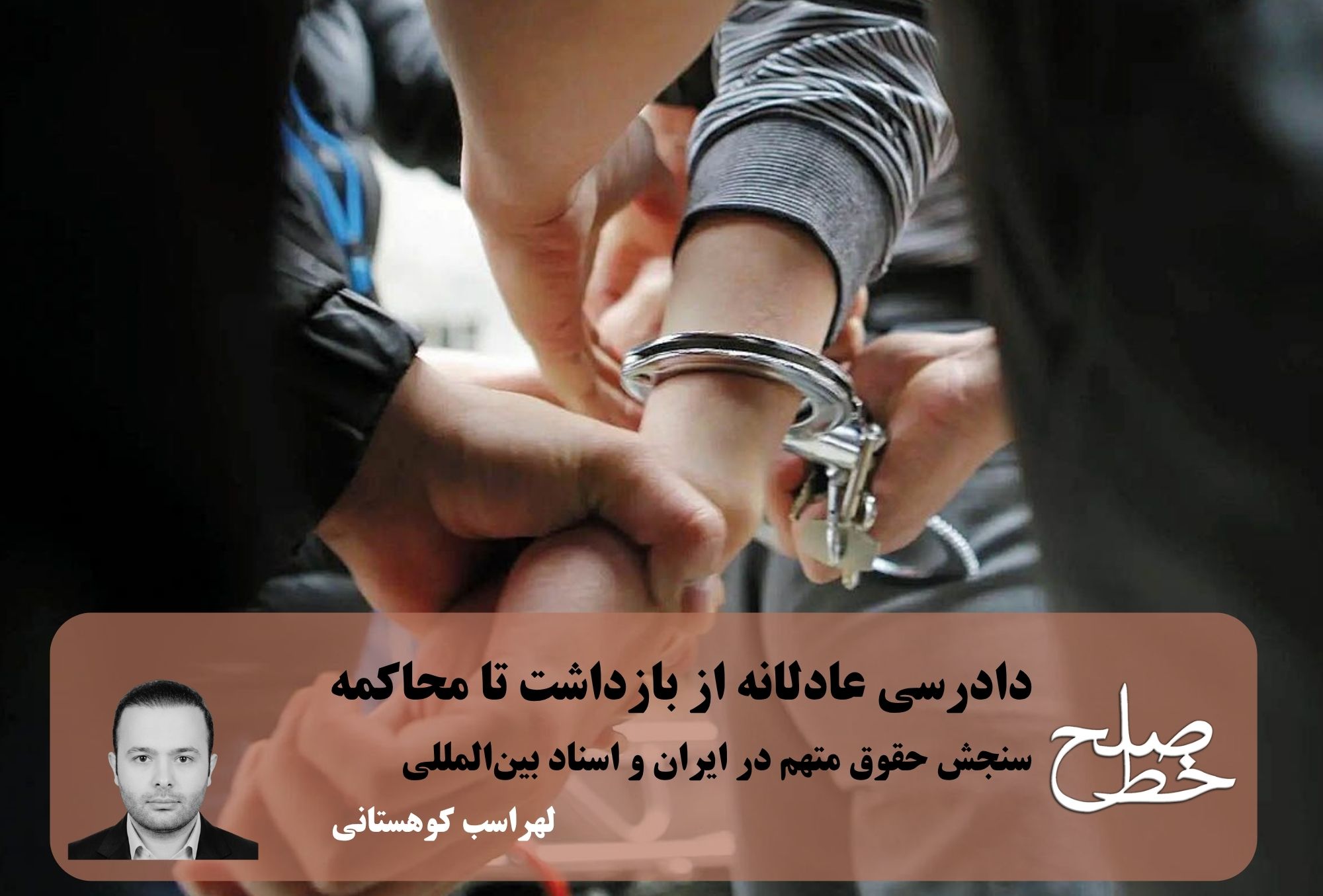
Fair trial from arrest to trial/ Lohrasb Kouhestani
The interval between the moment of arrest and the day of trial is the most sensitive, critical, and at the same time the most vulnerable part of the criminal justice process. It is during this period that the individual is directly confronted with the powerful and organized machine of state prosecution; while his guilt has not yet been established, one of his most important fundamental rights, namely freedom, has been taken away. At this stage, the accused is forced to test his ability to defend himself in completely unequal conditions and in an isolated environment. The literature of international human rights law and the philosophy of modern criminal law are based on the assumption that without restraining guarantees, public power will quickly tend towards monopolization, using detention as an instrument of repression, and transforming interrogation into a means of extracting forced confessions. Therefore, a fair trial is not considered a privilege granted by the government, but rather a structural antidote to adjust this inherent inequality.
This article, with an analytical and critical perspective, first explains the strict international frameworks based on the International Covenant on Civil and Political Rights and its supplementary charters, and then dissects the degree of alignment, structural conflicts, and legislative and procedural gaps of the Iranian criminal system with these global standards.
Geometry of the rights of the accused in international doctrine and fundamental human documents
International human rights law, with a precise understanding of the dangers of physical captivity, has outlined a system of mandatory and binding rules, the central core of which is manifested in the International Covenant on Civil and Political Rights (ICCPR). The Iranian government acceded to this covenant in 1975 without any reservations, and according to Article 9 of the Civil Code, its provisions are domestic law and have legally binding effect.
In this supervisory geometry, Articles 9 and 14 of the Covenant establish the fundamental pillars of the right to liberty and a fair trial. Article 9, by declaring the absolute prohibition of arbitrary detention, gives primacy to human freedom and recognizes pre-trial detention as a very limited exception, interpretable only on the basis of strict legal necessities (such as the risk of flight or the destruction of evidence of a crime). This article explicitly stipulates that any person arrested must be brought immediately and without delay before a judge or competent judicial authority in order to monitor the legality of the deprivation of his liberty; a principle known as the writ of habeas corpus in legal systems and its purpose is to remove the accused from the absolute hands of supervisory and security officers and entrust his fate to an impartial judicial authority.
The logical extension of this umbrella of protection is reflected in Article 14 of the Covenant, where the fundamental principle of innocence is raised as a pillar of the tent of a fair trial.
Under this assumption, the burden of proof lies entirely with the prosecutor and the prosecuting authority, and the accused has no obligation to prove his innocence. The guarantees enumerated in this article, including the right to be informed promptly and in detail of the nature of the charge in a language that the accused can understand, to have adequate time and facilities for the preparation of his defense, and the absolute right to communicate freely and confidentially with counsel of his choosing, are all tools for operationalizing the principle of innocence.
From the perspective of this article, the silence of the accused is a right and should not be interpreted as evidence of guilt. Section 8 of this article explicitly prohibits the coercion of the accused to testify against himself or to confess guilt. This absolute prohibition is a fundamental evidentiary rule, according to which any confession obtained through pressure, intimidation, torture or even seduction is inadmissible and devoid of any probative value in court.
To translate these general principles into operational and enforcement norms in detention settings, the United Nations General Assembly adopted in 1988 the Body of Principles for the Protection of All Persons under Any Form of Detention or Imprisonment.
This complementary document injects precise details into the veins of the criminal process. Based on the inseparability of human dignity from the body of the accused, these principles absolutely prohibit detention in unofficial, secret places or under the supervision of parallel institutions, and require official and precise recording of the time of entry, place of detention, and the identity of the officers and authorities giving the orders.
From the perspective of this document, isolating the accused and cutting off his contact with the outside world is a clear example of inhuman and degrading treatment. Therefore, immediate notification to the family or a trusted person about the whereabouts and health status of the accused, along with the right of access to an independent doctor and lawyer, are established as inalienable rights.
Complementing this framework is the United Nations Basic Principles on the Role of Lawyers (1990), which emphasize the structural independence of bar associations and the professional immunity of defense counsel, as a lawyer cannot provide an effective and independent defense of his or her client under the shadow of intimidation, threats, or secondary prosecution for the performance of his or her professional duties.
Iran’s Legislative Structure and the Dichotomy Between Fundamentalism and Exceptionalism
When we step from the realm of international documents to the realm of the Iranian legislative system, we are faced with a perspective that, at first glance and at the level of fundamental norms, has remarkable similarities with global standards. The Constitution of the Islamic Republic of Iran, in Chapter Three (Rights of the Nation), takes a principled approach to this issue. Article 32 prohibits arrest without a legal warrant and stipulates that in the event of arrest, the subject of the charge must be explained to the accused immediately and in writing, stating the reasons, and the preliminary file must be sent to the competent judicial authorities within 24 hours at the latest, so that the preparations for the trial can be made as soon as possible.
Article 35 absolutely guarantees the right to choose a lawyer in all courts for the parties to the dispute, and Article 38, with admirable clarity, prohibits any torture to extract a confession and considers the confessions obtained from it to be without legal value and validity. This legislative will found a more concrete manifestation in the Criminal Procedure Code approved in 2013.
Adopting a rights-based approach and influenced by the fair trial doctrine, this law emphasized in Article 5 the necessity for the accused to be aware of his rights in the trial process and in Article 48, it took a major step and stipulated that the accused can request the presence of a lawyer upon the start of surveillance and the lawyer also has the right to meet with his client, with the addition of confidentiality, and to make his observations for inclusion in the written file. Also, Article 190 of this law accepted the right to have a lawyer during the preliminary investigation stage as an established principle and considered the denial of this right or the failure to explain it to the accused as a cause of invalidating the investigation.
However, this growing legislative trend faced a structural setback in 2015. The addition of a note to Article 48 of the Criminal Procedure Code left Iran’s legal system deeply divided. According to this note, in crimes against internal or external security, as well as organized crimes, defendants were required to choose their own lawyer during the preliminary investigation phase from among the official lawyers of the judiciary who were approved by the head of the judiciary. This provision severely undermined the applicability and generality of Article 35 of the Constitution and the express provisions of Article 14 of the International Covenant on Civil and Political Rights. The existential philosophy of the defense lawyer is to create a balance against the power of the prosecutor; when the criterion for choosing a lawyer is the approval of one of the parties to the legal process (the head of the judiciary as the highest authority in the prosecution and judicial system), the structural independence of the defense collapses.
This provision effectively divided lawyers into two classes: insiders and trusted ones, and outsiders or those without qualifications, and placed security and political defendants – who, due to the nature of their charges, need independent, courageous, and impartial lawyers more than anyone else – within a fence of restrictions.
Repeated efforts by bar associations, law professors, and even reform bills in the Islamic Consultative Assembly to remove or amend this note have not yielded any tangible results for years due to structural resistance within the security and judicial bodies, and this legal exception has practically become a rule governing sensitive cases.
Dissecting the structural gap between legal text and practical practice
The fundamental challenge to fair trial in Iran is not limited to legislative limitations such as the provision in Article 48, but rather lies in the deep and tangible gap between legal texts and practical procedures. The content of reports and briefings by human rights lawyers in Iran implies the claim that at the procedural implementation level, supervisory authorities and judicial officers, especially special security officers, have created special interpretative and operational mechanisms that effectively suspend legal guarantees. One of these mechanisms is the prolongation of supervised detention and its systematic transformation into long-term temporary detention in solitary confinement in special detention centers.
In these isolated environments, interrogators repeatedly extend detention orders under vague pretexts such as completing investigations or risking destruction of evidence, keeping the accused in a state of complete disconnection from the outside world for weeks and sometimes months.
During this period, not only is the possibility of meeting with the family denied, but access to a lawyer, even lawyers subject to the note of Article 48, is completely denied under the pretext of the confidentiality of the investigation or the lack of authorization from the investigator.
This cycle of communication breakdown directly alters the functioning of the process of proving a crime. In the absence of a lawyer and in a situation where the accused is under severe psychological pressure from solitary confinement, ignorance of his or her and family’s fate, and exhausting interrogations, the principle of innocence is sacrificed. In such a structural context, obtaining confessions and statements becomes the ultimate and main goal of preliminary investigations. The operational judicial system, contrary to the explicit prohibition of Article 38 of the Constitution and Article 9 of the Law on Respect for Legitimate Freedoms and Protection of Citizen Rights, shows a strong tendency to give authenticity to confessions.
Since the burden of proving torture or psychological pressure in solitary confinement is placed on the accused, and investigators often rely on the written form of the confession regardless of the context in which it was produced, these confessions during detention become the cornerstone of the prosecution’s indictment and, ultimately, the main document for convictions in revolutionary or criminal courts.
This practice goes further and, in certain cases, leads to the media exploitation of these confessions before a final verdict is issued, which is a gross violation of Article 14, paragraph 2, of the Covenant, which states that the accused’s reputation must be preserved until the crime is legally proven.
Another part of this procedural gap is aimed at structurally weakening the defense institution itself and pressuring lawyers who define their mission beyond formalities. In recent years, a specific pattern of behavior has emerged in which independent defense lawyers find themselves facing charges such as propaganda against the system, spreading lies or conspiracy against the security of the country, for interviewing their clients, informing them about violations of the law in the proceedings, or insisting on the implementation of specific provisions of the Criminal Procedure Code. This has created a phenomenon that can be called the criminalization of defense.
When a lawyer knows that insisting on the right to access the file or objecting to the interrogation procedure of the officers may cost him his personal freedom and the revocation of his license to practice law, the professional courage that is the cornerstone of the right to defense is structurally eroded. As a result, in many sensitive cases, the process of lawyer presence is reduced to a featureless and formal administrative procedure, where the lawyer is only allowed to read a written bill in the last hearings of the trial, without ever having the opportunity or possibility to truly challenge the prosecutor’s material evidence or cross-examine witnesses and investigators.
delayed
A comparative analysis between international fair trial standards and the Iranian legal system shows that the main challenge is not due to the lack of progressive legal texts. The Iranian legislative system, especially in the Constitution and the Criminal Procedure Code of 1392, has the necessary theoretical frameworks to comply with the standards of the International Covenant on Civil and Political Rights. The main and crisis-causing rupture occurs at two levels: the first level is the expedient exceptions in the text of the law (such as the note to Article 48), which fragment the legal system and distort the general validity of the laws; and the second level is the dominance of the security thinking of the guards over the protective view of the judges at the preliminary investigation stage, where the lack of independent and efficient judicial oversight of detention centers suspends the protective laws.
For lawyers, researchers, and especially young legal trainees entering this difficult arena, a precise and realistic understanding of these two layers, the fundamental distinction between the revised text of the law and the raw reality of the practical practice of the courts, is a prerequisite and fundamental condition for any effective defense.
Defending the right to a fair trial requires lawyers who are not only armed with legal materials, but also with an understanding of procedural structure, moral courage, and legal indestructibility, who strive to return practical procedure to the safe haven of law; because justice in a criminal system will be measured by the degree of respect given to the rights of the accused in the darkest and most hidden corners of detention centers.
 Created By: Lohrasb Kouhestani
 July 23, 2026
Tags
International Covenant on Civil and Political Rights Islamic Penal Law Mandela's Rules Mountain Lahrasb peace line Peace Line 183 Prisoners Prisoners' harassment Prisoners' rights Revolutionary Court Rights of the accused Trial