


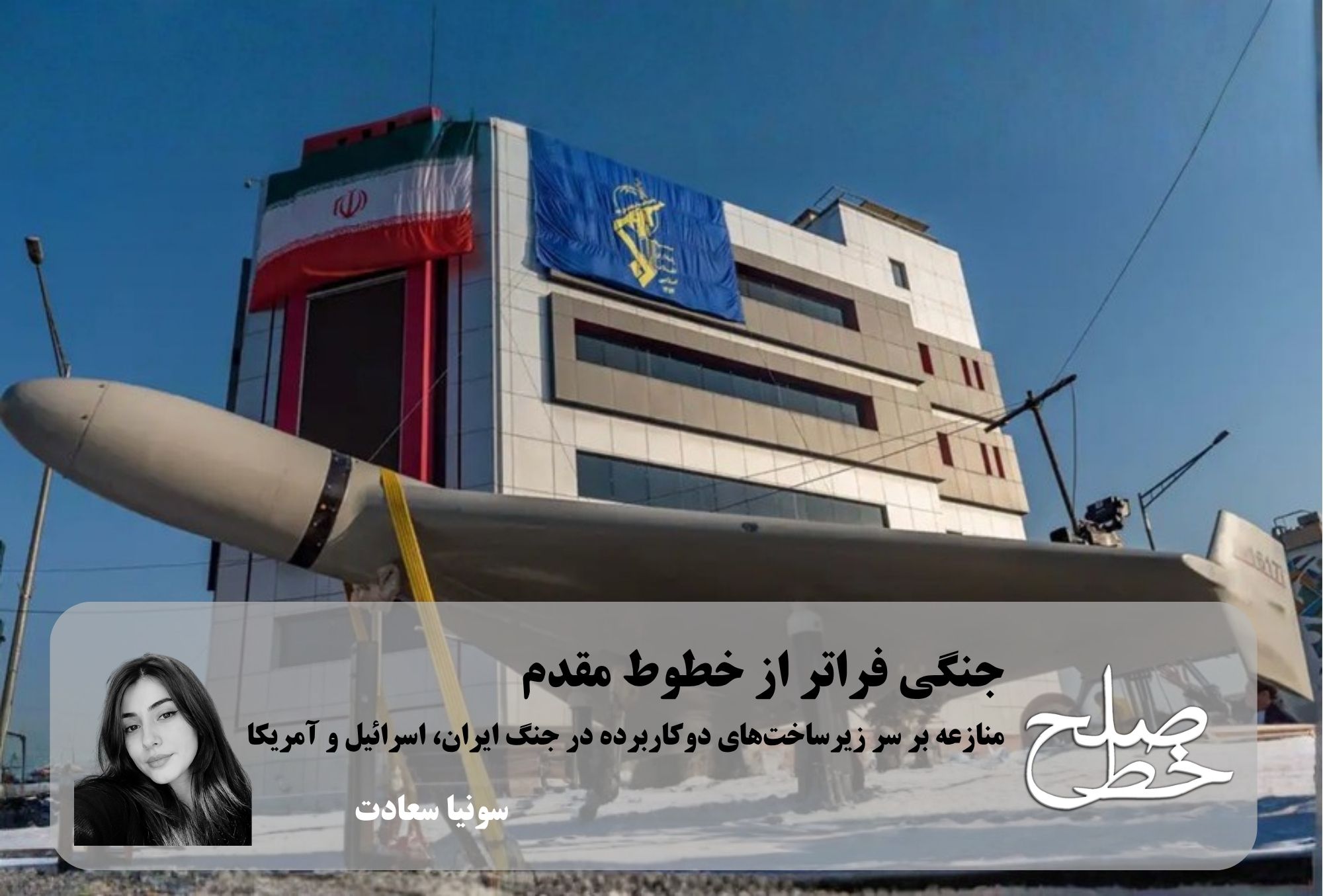
The Dispute over Dual-Use Infrastructure in the Iran, Israel, and U.S. War/ Sonia Saadat
The patterns of conflict and strategic transformations in the international system over recent decades have undergone a fundamental metamorphosis that challenges the traditional concept of war. Modern conflicts are no longer limited to direct and classical confrontation between armed forces on front lines. In the contemporary era, technological advancement and societies’ deep structural dependence on complex and interwoven networks—such as energy production and distribution systems, drinking water treatment and supply facilities, telecommunications systems, and transportation and logistics corridors—have turned these vital arteries into a main focus of military planners.
In such an environment, disabling or disrupting a country’s large-scale infrastructure, even without the need for extensive firing or armies crossing geographical borders, can have an effect far more destructive, paralyzing, and lasting than direct military operations. Targeting these arteries, as a tool of strategic pressure, breaks the economic capacity, social cohesion, and psychological resilience of the target society and disables the rival’s war machine.
From 2020 to mid-2026, a multifaceted and complex confrontation unfolded between the Islamic Republic of Iran, Israel, and the United States. This period, which began with a series of cyber infiltration operations, later escalated into physical sabotage attributed to intelligence services and ultimately led to direct military confrontation. Throughout this period, water supply networks in rural and urban areas, power plants, gas transmission pipelines, communications systems, and logistical ports were at the center of offensive operations by the actors involved.
Legal Foundations and Dual-Use Infrastructure
One of the most complex and contentious issues in contemporary military doctrine and the law of armed conflict is how to deal with facilities known as “dual-use infrastructure.” Dual-use infrastructure refers to facilities that, due to their networked nature, simultaneously serve civilian goals and needs while also supporting military operations. For example, national electricity distribution networks, strategic transit roads, commercial ports, airports, and refinery complexes not only provide citizens’ basic needs for survival, but also simultaneously supply the energy needed for military radars, command systems, troop transport, and military logistics.
The raison d’être of international humanitarian law rests on principles whose ultimate aim is to limit wartime violence and reduce human suffering. In this regard, Article 48 of Additional Protocol I (1977) to the four Geneva Conventions (1949) established the “principle of distinction” as the cornerstone of the law of war. This principle obliges parties to a conflict, always and under all circumstances, to distinguish between the civilian population and combatants, as well as between civilian objects and military objectives. Following this principle, Article 52, paragraph 2, of Additional Protocol I states that civilian infrastructure loses its legal immunity and becomes a legitimate military objective only if it successfully passes a two-part test: first, the object in question must, by its nature, location, purpose, or use, make an effective contribution to military action. Second, its destruction, capture, or neutralization, in the circumstances ruling at the time of the attack, must offer the attacking force a definite and concrete military advantage.
In the absence of either of these two conditions, targeting that facility is explicitly considered unlawful, and according to customary legal guides, objects are always presumed to be civilian unless compelling evidence proves otherwise. Nevertheless, in practice, the interpretation of these conditions has always been a point of deep disagreement between attacking armies and monitoring bodies. Military commanders tend to view communications and energy networks as an integrated system that must be fully paralyzed in order to stop the adversary. By contrast, human rights organizations and the International Committee of the Red Cross (ICRC) argue that even if infrastructure becomes a legitimate target because of military use, this does not amount to an absolute license to destroy it.
Another fundamental concept raised in evaluating attacks on dual-use infrastructure is the “principle of proportionality.” The principle of proportionality, established in Article 51, paragraph 5, of the Additional Protocol and in customary international law, provides that if an attack on a legitimate military objective causes incidental damage, injury, or death to civilians and damage to civilian objects that would be excessive and disproportionate in relation to the concrete and direct military advantage anticipated, that attack is completely prohibited and unlawful.
Legal scholars also emphasize that the assessment of incidental damage in targeting vital infrastructure must not be limited to direct harm caused by the explosion; indirect harm must also be taken into account. Bombing a power plant may cause few direct casualties, but the power outage can quickly lead to the failure of life-support devices in hospitals, the shutdown of sewage disposal systems and drinking water treatment plants, and the spoilage of vaccines and medicines. In the architecture of modern societies, every infrastructure functions as a vital link in a complex chain, and damage to one part triggers a wave of secondary crises in other pillars of urban life. The attacking army is obliged to include these secondary effects in its proportionality assessment before issuing the order to attack. However, practical experiences have shown that many armies evade responsibility for assessing indirect harm.
Cyberwarfare and Physical Sabotage (2020 to 2024)
An analysis of the evolution of the Iran, Israel, and U.S. confrontation in the early years of this period shows a gradual but dangerous transition from cyberspace to physical sabotage. The first phase of this confrontation largely took place within the doctrine of covert warfare or gray-zone conflicts. Of course, the history of this confrontation goes back to 2010 and the exposure of the “Stuxnet” malware, recognized as the first cyberweapon capable of causing physical destruction in Iran’s nuclear facilities. However, 2020 can be regarded as a turning point in the expansion of these attacks from military and nuclear targets toward entirely civilian and service infrastructure.
In April 2020, vital water and wastewater supply networks in several rural and urban areas of Israel were targeted by an organized cyberattack linked to hacker groups attributed to Iran. By infiltrating operational technology and industrial control systems, the attackers attempted to disrupt chlorine distribution levels and the monitoring of drinking water quality. This attack could have affected water quality and endangered public health. Although officials of the Islamic Republic of Iran did not accept responsibility for the attack and some reports indicated that it was quickly repelled, the incident was regarded in academic and security circles as crossing an unwritten red line in cyber conflicts, because it directly targeted the health and survival of the civilian population. According to Rule 92 of the “Tallinn Manual 2.0,” the most comprehensive academic effort to adapt the law of war to cyberspace, a digital operation is considered equivalent to an attack under humanitarian law if it results in casualties or physical destruction. Manipulating the chemical composition of drinking water, because of its high potential to cause poisoning on a large scale, is assessed as a clear example of an unlawful attack; because, in the absence of clear evidence of military use, water facilities are in principle civilian objects and enjoy special protection, and targeting them violates the principle of distinction.
Shortly after this incident, in May 2020, the strategic Shahid Rajaee Port in Bandar Abbas was targeted by a retaliatory cyberattack attributed to Israel. This operation led to the widespread shutdown of computer systems, traffic management systems, and ship guidance systems. The consequence of this attack was extensive disruption in customs clearance processes and confusion among trucks and commercial ships for several consecutive days. Commercial ports are among the clearest examples of dual-use infrastructure. While these ports constitute the main artery for supplying basic goods, medicine, and food to a country’s civilian population, they also serve as routes for transferring military equipment. This incident proved that the parties to the conflict were seeking, through cyberspace, to impose paralyzing strategic and economic costs on each other without accepting responsibility and without entering the phase of military conflict.
As diplomatic and geopolitical deadlocks continued, the scope of these covert operations escalated from software disruption to physical, time-consuming, and costly sabotage. One of the peaks of this metamorphosis was the coordinated explosions in Iran’s main gas transmission pipelines in mid-February 2024 (25 Bahman 1402). These explosions targeted pipelines that transported gas produced from the South Pars field to different parts of Iran. Iranian officials identified Israel as the actor behind this sabotage.
Supporters of these attacks argue that integrated energy networks supply the fuel required for the war machine and military-industrial complexes and, in this way, become legitimate military objectives. By contrast, observers of international law warn that this highly expanded reading of the concept of military advantage risks justifying the bombing of any vital infrastructure in society. Cutting off gas in winter directly targets the heating of citizens’ homes and the operation of hospitals, which stands in clear contradiction to the fundamental principle of proportionality and the spirit of the Additional Protocols to the Geneva Conventions.
The Twelve-Day War (2025)
The escalating trend of destruction and reciprocal attacks ultimately led to direct military confrontation between Iran and Israel. This confrontation, which became known as the “Twelve-Day War,” lasted from June 13 to 24, 2025 (23 Khordad to 3 Tir 1404). What makes the Twelve-Day War important within the framework of this discussion is the breadth of targets and the expansion of the radius of attacks from purely military centers—such as the Fordow nuclear site—to dual-use infrastructure. During these clashes, the buildings of the Islamic Republic of Iran Broadcasting organization and national media networks were bombed. The attackers’ justification was that state media had acquired a military function because of broadcasting war propaganda and guiding public opinion. However, the legal legitimacy of attacks on media remains a contentious issue in international humanitarian law. According to the prevailing interpretation of legal scholars and the view of the International Committee of the Red Cross, mere propaganda activity, publishing news, or media support for one party to a conflict does not by itself turn a media outlet into a legitimate military objective. By contrast, some states and military doctrines argue that when a media center directly participates in command-and-control systems, the transmission of operational information, or the coordination of military activities, it may qualify as a military objective.
On the other hand, vital urban infrastructure was not spared from the shrapnel of this war. According to published reports, a missile strike on Qods Square in Tajrish, Tehran, led to the destruction of the main water pipeline supplying the area. The flow of a massive volume of water through the crowded streets of the capital not only paralyzed urban services, but also created the risk of a secondary disaster, with the possibility of flooding entering Tajrish Metro Station. This incident clearly showed how targeting in densely populated urban areas conflicts with the principle of precaution and the minimization of collateral harm.
The Expansion of Conflicts in 2026
The fragile ceasefire after the Twelve-Day War did not last. With the complete blockage of diplomatic channels, the conflicts escalated into a full-scale war on February 28, 2026 (9 Esfand 1404). At this stage, the U.S.-led military coalition implemented a specific military doctrine based on a strategic assumption: by destroying vital energy, water, and transportation networks, social resilience would collapse, the will to continue the war would break, and the opponent’s military machine would stop on its own.
On March 7 and 8, 2026 (16 and 17 Esfand 1404), the Israeli Air Force, with diplomatic and intelligence support from the United States, carried out a heavy wave of airstrikes against four major refinery hubs and strategic fuel storage depots near the metropolises of Tehran and Karaj. Among the bombed targets were the Aqdasiyeh oil depot in the northeast of the capital and the Shahran oil facilities in northern Tehran. According to credible reports, during the massive fire at the oil depot in the Fardis area of Karaj, several civilians were killed and dozens injured, and the flames completely destroyed a dialysis center for kidney patients adjacent to the depot. This incident was clear evidence of absolute disregard for the rule of minimizing collateral harm and of overlooking the secondary effects of bombing in densely populated residential areas.
In addition to human and economic damage, the attacks on oil facilities and fuel depots around Tehran and Karaj in March 2026 had extensive environmental consequences. Large fires in oil tanks released enormous volumes of smoke, soot, particulate matter, and sulfur compounds into the air.
In the days after the attacks, as rain systems entered the region, residents of Tehran and Karaj reported the fall of dark-colored droplets and widespread soot deposits on buildings, cars, vegetation, and urban roads. Environmental experts attributed this phenomenon to the combination of rain with particulate matter, soot, and pollutants from the burning of petroleum products, referring to it as black rain. Eyewitnesses described that in the middle of the day, the city sky became completely dark and acidic black rainfall coated all urban surfaces, vegetation, and streets. This toxic rain quickly infiltrated surface water sources, groundwater aquifers, and agricultural lands around Tehran. Field reports indicated that many citizens in areas exposed to smoke and pollution experienced symptoms such as shortness of breath, coughing, eye irritation, and skin irritation. Concerns were also raised about the long-term effects of pollution caused by burning oil and petrochemical products on public health, water resources, and the environment.
Articles 35, paragraph 3, and 55 of Additional Protocol I to the Geneva Conventions prohibit the use of methods and means of warfare expected to cause widespread, long-term, and severe damage to the natural environment. The occurrence of black rain in Tehran was a possible example of the secondary effects of bombing energy facilities, endangering the public health, water security, and food chain of millions of civilian citizens for many years.
As this attritional process continued, tensions spread to the strategic waterways of the south. According to Iranian state media reports, in the early hours of June 6, 2026 (16 Khordad 1405), the United States military carried out an operation against positions in Sirik County and Qeshm Island in Hormozgan Province. The United States claimed that the purpose of these attacks was to destroy radar facilities and coastal surveillance systems that threatened international security by targeting ships passing through the Strait of Hormuz.
Reports by Iranian state news sources showed that during these airstrikes, two main drinking water storage tanks in the Sirik and Bandar Kuhestak areas were destroyed. The destruction of water tanks in the hot and arid regions of southern Iran, which have always struggled with severe water stress, carries irreparable human consequences and is unjustifiable from the perspective of the law of war. Article 54 of Additional Protocol I to the Geneva Conventions establishes a fundamental principle under the title “protection of objects indispensable to the survival of the civilian population.” This article explicitly prohibits, in principle, attacking, destroying, removing, or rendering useless facilities such as drinking water supply networks, water resources, and irrigation works.
Although international humanitarian law was formed with the aim of protecting civilians and limiting the effects of war, the experience of recent conflicts shows that existing rules face serious challenges in dealing with modern wars and dual-use infrastructure. Broad interpretations of the concept of “military advantage” and disregard for the indirect harms of attacks have placed vital infrastructure, and consequently the lives of millions of civilians, at risk.
As long as clearer criteria and more effective enforcement guarantees for the protection of vital infrastructure are not developed, these challenges will continue. Preserving minimum humanitarian standards in contemporary conflicts requires more serious attention to the principles of distinction, proportionality, and precaution, as well as more effective protection for facilities on which the survival and welfare of societies depend.
 Created By: Sonia Saadat
 June 22, 2026
Tags
Dual infrastructure Dual-use infrastructure Infrastructure Iran-US war Launcher peace line Rocket Rocket fuel The war between Iran and Israel. Ukraine War War