


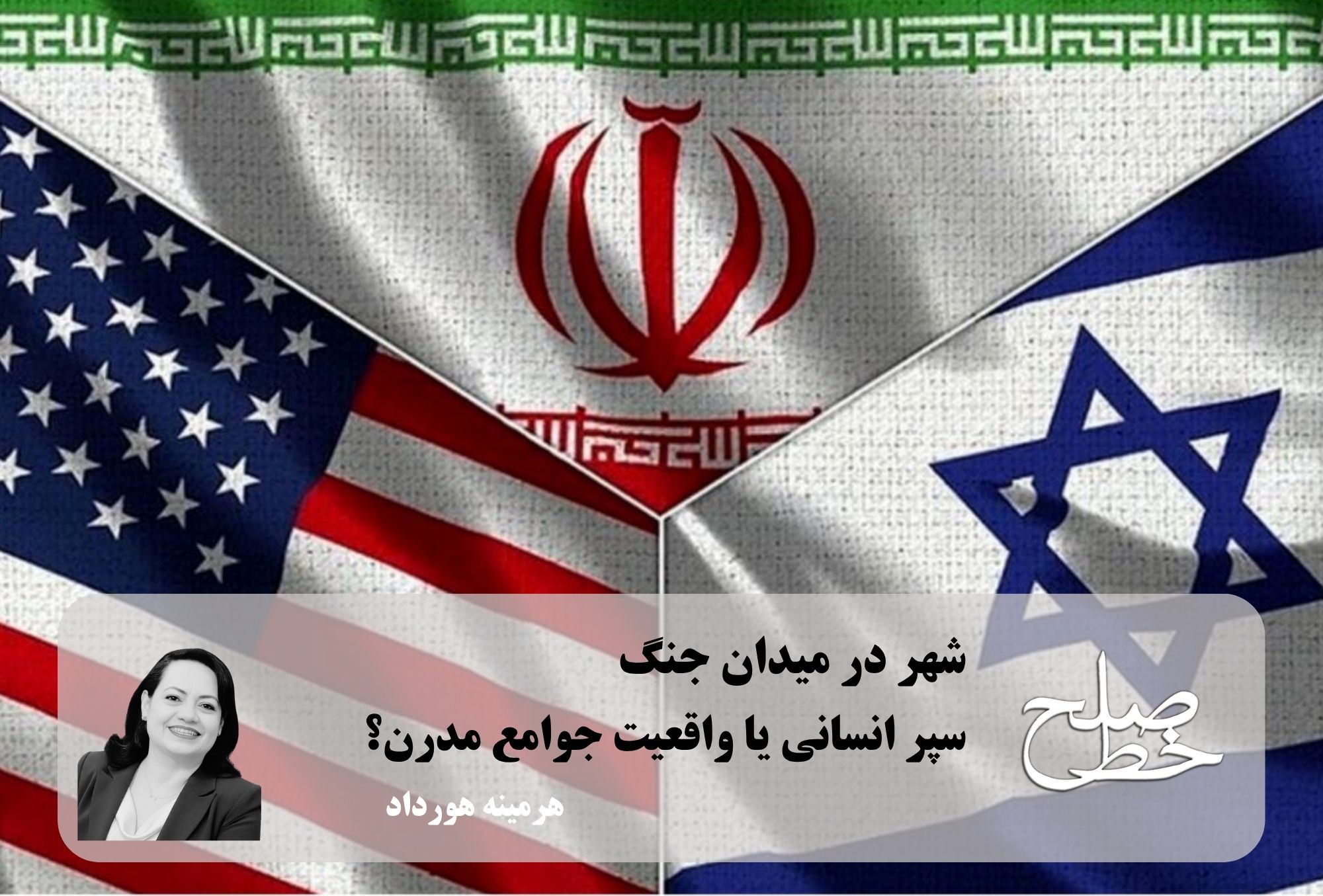
The City on the Battlefield: Human Shield or the Reality of Modern Societies?/ Hermineh Hourdad
In recent years, alongside the expansion of military conflicts in the Middle East, this question has repeatedly been raised: does the Islamic Republic of Iran deliberately use people as “human shields,” or is what we are witnessing the product of the complex structure of modern societies and the concentration of infrastructure in cities? This question leads us to a broader issue: why have contemporary wars moved further away from classical fronts than in the past and drawn closer to cities and population centers? Why are vital infrastructures—from refineries and power plants to transportation networks, ports, and service centers—located adjacent to residential areas and, during war, become part of the battlefield? Should this proximity be regarded as a sign of the conscious use of civilians as human shields, or is it the inevitable result of the concentration of power, economy, governance, and public services in modern cities? In a world where the boundary between military targets, economic infrastructure, and citizens’ daily lives grows more blurred every day, answering these questions requires stepping away from propaganda narratives and turning to the historical, legal, and political realities of war. This article seeks, with such an approach, to examine the relationship between war, the city, infrastructure, and the concept of human shields in the context of Iran’s experience and the transformations of contemporary wars.
Here, it is necessary to emphasize that war is condemnable. Not merely because it takes human lives, but because, at its deepest layers, it targets the very foundations of human life. War does not only destroy buildings; it destroys trust. It does not only destroy infrastructure; it destroys the future. It does not only take victims; it shapes generations with the memory of violence, fear, and insecurity. Rebuilding a society after war sometimes takes decades, and many survivors live with war trauma and lasting psychological harm; injuries that, in some cases, never fully heal. In fact, no society remains the same society after war as it was before war.
For this reason, the author of this article regards war neither as a solution to political crises nor as a desirable tool for resolving disputes between states. The experience of the twentieth and twenty-first centuries has shown that war, even when it begins with the promise of security, freedom, justice, or peace, often leads to outcomes far more complex, costly, and destructive than its initiators imagined. But opposition to war should not mean closing one’s eyes to its reality. If we are to take an ethical stance against war, we must first understand it. If we are not to become victims of propaganda, we must understand the real mechanisms of war. If we are to distinguish between reality and narrative and not become playthings in the war of narratives and propaganda, we must think more deeply than slogans, momentary images, reels, and aphorisms. Before entering the main discussion, the author’s position must be clearly stated to prevent any misunderstanding.
This article is neither an attempt to normalize the behavior of the Islamic Republic nor an effort to justify the policies of Israel or the United States. Describing a political or military reality does not mean morally or politically endorsing it. The author is well aware that, for more than four decades, the Islamic Republic has been one of the most important actors opposing the existing order in the Middle East. From the first years after the revolution, the idea of exporting the revolution became part of the political identity of the system; an identity that, in the following decades, continued in the form of regional networks, support for proxy groups, cross-border interventions, a continuous discourse of confrontation with the West and Israel, and attempts to redefine the balance of power in the Middle East. It also cannot be ignored that parts of the Islamic Republic’s official discourse have, for many years, been shaped around ideological hostility toward Israel; from official slogans to the symbolic display of a countdown to the end of Israel’s existence, or the use of language of destruction and elimination in parts of political and military propaganda. Such approaches have undoubtedly played a role in shaping an atmosphere of confrontation, intensifying distrust, and increasing the likelihood of conflict in the region. But accepting this reality does not mean ignoring the responsibility of other actors in the arena of these wars.
Israel, too, has repeatedly used military force in recent decades as one of the main tools of its regional policy. The United States has also, at various points, played a role in shaping the current situation of the region through wars, military interventions, broad sanctions, and maximum-pressure policies. None of these actors can be placed solely in the position of victim or solely in the position of crisis-maker. The reality is that all three main actors in these conflicts—in Tel Aviv, Tehran, and Washington—although with different goals and narratives, seek to preserve, expand, or reproduce their own power. The logic of survival, security, and deterrence plays a decisive role in all three cases; even when the costs of these competitions fall on societies, cities, and ordinary citizens. For this reason, this article does not seek to stand beside any party to this conflict. Its aim is not to defend the Islamic Republic, nor to defend Israel, nor to defend the policies of the United States. The aim of this article is only to understand the mechanisms that make war possible; mechanisms in which states compete for survival, but the consequences of this competition are often imposed on the lives of people who had no role in shaping it.
Having clarified this starting point and this perspective, we can now return to the article’s main question: why have contemporary wars moved from fronts to cities, and why are vital infrastructures located alongside residential areas? Why, more than ever before, has society become the main arena of power struggles? Is urban planning really designed this way to create human shields in times of danger and war?
This question becomes stronger in public minds when Ali Khamenei has lived throughout all the years of his leadership in the middle of Tehran, in the city’s busiest urban area.
A closer look at the two recent wars in Iran shows that, instead of taking place in military and war zones, as stipulated in international laws of war, these wars were drawn directly into cities, the capital, and the places where civilians live. From a missile striking Tajrish Square to a missile striking a school in Minab County at a time when students were present at school—an attack that caused the deaths of students, teachers, school staff, and many other civilians—all occurred in urban, residential, and civilian areas.
During the attacks on gas and petrochemical facilities, the Asaluyeh region and parts of the South Pars gas field were also targeted by airstrikes. According to published reports, these attacks damaged storage tanks, refinery facilities, transmission lines, and parts of energy infrastructure, and caused fires in the area that certainly involved casualties and injuries, although no official figures are yet available. Asaluyeh is a clear example of the reality that distinguishes modern wars from classical wars; a place where the boundary between military target, economic infrastructure, and the civic life of society gradually disappears.
The question that comes to mind amid the smoke and fire inside Iran and among stunned looks at the transmitted images is this: why are the dominant images of war no longer trenches in war zones and border areas and classical front lines? Why have schools, hospitals, refineries, ports, power plants, residential areas, and even commercial ships become part of the daily targets and news of war? And most importantly, why does it seem that civilians are more than ever at the center of the battlefield?
Have Wars Far from Cities Become a Myth?
One of the most common public perceptions of war is that past wars took place on defined fronts far from people’s lives, while today’s wars have been drawn into residential areas. We can see this in recent wars in the Middle East, even in Europe and in Russia’s war with Ukraine. However, when we examine wars more precisely and realistically, we realize that the idea that twentieth-century wars took place only on fronts and in war zones reflects only part of the truth. The reality is that cities have always been part of war. From the sieges of cities in ancient times to the destruction of European cities in the Second World War, from the bombing of London and Dresden to Hiroshima and Nagasaki, civilians have always been among the victims of war. What has changed is not the presence of cities in war, but the place of cities in war. In the past, cities were often targets of war; that is, they were ultimately conquered, or their owners could defend them. Today, cities themselves are the battlefield. This is a fundamental difference.
In classical wars, the main objective was to defeat the enemy army. Seizing territory, breaking defensive lines, and destroying the opponent’s combat capability formed the central axis of military operations. But in today’s world and today’s wars, power is no longer concentrated only at borders and in barracks. Power is stationed in cities.
The City: The Beating Heart of Power in the Modern World
To understand contemporary wars, we must understand the place of the city in the structure of modern power. The city is not only where people live. Since states are based in cities, the economy flows in cities; banks, decision-making centers, universities, media, communication networks, vital infrastructure, and key industries are located in cities. Cities are, in fact, places where power is concentrated.
In the past, the capture of a geographical area had strategic importance. Today, control of a large city can determine the fate of a country. That is why cities, and especially capitals, naturally become political and military targets. When a country’s command center, communication network, economy, energy, and administrative structure are concentrated in cities, war also inevitably draws closer to cities. As noted earlier, this trend is not limited to developing countries. From Ukraine to Gaza, from Syria to Sudan, from Mosul to Aleppo, twenty-first-century wars have shown that cities and capitals have become the most important arenas of power competition.
But Is the Presence of Military Facilities in Cities Unusual? Or Are They Human Shields?
The short answer is no. In nearly every country in the world, military buildings, command headquarters, intelligence centers, defense ministries, and security facilities can be found inside or around urban areas. This does not necessarily indicate malicious intent or the use of human shields. Many of these centers were built decades ago, at a time when they were still outside city limits. As cities expanded, these centers gradually became located within the urban fabric. But this very reality has created the grounds for one of the most controversial issues in modern wars: human shields. Something we Iranians read and heard a great deal about during the Hamas conflicts, the construction of underground tunnels and ammunition depots, and then after the events of October 7 and the war in Gaza.
Human Shield: Reality, Accusation, or Propaganda Tool?
In almost all contemporary wars, the warring parties have accused one another of using human shields. This is a serious accusation; because if it is proven that one side has deliberately placed civilians at risk to protect military objectives, we are facing one of the gravest violations of the laws of war. Although today, for warmongers and the powerful, this issue matters little, and despite the fact that an international arrest warrant has been issued against Netanyahu on charges of war crimes and crimes against humanity, while a separate case regarding the allegation of genocide against the State of Israel is simultaneously being heard at the International Court of Justice (ICJ), he remains in power and starts new wars.
But the question is that the distance between accusing someone of using human shields and proving it is very great, and proving such a claim—especially with regard to Iran, with its urban structure and diverse fabrics—cannot be based solely on the proximity of facilities to residential areas.
Perhaps the main question is not whether a government uses people as human shields or not. Perhaps the more important question is whether, in modern state systems, it is still even possible to draw a clear boundary between government, vital infrastructure, and the daily life of society.
Government and country are always intertwined and have shared interests, but in the Islamic Republic and governments like it, the interests of the people and the government are in many cases in conflict. Yet one must see to what extent the Islamic Republic government has the desire to exploit the issue of human shields. In various cases, there is evidence indicating that the Islamic Republic has used people as human shields in conflicts. However, in discussing the use of “human shields,” a distinction must also be made between a political accusation and a legal definition. To date, no international court has convicted the Islamic Republic of using the people of Iran as human shields. Nevertheless, critics of the government point to cases in which society has, in practice, been exposed to risks resulting from security and military decisions.
One of the most important examples was the downing of Ukraine International Airlines Flight 752 (PS752) in January 2020; when, after Iran’s missile attacks on U.S. positions, the country’s airspace remained open to civilian flights, and the Ukrainian passenger plane with 176 people on board was shot down by IRGC air defense. Some families of the victims and a number of jurists have regarded this event as an example of exposing civilians to the risks of a military situation, although from a legal perspective it does not necessarily fall within the classical definition of “human shield.”
In later years, government critics have also argued that using a wartime atmosphere to intensify domestic control, suppress opponents, and prioritize the considerations of regime survival over the security and welfare of citizens constitutes a form of political exploitation of society in times of crisis. From this perspective, the main issue is not merely the placement of a military target next to residential areas, but the transformation of the whole of society into part of the equation of survival and deterrence of a political system; a situation that, although not identical to the legal definition of human shields, raises important questions about the relationship between the security of the government and the security of citizens.
On the other hand, in political science there is a concept referred to as the “securitization of the state.” This phenomenon occurs when a government has faced internal and external threats for many years. Under such conditions, the survival of the government gradually becomes the most important priority. The boundary between the security of the government and the security of the country becomes blurred. The security of the political system is assumed to be the same as national security, and a threat against the power structure is defined as a threat against the existence of the country. In this situation, distinguishing between government and society becomes more difficult. Security structures expand. Political decisions are increasingly influenced by security considerations, and crisis becomes a permanent part of the mechanism of governance.
The Islamic Republic: A Case Study of a Security State
The Islamic Republic of Iran is one of the most important examples of such a situation in the contemporary world. This political system has, for more than four decades, faced a combination of external pressures and internal challenges: economic sanctions, tensions with the United States, confrontation with Israel, regional conflicts, social protests, economic divides, legitimacy crises, and accumulated political demands. Under such conditions, the survival of the political structure has become the government’s most important issue. But here a paradox emerges. The more external pressure increases, the more the necessity of survival increases for the government; and the more the necessity of survival increases, the more the security atmosphere expands.
As a result, external pressure does not necessarily lead to the weakening of the government. Sometimes it can help strengthen its survival mechanisms. This paradox is not limited to Iran. Saddam Hussein’s Iraq, Bashar al-Assad’s Syria, North Korea, Cuba, and numerous other examples have shown that external pressure can simultaneously weaken a government and strengthen its security logic.
An examination of available evidence shows that some of Iran’s missile infrastructure has been located near cities or populated areas; although because of the classified nature of these facilities, accurate official information about the location and distance of many of them from residential areas is not publicly available. For this reason, a large part of existing assessments is based on satellite images, specialized reports, and independent analyses.
Nevertheless, in examining this issue, one must distinguish between two completely different categories of infrastructure: first, military infrastructure, including bases, command centers, ammunition depots, and missile facilities; and second, urban and vital infrastructure directly connected to citizens’ daily lives, including roads, bridges, water and electricity networks, refineries, factories, ports, administrative centers, and organizational housing.
Unlike military facilities, which are located based on security, defensive, and strategic considerations, infrastructure related to society’s daily life must inevitably be located near population centers. A water supply network only makes sense when it provides services to citizens; power plants and electricity networks are built to supply energy to cities; roads and bridges are created to connect residential centers and economic activity; and factories, ports, and industrial zones usually develop in connection with labor, supply chains, and urban fabrics. For this reason, the proximity of these infrastructures to residential areas is not an exceptional choice, but an inherent feature of modern societies and an inevitable result of the economic and social organization of countries.
From this perspective, observing the proximity of some vital infrastructures to residential areas cannot necessarily, on its own, be considered evidence of a deliberate design to use civilians as “human shields.” In many cases, what is seen is the result of the growth of cities, the gradual expansion of urban fabrics, and the natural interweaving of service, industrial, and economic centers with citizens’ places of residence; a phenomenon observed not only in Iran but in most countries of the world.
Of course, this reality does not eliminate legitimate questions about the placement of some military facilities, the degree to which safety considerations are observed, and the responsibility of states to protect citizens. But for an accurate analysis of this issue, it is necessary to draw a clear distinction between infrastructures that, by their nature, must be present alongside people in order to serve society, and facilities that have purely military functions. Otherwise, there is a risk that public analyses will be influenced by political and propaganda narratives, and the real complexities of the spatial and infrastructural organization of modern societies will be ignored.
But How Does War Get Out of Control?
Modern war does not begin with destruction; it begins with the collapse of boundaries: the boundary between military target and economic infrastructure, the boundary between national security and daily life, and the boundary between government and society. When these boundaries disappear, war no longer remains limited to barracks and front lines. Refineries become targets, ports become targets, energy infrastructure becomes a target, transportation networks become targets, and even commercial ships become targets. Ultimately, society becomes part of the battlefield.
A refinery is not merely an industrial facility; it is part of a country’s economic life. In addition, many organizational housing units and residential areas are located beside these industrial and economic centers and infrastructures. For example, a port is not merely a logistical center; it is a route for the entry of food, medicine, and basic goods. A commercial ship is not merely a vessel; it is part of a network on which the livelihoods of millions of people depend. A school is not merely a building; it is the symbol of a society’s future. But in war, all these distinctions become fragile.
The Cost Society Pays
When a missile is fired toward a military target, it is never only the military target that is harmed.
Workers are present in refineries, children are present in schools, doctors are present in hospitals, crews are present on commercial ships, and families live in their homes.
The War of Narratives
But war today does not occur only on the battlefield; there is another front as well: the media, social networks, and public opinion. In the twentieth century, the media narrated war; in the twenty-first century, the media has become part of war. Each side tries to impose its own narrative on public opinion. Each side presents itself as the victim. Each side calls the other an aggressor, and each side tries to interpret images, statistics, and news to its own advantage. In such a space, citizens are often victims not of a lack of information, but of an abundance of information; abundant information, abundant images, abundant emotions, but very little real analysis. It is precisely at this point that propaganda gains power.
To avoid falling into the trap of propaganda, we have no tool except a critical perspective. The greatest danger during war is not only missiles and bullets, but the loss of the ability to ask questions. This questioning, which is necessary to avoid falling into the trap of propaganda, is first and foremost the posing of critical questions by each person in their own internal dialogue. Whenever a society stops asking questions, formulaic and manufactured narratives easily take the place of reality.
Twenty-first-century wars have become more urban than ever before. Not because international laws of war have changed, but because the world has changed, weapons of war have changed, and goals and conquests have taken on a different meaning. Today, power is concentrated in cities; cities that for centuries have been formed alongside or intertwined with infrastructure. The economy is concentrated in cities, and infrastructure is concentrated in cities, just as governing capacity is concentrated in cities. As a result, war too has come to cities.
Therefore, it cannot be said with certainty whether the Islamic Republic—which indeed has a history of abusing people’s lives as human shields—is completely cleared of this accusation. One cannot ignore the failure to close schools, factories, and oil facilities in the middle of war and absolve the government of the Islamic Republic. In this sense, the main question can be answered this way: all sides of this war, by targeting civilians, each in their own way exercised power in the arena of war, and here too, as always, it was the people and civilians in Iran, the land to which war had been brought, who bore the most irreparable and endless costs.
Yes, the people, children, and civilians were the ones who were instrumentally exploited by powers in this war, and each of those powers took its own benefit from killing and harming them.
 Created By: Hermineh Hourdad
 June 22, 2026
Tags
Dual infrastructure Dual-use infrastructure Human shield Iran-US war Launcher Military base peace line The war between Iran and Israel. The War of Narratives War