


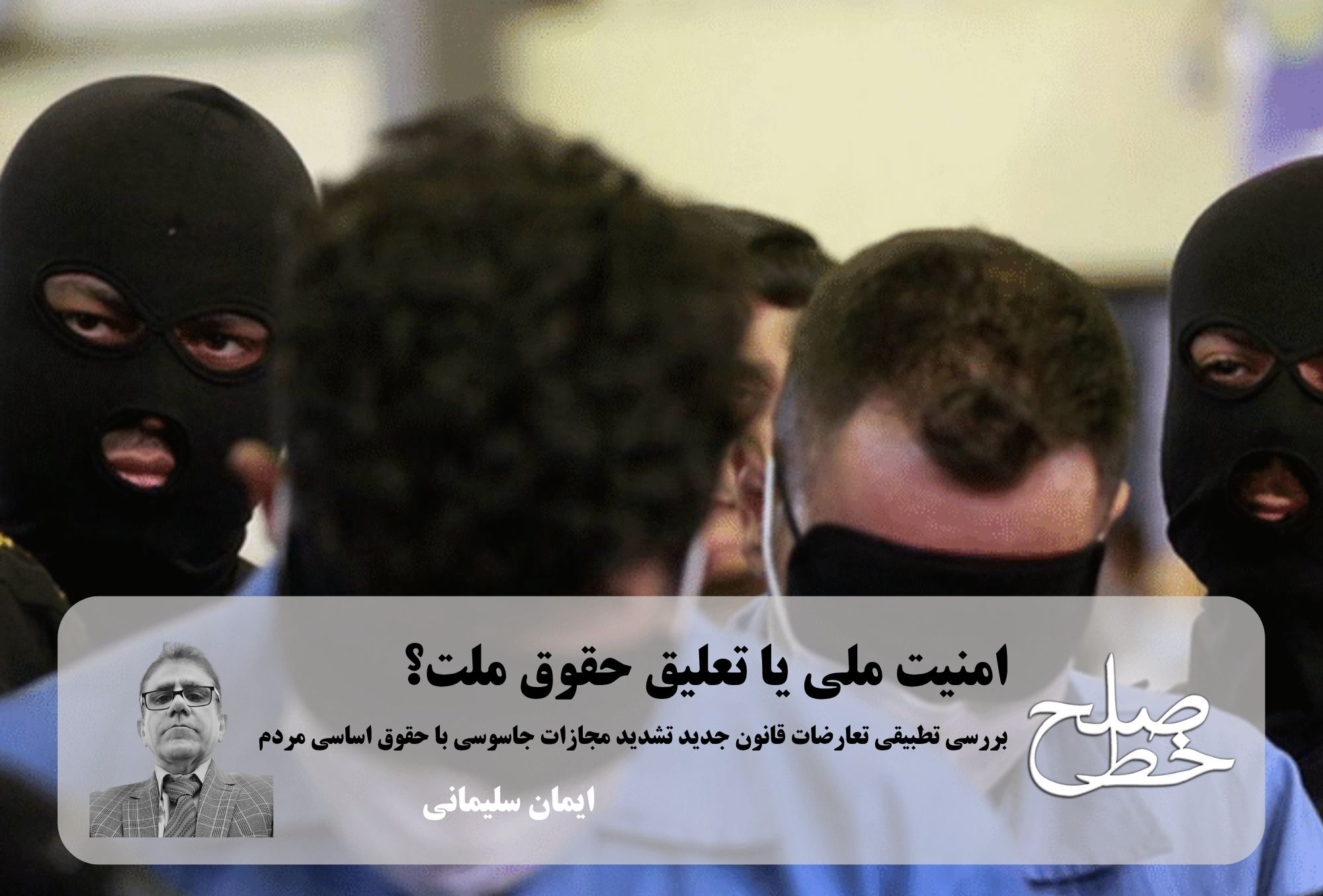
A Comparative Review of the Conflicts Between the New Law Intensifying Punishment for Espionage and the Fundamental Rights of the People/ Iman Soleimani
The law titled “Intensifying Punishment for Espionage and Cooperation with the Zionist Regime and Hostile Countries Against National Security and Interests” (approved by Parliament in Mehr 1404 and confirmed by the Guardian Council) is among the Islamic Republic’s recent security laws, prescribing heavy punishments such as execution and full confiscation of property for a wide range of actions.
Summary of the Most Important Articles of This Law
Article 1: Any operational action, intelligence activity, or espionage for Israel, the United States, or other hostile countries and groups (as determined by the Supreme National Security Council) carries the punishment of execution and confiscation of property under the title of corruption on earth.
Articles 2 and 3: Any direct or indirect assistance, as well as security, economic, or technological actions that lead to the strengthening of Israel, may face execution or heavy prison sentences.
Article 4: Political, cultural, media, or propaganda activities that cause “fear and terror,” the publication of false news, or sending content to hostile media outlets (as determined by the Ministry of Intelligence), may lead to grade 3 to 5 imprisonment and permanent dismissal from government service.
Article 5: The use or distribution of tools such as Starlink without authorization, especially if the intent to confront the system is established, may carry imprisonment or execution.
This law also provides for expedited proceedings in special branches of the Revolutionary Court, short deadlines for appeal (10 days), mandatory temporary detention in many cases, and restrictions on appeals.
It should be noted that this law has expanded the scope of security crimes to the fields of media, cyberspace, cultural activities, and even the use of technology.
Main Conflicts with the Constitution and Iranian Legal Principles
This law has serious conflicts with some principles of the Constitution of the Islamic Republic of Iran, especially the principles related to the rights of the nation, fair trial, and limitations on the powers of the ruling establishment. From a legal perspective, the rushed approval of such a law cannot be interpreted as being in line with ensuring the security and welfare of citizens; especially under circumstances in which the government, within the security atmosphere after the war, has granted broad powers to special judicial officers and special branches of the Revolutionary Court and has organized a significant part of the judicial process within an exceptional and security-based framework.
These conflicts can be summarized as follows:
The principle of legality of crimes and punishments (Article 169 of the Constitution and Article 2 of the Islamic Penal Code): Crimes must be defined explicitly, clearly, and without ambiguity. However, this law uses broad and interpretable terms such as “operational action,” “public fear and terror,” “against national security,” “legitimization,” and “hostile networks.” The ambiguity of these concepts conflicts with the principle of legality of crimes and punishments and creates grounds for broad interpretation by security and judicial institutions.
The principle of non-retroactivity of criminal laws (Article 169 of the Constitution): Article 9 of the law, in some cases, subjects conduct that began before the law’s approval to new punishments, including execution, and also sets a short deadline for reporting or self-disclosure. This conflicts with the principle of non-retroactivity of criminal laws and the rule of “the ugliness of punishment without prior declaration,” unless the new law is lighter than the previous law.
Rights to fair and public trial (Articles 34, 35, 37, and 168 of the Constitution): These cases are heard in special branches of the Revolutionary Court and without the presence of a jury, while according to Article 168 of the Constitution, political and press crimes must be tried publicly and in the presence of a jury. Also, the setting of very short deadlines, the possibility of completing investigations by the court, widespread temporary detention, and restrictions on appeals are among other points of criticism in this law.
Critics believe that concentrating cases in security institutions, special prosecutors’ offices, and the Revolutionary Court can, in practice, weaken the independence and impartiality of the judicial process. This set of conditions is considered to conflict with the right to defense, fair trial, and the principle of public hearings.
The principle of the personal nature of punishments and proportionality between crime and punishment (Article 39 of the Constitution and jurisprudential and legal foundations): Providing for the confiscation of all property, even property that has no direct connection to the crime, as well as setting very heavy punishments for assistance or indirect actions, conflicts with the principle of the personal nature of punishments and the principle of proportionality between crime and punishment. Broad confiscation of property can also be considered inconsistent with property rights set out in Articles 46 and 47 of the Constitution.
Freedom of expression, the press, and political and cultural activities (Articles 23, 24, 26, and 27 of the Constitution): Article 4 of the law exposes some media, cultural, and political activities to criminalization through ambiguous and interpretable terms. Critics believe this issue can conflict with freedom of expression, freedom of the press, and the right to hold gatherings and peaceful activities.
Citizenship and citizenship rights (Article 41 of the Constitution): Although the law does not directly provide for deprivation of citizenship, some related interpretations and statements, including discussion of deprivation of certain consular protections or services, may conflict with the constitutional principle protecting Iranian citizenship.
Article 4 of the Constitution (the requirement that laws conform to Islamic standards): The broad use of the title “corruption on earth” — whose punishment is execution — without precisely defining its religious and legal elements, including the realization of widespread corruption and conduct at the level of moharebeh, is a matter of doubt and dispute from the perspective of some jurisprudential and legal views.
This law, which was approved in the security atmosphere following the twelve-day war, has also faced criticism from the perspective of international law. Critics believe that some of its provisions conflict with Iran’s international obligations, including the International Covenant on Civil and Political Rights, in areas such as fair trial, freedom of expression, and the prohibition of disproportionate punishments. Critics believe that this law, rather than being solely aimed at confronting security threats, gives the ruling establishment broader tools for security intervention and control. In contrast, citizens’ legal guarantees, including the right to defense, clarity in criminalization, freedom of expression, and property rights, have become more limited, and the grounds for abuse of ambiguous legal concepts have increased.
Impact on International Human Rights
The impact of the new law intensifying punishment for espionage on the human rights situation, from the perspective of international law, has been widely assessed as negative and has been criticized by legal experts, human rights organizations, and United Nations special rapporteurs as a serious violation of Iran’s international obligations.
Iran is a party to the International Covenant on Civil and Political Rights (ICCPR), and this law, especially in relation to some articles of the Covenant, has significant conflicts:
Article 6 (right to life): Expanding the death penalty to a wide range of conduct, including some media, intelligence, or communication activities, is considered to conflict with international standards limiting the death penalty to the “most serious crimes.” Critics believe that many acts that may be subject to the death penalty under this law lack such a characterization.
Article 7 (prohibition of torture and inhuman punishments): Broad confiscation of property, heavy punishments, and compressed judicial processes have been criticized by some human rights institutions as examples of inhuman and disproportionate treatment.
Article 14 (right to fair trial): Proceedings in special branches of the Revolutionary Court, short deadlines for appeal, widespread temporary detention, restrictions on appeals, and the possibility of completing investigations by the court are among the issues critics consider inconsistent with judicial independence, the right to effective defense, the right to freely choose a lawyer, and the principle of public trial. Also, the absence of a jury in cases that take on a political or media nature has been criticized.
Article 19 (freedom of expression and access to information): The criminalization of some political, cultural, and media activities, as well as restrictions on communication tools and sending information outside the country, has been assessed from a human rights perspective as a limitation on freedom of expression and free access to information. The ambiguity of concepts such as “public fear and terror” or “against national security” also, according to critics, creates grounds for broad and arbitrary interpretations.
Some human rights institutions have also criticized this law from the perspective of freedom of assembly, property rights, and the prohibition of disproportionate punishments.
International Reactions
Special rapporteurs and experts of the United Nations Fact-Finding Mission, including Mai Sato, have expressed concern about increasing civil restrictions, intensified repression, and the expansion of the death penalty after the approval of this law. Some of these reports have described the new law as part of a broader trend of securitizing the political and social space in Iran.
Organizations such as Amnesty International have also considered this law a factor in weakening fair trial and increasing the risk of criminalizing peaceful activities, including documenting human rights violations.
Legal experts have also assessed the ambiguity of legal concepts, the expansion of the scope of criminalization to cyber and media fields, and the provision of severe and disproportionate punishments as inconsistent with fundamental principles of criminal law, including the principle of legality of crimes and punishments and the principle of proportionality.
Practical Consequences
Critics believe this law could pave the way for an increase in death sentences, especially in cases involving political activists, cyberspace users, citizen journalists, and protesters. Also, criminalizing the use of certain communication tools and the publication of content can further restrict free access to the internet, freedom of expression, and civil activities.
Some analyses have also pointed to the impact of this law on Iranians outside the country, including concerns about charges of cooperation or the possibility of property confiscation.
At a general level, this law is considered part of the broader trend of securitizing the political and social space after the developments of 1404; a trend that, according to critics, has increased pressure on civil activists, women, minorities, and human rights defenders.
In the international arena as well, the approval of this law could pave the way for more reports and resolutions in United Nations human rights bodies and increase human rights pressure against the Islamic Republic. Some human rights organizations have described this law as an example of the “formalization of repression.”
Overall, critics believe that this law turns national security into an absolute priority and, in this path, has restricted part of citizens’ fundamental rights and guarantees; an issue that could, in the long term, have broad legal and political consequences for the Islamic Republic at both domestic and international levels.
 Created By: Iman Soleimani
 May 22, 2026
Tags
Espionage Forty Days War Increasing the punishment for espionage Iran-US war National security Peace peace line Peace Line 181 Spy The war between Iran and Israel. Twelve-day war War