


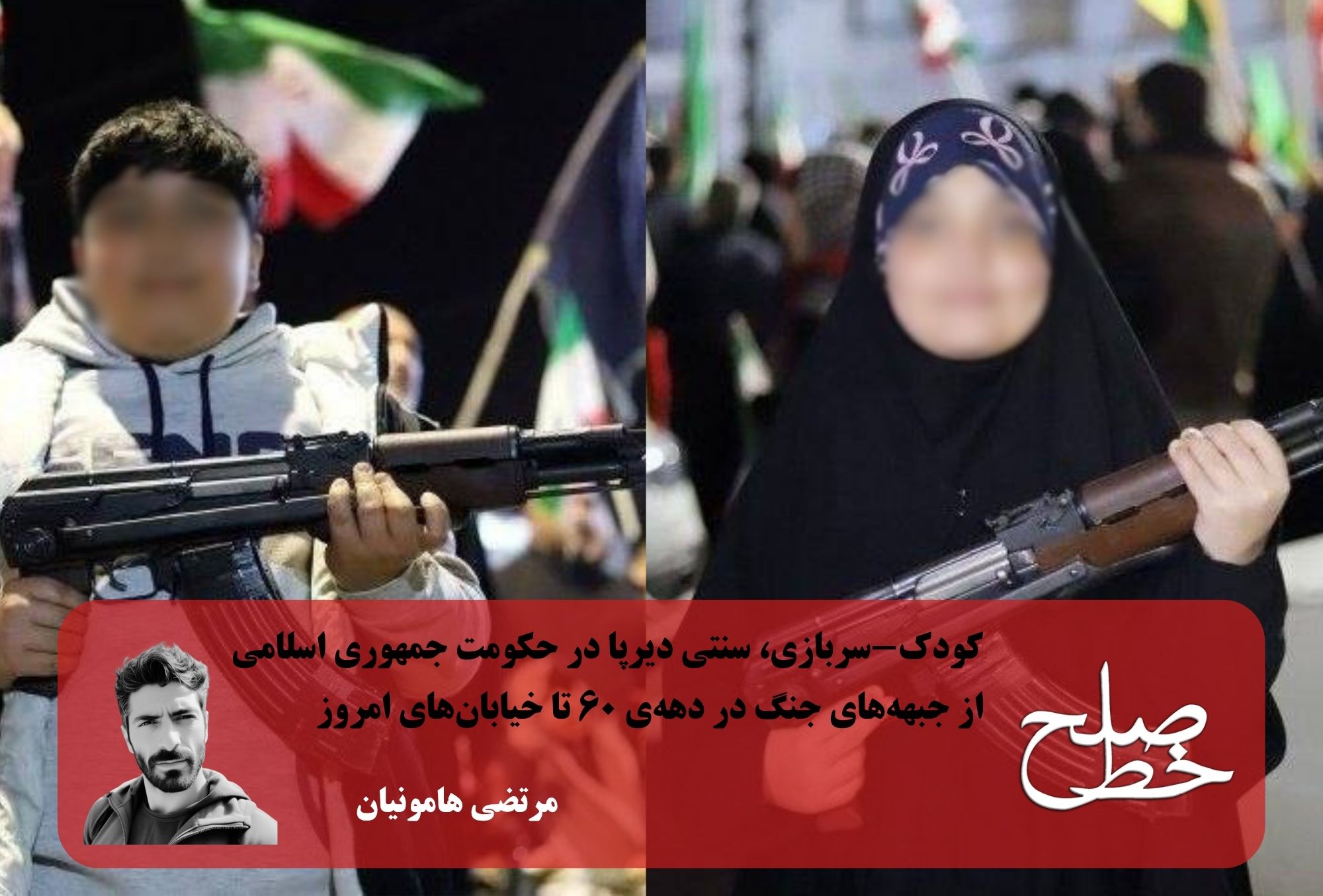
Child Soldiering, a Long-Standing Tradition in the Islamic Republic / Morteza Hamounian
Children are among the first victims of war; whether they are present in war themselves or killed as a result of an act of war; whether they are armed and fire in one direction, or are not present in war and are killed or wounded in its turmoil. Even merely witnessing the catastrophe of war is enough for children to carry what they have seen throughout their lives and to experience its effects on their minds and bodies. There was a time, not so long ago, when wars recognized no age. Anyone capable of carrying a weapon, drawing a sword, or holding a bow and arrow had to be present in battle to defend their tribe, clan, city, and homeland against foreign aggression. This process continued into the era of wars fought with firearms, and it took a long time, until years after World War II, for that pattern to change. At first, in the Geneva Conventions of 1949, it was stipulated that children and other civilians should be protected in war. About three decades later, in 1977, in the Additional Protocol to the Geneva Conventions, it was recommended that persons under the age of 15 should not be involved in war. Finally, in 1989, in the Convention on the Rights of the Child, countries were required not to use children under the age of 15 in war; an age threshold that was raised to 18 in 2000, in the Optional Protocol on the involvement of children in armed conflict. It was decided that in the civilized world, citizens under the age of 18, that is, children, should not enter military conflicts and confrontations. It was decided that children should not be warriors on the battlefield.
But in reality, these children are generally drawn into wars in two ways. One is through an overt violation and infringement of these children’s rights by governments, and the other is through compulsion arising from circumstances; a situation which, despite its occurrence, is by no means acceptable or justifiable.
Iran, in the period after World War II and until the beginning of the Iran-Iraq War, has no serious and open war in its memory. From border clashes to serious tensions over the Arvand Rud—or, as Iraqis call it, Shatt al-Arab—that took place in Iran, until September 1980, that is, the final days of Shahrivar 1359, Iran had not witnessed a full-scale war. At the end of Shahrivar 1359, with Iraq’s attack, a particular situation took shape along the borders, especially the country’s southern borders. Throughout the eight years of the Iran-Iraq War, the phenomenon of the child soldier emerged in Iran. Children who have recounted: “The first time I saw a martyr was on a minefield; suddenly I saw a boot and half a leg lying there. It was terrifying.” (1) Children who were brought into the Iran-Iraq War as military forces and in the uniform of the Basij force constituted a notable phenomenon. Many lost their lives in this war, many were left disabled, and some were taken prisoner. Conditions prevailed in which the state issued widespread calls for deployment, and many young people were sent to the front lines with minimal equipment and training. Among them were children and adolescents who, before reaching legal age and contrary to all internationally accepted laws and treaties up to that time, appeared on the war fronts; a bitter and merciless reality that continued throughout all the years of the war. In 1994 (1373), with the condition of compliance with Islamic regulations, Iran joined the Convention on the Rights of the Child. Also, in 1980 (1359), the defined age for a child soldier had not yet been raised to 18. (6) Even so, the presence of these children in that war has always been, and remains, a matter of question. The main question here is: why? What happened?
The presence of these child soldiers in the war had two aspects. Some of them were children from the very regions involved in the war; children who, in the traditional culture of those regions, were not considered children in the sense that we understand based on international conventions. In such a culture, a 17-year-old adolescent, and even younger, could have a spouse and sometimes a child. These children were children according to international law and men according to the culture of that society, and they hurried to the battlefield. Children who should not have been involved in war, but whose land and circumstances had thrown them into the middle of it. At that time, the government had not yet signed the Convention on the Rights of the Child, and the year 2000 had not yet arrived either. Of course, it should not be forgotten that the government and its official ideology encouraged this child fighter. Across the country, and during the 1980s, the media and educational institutions in Iran were deeply affected by the war and its propaganda. Every morning, children went to class with epic songs and revolutionary slogans, so they could read the story of Hossein Fahmideh, the 13-year-old boy who threw himself with a grenade beneath a tank. According to Reza Shokrallahi, an Iranian journalist who himself first experienced the front lines at the age of 11, “Hossein Fahmideh was more important than the Hidden Imam. His picture was everywhere in school. His poster was everywhere. His slogan was everywhere.” He goes on to say, “I felt these were very distinct personalities, a kind of hero. I had no idea what I was doing. I only remember that I really wanted to go to war.” (1) Never mind that years later, accounts were published claiming that the entire Hossein Fahmideh story had been a fabrication and fictional construction by Hamid Hooshangi, a war journalist who served as deputy head of news at IRNA between 1980 (1359) and 1985 (1364). (2) This is where children no longer came only from war-affected territories, but from all corners of the country, joining the war as a result of this propaganda and contrary to all international principles. These children sometimes hid themselves and made their way to operational zones. Masoud Hashemi, who was present on the fronts from the ages of 14 to 20 and was wounded many times, recounts the memory of how he went to the front: “I got on the bus and sat down until we reached the road police checkpoint. A traffic officer came aboard, and the moment he saw me, he dragged me down and said, where are you taking this child? Two weeks later, I went again with the next group being sent. This time I hid under the seat of the bus. I was delicate and small.” But the reality is that those in charge themselves also, in this process, “gave the children instructions on how they could legalize this illegal act, and we would ignore it.” (1) To the point that years later, in a television series produced in 1996 (1375) titled My Best Summer, this narrative of a child’s presence at the front was turned into comedy and, in effect, stripped of its stigma. In this series, a teenager named Saeed who tries to go to war and be present behind the front lines is presented to the audience in a comic format so that, by taking the sting out of his being a child soldier, society would treat this phenomenon with greater leniency.
The central idea behind this child soldiering, which continued after the war as well, was clear: the idea of the twenty-million-strong Basij proposed by the founder of the Islamic Republic, which during and after the war expanded into school Basij units, mosque Basij units, student Basij units, office Basij units, and in short, everywhere the government could somehow reach. After the war too, in mosques and schools, turning citizens under 18 into Basij members, putting weapons in their hands, and using them at checkpoints became a common practice. In other words, after the war the government needed this time to secure itself against a nation that had endured the eight-year war, gone through the bitter security conditions, the arrests and crackdowns, the executions of the 1980s, the 1988 massacre, and was also grappling with serious economic problems. For this security, the best tool was the Basij of mosques and neighborhoods, where children were used, as armed and unarmed soldiers, against unarmed citizens. Children who were meant to act as enforcers of the ruling government’s will and confiscate from citizens everything from cassette tapes, tape recorders, and video players to leaflets, books, and alcohol, and interfere in citizens’ relationships with one another; children whom the government turned into instruments for ensuring the security of the ruling system. The cultural engineering was the same cultural engineering order of the 1980s; the taboo of death for children had been broken, and through state propaganda, the culture of death and death-seeking, under the name of martyrdom, had occupied the place of life. In the previous decade, during the eight-year war, children obtained permission from their families to go to the front, and here too they took steps to become members of mosque Basij units and to become active in this armed militia of the government. In the 1980s, some people even altered their identity documents, changed their age, or produced forged parental consent forms. The state was not strict either, and sent them to the front with ease. (3) In the 1990s, even in the face of family opposition, children themselves, as a result of the propaganda flowing through society, school, and every sphere of social life, were drawn into this armed state militia, and at the age of 14 or 15 or older, stood with Kalashnikovs at checkpoints facing citizens. These children even pointed weapons at one another—seeing them as just another toy that adults also “played” with, or as a tool for displaying power that gave them a distinct identity from their peers—and matters sometimes came to actual shooting. There are not few children who were killed in Basij bases as a result of gunfire from their own peers. This process has continued throughout all the years of the Islamic Republic. In all these years, mosque Basij units and school Basij units, becoming Basij members, becoming armed, and taking children under 18 to shooting ranges have remained in place, and in reality the government has not, and does not, regard childhood as something inviolable for children.
But the story does not end with Iranian children. A government that claims a global ideology will treat non-Iranian children in the same way if it can reach them. During the Syrian war, the Islamic Republic also adopted the same approach toward children—especially those taken to Syria in the Fatemiyoun Division. There are reports showing that the Iranian government has for decades been active in the systematic recruitment of child soldiers, through methods that go back to the Iran-Iraq War and continued through its involvement in the Syrian conflict. These reports explain how the government of the Islamic Republic of Iran targets vulnerable populations—especially Afghan refugees and migrants, many of whom are also very young—and compels them into military service with promises of financial reward or legal residency. (4)
And the wheel of time turned until, in 2025 (1404), war was once again imposed on Iran; first the 12-day war and Israeli airstrikes, and then a war involving the United States and Israel against Iran that continued into the days of Farvardin 1405 (March-April 2026). This was an air war; one side had missiles, drones, and aircraft, and the other side also had missiles and drones. No ground war broke out, but for children the war on the ground was underway. In the twenty-first century, the government employed the same methods of the 1980s, and once again Basij street patrols and checkpoints flourished. During these clashes, the United States and Israel also targeted Basij patrols several times. For example, in Esfand 1404 (February-March 2026), a child named Alireza Jafari was killed along with his father—who had been helping Basij patrols and checkpoints “to preserve the security of Tehran and its people”—in these attacks. (5) Also, in Farvardin 1405 (March-April 2026), one of the commanders of the Islamic Revolutionary Guard Corps in Tehran told Fars News Agency, which is affiliated with the Guards, that this institution intended to recruit “volunteers” aged 12 and above. (5)
The pattern is the same as it always was. Alireza’s mother says her husband had told her that there was not enough personnel at the checkpoint and that “only four people” were present. She added that Alireza’s father had taken him along and said that the boy had to “be ready for the days ahead.” The government’s cultural engineering and propaganda are still such that Alireza Jafari’s mother quoted her son as saying: “Mom, either we win this war or we become martyrs. God willing, we will win, but I want to become a martyr.” (5)
The government is stubbornly fixed on using children under 18 for militarization, and the model of propaganda and cultural engineering is the same; the same pattern built on narratives such as that of Hossein Fahmideh, which throughout all these years continued and expanded through Rahian-e Noor camps and then through the propagandistic use of children in what the government called the “Defenders of the Shrine,” and has now reached this point. The government has turned children into the extras of its propaganda and into a force in the middle of the field. These are the same children who during various crackdowns are also given weapons so that they will fire at dissenting citizens and bring about disasters such as November 2019 (Aban 1398), the 2022 killings (1401), and the events of Dey 1404 (December 2025-January 2026); children who, with weapons in their hands, think they are playing Call of Duty, and while firing at protesting citizens, have no understanding of what they are doing. Children who are tools in the hands of repression in a system that places no value on their childhood. For the government of the Islamic Republic, the matter of child soldiering has only one rigid answer; a government that does not accept that a 12-year-old is a child, because if it accepted this, it would inevitably have to submit to many internationally accepted principles as well—something it does not want. Wherever it has retreated, it has done so not out of reform, but because it has yielded to pressure from the global community or from the people; and perhaps the time will come when it is forced to yield on this principle as well, and the era of child soldiering in Iran will come to an end—an امید that must be realized as soon as possible.
Footnotes:
1- Documentary Child Soldier; the unheard and painful account of child soldiers in the Iran-Iraq War, BBC Persian, September 21, 2024 (31 Shahrivar 1403).
2- The result of the Revolutionary Guards’ investigation into the death of Hossein Fahmideh, IranWire, November 9, 2018 (18 Aban 1397).
3- A look at Pegah Ahangarani’s new documentary, Child Soldier; an unheard account of child soldiers in the Iran-Iraq War, Radio Zamaneh, October 28, 2024 (6 Aban 1403).
4- Comprehensive report on Iran’s recruitment and use of child soldiers in war, Human Rights Activists in Iran, HRANA, March 12, 2024 (22 Esfand 1402).
5- According to witnesses and reports, the Iranian government uses children in security roles, BBC Persian, April 1, 2026 (12 Farvardin 1405).
6- Farmand, Hamed, “Hassan Jangjoo and Child Soldiers; Victims of War or National Heroes,” BBC Persian, September 13, 2017 (22 Shahrivar 1396).
 Created By: Morteza Hamounian
 April 21, 2026
Tags
Child soldier Geneva Convention Iran-US war peace line Peace Line 180 The war between Iran and Iraq The war between Iran and Israel. War World War II ماهنامه خط صلح