


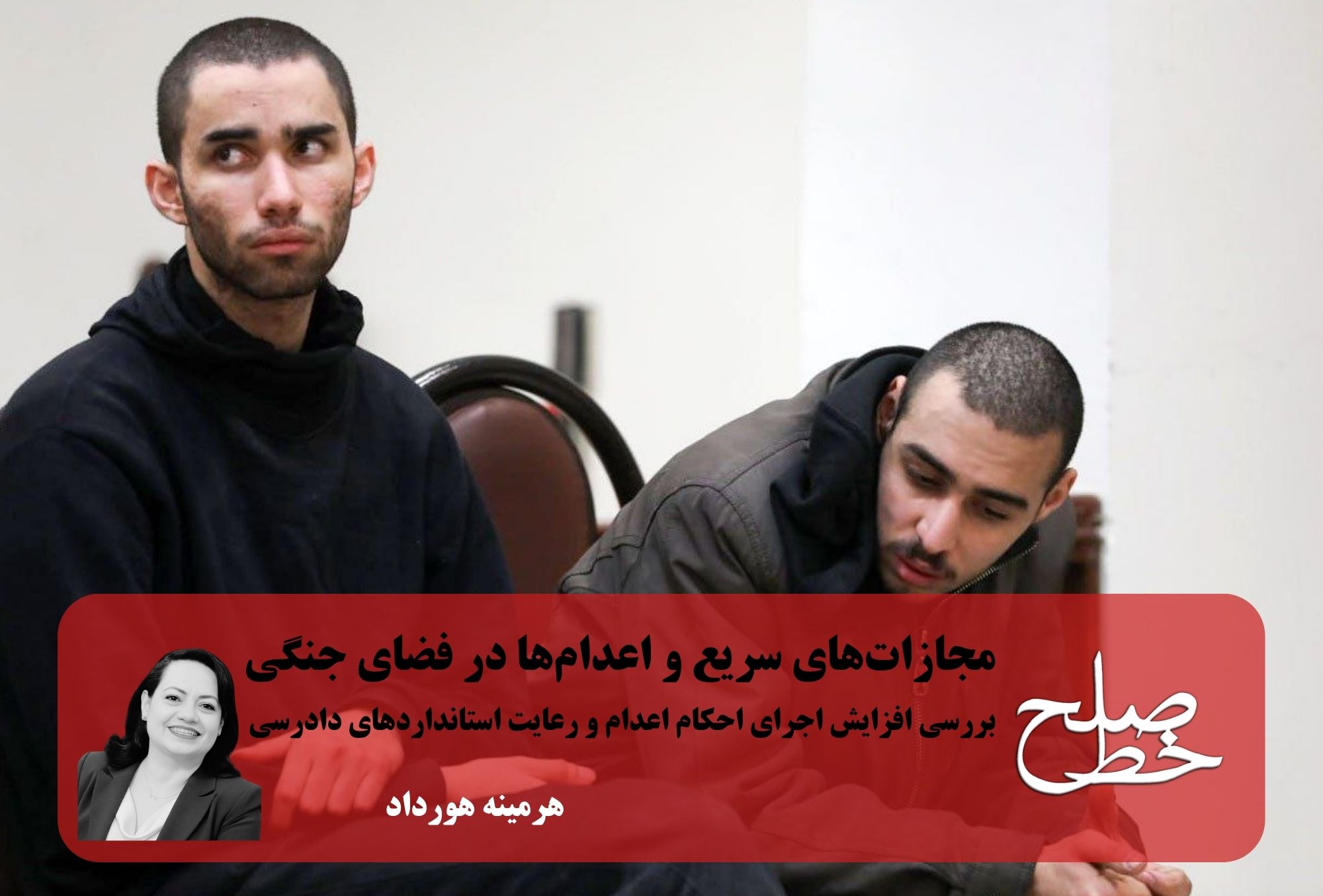
Rapid Punishments and Executions in Wartime Conditions/ Hermineh Hourdad
To understand the mechanisms of power in the Islamic Republic, no point is as significant as execution, because in this system execution is not merely a judicial punishment, but a political instrument for producing fear, silencing dissent, and pushing society toward silence and marginalization. Each time the Islamic Republic has faced crisis, war, or instability, it has placed this instrument at the center of its policy: from the rapid and public executions of the early days of the revolution, to the hidden and security-driven executions of later years, to the recent expedited executions—all have served as tools to suppress opposing voices. Therefore, examining execution in the Islamic Republic is not merely an examination of the fate of the condemned, but a study of the relationship between the state and society, the relation of power to human bodies and lives, and the manner in which violence is transformed into a language of governance. This article begins with the question of why execution in the Islamic Republic has consistently functioned less as a judicial ruling and more as a political and social tool for consolidating authority and generating terror. At the same time, to understand the situation that society currently faces—and may face even more intensely—it is necessary to carefully revisit this history, this function, and this logic.
This is not the first time the Islamic Republic has been in a wartime situation. As a government that has derived its legitimacy not from genuine votes and the majority of the people, but from exercising power over the bodies and lives of the people of Iran, the Islamic Republic has, from the very beginning of its establishment—even before it was named the Islamic Republic—continuously leveled accusations against its opponents that in many cases may be baseless and unfounded; nevertheless, it has executed them in order to instill fear in society and push larger segments of the population into the gray margins. For this reason, even prior to its formal establishment, it began killing under the guise of revolutionary executions.
Between February 1, 1979 (12 Bahman 1357) and April 1, 1979 (12 Farvardin 1358), executions issued by revolutionary courts were not only not hidden, but were rapidly and widely publicized through official media. Newspapers such as Kayhan and Ettela’at published execution news with bold headlines, and radio and television announced the names and charges of individuals. At the same time, official statements from revolutionary courts headed by figures such as Sadegh Khalkhali were released, listing the names and accusations of those convicted. This one-sided method of public communication, alongside the high speed of implementation of sentences, indicated an effort to consolidate the authority of the new system and shape public opinion in the turbulent days following the 1979 revolution in Iran.
This process can be understood within the context of the formation of revolutionary courts; institutions that were established immediately after the victory of the revolution in the vacuum created by the collapse of the previous judicial system. By order of Ruhollah Khomeini, these courts were formed with the aim of rapidly addressing the cases of former officials and those accused of “crimes against the people.” At the outset, these courts lacked codified laws and clear procedural rules, operating instead based on the discretion of the religious judge. Trial sessions were often short, non-public, and without effective access to legal counsel, and in many cases the time between arrest and execution was extremely brief. Although efforts were made in subsequent months to formalize this structure, its nature remained revolutionary, rapid, and based on the broad authority of judges.
Societal reaction to this process was not uniform. In the emotional and revolutionary atmosphere of that period, a significant portion of society accepted these executions within the framework of “revolutionary justice” and as a response to past repression. In contrast, some intellectuals, legal experts, and political groups warned about the absence of fair trials, the brevity of proceedings, and the lack of the right to defense. At the same time, another segment of society viewed these developments with concern and caution, considering them a sign of uncertainty and the potential continuation of violence. Overall, the social atmosphere of this period was a combination of support, revolutionary excitement, and the gradual emergence of doubts and legal criticisms.
After the establishment of the system in 1979 (1358) and before the start of the Iran–Iraq War, executions remained one of the primary tools for consolidating power, and their scope expanded to a broader range of political opponents and even some religious minorities. Public communication about these executions became more formal and controlled compared to the early months, yet it still maintained its deterrent message. During this period as well, societal reactions were diverse: from justification within the framework of preserving the system to concern about the expansion of violence and the lack of judicial transparency. On a social level, these executions played a significant intimidating role and increased the cost of overt action for part of society—especially political activists—although opposition and activities did not cease entirely.
Within this framework, revolutionary courts gradually became part of the formal judicial structure of the system, but retained many of their initial characteristics. These courts were typically run by a single judge with broad authority, and their proceedings remained brief, limited in terms of the defendant’s ability to defend themselves, and often non-public. Charges with broad and interpretable definitions in Shiite jurisprudence, such as “enmity against God” and “corruption on earth,” formed the basis of many rulings. Accordingly, the accused was presented as an enemy of God and a promoter of corruption on earth, thereby legitimizing execution as a form of state killing. As a result, these courts played a role in consolidating the new political order while simultaneously remaining subject to criticism and controversy due to the absence of legal and procedural standards.
In the final years of the Iran–Iraq War, particularly in 1988 (1367), the pattern of announcing executions noticeably shifted away from the public and media-oriented form of the early years toward greater secrecy; a change that can be attributed to a combination of political, security, and social factors. At a time when the government faced simultaneous internal and external threats, many opponents were defined within the framework of “security threats,” and limiting public communication about these confrontations was seen, from the government’s perspective, as a tool for controlling the environment and preventing unpredictable reactions. On the other hand, the experience of the early revolutionary years had shown that public executions, while initially deterrent and effective in pushing citizens into the gray zone in the short term, in the long term led to increased sensitivity and the emergence of criticism both domestically and internationally—especially as revolutionary fervor subsided and society became less willing to accept widespread violence.
Over time, despite the repressive atmosphere within the country, increasing international pressure—including reports and criticisms from organizations such as Amnesty International—turned the issue of executions into a key axis in foreign relations. In such a context, reducing the visibility of these actions could help limit media attention and reduce international costs. Additionally, the nature of some executions in 1988 (1367) was such that their widespread announcement could have caused tensions or divisions within society or even within the power structure; thus, secrecy was perceived as a means of maintaining cohesion.
As a result of these developments, the executions of 1988 (1367) were largely carried out without official and widespread announcement, marking a significant difference from previous periods. Unlike the years 1979 to 1981 (1357 to 1360), when media outlets such as Kayhan, Ettela’at, or national radio broadcasts reported executions, public communication during this period was severely restricted and in many cases entirely absent. Families were often informed of the fate of their loved ones only after some time, through in-person inquiries or by receiving personal belongings, without clear explanations regarding the time, method of execution, or burial location. For this reason, much of the information about these executions became known not at the time they occurred, but years later through testimonies and human rights reports—an indication of the transition from a public and demonstrative period to a more securitized environment in which control of information became an integral part of the exercise of power.
From the 1990s to around 2021, the pattern of execution and political violence in Iran gradually shifted from the relatively uniform and overt form of the 1980s to a dual structure: on one hand, executions in criminal cases, especially murder and drug-related crimes, were sometimes carried out publicly and even in public spaces, acquiring a demonstrative and deterrent function; on the other hand, in political and security cases, public communication was more limited, controlled, and sometimes ambiguous. Within this framework, events such as the chain murders demonstrated that alongside formal mechanisms, more hidden forms of violence also existed, initially kept out of public view and only becoming political crises after exposure. At the same time, the use of public executions, despite their stated aim of deterrence, sparked widespread debate about their psychological and ethical effects on society.
In the 2000s and 2010s, this duality became consolidated. Executions related to public crimes made up a significant portion of the statistics and were usually officially announced, while political or security-related executions were managed with greater sensitivity and were sometimes accompanied by a lack of public disclosure or only limited communication. During this period, increasing international pressure and reports from human rights organizations consistently kept Iran in global focus. At the same time, with the expansion of social media, certain cases gained broader visibility and led to the formation of protest campaigns.
At the societal level, reactions to execution also became more complex. Although in some segments of society—particularly in response to violent crimes—there remained a degree of acceptance or support for this punishment, sensitivity and opposition to execution increased among the middle class, students, and civil activists. This trend was reinforced by events such as the protests of 1999, 2009, 2017, and 2019, and execution—especially in political cases—came to be seen by many not merely as a judicial punishment, but as a sign of the limitation of political space. As a result, a degree of division, or at least diversity of perspectives, emerged in public opinion.
In this context, the impact of executions on the “gray class” was also dual. On one hand, the publication of heavy sentences could increase feelings of risk and caution, pushing part of society toward minimal action or political disengagement; on the other hand, at certain moments, these same cases led to increased sensitivity and even social mobilization—especially when they received widespread attention. For this reason, executions during these three decades simultaneously functioned as deterrent tools and, in some cases, as catalysts for protest and resistance.
Overall, from the 1990s until before 2022, executions were one of the tools that, alongside other factors, contributed to the formation of an atmosphere of caution, distrust, and limited action within parts of society; however, their impact was neither uniform nor definitive. Depending on the political and social conditions of each period, this tool sometimes led to passivity and retreat, and at other times—especially during critical moments—contributed to increased sensitivity and even the emergence of protest reactions.
From 2022 onward, especially during the “Woman, Life, Freedom” movement, the pattern of executions entered a new phase for many observers. The increased speed of issuing and implementing certain sentences, the more prominent announcement of them—such as the executions of Majidreza Rahnavard, Mohammad Mehdi Karami, and Mohammad Hosseini—and the expansion of media attention, both in official outlets and on social networks, made this issue more visible than before. This shift can be analyzed in connection with several factors. First, the government’s effort to reassert control in the aftermath of widespread protests; in such a way that the publication of these sentences, along with the broadcast of interviews or images of defendants in prison clothing, could serve a deterrent function. Second, the expansion of social media as a platform for information dissemination, which rapidly turns each case into a public issue. Third, the effort to display authority under conditions of political and economic pressure.
In this context, communication about executions has also taken on a dual form: on one hand, official institutions publish sentences, and on the other hand, the widespread circulation of information in the digital space makes them more visible than ever. At the international level, reactions have continued, and campaigns such as “No to Execution,” both inside and outside the country and even within prisons, have taken shape. Although these pressures have not yet led to immediate policy changes, they have, in some cases—such as the overturning of the death sentences of Sharifeh Mohammadi or Toomaj Salehi—had an effect.
From a social perspective, the consequences of this situation have also not been uniform. In part of society, especially among younger generations and civil groups, sensitivity and opposition to the death penalty have increased and become an important human rights demand. In contrast, in some layers—particularly in response to violent crimes such as rape—there remains a degree of acceptance of this punishment. At the same time, the judicial system has, at certain moments, highlighted cases such as child rape or major economic crimes, engaging public opinion with questions about the deservingness and limits of punishment. Meanwhile, for part of society, the continuities of harsh sentences can reinforce feelings of risk and caution in political activity, while for others, the same situation becomes a motivation for protest and more active engagement.
In such an environment—marked by a combination of domestic protests, strikes, external pressures, and security tensions—patterns of judicial response typically become more severe, while interpretations and narratives of this process become increasingly layered and contested.
In such conditions, the emergence of protest strikes within prisons against execution can be seen as signs of increased sensitivity among parts of society toward the death penalty and judicial processes. These actions, even if limited or scattered, are reflected through social networks and informal media, contributing to a sense of solidarity or at least drawing public attention. At the same time, in the aftermath of security or military tensions, governments typically intensify their crackdown with what is defined as a “security threat”; a process that may include increased arrests, the issuance of heavy sentences, and sometimes the faster implementation of punishments. In this framework, communication also takes on a dual form: some sentences are officially announced with the aim of deterrence, while others are released with limited detail or reduced transparency.
In such a situation, where the judicial system effectively becomes an instrument for control, intimidation, and suppression of society, there is essentially no room left for the formation of an independent and reliable judicial process. Under these conditions, judicial processes are defined and implemented not on the basis of recognized principles of justice and fair trial, but within the framework of security and political considerations. As a result, the possibility of meaningful case-by-case examination as examples of a fair legal system is effectively eliminated.
By placing these trends together, it becomes clear that expedited executions in times of crisis cannot be explained solely at the level of government decisions; rather, this phenomenon is directly connected to the condition of society, its level of organization, and the horizon it perceives ahead. The more society remains in a state of fear, fragmentation, and lack of vision, the more effectively the logic of intimidation operates; but the more the possibility of solidarity, civic action, and the تصور of political alternatives increases, the more this logic gradually erodes.
In this context, the role of civil society and its internal capacities becomes more prominent. Historical experiences show that rapid punishments and executions, although they may help stabilize order in the short term, do not endure without a foundation of social legitimacy. What can challenge this cycle is the gradual formation of networks of trust, the increase of public awareness, and the transformation of demands such as opposition to execution into part of public discourse. Democratic political alternatives can also become effective when they connect with these internal capacities and help strengthen civic action within society. Ultimately, the relationship between the intensification of executions in times of crisis and the weakening of judicial standards shows that these two are often in tension with one another; however, this situation is not necessarily permanent and can be challenged by social dynamics and the accumulation of collective experience.
Ending execution and ending the Islamic Republic cannot be considered separately, because the two are intertwined within the structure of power and have been formed as mutually dependent elements. Execution in this system is not merely a penal tool, but part of the logic of survival and the exercise of political authority; in both political and criminal domains, it is used as an instrument for elimination, intimidation, and control of citizens. Therefore, any effort to move beyond this situation must simultaneously involve a critique and rejection of this logic. In other words, ending execution—especially in the sense of abolishing it as a punishment within the entire legal system—is only possible within the framework of a deeper transformation in which the right to dissent, human dignity, and fundamental freedoms are recognized. In such a horizon, transition from the Islamic Republic is not merely a change of political structure, but a break from a logic that has turned violence and death into instruments of governance.
This path, although complex, gradual, and full of obstacles, is not impossible at the historical and social level. From this perspective, hope for change is not a definite prediction, but a historical possibility—one that emerges from within society, from collective experiences, and through the formation of awareness and solidarity. This path may be long, costly, and nonlinear, but its horizon is not limited to “fairer trials”; rather, it points to a more fundamental transformation: a society in which dissent and political activity are not crimes but rights, the historical tradition of criminalization is dismantled, and the death penalty is removed not only for political opponents but entirely from the legal system. Such a horizon, although distant and difficult, is precisely the point at which a real transition from the logic of repression to the logic of freedom and human dignity becomes possible.
 Created By: Hermineh Hourdad
 April 21, 2026
Tags
Ali Fahim Execution Hermine Hordad Iran-US war Killing of prisoners Mohammad Amin Biglari Nationwide protests in December peace line Peace Line 180 Political prisoners Revolutionary Court Shahin Vahetrapast The war between Iran and Israel. War ماهنامه خط صلح