


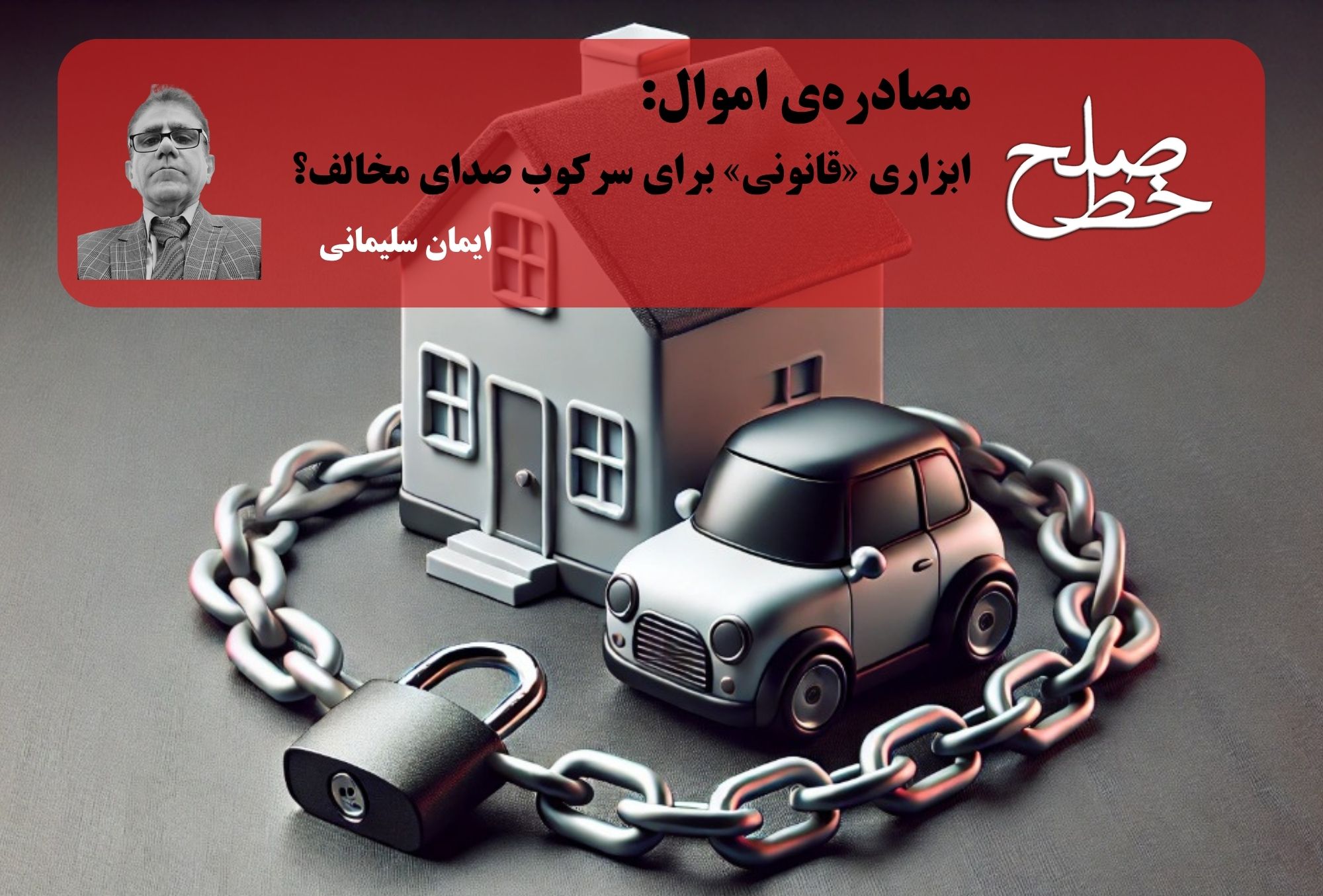
Confiscation of Property: A “Legal” Tool for Silencing Dissent?/ Iman Soleimani
In recent years, particularly following the adoption and implementation of the law titled “Intensification of Punishment for Espionage and Cooperation with the Zionist Regime and Hostile Countries Against National Security and Interests” in October 2025 (Mehr 1404), the issue of confiscation and seizure of the assets of Iranian citizens—especially those living abroad, ranging from ordinary individuals to journalists, analysts, and celebrities—has become one of the most controversial legal and political matters in Iran. In practice, this process has been used as a tool to suppress demands for accountability and opposition to the government.
In addition, in recent days, the Islamic Republic has highlighted the issue of revoking the citizenship of Iranians living abroad as a means of exerting pressure on critics, opponents, and protesters, as well as for political retaliation. This is despite the fact that revocation of citizenship and its conditions are explicitly defined in civil law and fundamentally fall within the authority of the executive branch, not the judiciary. The unilateral and coordinated intervention of intelligence bodies and the judiciary in this matter serves solely to pressure individuals and force them into silence. Moreover, revocation of citizenship does not fall under the Islamic Penal Code; it is neither considered a crime nor a punishment. Therefore, judicial involvement lacks a legal basis. As a result, such actions are unlawful and devoid of any legal justification or validity.
Nevertheless, the Tehran Prosecutor’s Office and the Office of the Prosecutor General have recently ordered the identification, seizure, and freezing of the accounts of more than one hundred well-known figures living abroad, including actors, athletes, and employees of media outlets such as Iran International and Manoto. But do these actions truly have a solid legal foundation, or are they primarily instruments of political punishment?
The Legal Grounds Claimed by the Islamic Republic
The Islamic Republic, as both the drafter and beneficiary of these laws, primarily relies on three sources to justify such confiscations:
Article 49 of the Constitution obliges the government to confiscate wealth acquired through illegitimate means (such as usury, usurpation, bribery, embezzlement, and other unlawful sources) after due investigation and verification. In the executive regulations of this article, the assets of individuals whose connections with hostile groups or enemies are established are considered outside the scope of lawful ownership and therefore subject to confiscation.
The Islamic Penal Code recognizes the confiscation of all assets as one of the highest levels of discretionary punishment for certain serious crimes. It also permits the seizure of property related to a crime.
The 2025 law on intensified punishment for espionage, which came into force in November 2025 (Aban 1404), criminalizes any media, propaganda, informational activity, or cooperation with hostile governments (including the United States and Israel) or opposition networks. In severe cases, punishments such as execution, accompanied by full confiscation of assets, are предусмотрены. Sending videos, photos, or analyses to foreign media, participating in protest gatherings, and even perceived alignment with hostile actors may fall under this law. The designation of opposition networks is determined by the Ministry of Intelligence, and the identification of hostile governments by the Supreme National Security Council. At present, this law is the primary basis cited.
Furthermore, Revolutionary Courts often handle these cases in absentia and issue rulings without the presence of the accused. In practice, confiscation is limited to assets located within Iran, such as property, bank accounts, shares, and vehicles, while assets abroad cannot be directly seized.
Scope of Application
The scope of these measures is broad, encompassing both ordinary citizens and public figures. Under current practice, individuals who participate in protests or send information to foreign media may fall within the scope of these laws. Journalists and analysts working with foreign media and expressing views against the Islamic Republic may also be targeted.
Celebrities may face asset confiscation if deemed to have supported or cooperated with opposition activities, even at the level of interviews or expressions of support for protests. In recent months, the Prosecutor’s Office has repeatedly emphasized that these measures are intended to counter what it describes as hostile actions by opposition media.
Legal and Human Rights Critiques
Despite these domestic legal justifications, many independent legal experts argue that the broad interpretation of such laws contradicts fundamental principles, including the principle of narrow interpretation of criminal law, the presumption of innocence, and interpretation in favor of the accused. This approach also conflicts with Article 22 of the Constitution, which protects individuals’ property unless lawfully and justly adjudicated. From this perspective, confiscation should be limited to wealth obtained through illegitimate economic means, not used as a tool to punish political or media activities.
Moreover, trials conducted in absentia, lack of adequate opportunity for defense, denial of access to independent legal counsel, and the absence of impartiality among investigators, prosecutors, and Revolutionary Courts raise serious concerns. Ambiguities in concepts such as threats to national security, combined with interpretations favoring the authorities, have made the process appear arbitrary and unjustifiable. In practice, such actions function less as instruments of justice and more as tools to silence dissent and suppress civic demands.
From the perspective of international human rights law, these measures violate the right to property, freedom of expression, and the right to a fair trial. Organizations such as Amnesty International have described such practices as forms of collective punishment and systematic repression, aimed at restricting freedom of expression and depriving individuals of their assets without fair legal proceedings.
Conclusion
Confiscation of property based on protest-related, media-related, or analytical activities, under the current legal framework of the Islamic Republic—where legislation, judiciary, and enforcement operate in alignment—is regarded by the authorities as having a domestic legal basis and is actively implemented. The 2025 law has further expanded this tool, granting broader powers to the judiciary to act against opponents.
However, this approach not only conflicts with fundamental principles of justice and property rights, but is also widely recognized at the international level as a violation of human rights. These laws are incompatible with freedom of expression and undermine basic individual rights. In practice, such policies deepen the divide between the state and society and weaken public trust rather than strengthening national security.
Ultimately, these measures appear to function primarily as tools for intimidation, enforced silence, and political retaliation against critics, opponents, and activists.
Whether such punitive instruments will succeed in silencing dissenting voices or, conversely, contribute to the expansion of resistance, is a question that will become clearer over time.
 Created By: Iman Soleimani
 April 21, 2026
Tags
Confiscation of property Economic pressure Freedom of speech Iran-US war peace line Peace Line 180 The right to freedom of expression The war between Iran and Israel. War ماهنامه خط صلح