


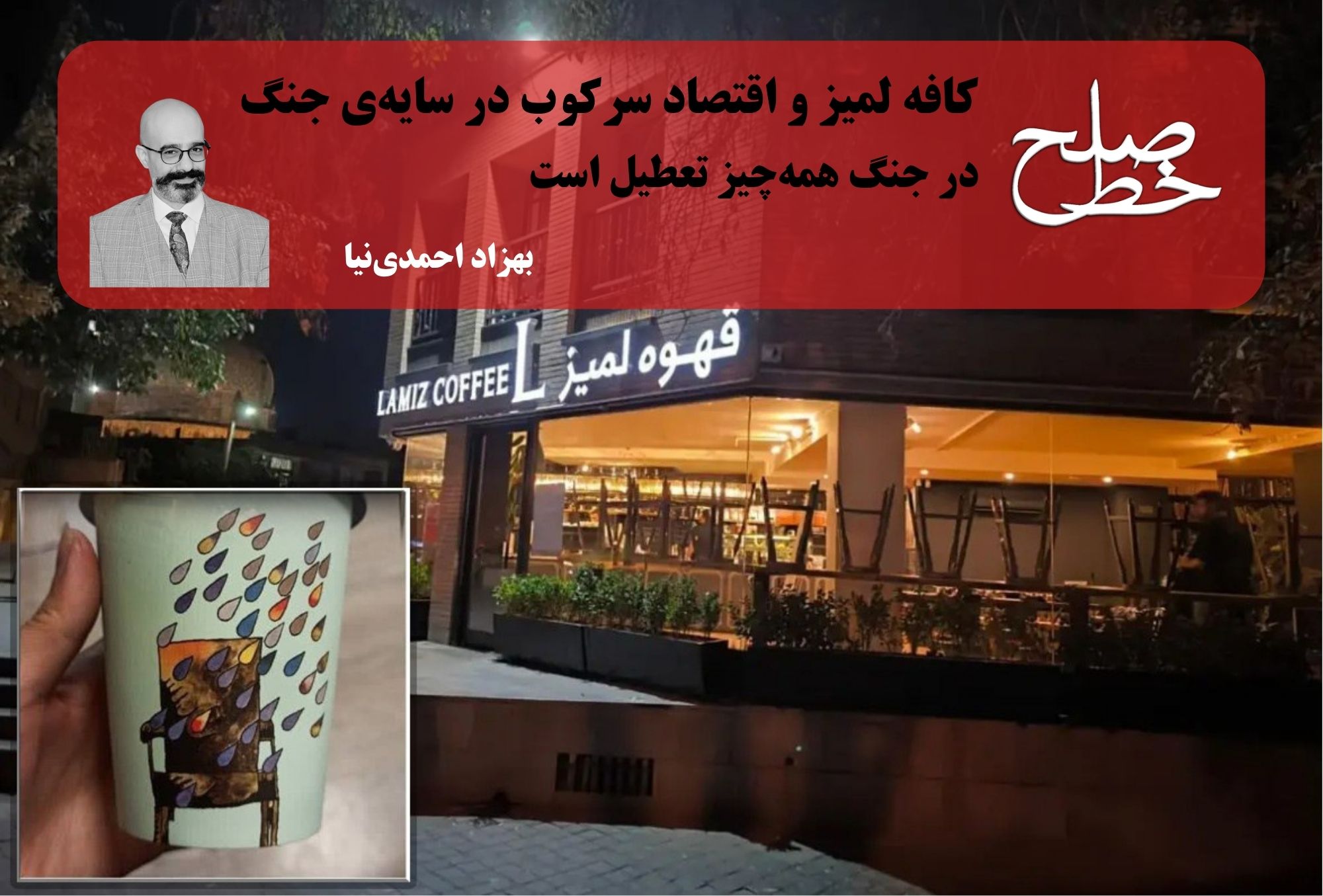
Cafe Lamiz” and the Economy of Suppression in the Shadow of War / Behzad Ahmadinia”
The ugliest—and perhaps most familiar—face of human society is “war.” This can be read between the lines of the book An Introduction to Polemology by Gaston Bouthoul. In this work, he explains how no law, treaty, or prohibition can stand against war. In a case study, the book describes the international restrictions and global pressures imposed on Germany after World War I, then shows how, as history demonstrated, these laws and limitations were little more than playthings. No law, treaty, or prohibition was able to prevent World War II; in fact, even its end was only made possible through an even more devastating war and the United States’ use of nuclear weapons.
One of the first principles of civil activism is that overt violence and war should never be promoted, because such actions open the hand of the opposing side—who holds power—to impose and exercise violent wartime conditions. In a situation where the opposing side is always more armed and more ruthless, such actions result in nothing but inevitable defeat for uprisings and civil society. The recent war has also provided broad freedom of action for an extremely violent and irrational system (the Islamic Republic) in carrying out repression. The full dimensions of what has occurred will take years to be revealed and examined, but one of its earliest and most visible consequences has been the unrestrained use of economic pressure as a tool against opponents.
Economic and income pressure on opponents is one of the most abhorrent tools of governance. In the modern world, perhaps only two prominent examples can be cited: Nazi Germany, with its prohibition on trade and possession of money for Jews, and the Islamic Republic, with rulings of property confiscation and bans on employment for anyone deemed to be in conflict with the interests of the Islamic government. This category of “anyone” initially included officials of the previous regime and later expanded to Baha’is and even dissenting clerics. More recently, in January, this prohibition in Iran entered a new phase with the confiscation of the assets and the banning of activities of the owner of the “Saedi-Nia” brand. It escalated further with the confiscation of assets belonging to other opponents of the government—and in some cases even individuals who supported the war—and ultimately reached its peak with the shutdown of the “Lamiz” chain coffee shops, under the pretext of printing an image on coffee cups.
First, it is important to note that in modern civil law, confiscation of property and the prevention of economic activity are acceptable only in cases of proven economic crimes. In almost no other form of criminal, civil, or even political offense—even in a country like Russia under Putin—are such punishments applied. The reason is that depriving individuals of legitimate income and property can itself lead to criminal behavior, and no rational government is interested in enacting laws that push its citizens in that direction.
Second, it must be understood that rationality in politics is not one-sided. In political life and civil-political activity, rationality and adherence to boundaries are always mutual. The necessity of this was explained earlier. Since civil and political activities against a government are always in conflict with the most powerful institution in society, any deviation on one side creates an unequal opportunity for response in favor of the ruling power—an opportunity that can lead to catastrophic outcomes and ultimately act as the final nail in the coffin of citizens’ civil rights in Iran.
The Islamic Republic, as a religious authoritarian government, has demonstrated over nearly five decades that it recognizes no limits in exercising its authority. A regime that has prosecuted and punished individuals for holding “unauthorized prayer” will, when faced with a lucrative opportunity such as war with a foreign aggressor, seize it with great appetite.
With this extended introduction, we can take a brief look at what happened to the “Lamiz” chain coffee shops. For many years, the Islamic Republic resisted the operation of establishments known as coffee shops. It was only in the mid-1990s (1370s in the Iranian calendar), following the rise of the so-called Reconstruction government led by Akbar Hashemi Rafsanjani and certain reform-like measures, that coffee shops were added to the very limited range of leisure spaces available to Iranians outside the home. Since then, despite significant growth and, in some cases, expansion from small businesses into franchise models, these establishments have consistently faced pressure and برخورد from regulatory authorities and other branches of law enforcement.
Lamiz was one of the successful examples of a franchise-based business model in Iran. This coffee shop, shaped by Western business patterns, had managed to establish its name in a relatively short time through quality and a welcoming environment. Although the prevailing pattern in the Islamic Republic is that independent business owners are typically not accepted or tolerated, Lamiz had managed to endure. It succeeded both in maintaining its operations and expanding its market—in effect, it had learned to dance with wolves, until war broke out.
In wartime conditions, nearly all governments—at any time in history and in any part of the world—free themselves from existing laws and civil procedures that prevent the establishment of dictatorship, and under the banner of “defense of the nation takes priority,” they strip citizens of many of their rights. Cafe Lamiz is an example of this deprivation. An image of an empty chair printed on coffee cups with the phrase “Nowruz 2026 (1405), spring is coming” was interpreted by an individual within an office or institution as “celebrating the death of Seyed Ali Khamenei.” Subsequently, without requesting an explanation, without a court order, and without even a minimal legal basis, the operations of a brand employing hundreds of workers were completely halted. This was despite the fact that the design was taken from the poster of the 10th International Festival of Films for Children and Young Adults, created by Farshid Mesghali, a prominent artist and painter, dating back to 1975 (1354).
Yes, the bitter reality is that just as in Ukraine it is not possible to hold presidential elections under wartime conditions, in Iran citizens cannot continue their daily lives—even in simple spaces such as coffee shops—without fear of restrictions and pressure.
In sum, this is the ugly face of war: a situation in which even the minimal aspects of life that had been granted to the people of Iran are taken away under the slogan of “defending the homeland.” In other words, the civic struggle that society had waged against the government over decades is lost overnight. The harsh truth is that neither do the people of Ukraine have a practical opportunity to reclaim their right to hold presidential elections in the midst of war, nor can Iranians sit comfortably in a coffee shop in their own country and drink a cup of coffee without facing restrictions and pressure.
 Created By: Behzad Ahmadinia
 April 21, 2026
Tags
Behzad Ahmadi Nia Behzad Ahmadinia Cafe Coffee shop Confiscation of property Economic pressure Farshid Mesghali Iran-US war Lamiz Cafe peace line Peace Line 180 Seizure of property The war between Iran and Israel. War ماهنامه خط صلح