


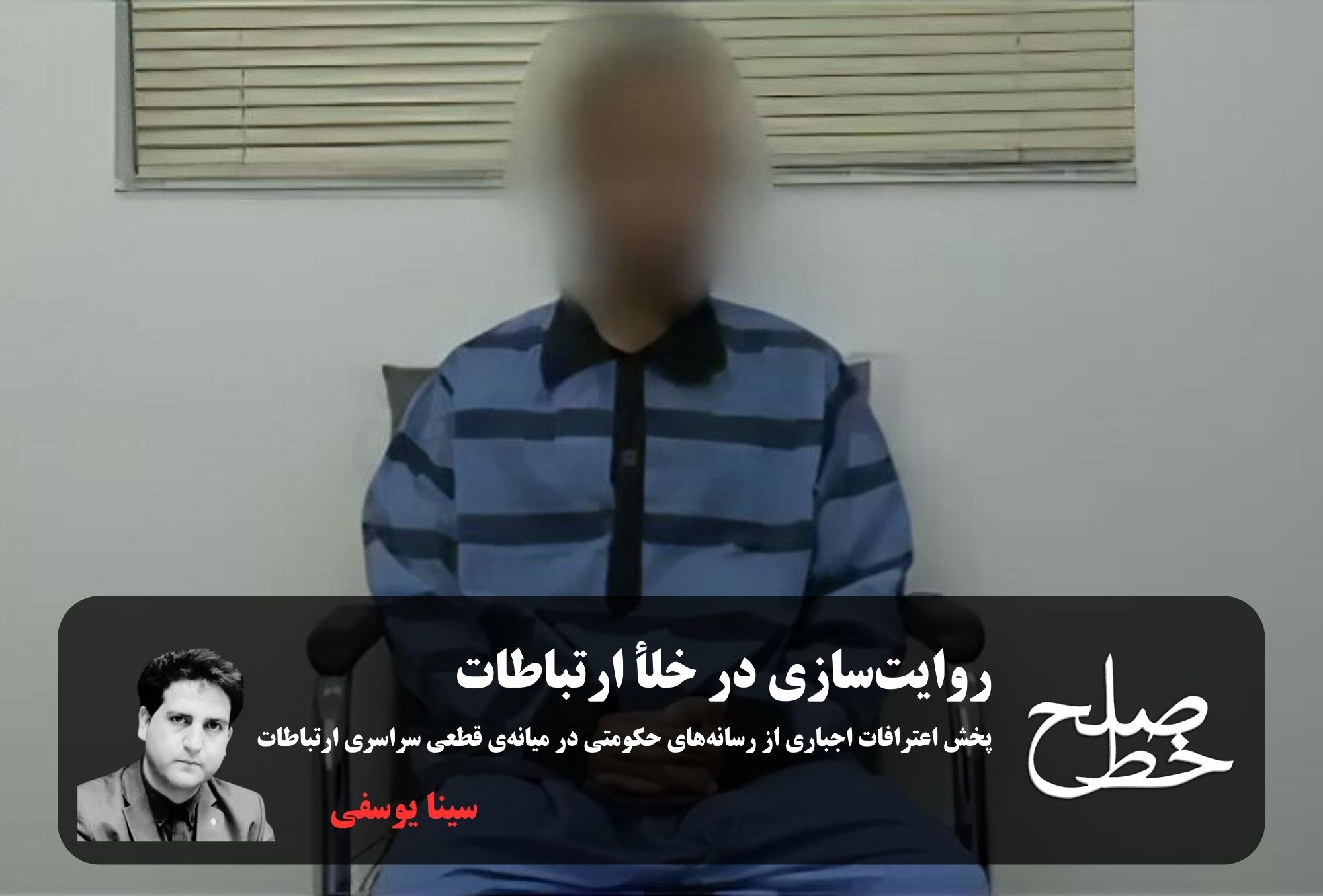
Narrative Creation in the Communication Void/Sina Yousefi
The recent protests in Iran, accompanied by widespread, violent and unprecedented repression, have once again exposed the established patterns of human rights violations by the government. Along with the killing of protesters, mass arrests and the imposition of severe security restrictions, the broadcast of forced confessions by state media has become a central tool for controlling and distorting reality. These confessions were broadcast not under normal circumstances, but simultaneously with a nationwide and widespread shutdown of the internet and means of communication. A situation that effectively deprived society of access to independent information, communication with the outside world and even following the fate of those arrested. In such a situation, by silencing independent voices while simultaneously highlighting televised confessions, the government attempted to portray the protests not as a legal and social demand, but as an organized conspiracy and a threat to public security.
From the perspective of international law, forcing individuals to confess against themselves is one of the most explicit and blatant violations of fundamental human rights. This prohibition is not merely a formal rule of procedure, but is directly related to the concept of human dignity and the protection of the individual against the unlimited power of the State. The principle of prohibition of torture and cruel, inhuman or degrading treatment or punishment, the right to remain silent, the right not to be compelled to testify against oneself, and the right to a fair trial all operate in this context in an overlapping manner. The practical experience of human rights monitoring bodies shows that forced confessions are often imposed through a combination of psychological pressure, implicit or explicit threats, prolonged isolation, deprivation of sleep or contact with family, and the induction of complete helplessness, even if there are no visible signs of physical torture. Therefore, such confessions not only lack legal value, but can themselves be examined and documented as evidence of human rights violations; especially since this prohibition is one of the rules that cannot be suspended under any circumstances, even in a state of emergency or widespread unrest.
The public broadcasting of forced confessions before any independent and fair judicial proceedings constitutes a violation that goes beyond the stage of detention and interrogation and effectively renders the entire criminal justice process meaningless. The principle of innocence, which is considered one of the main pillars of a fair trial, is completely abandoned in this situation and the arrested person is presented to the public as a “criminal” in advance. This measure not only targets the dignity, honor and human dignity of the individual, but also severely undermines the possibility of an effective defense in the future, since the public mentality is formed before any judicial verdict. Moreover, televised confessions have a function beyond the individual case and become a means of imposing symbolic and public punishment. A punishment that is not aimed solely at the arrested person, but also at sending a deterrent message to the whole of society and instilling the heavy costs of protest and civil disobedience.
The nationwide shutdown of communications plays a decisive and multi-layered role in this, acting as a facilitating platform for other violations. Cutting off the internet and restricting communication tools is itself an independent violation of rights such as freedom of expression, the right to access information, the right to communicate with others, and even the right to participate in public affairs. However, when combined with the broadcasting of forced confessions, this measure becomes a tool for total control of the space. In the absence of the internet, families remain unaware of the status of detainees, lawyers face serious obstacles in accessing their clients, and the possibility of immediate information and independent documentation is greatly reduced. At the same time, society is deprived of hearing alternative and truthful narratives, objective testimonies, and independent reports. In such an information vacuum, the televised confession is presented not only as the dominant narrative, but as the only narrative available, and the audience is effectively deprived of the possibility of informed and critical judgment.
The persistence and repetition of this pattern at different stages of the protests shows that the broadcasting of forced confessions in certain communication situations cannot be reduced to ad hoc decisions, individual errors or arbitrary actions. These actions are part of an organized policy of repression that aims to control society through a combination of physical violence, psychological pressure, collective intimidation and the engineering of the public narrative. In this context, the broadcasting of forced confessions is not a side tool, but one of the pillars of this policy. Given the scale, repetition and political orientation of these practices, they can be analyzed in the context of a widespread and systematic attack on the civilian population. Accurate documentation of these actions and emphasis on their legal consequences is essential and urgent, not only to pursue responsibility and accountability, but also to prevent the normalization of these forms of repression and to preserve the legal memory of society and victims.
 Created By: Sina Yousefi
 February 20, 2026
Tags
Censorship Compulsory confessions Crime against humanity Criminal Human rights Internet outage Massacre 1404 peace line Peace Line 178 Psychological stress Sina Yousefi Taking confession Television Confessions The Di 1404 Uprising Uprising of 1404 ماهنامه خط صلح