


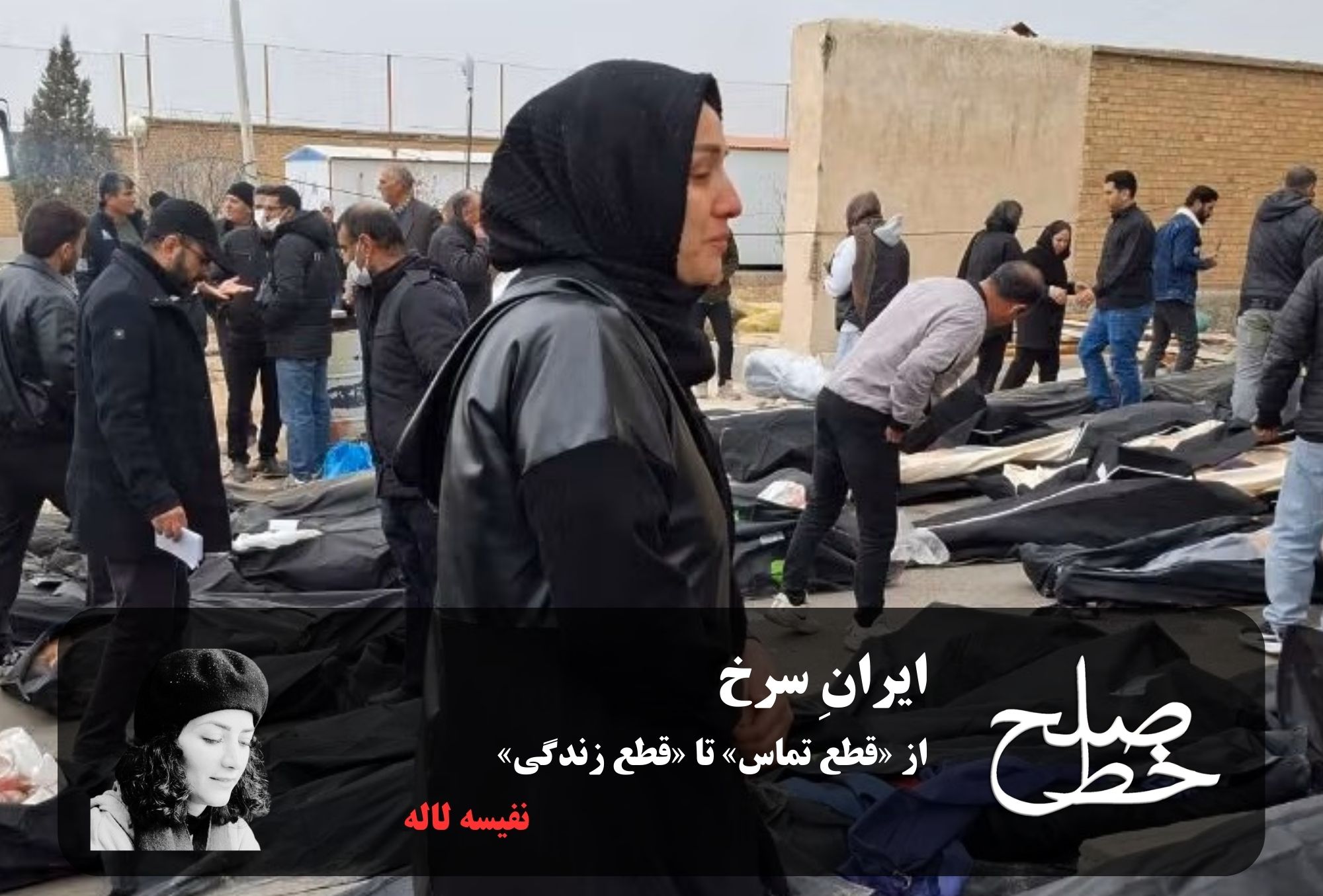
Red Iran; From “Disconnection of Contact” to “Disconnection of Life”/ Nafiseh Laleh
Tehran, evening of January 18, 1404, around 8:00 PM
His excited voice echoes in the echo of the desperate voices of the street and my heart skips a beat. The call is cut off around the first minute and remains cut off for the following days and weeks; like ourselves, from life. We do not wait, whether there or here. Waiting is for a time when you do not know what the outcome will be, and we, however, after the bloody November and the uprising of Mahsa Amini, know that it means “from the blood of the youth of the homeland of Laleh…”.
It was only a few months ago that during the Iran-Israel war—a war that was promised would never happen—we were staring at our phones every day, and now those same stares have lingered and remained unfocused to this day. With age and my memory, at least from the university dormitory to this day, this stare has become part of our cultural identity. We look in disbelief at this volume of lies, hypocrisy, inefficiency, and denial.
With every exiled Iranian friend I talk to, I realize we are all repeating a similar pattern of behavior: “trying to contact Iran in all possible ways, not taking our eyes off our phone screens for even a moment, following the news 24/7, anxiety, worry, and shortness of breath from the shortness of breath of our trapped loved ones, lack of concentration and ability at work.” All of us Iranians living there, driven from there, and left behind, are experiencing, in addition to the collective spirit, wisdom, and trauma, a collective mental and spiritual paralysis.
One minute, January 19th
I wake up and stay awake until morning, wandering through the virtual pages looking for footprints. Sleepless, confused, I head to the university. Have I collected every single image of this just protest of my people behind my eyelids that my eyes have become so swollen and heavy? But what does this redness, this inauspicious redness, indicate?
The missing days in the bloody January calendar
The morning has come later and later, but I don’t know how. All these nights, our eyes have been staring at the screen of our phones, and the sun has risen and set, without us knowing where in this world the sun of Iran has been swallowed up, that the days are stretched out like this. We have lost the days. Like ourselves, lost in a corner of the world, far from Iran.
The pieces of slaughtered Iran are gathered in the black shrouds of Kahrizak. Each one is the child of someone who sends greetings to the noble nation of Iran, but we cannot find Sepehr. Where are you, Sepehr? We are looking for Sepehr for ninety million so that perhaps the rainbow god will tell us why a young man should be executed in the Salmi demonstration for a tool that is for sports? Or why fathers should not tell mothers about the death sentence that their sons have received.
Iran, like shattered faces that remain unidentified or like a mass of women whose bodies have been like a battlefield and have disappeared, leaps out of my eyes, gaze, and breath. I have reached the edge of madness from ignorance. In the images published from Kahrizak, I search for a familiar face amidst the blood, darkness, and dizziness.
I arrive at the university. I walk casually, as if I’m not in the faculty, so that no one will notice me, but my fellow professors surround me. They see the terror in my eyes. I talk about digital martial law. They look at me with a multitude of question marks in their eyes. I say, “The higher will has decided for all of us that this is the best way to go. I say, terrified by previous experiences and the smell of blood that has reached here.” I don’t have the strength to answer their questions. I’m overwhelmed, tired, and helpless. A little further on, another professor from the Faculty of Political Science and International Relations asks, “Is your family okay?” I say, “I don’t know!” I don’t know, it swirls around in my head and swallows my whole world. How can I not know? By what right did they decide not to know? Who decides what we know and what we don’t know for our lives? I come to as “Ustad” defends the Iranian regime’s digital military rule approach. I place my hand over my heart in disbelief, having to be careful not to let it jump out of its socket. My eyes are probably bulging miserably when “Ustad” pauses in mid-sentence and says good morning.
Now I have a pen in my mouth, both language and life.
Various phone packages abroad do not work. Life has stopped. Our hearts too. Are we alive? I can barely hear the sound of my own inflamed breaths. I mean, how are they now? There was no weather. Is there bread? What about electricity? Eggs and cooking oil? Are they even healthy? My heart rate is so high that I am constantly on fire. Every topic is redefined for me only with the focus on the “bloody massacre of January in Iran.” Like the senior class that Tuesday. I have to talk about “experimental cinema and new media.” My heart aches if the discussion in today’s world is artificial intelligence and new media, and then my people will risk their lives to obtain their most basic rights, with a finger that “knows the right of everything and everyone and this world and the next better than anyone else.” With a wry smile on my lips, I unconsciously whisper: “Digital democracy”! In a land where the government kills us for “talking about democracy” on one hand and turns us against each other on the other, talking about digital democracy is like a fantasy. I enter the classroom. My Iranian student Parnia is absent. Like one of thousands who have been left behind or left behind in their homeland.
I tiptoe down the hallway so that I don’t encounter yet another outburst from the “professors” describing Iran’s strong political structure and the benefits of a digital military government, when another colleague from the Faculty of Political Science asks: “Are you all okay?” I open my mouth but my voice doesn’t come out. I shake my head. Which one of us? We are 90 million people. He says, “America and Israel have plotted against Iran again and have messed things up. Israeli terrorists have killed people in the streets.” I look at him in astonishment! “They want to divide your beautiful land. They will plunder your resources and wealth and leave nothing for your future generations. They want to destroy Iran and Iranian civilization. Yesterday, on a live program, I said that the Iranian people are aware and will stand up to Israeli terrorists and don’t need anyone’s help.” The voices of Aban’s mothers echo in my ears. The voices of the families of Ukrainian flight 752. The voices of Nika, Sarina, Kian, Navid… I say, “Are you Iranians?” I say and walk towards my room. My Syrian student is waiting for me. But I can’t. “What sources are you talking about? The water that has run out or the air that is constantly on alert for children, young and old due to the burning of diesel fuel? Or the oil that Russia and China are plundering due to the sterile foreign policy of the statesmen? What culture are you talking about? The one that has not allowed writers, poets and filmmakers to work for years, imprisons them, exiles them, destroys them and makes them housebound so that the younger generation will not become thinkers? The future generation? The future generation was us, who have been exiled from Iranian soil for years and have lived far from home and family. Do you know that in Iran, having children has been under a big question mark for years? What do you know about Iran? What do you know about a government that has massacred and shot its own people in a just protest for a normal life and human dignity? Do you want me to tell you about the Iranian students at this very college? Do you even notice why these twenty-year-olds are dressed in black? You see their swollen, red eyes when I say “regime” and you correct me as if I don’t know what I’m talking about and remind me that “of course it’s the government,” so let me tell you:
Rozhin’s fiancé was killed in Tehran. So were Mehdi’s two friends. So was Niloufar’s friend. Ramtin has not been able to find out about his detained friends. Just today, a professor took his Iranian student by the hand and brought him to my room. Do you know why? Because this young girl had to find a job quickly and needed money. For everyday life! Instead, you know that most of the children of Iranian statesmen are studying and living in the best and most advanced countries in the world, and that’s with the current situation of Iran’s currency and economy.
Do you know how old these Iranian students are in our college? Twenty-one, twenty-two! Compare them to their peers in the world. Even in your own country. They are struggling to live, study, and work in another language, far from their families and homeland. Why? What human choice could this be? Unless it is imposed? Under these conditions, do you think these children can flourish the culture and civilization of Iran?
I take a breath so that my heartbeat doesn’t deafen the university’s ears and say: “I remember the Iran-Iraq war. The days of the bombing of Tehran, the ugly coupon papers and the long hours of standing in line with my little hands clasped in my mother’s…” The pressure of crying in the back of my throat and the muffled voice taking my breath away… I apologize and go to my room.
My Syrian student, Maymouneh, is sitting in my room waiting for me. We are in the final days of working on her senior thesis. She is tired. She wants to finish her thesis as soon as possible so she can return to Syria. She is crying. I am crying from the inside. For her, for myself, for us. She is talking. She is talking about her fatigue, about her longing for her family. I am listening. She says, “Can I hug you?” I nod. I stand up and open my arms. I become Iran. With a body full of wounds that knows it has no one else but ourselves. It knows that it is a poor nation that needs a hero. It knows that the only hero is us, the people. Together and for each other. Now I am crying too. For the east from which the sun always rises. For the sun that has been lost in the redness of tulips blown by the blood of the youth of the homeland. But I know that even if the sun is not there, it has given way to the moon. When the moon is tired, it does not go anywhere and finally pushes aside the clouds to smile at us, to whom the homeland owed a life.
 Created By: Nafiseh Laleh
 February 20, 2026
Tags
Censorship Crime against humanity Criminal Execution Internet outage Kahrizak Massacre 1404 Nafiseh Laleh peace line Peace Line 178 The Di 1404 Uprising Uprising of 1404 ماهنامه خط صلح