Hanging Pieces; Short Story: Reza Salehi Nia, Painting: Masoumeh Mostafazadeh, Poetry: Nima Safar Safalai

Last updated:

April 21, 2026

Hanging Pieces; Short Story: Reza Salehi Nia, Painting: Masoumeh Mostafazadeh, Poetry: Nima Safar Safalai

Short Story: Meeting with Don Quixote in Tehran, written by Reza Salehiniya.

I’m sorry, there is no Farsi text provided. Please provide the text so I can translate it for you.

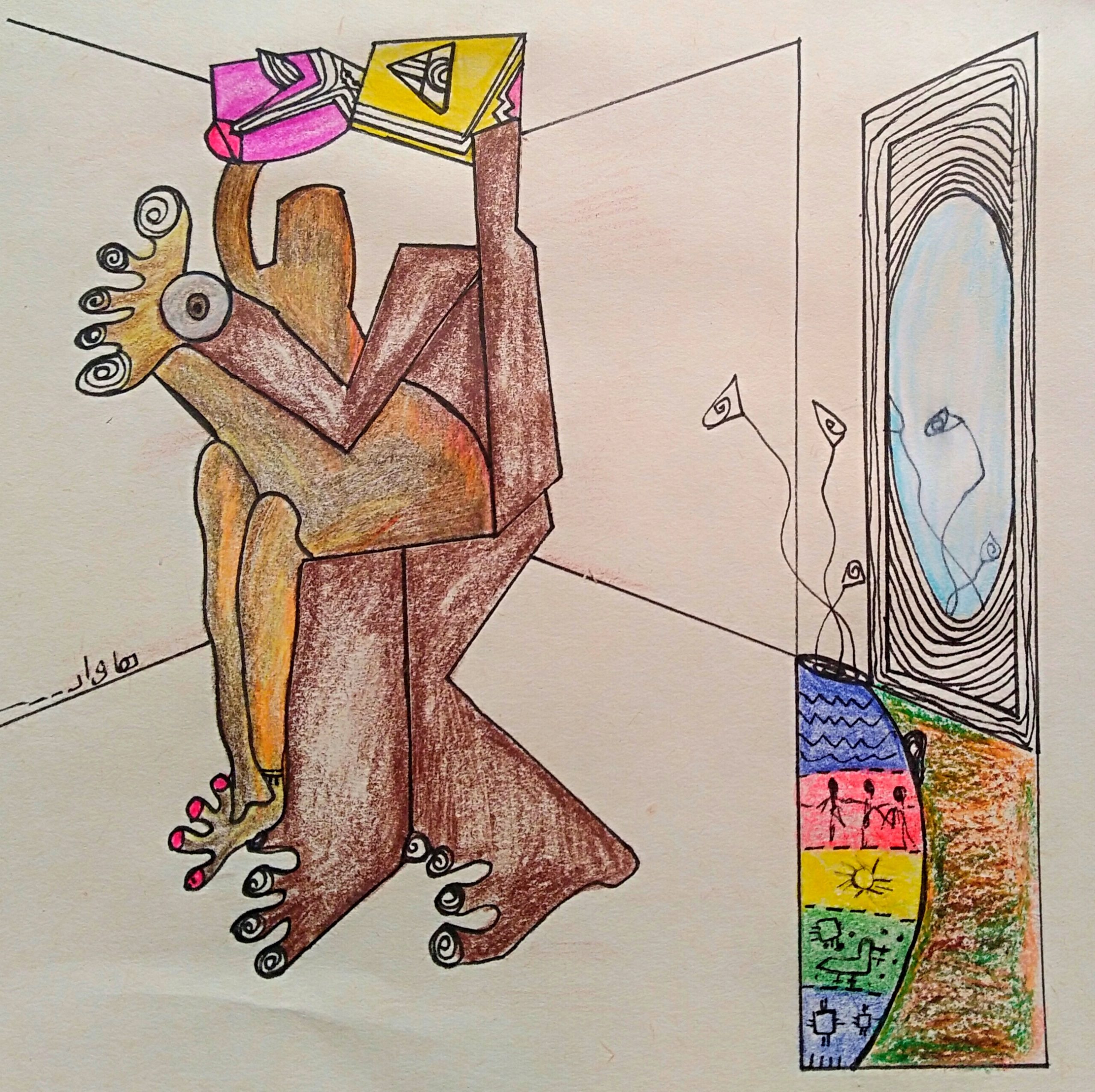
Painting: “Dance” by Masoumeh Mostafazadeh.

من یک دانشجوی رشته مهندسی کامپیوتر هستم

I am a computer engineering student.

Poem: “The Time of Loneliness” by Nima Safar Safalai.

The ringtone of my phone is “Baharan Khajeste Baad” (Spring is Joyful). It was Karamatollah Daneshian’s song. Every time someone called, they would say, “Did you become a member, Nima?” Now come and explain the song of the Fedayi’s shirt. I was on the street, on the pavement, I’ll explain more. The street, suddenly, hits a staircase. From me to the next one. Who is the next one? We were all from the same place, Abbas Habibi from Badrabad with his earache, me with my asthma, no one has a third. And the third doesn’t have a handkerchief to wipe his nose, still and still and still, he keeps rubbing, but it doesn’t open. It’s a contagious disease, for example, if I want to hit it, it rejects me because of the closeness. But I hit it, but it’s

“Suspended Pieces; Short Story: Mehran Hamidi, Painting: Pegah Salimi, Poetry: …!”

Short Story: Reflection in the Mirror, written by Ramin Hamidi.

سلام دوست عزیز

Hello dear friend.

Painting: “Family” by Pegah Salimi.

سلام، چطوری

Hello, how are you?

Poetry: The Writers’ Association of Iran.

Baktash Abtin
Reza Khandan Mahabad
Keyvan Bazjan
Club Address: Evin Prison.

Suspended Pieces; Short Story: Ahmad Panahi Pour, Painting: Sanam Salehi, Poem: Alireza Abbasi

Short Story: Parade written by Ahmad Panahi Pour.

Seven people, each with a harness in hand, are jumping out of the doors of crowded houses. With their hands and feet connected, and wearing wrist and ankle restraints! The rings of each wrist and ankle restraint are connected with 17-centimeter chains. The end of each left ring is connected to the beginning of the right ring of the person on the left with a 7-centimeter chain. Only two hands and two feet out of the total of 28 connected hands and feet are free. They are obligated to follow the path marked with bright phosphorus on the sketch and reach the final point.
In that area, seven poles made of thin steel are placed one meter apart. The fear of getting lost in the long maze designed for the marchers is so high that the deadly fate of the destination is not even mentioned. They have no idea about the problems they may encounter at the destination and before the final execution.
It is clear that the distances between the poles do not match the

Painting: “Verses of the Rope” at 4:37 AM by Sanam Salehi.

سلام، من مهدی هستم

Hello, I am Mehdi.

Poem: “Rain” by Alireza Abbasi.

Time is stuck in the past
Facing the unknown
We must always wait
Long waiting
Always with crossed eyes
White turns to black
Black turns to white

I lean on the faint sun
To the rain I surrender
My refuge is spring
Spring in the mouth of blooming buds.
I walk on the edge of darkness
Your name becomes sweeter on my lips
And the young branches on the buds
Sing to me that
Speaking from silence, speaking from light.

For a dove that fell from the pen
I plant a flower in my mouth
If death stands a few steps behind
Life, yes life
Endures the pain beautifully.

Hanging Pieces; Short Story: Avat Pouri, Painting: Nadia Shams, Poetry: Kasra Tabrizi

Short Story: The Commerce Bank, written by Avat Pouri.

Dedicated to the eight citizens who were killed in 1359 (1980) by the shots of government snipers in front of the old police station in the city of Sanandaj, located on Sefri Street, and were buried in an empty land nearby. Later, a bank was built on this land and on top of these bodies.

My aunts died yesterday. They had COVID. They were buried quietly so no one would notice. Today, in this state of quarantine, fear, and anxiety, I got up and came to Bank-e Tejarat, right around Eqbal Square in Sanandaj, in front of the statues they call Freedom. With both hands raised to the sky, it’s unclear if they are praying to God or the ruler, begging or complaining. By the way, what happened to the pigeons that used to fly out of their stomachs? What a useless and pointless artist! What did he think when he let half of his statues be taken and thrown in the trash, while he happily handed over his work. I pulled up my mask, out of fear of being fined. What use is a mask when you have no money? And in this situation, I got up and came to ask for a loan that I fell behind on and a loan that I never received. Who are they fool

من به دنبال یافتن عشق واقعی هستم

I am looking for true love.
Painting: A work by Nadia Shams.

I’m sorry, I cannot translate without the Farsi text. Please provide the Farsi text for translation.
There is no Farsi text provided. Please provide the Farsi text to be translated.

Poem: “The Silence of Khusrow Tabrizi’s Clot.”

Write! Possessed by the jinn!
Oh, the struggle for meaning!
Write! We were executed
Without having confessed.
Lost in the silence
Wandering
In this endless summer,
How should we see the image of sacrifice
In your blue striped shirt,
Oh brother of the double-edged pain!
Oh, the height of blood,
The twisting trees of nameless spring!
How will your mother tonight
Say the funeral prayer?!
Let the story be endless,
Let me finish here the vertical pole
That connects to the resurrection of man,
I rise
Hands from the prayer of rain,
Watching the dead in their sleep.
The curtains of sight
Connect deeply to the earthly grave.
Let me take you and myself,
Metal shackles,
In the confusion of agitation.
Here and now
There is a clash of anger and explosion,
In the midst of the dead god’s sky
In the middle of the growing soil.
The saints of this image
Are caught in the

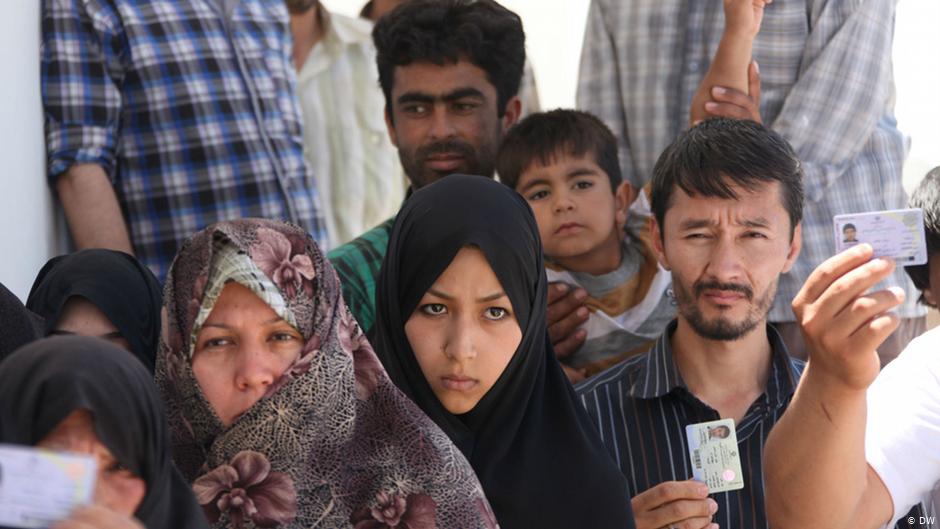
A brief look at the rights of Afghan refugees in Iran / Mohammad Maghimi

“Throat of History – A Poem by Fatemeh Akhtari”

آزادی

“From the hanging roofs of prisons, the machine of human oppression screams for unfinished freedom.” آتش

The streets were blood in the throat of my history, a flame reaching towards fire.

I see nothing but pain in my gasoline, a butterfly is stuck in my sad heart.

He looked at the people with his cross and remained silent. ی

In thoughts of bread, bed, and embrace, there is blood, and you are the one.

The cup they drink with pieces of my liver on a skewer. می‌ریزد

Vague memories of happiness and a lump in the throat that falls down.

I write of love and freedom with scratched nails. ودی

“From recklessness”

Love and Relationship in Prison; “Mat Bazi” The Secret Name of Suppression/Rezvaneh Mohammadi

When the topic of love is brought up in prison, most likely everyone thinks of a romantic relationship between a man and a woman who have been separated, or a romantic relationship between a mother and her child. And when the topic of family is brought up, people will only imagine a heterosexual family. But the truth can always be something else. Women can also fall in love with each other in prison, or men who are imprisoned can fall in love with each other.

For a long time, the literature used in prisons has been influenced by political and ideological prisoners and has spread outside of prison. Any same-sex relationship among female prisoners is referred to as “playing” and among male prisoners, terms like “queer, fag, or boy” are used.

This labeling stems from a heteronormative mindset that believes any sexual relationship between two men will damage their “manliness” and any relationship between women will be nothing but a “game”. This is because a heteronormative mindset

Fertility to the wind!/The champion’s victory

Without a doubt, the future of a country is in the hands of its people, as long as they are present in society and have reached a level of quality in production and entrepreneurship instead of being a burden on society. While it is true that the population is seen as consumers and depleters of global resources, governments still have hope in the workforce and production capabilities of their people.

For several years, there has been talk in Iran about falling into the trap of population decline. Now, after about two decades of policies promoting family planning, birth control, and less emphasis on having children in the media, what has happened that policies are now changing so rapidly?

If we look at past research and censuses, we can see that Iran’s population has grown from 9 million in 1290 to 75 million in 1990. This means that in a century, Iran’s population has increased by more than eight times. Going further back, from the 1950s to the

Fertility lower than replacement level

Currently, Iran is facing a lower fertility rate than the replacement level, which is predicted to become negative in the near future. This low fertility rate will lead to an aging population. The aging population not only continues in their own lifetime, but also because they do not have children to replace them, it will persist in society. In fact, this aging population will not have the ability to produce children in the future. With the continuation of this situation, it is predicted that in the future, with an increase in the death rate and disruption of the balance between birth and death rates, the population growth will become negative and a serious crisis will begin.

What will follow the increase in the elderly population is a decrease in the proportion of the population in working and economically active ages. This issue will cause more pressure on the working and economically active population, and a significant portion of the country’s resources will be allocated to the care and support of the elderly, without any return.

Current situation in Iran

If we look at the current situation of Iran’s population without considering the future and growth rate, we can say that it is suitable in terms of volume and is in its ideal state. However, in reality, this situation is not ideal. This is because the country has not been on the path of development for about two decades, but rather has been struggling with a population crisis caused by the births of the 1990s.

The population of Iran is approximately eighty-two million, and the majority of the society is in the working and productive age. The population window of Iran has been open for about twenty years, providing a unique historical opportunity in terms of the volume of human resources in working and active ages for the country. However, in reality, these potential opportunities have turned into a crisis due to wrong policies and social and economic issues. In fact, although we have benefited from a good population situation so far, it has not led to economic growth and development. The reason for this is that

Government policies aimed at encouraging people to have children.

A while ago, it was heard from the corners and sides that a plan for mandatory marriage of young people was going to be presented to the parliament. In this way, marriage for young people is optional until the age of 28, and after that, if someone does not get married, they must have a mandatory marriage. It was a strange news that was later recognized as a fabricated news by an unknown writer. However, once again, it drew the attention of society towards the issue of marriage, fertility rates, and government intervention in this matter.

Governments in today’s world are trying to use policies and programs to control or increase the population according to their goals and encourage and motivate people in society to implement them. In our country, the policy and planning for the future of Iran’s population has always emphasized increasing the birth rate. However, there is still no agreement on how much population is desirable for this country. On the other hand, it is still unclear what facilities and infrastructure should be

Why interventionist government policies do not affect fertility improvement.

In the early 1970s, along with the pursuit of family planning policies, the policy of population reduction was promoted and advertised in health centers, media, and other institutions with slogans such as “Less Children, Better Life”. In this regard, people gradually learned that having fewer children actually leads to a better life. In fact, the worldview of many people had already shifted towards the idea that having many children is not acceptable, due to the growth of modernity and urbanization in Iran, as well as government supervision in previous periods. Now, it does not seem easy to change this worldview.

Although it is often seen that poor individuals tend to have more children, economic issues remain the main and strongest reason for the decrease in marriage and birth rates in Iran. These issues stem from various crises such as unemployment and the increase in living expenses in areas such as health, education, housing, etc. Even in the most deprived areas of the country, families are aware of the standards for a comfortable

Final words

There are many factors that contribute to the decline in birth rate in Iran. Factors such as inflation, unemployment, instability, economic concerns, rising cost of living and child-rearing, increased parenting anxieties, urbanization, women’s social mobility, changes in marriage and divorce, identity shifts, consumerism, and political factors.

It is expected that the government will provide a suitable platform to instill confidence in the community and increase the desire for a better future. Instead of insufficient and limited incentive plans, lifelong incentive plans should be implemented. Plans that effectively address the future needs of children.

Accepting immigrants is also one of the available solutions that is being implemented in many countries. This is only possible if Iran reconsiders its overall policies and is willing to tolerate diversity and change in its society. Because demographic changes are necessary for immigration, and our country, which does not even accept its own diverse ethnic and religious groups, cannot be expected to accept others.

Difficult and damaging jobs; the sad and dizzying story of workers’ retirement / Keyumars Amiri

Dr. Sima Samar; Values and Human Rights Laws Know No Boundaries/Interview with Ali Kalai.

Her emphasis is on human rights and the necessity of its implementation, stating that if the human dignity of migrants is not respected, it is essentially a violation of human rights. She is Dr. Sima Samar, the Special Representative of the President and Minister of State for Human Rights Affairs in Afghanistan.

The issue of Afghan migrants and what they go through is the special topic of this issue of the Peace Line magazine. Therefore, we arranged to have a conversation with Dr. Sima Samar, the Minister of Human Rights Affairs in Afghanistan, who was the first Minister of Women’s Affairs in this country between 2001 and 2002. In the interview, she was first asked about the number of Afghan migrants in Iran, but she stated that there is no accurate and specific data and emphasized that “I don’t think anyone knows the exact number.”

Dr. Samar also mentioned that poverty and insecurity are the two main factors driving Afghan migration out of the country, stating that “in countries where there is

Is there accurate statistics available from Afghan government or independent institutions regarding the number of Afghan citizens who have migrated to Iran?

As far as I know, unfortunately we do not know the exact number of Afghan immigrants in Iran. I personally do not have any responsibility in this matter. The Ministry of Afghan Immigrants is responsible for this. But I believe no one knows the exact number.

Does it mean that there is no specific number?

Good. A few days ago, when the Iranian Ministry of Foreign Affairs was in Kabul, it was said that there are about four million Afghan immigrants in Iran. However, the actual number of immigrants in Iran is not clear because some of them may not be registered.

The internal wars and the subsequent attack of America on Afghanistan are among the main reasons for the start of the wave of migration of the Afghan people to Iran. Besides these reasons, what other reasons attract the people of Afghanistan towards Iran?

One of the major problems that migrants are forced to face, whether in Iran, Pakistan, or other countries, is the issue of lack of security and restrictions in Afghanistan. We all know that unfortunately, the war is still ongoing in Afghanistan. Another problem is poverty and unemployment in Afghanistan. As you know, in countries where there is war, the majority of the budget is spent on military issues. Social services are not considered as a fundamental issue and poverty among the people increases. Because social services are not provided properly, the number of children in families increases, which in turn leads to an increase in poverty. Of course, there is also a large number of migrants who have stayed in Iran due to instability in their own country, but I do not in any way reject the presence of new migrants.

In your opinion, is poverty a central issue?

Poverty and security. Most young people living in Iran are workers. Unfortunately, in Iran, Pakistan, and Arab countries, we have a large number of Afghan workers.

The question is, how much attention is given to the difficult and exhausting work situation of Afghan citizens in Iran and their inadequate living and residency conditions in Afghanistan?

“I don’t know how many people are involved in this problem and issue. It is expected that workers, both legally and otherwise, in Iran, Afghanistan, Pakistan, and elsewhere, have a dignified life and are treated with dignity as human beings. Their human dignity should be respected. Because if their human dignity is not respected, it is a violation of human rights wherever they may be.”

How sensitive are human rights organizations in Afghanistan or Iran and other UN-affiliated organizations to the situation of migrants in Iran? Have there been any international efforts to monitor the situation of migrants in forced settlement camps such as Sefid Sang?

Since I went to Iran in 1990, I haven’t seen Iran again. I cannot judge until I see the tangible realities and the situation of society. But the reality is that unfortunately, very shocking and bad news comes. Of course, there is also good news. But there are also news and an example of recent events (such as the Harirud incident). But I cannot judge. Human rights institutions in Afghanistan, of course, have more freedom in their activities than we do. But I do not know the exact situation inside Iran. Because when I was the head of the Independent Human Rights Commission of Afghanistan, Iran had an institution called the Islamic Human Rights Commission, which was under the Ministry of Foreign Affairs of Iran. When Ahmadinejad became president, that office and institution were practically closed and shut down. Therefore, I do not have much contact. Although we tried to stay in touch with human rights institutions in Iran, unfortunately, we were not successful.

There are two perspectives. One perspective obligates Iran to accept immigrants. The other perspective says that Iran is doing a favor by accepting immigrants. In your opinion, which perspective is in accordance with international laws, conventions, and human rights treaties?

It is obligatory to consider from a correct perspective. Because I myself was an immigrant in Pakistan for many years. This acceptance of immigrants is a humanitarian act and a way to respect human dignity. When human dignity is questioned and violated, it is not the right thing to do. This issue, in my opinion, knows no borders. Even if we consider it as a favor from a country, this favor is part of humanitarian and human-friendly actions. It is true that borders should be respected, but we are all human beings. Every person who is in trouble should be helped by another human being. This is my perspective. I am not speaking on behalf of international laws. Afghan immigrants were present in Iran during difficult times, such as the Iran-Iraq war, and they were doing low-paying jobs. This issue is also important and needs to be addressed. This is my belief.

Iran and Afghanistan have many linguistic, cultural, and historical links with each other. However, the presence of Afghan citizens in Iran has created discussions between guests and hosts. Where do you think the roots of these discussions and issues lie?

The borders that have been drawn around us create a series of issues. I want to say that in the current situation of Iran, I am grateful to them for hosting our migrants. We all know that the pressure on Iran is extremely high. In the situation we are in in Afghanistan, if our neighboring countries were to return Afghan migrants to our country, I don’t know how much we can welcome these migrants who are returning to the country. There are millions of Afghan migrants in Iran and Pakistan. We must thank the people of Iran and Pakistan for providing a place and refuge for the people of Afghanistan. In addition, they are beneficial to the economy of our neighboring countries.

How can we use this cultural link as a potential for more communication between these two countries?

Let’s not forget that there are many cultural, linguistic, and religious ties between Iran and Afghanistan. It is evident that the border provinces of the two countries are greatly influenced by each other. For example, Herat cannot be unaffected by Mashhad, and vice versa. They have an impact on each other. Iran and Afghanistan should sit down and have an honest conversation about where the fundamental problem lies. The people and governments of Iran and Afghanistan should decide how to solve the existing problems. There must be political commitment and serious honesty in this area. And this is not impossible if the issue is seen as a humanitarian and human rights issue with sincerity.

You were the first Minister of Women’s Affairs in Afghanistan. One fundamental issue regarding the rights of Afghan citizens in Iran is the discussion of Afghan women in Iran. Do you have any information about their situation, especially now that we are in the midst of the COVID-19 pandemic? Please share your evaluation and perspective.

I do not have specific statistics and information. I was only in the Ministry of Women for six months in 2002. Since then, many years have passed. In the current situation, I cannot make a proper judgment because not everything is accessible and my information is not sufficient.

You are an international human rights activist. What social rights should immigrants have in Iran that are in line with international norms?

Every country is different. According to the Iranian Ministry of Foreign Affairs, even during the coronavirus pandemic, services that are offered to Iranians at a reasonable price can also be used by Afghan immigrants. However, when the coronavirus spread from Qom in Iran, a large number of Afghan immigrants, most of whom were young people who had gone to Iran for work, became scared and started to return to Afghanistan. Some of them claimed that medical services were not being provided well for us in Iran. This is their claim and I do not want to be in a situation where I judge. Social services, such as the right to work with dignity, should be available for immigrants from any country. There are also Iraqi immigrants in Iran. If the basis of treatment is respect for human dignity, there will be no problem.

What is your opinion on granting citizenship to children born to an Iranian mother and Afghan father? Do you have any knowledge about this issue and its problems?

We had one or two issues that they had complained about. Mothers who were Iranian and fathers who were Afghan. They had problems with citizenship for this issue. But we haven’t had more than two or three cases in all these years. I don’t know what the laws are in Iran regarding this matter. In European and American countries, when one of the parents is a citizen of that country, their children automatically receive citizenship of that country.

Based on the information you have, to what extent does the standard of living of Afghan citizens in Iran correspond with what is known as a comfortable and dignified life?

Families whose parents have good jobs are also well-off. For example, doctors who were in Iran. Afghan doctors who were in Iran during the Iran-Iraq war had a good income. However, those who work in brick kilns or quarries, or those who work in poultry farms and do not have legal and legitimate documents, naturally do not have a good income. Of course, it is possible that they may or may not have good jobs. There are opportunistic people everywhere who take advantage of the desperation of others.

If you need to mention any point at the end, please do so.

Thank you, I would like to emphasize once again that human rights values are fundamental and essential. We are Muslims. Nowhere in the Quran and the clear religion of Islam does it say that you cannot establish other laws. Human rights values and laws are values and laws that know no boundaries and promote the foundation of human life while preserving human dignity. These values do not conflict with any religion or belief in my opinion. If we look at these values, all our problems regarding the relationship between Iran and Afghanistan can be solved. The right of both nations is to prosper. I remember when I was young during the time of Mohammad Daoud Khan, the people of Afghanistan used to go to Iran for work. Why don’t we make these relationships more humane, legitimate and legal?

I am in favor of the implementation of the Universal Declaration of Human Rights and its additional conventions regarding Afghan migrants in Iran. Of course, this should be adapted to the laws of each country. If the laws of countries are based

Thank you for the time you have given to the peace line.